
Over 175,000 boundary disputes are estimated to arise across England and Wales each year — and since the pandemic, RICS has reported a significant surge in neighbour conflicts over land, fences, and encroachments [3]. Many of these disputes drag through courts for years, costing tens of thousands of pounds in legal fees, when a structured expert witness approach could resolve them in months. Boundary Dispute Resolutions 2026: Expert Witness Strategies Using RICS Site Surveys and CPR Part 35 for Neighbour Agreements represents the gold standard framework that chartered surveyors, solicitors, and property owners must understand to navigate these conflicts efficiently and cost-effectively.
This article details the practical protocols building surveyors use when acting as expert witnesses — from commissioning title plan analysis and laser scanning surveys to producing CPR Part 35-compliant reports that hold weight in both mediation and court proceedings.
Key Takeaways 📌
- RICS site surveys combining title plans, historical maps, and laser scanning provide the evidential foundation for resolving boundary disputes.
- CPR Part 35 sets strict duties for expert witnesses — reports must be impartial, structured, and addressed to the court, not the instructing party.
- Mediation and negotiated settlement are strongly preferred over litigation; RICS guidance explicitly promotes this approach to reduce costs [3].
- Expert witnesses must meet rigorous RICS qualification standards, including a minimum of 10 years post-qualification experience for panel appointment [5].
- Early engagement of a qualified surveyor dramatically increases the likelihood of an out-of-court neighbour agreement.
Understanding the Legal and Professional Framework in 2026
What Drives Boundary Disputes?
Boundary disputes arise when neighbouring property owners disagree about where one plot ends and another begins. Common triggers include:
- 🏗️ New construction or extensions encroaching on a neighbour's land
- 🌿 Overgrown hedges or fences repositioned over time
- 📄 Ambiguous or outdated title deeds with imprecise measurements
- 🏘️ Property sales revealing discrepancies between Land Registry plans and physical boundaries
"Land Registry title plans alone are insufficient to determine precise boundary positions — they are indicative only and drawn to a scale that can represent metres of uncertainty on the ground." [3]
This is a critical point that many property owners misunderstand. The Land Registry's general boundary rule means that the red line on a title plan does not define the legal boundary with precision. Resolving this requires professional survey evidence.
The RICS Expert Witness Standards
RICS Expert Witness Standards establish clear requirements for surveyors acting in dispute resolution roles. Updated standards reinforce that expert witnesses must:
- Provide independent, objective opinion — duty is owed to the court, not the client
- Possess relevant specialist knowledge in the subject matter
- Comply with CPR Part 35 (Civil Procedure Rules) when instructed in civil proceedings [1]
For appointment to the RICS Panel of Dispute Resolvers, surveyors must demonstrate successful completion of the RICS Diploma in Construction Adjudication and hold a minimum of 10 years post-qualification experience [5]. The Dispute Resolution Appointments Board (DRAB) oversees governance, promoting high standards in conflict avoidance across land, property, and construction sectors [7].
For property owners, understanding what a party wall dispute involves provides useful context, since party wall and boundary matters frequently overlap in complex neighbour disagreements.
RICS Site Survey Protocols: Building the Evidential Foundation
Evidence Sources a Surveyor Must Examine
Professional land surveyors conducting boundary surveys draw on multiple layers of evidence [2][3]. Relying on a single document is insufficient — robust expert witness reports synthesise all available sources:
| Evidence Type | Purpose | Reliability Level |
|---|---|---|
| Title deeds & conveyances | Establish original intent of boundary | High (if detailed) |
| Land Registry title plans | General reference only | Low (indicative) |
| Ordnance Survey maps | Historical comparison | Medium |
| Aerial photographs | Show physical features over time | Medium-High |
| Historical maps (Tithe, Estate) | Establish long-term boundary positions | High |
| Physical features (walls, hedges) | Reflect established occupation | High |
| Witness evidence | Corroborate physical findings | Variable |
Laser Scanning and Modern Survey Technology 🔬
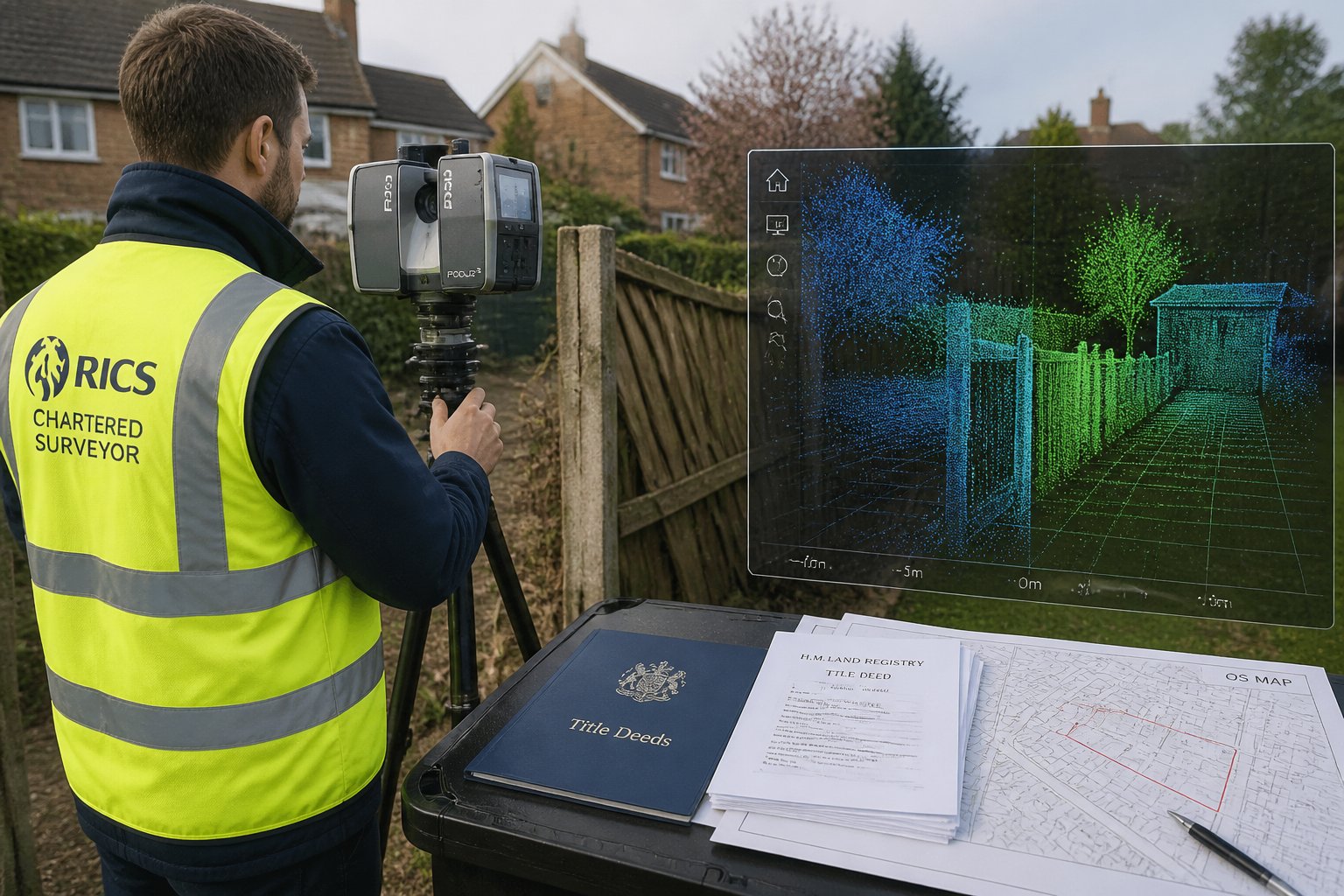
In 2026, 3D laser scanning (LiDAR) has become an increasingly standard tool in high-value or complex boundary disputes. Laser scanning produces a precise point cloud — a three-dimensional digital record of the physical environment — that can:
- Capture millimetre-accurate measurements of walls, fences, and structures
- Provide a permanent, reproducible record of site conditions at a specific date
- Be overlaid with historical plans to identify encroachments or shifts in physical features
This technology significantly strengthens an expert witness report because it removes ambiguity about physical measurements. Courts and mediators respond well to objective, technology-supported data.
For properties with complex structures or extensions near boundaries, a RICS-specific defect survey may also be warranted to document any structural impacts of a disputed boundary position.
Commissioning a Professional Boundary Survey
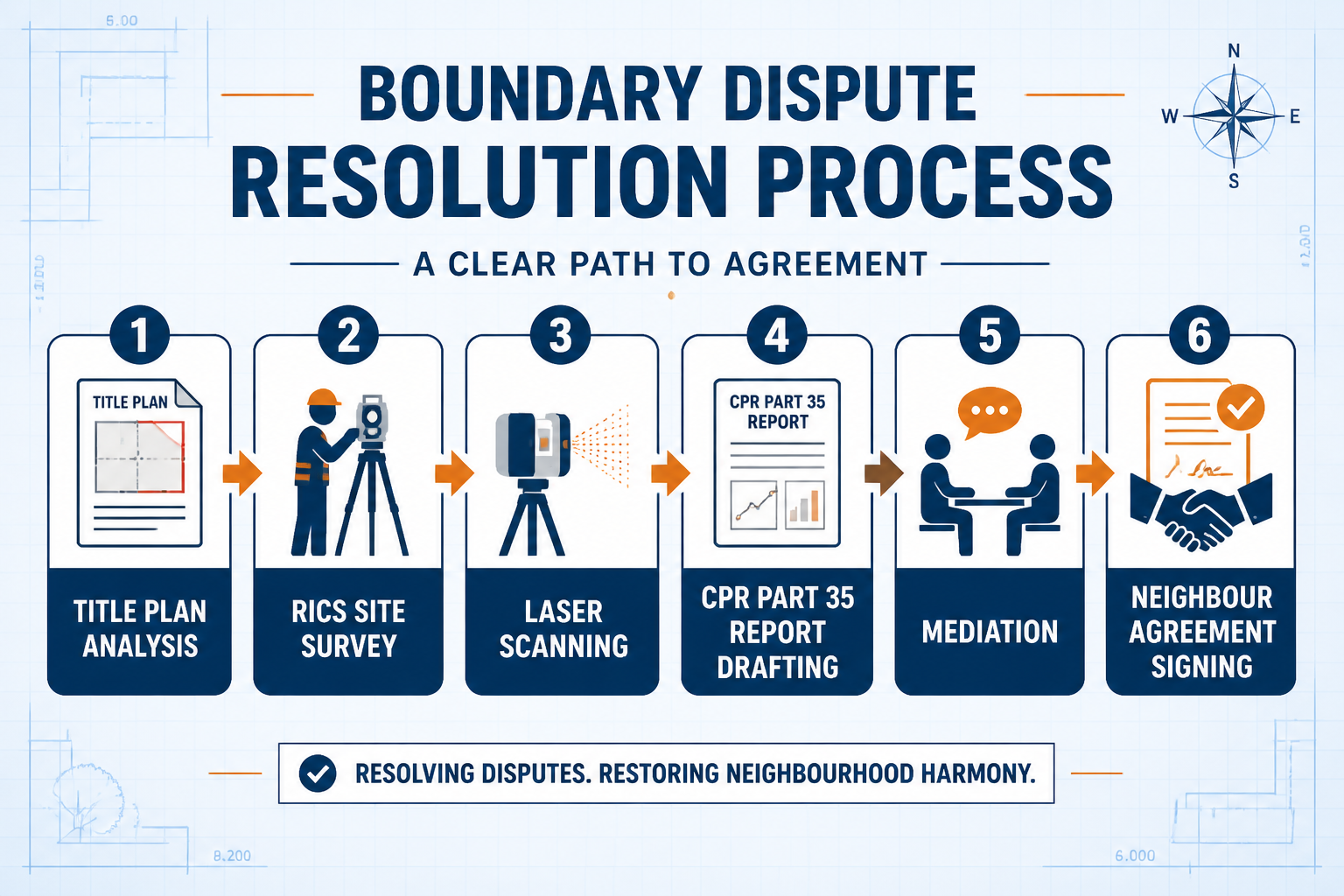
The process of commissioning a boundary survey typically follows this sequence:
- Initial instruction — solicitor or property owner engages a RICS-accredited surveyor
- Document gathering — title deeds, conveyances, Land Registry data, historical maps
- Site inspection — physical survey using total station, GPS, or laser scanning equipment
- Evidence analysis — cross-referencing documentary and physical evidence
- Boundary marking — installation of stakes, pins, or monuments to record findings [2]
- Report production — CPR Part 35-compliant expert witness report drafted
Professional surveyors also develop mitigation strategies at this stage — for example, recommending that a structure be relocated, or that a boundary adjustment be negotiated between parties [2]. This practical, solution-focused approach is what distinguishes a skilled expert witness from one who simply documents the problem.
CPR Part 35 Compliance: Writing Reports That Achieve Settlements
What CPR Part 35 Requires
Civil Procedure Rules Part 35 governs the use of expert evidence in civil litigation in England and Wales. For boundary dispute expert witnesses, compliance is non-negotiable. Key requirements include:
- The report must be addressed to the court, not to the instructing solicitor or client
- The expert must include a statement of truth confirming the report represents their genuine, independent opinion
- The report must state the expert's qualifications and the substance of instructions received
- Where there is a range of opinion, the expert must summarise it and give reasons for their own view
- The expert must confirm they understand their duty to the court overrides any duty to the instructing party
💡 A CPR Part 35-compliant report that is clearly structured, impartial, and technically rigorous is one of the most powerful tools for achieving an out-of-court settlement — because it signals to all parties what a court would likely conclude.
Structure of a Compliant Expert Witness Report
A well-constructed boundary dispute expert witness report typically contains:
- Cover page — case reference, expert's name, RICS membership details
- Executive summary — key findings in plain language
- Instructions received — scope of instruction and documents provided
- Methodology — survey methods used, including technology deployed
- Evidence analysis — systematic review of all documentary and physical evidence
- Expert opinion — clear statement of the boundary position with supporting rationale
- Range of opinion — acknowledgement of alternative interpretations where relevant
- Conclusions — actionable summary for the parties
- Statement of truth and declaration of independence
- Appendices — survey plans, photographs, historical maps, laser scan data
This structure aligns with guidance from the RICS Expert Witness Standards and ensures the report is court-ready while also serving as a credible foundation for mediation [1].
The Expert's Duty of Independence
One of the most common errors made by surveyors new to expert witness work is allowing the instructing party's position to colour their opinion. CPR Part 35 is unambiguous: the expert's overriding duty is to the court. Any perception of bias can result in the report being challenged or excluded.
Experienced expert witnesses maintain independence by:
- Declining to act if there is a conflict of interest
- Clearly separating factual findings from expert opinion in their reports
- Engaging in without prejudice discussions with the opposing expert where directed
- Participating in joint statements that narrow the issues in dispute
Understanding the broader responsibilities of a surveyor in dispute contexts is covered well in resources on what a party wall surveyor does, which shares many parallels with boundary expert witness work.
Achieving Neighbour Agreements: Mediation and Out-of-Court Strategies
Why Mediation Should Always Come First
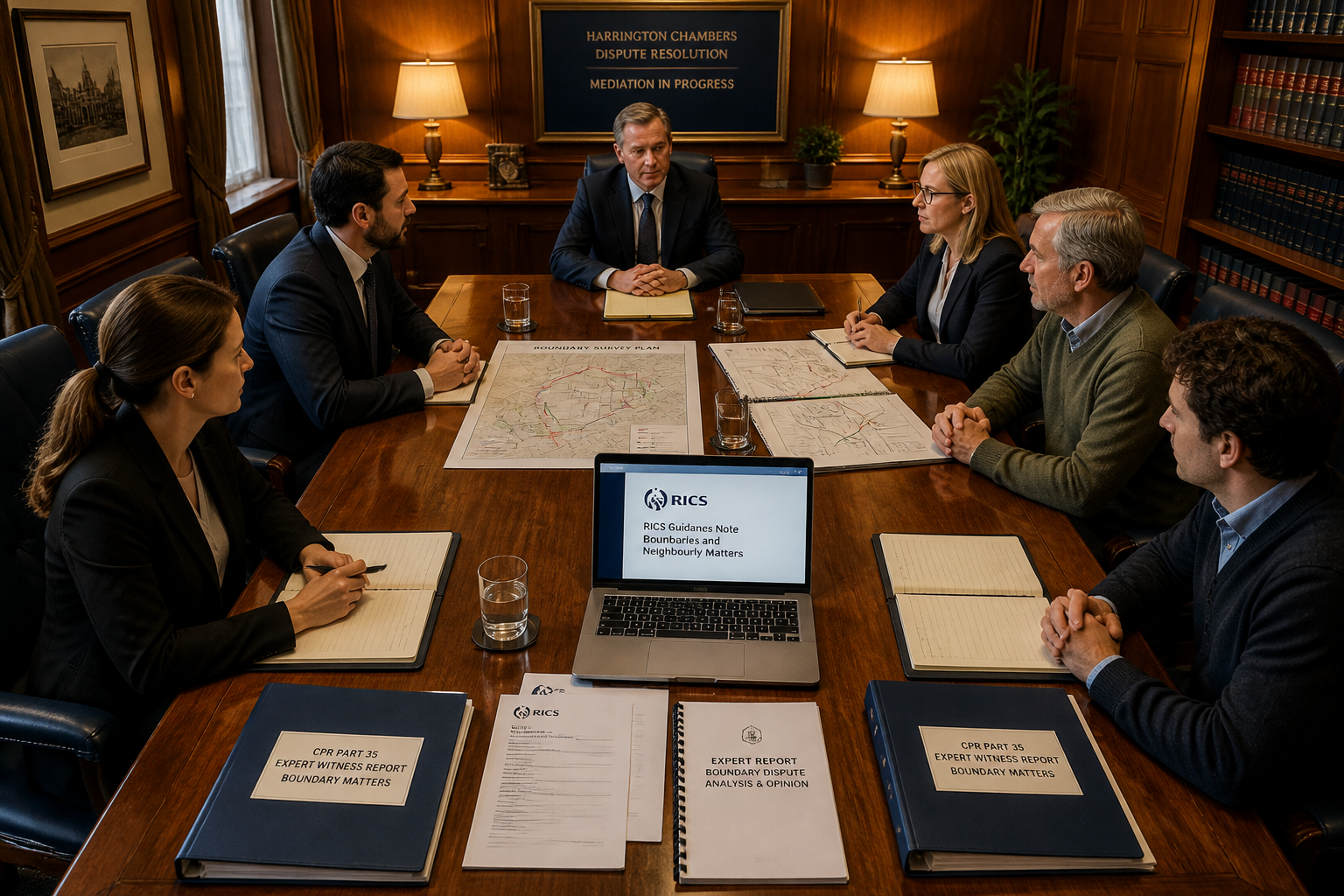
RICS guidance is explicit: mediation is the preferred route for resolving boundary disputes, and litigation should be a last resort [3]. The reasons are compelling:
- ⚖️ Cost: Court proceedings can cost £50,000–£200,000+ in legal fees; mediation typically costs a fraction of this
- ⏱️ Speed: Mediation can resolve disputes in weeks; litigation takes years
- 🤝 Relationship preservation: Neighbours must continue living side by side — mediation allows face-saving compromise
- 🎯 Control: Parties retain control over the outcome rather than leaving it to a judge
RICS promotes the joint selection of independent experts in mediation contexts, where both parties agree on a single surveyor whose findings both sides accept [3]. This approach — known as single joint expert (SJE) instruction — is cost-efficient and reduces adversarial dynamics.
The Role of the Expert Witness in Mediation
In mediation, the expert witness plays a subtly different role than in court. Rather than simply presenting findings to a judge, the expert may:
- Present findings directly to both parties and their representatives
- Answer questions from mediators and legal advisors in plain language
- Participate in without-prejudice discussions to explore compromise positions
- Assist in drafting the technical elements of a negotiated boundary agreement
This requires strong communication skills alongside technical expertise. The most effective expert witnesses in 2026 are those who can translate complex survey data into clear, accessible language — for both legal professionals and lay property owners.
Formalising the Neighbour Agreement
When mediation succeeds, the outcome must be properly documented to be legally binding. A neighbour boundary agreement typically includes:
- Agreed boundary line described with precision (measurements, coordinates, or reference to a surveyor's plan)
- Physical demarcation — confirmation of what markers, fences, or walls will define the boundary
- Maintenance responsibilities — who maintains the boundary feature
- Costs agreement — how survey and legal costs are apportioned
- Registration — where appropriate, the agreement should be noted at HM Land Registry
Solicitors handle the legal drafting, but the surveyor's plan forms the technical backbone of the agreement. This is why survey precision matters so much — a vague plan creates future disputes.
For those dealing with related structural and legal complexities, understanding party wall agreements is often essential, as boundary and party wall issues frequently arise together during building works.
Practical Protocols for Surveyors Acting as Expert Witnesses in 2026
Pre-Instruction Checklist ✅
Before accepting an expert witness instruction, a RICS surveyor should confirm:
- No conflict of interest with either party
- Sufficient expertise in boundary surveying and relevant technology
- Availability to meet court or mediation timetables
- Clear written instruction letter from the solicitor
- Access to all relevant documents (deeds, title plans, correspondence)
- Agreement on fee structure and scope of work
Common Pitfalls to Avoid
1. Over-reliance on Land Registry plans — these are general boundary indicators only, not legal boundary definitions [3].
2. Failing to consider adverse possession — long-term occupation of land can create legal rights that override paper title. Expert witnesses must address this possibility.
3. Inadequate site documentation — photographs, measurements, and laser scan data must be taken systematically and stored securely.
4. Advocacy creep — subtly favouring the instructing party's position undermines the report's credibility and the surveyor's professional standing.
5. Ignoring historical evidence — older maps and aerial photographs often provide the clearest indication of where a boundary has historically been treated as lying [3].
For those seeking broader context on survey types and their applications, the complete guide to party wall surveys offers useful parallel insights into professional survey standards.
When Cases Do Proceed to Court
Despite best efforts, some boundary disputes reach the First-tier Tribunal (Property Chamber) or the County Court. In these situations, the expert witness must be prepared to:
- Give oral evidence and be cross-examined on their report
- Defend methodology under questioning from opposing counsel
- Participate in a joint expert meeting prior to the hearing to produce a joint statement
- Remain impartial even when challenged aggressively
The strength of a well-prepared, CPR Part 35-compliant report — supported by laser scan data, historical evidence, and clear reasoning — is that it withstands cross-examination. Judges in boundary cases respond well to expert witnesses who are measured, transparent about uncertainty, and clearly independent [6].
Conclusion: Actionable Next Steps for 2026
Boundary Dispute Resolutions 2026: Expert Witness Strategies Using RICS Site Surveys and CPR Part 35 for Neighbour Agreements is not merely a procedural checklist — it is a strategic framework that, when followed correctly, transforms costly and emotionally draining disputes into manageable, resolvable conflicts.
Actionable Next Steps
For property owners:
- Do not act unilaterally — do not move fences, erect structures, or clear vegetation until the boundary position is professionally established.
- Engage a RICS-accredited surveyor early — early expert involvement reduces costs and preserves options.
- Request mediation before instructing solicitors to issue proceedings.
For surveyors acting as expert witnesses:
- Invest in laser scanning capability or partner with a specialist — technology-supported evidence is increasingly expected.
- Ensure CPR Part 35 compliance in every report, regardless of whether the case goes to court.
- Maintain rigorous independence — your professional reputation depends on it.
For solicitors:
- Instruct surveyors early in the dispute lifecycle, not as an afterthought before trial.
- Consider single joint expert instruction to reduce costs and accelerate resolution.
- Use the expert's report as the foundation for negotiation, not just litigation preparation.
Boundary disputes resolved through expert-led mediation and professionally prepared RICS surveys consistently achieve better outcomes — faster, cheaper, and with less damage to neighbour relationships — than those that proceed to litigation. In 2026, the tools, standards, and frameworks exist to resolve the vast majority of boundary conflicts without ever entering a courtroom.
References
[1] Expert Witness Preparation For 2026 Regional Price Dispute Cases North Vs South Rics Evidence Strategies – https://nottinghillsurveyors.com/blog/expert-witness-preparation-for-2026-regional-price-dispute-cases-north-vs-south-rics-evidence-strategies
[2] Boundary Disputes How Professional Land Surveyors Resolve Conflicts – https://www.mcneilengineering.com/boundary-disputes-how-professional-land-surveyors-resolve-conflicts/
[3] Boundary Dispute Resolution – https://www.carterjonas.co.uk/measured-survey/boundary-dispute-resolution
[4] Boundary Dispute Resolution – https://www.apexsurveyor.com/boundary-dispute-resolution
[5] Panel Of Experts – https://www.rics.org/dispute-resolution-service/panel-of-experts
[6] Boundaries – https://www.jspubs.com/expert-witness/si/b/boundaries/
[7] Dispute Resolution Appointments Board – https://www.rics.org/regulation/regulatory-governance/standards-and-regulation-board-sub-groups/dispute-resolution-appointments-board
