
Roughly 70% of loft conversion disputes in urban terraced properties stem from one avoidable mistake: the building owner failed to serve the correct Party Wall Act notice before work began. In 2026, with RICS actively consulting on its landmark 8th edition of "Party Wall Legislation and Procedure", the rules governing party wall surveys for loft conversions are sharper, more structured, and more consequential than ever before.
This guide breaks down exactly when a loft conversion triggers notifiable works under the Party Wall etc. Act 1996, what the updated RICS 8th edition protocols mean for surveyors and homeowners alike, and how to navigate schedules of condition, party wall awards, and cost budgeting — especially on the terraced and semi-detached properties that dominate London and other UK cities.
For a detailed overview of the process specific to loft projects, see this practical resource on party wall surveys for loft conversions.
Key Takeaways 📋
- Loft conversions almost always trigger the Party Wall etc. Act 1996, particularly where works affect a shared wall, floor/ceiling junction, or require steel beam insertion.
- RICS launched a consultation on the 8th edition of its party wall practice guidance in April 2026, updating professional standards for surveyors across England and Wales. [1]
- A Schedule of Condition must be prepared before work starts to protect both the building owner and the adjoining owner from disputed damage claims.
- Party Wall Awards set out the legal framework for how and when works can proceed — failing to obtain one can expose building owners to injunctions and costly delays.
- Cost budgeting for party wall matters on loft conversions typically ranges from £800 to £2,500+ per surveyor, depending on complexity and whether a single or two-surveyor approach is used.
What the RICS 8th Edition Means for Party Wall Surveys for Loft Conversions in 2026
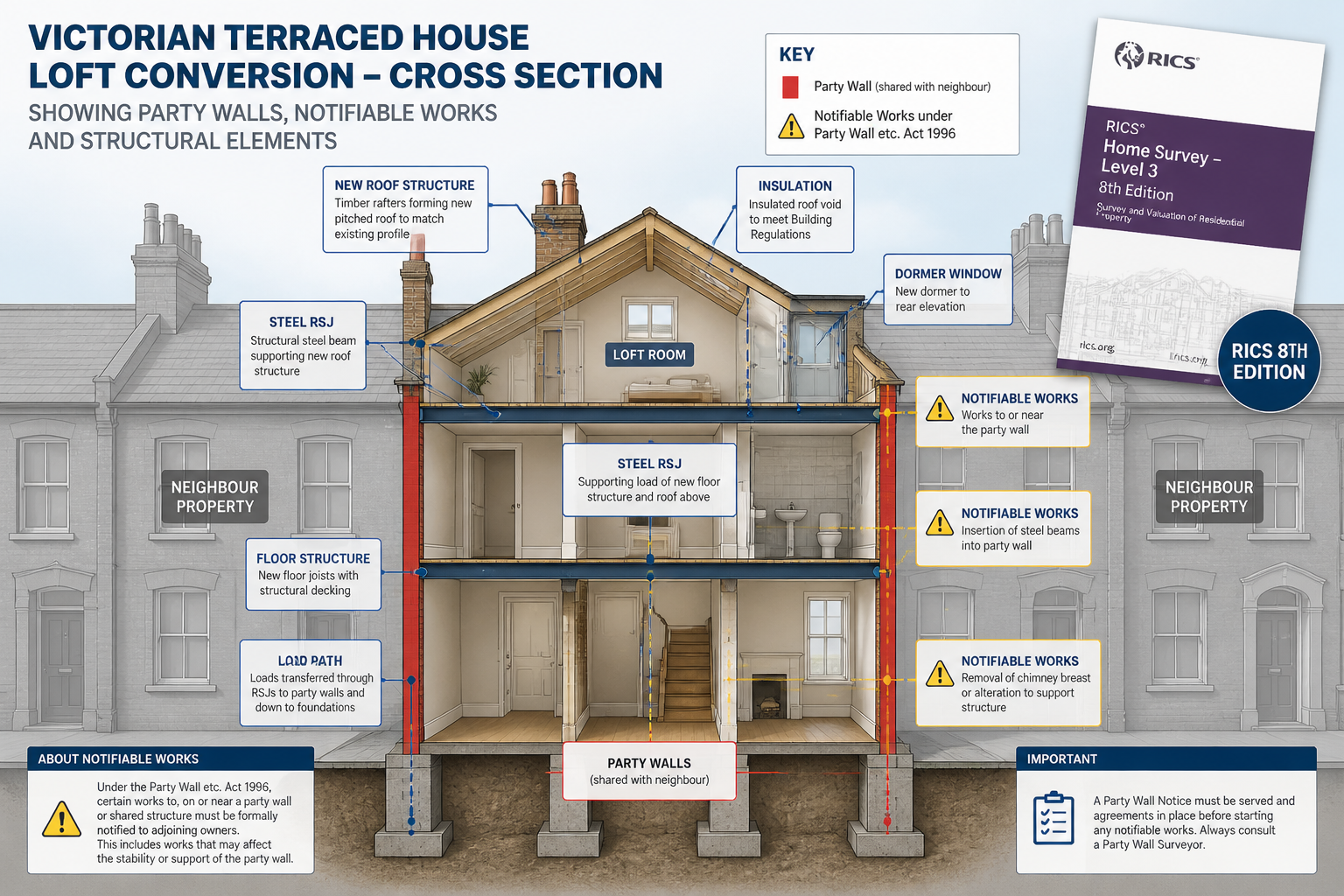
RICS launched a consultation on the updated 8th edition of its "Party Wall Legislation and Procedure" guidance in April 2026, with the consultation running for approximately eight weeks through May 2026. [1] This replaces the 7th edition and represents the most significant refresh of professional party wall standards in recent years.
What's Changing Under the 8th Edition?
The 8th edition guidance is designed to provide best-practice support for RICS members, clarifying:
- When the Party Wall etc. Act 1996 is engaged — particularly for complex projects like loft conversions where multiple sections of the Act may apply simultaneously
- The procedures that follow notice service, including dispute resolution timelines and surveyor appointment protocols
- Professional standards expected of members, including impartiality, record-keeping, and communication obligations [1]
💬 "The 8th edition signals a maturing of party wall practice — surveyors are now expected to demonstrate not just technical competence but procedural rigour from the very first notice."
The consultation sought input from surveyors, legal professionals, dispute resolution practitioners, and other stakeholders involved in party wall matters across England and Wales. [1] While the final published edition may refine some details, the core framework for loft conversions remains grounded in the Party Wall etc. Act 1996 — a statute that has not changed but is now better supported by professional guidance.
For a broader understanding of what the Act requires and when it applies, the complete guide to understanding the Party Wall Act is an excellent starting point.
When Does a Loft Conversion Trigger the Party Wall Act?
Not every loft conversion requires party wall notices — but the vast majority do. Understanding the triggers is the first step for any building owner or their surveyor.
The Three Key Sections of the Act
| Section | Trigger | Loft Conversion Relevance |
|---|---|---|
| Section 1 | Building a new wall on or at the boundary | Rare in loft conversions unless adding a gable wall |
| Section 2 | Works to an existing party wall or structure | ✅ Most common — cutting into party walls, inserting beams |
| Section 6 | Excavations within 3m or 6m of a neighbour's structure | Occasionally relevant for dormer foundations |
Section 2 Works: The Core Trigger for Loft Conversions
Section 2 of the Party Wall etc. Act 1996 is the primary trigger for loft conversions. Works that notifiably engage Section 2 include:
- ✅ Cutting into a party wall to insert steel RSJ beams (extremely common in hip-to-gable and dormer conversions)
- ✅ Raising the height of a party wall for a mansard or gable-end conversion
- ✅ Exposing a party wall by removing existing roof structures
- ✅ Inserting a damp-proof course into a party wall
- ✅ Underpinning any part of a party wall
Works That Do NOT Typically Require a Notice
- Internal-only loft boarding with no structural wall involvement
- Velux window installation that doesn't affect the party wall structure
- Purely decorative internal works
The critical question: Does the work cut into, build upon, or structurally alter a wall shared with a neighbour? If yes, a notice under Section 2 is almost certainly required. To understand when a party wall agreement is legally required in the UK, the legal thresholds are clearly explained in detail.
Surveyor Checklists: Schedules of Condition, Awards, and Cost Budgeting
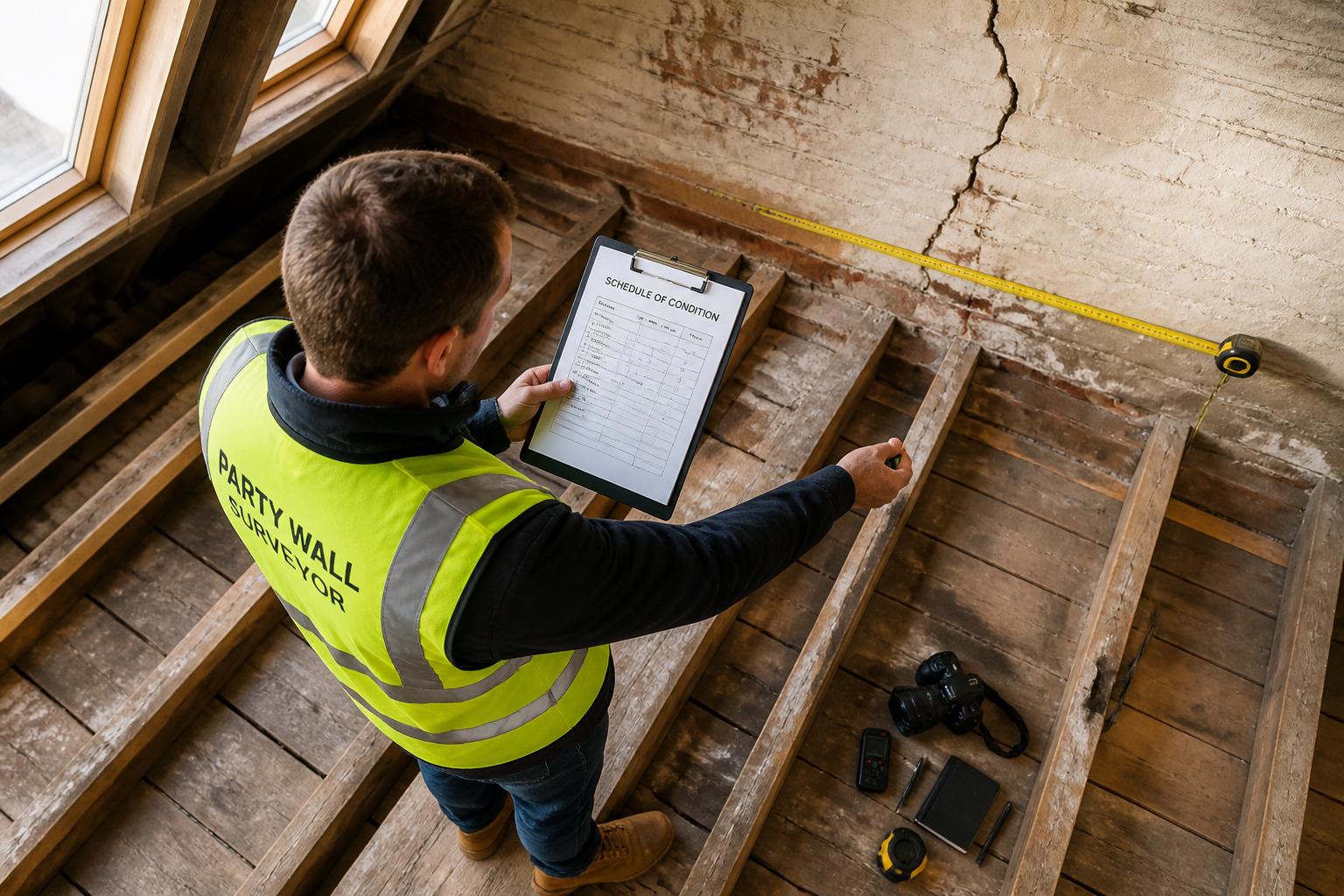
The practical work of a party wall surveyor on a loft conversion project follows a structured sequence. The RICS 8th edition reinforces this sequence as professional best practice.
✅ Surveyor Checklist: Schedule of Condition
A Schedule of Condition documents the pre-existing state of an adjoining owner's property before notifiable works begin. It is arguably the most important protective document in any party wall matter.
What a thorough Schedule of Condition should include:
- Photographic record of all rooms adjacent to or below the party wall
- Written description of existing cracks, settlement, or structural defects
- Condition of ceilings, cornices, and plasterwork in top-floor rooms
- State of any shared chimney stacks
- External condition of the party wall (where accessible)
- Date-stamped and signed by the appointed surveyor
- Appended to the Party Wall Award as a reference document
🔑 Pro tip: A Schedule of Condition protects the building owner just as much as the adjoining owner. Without one, any pre-existing crack becomes a potential liability claim.
For loft conversions specifically, surveyors should pay particular attention to top-floor ceilings and chimney breast junctions — these are the areas most likely to show movement during roof structure alterations.
A schedule of condition report prepared by a qualified chartered surveyor provides the evidentiary baseline that protects all parties if a dispute arises later.
✅ Surveyor Checklist: Party Wall Award
The Party Wall Award (also called a Party Wall Agreement in common usage) is the legal document that authorises the notifiable works to proceed. It is issued by the appointed surveyor(s) and is binding on both parties.
A compliant Party Wall Award for a loft conversion should address:
- Description of the proposed works (with reference to approved drawings)
- Hours during which works may be carried out
- Access rights for the surveyor and building owner's contractors
- Security for expenses (where appropriate)
- Attached Schedule of Condition
- Method statement for high-risk operations (e.g., beam insertion)
- Dispute resolution mechanism
- Right of adjoining owner to appoint their own surveyor
For a comprehensive breakdown of what this document contains and how it works, the complete guide to party wall awards for UK homeowners covers every element in plain language.
✅ Surveyor Checklist: Cost Budgeting for Urban Terraced Properties
Cost is one of the most misunderstood aspects of party wall matters. Building owners are typically responsible for the reasonable costs of the adjoining owner's surveyor — not just their own.
Typical cost ranges for loft conversion party wall matters in 2026:
| Item | Estimated Cost (2026) |
|---|---|
| Party wall notice service | £150 – £350 |
| Building owner's surveyor fee | £800 – £1,500 |
| Adjoining owner's surveyor fee (payable by building owner) | £800 – £1,500 |
| Third surveyor appointment (if required) | £1,500 – £3,000+ |
| Schedule of Condition (per property) | £300 – £600 |
| Total (typical terraced property, one neighbour) | £1,500 – £3,500 |
For terraced properties with neighbours on both sides — common in London, Manchester, and Birmingham — costs can double as notices must be served on each adjoining owner separately.
To understand the full cost of party wall surveys and what drives pricing up or down, a detailed breakdown helps building owners budget realistically from the outset.
Neighbour Protections Under the Updated RICS Framework

The RICS 8th edition places renewed emphasis on the rights of adjoining owners — the neighbours whose properties are affected by loft conversion works next door. Understanding these protections is essential for both sides of the party wall.
What Adjoining Owners Are Entitled To
Under the Party Wall etc. Act 1996, and reinforced by the updated RICS guidance, adjoining owners have the right to:
- Receive proper written notice at least two months before Section 2 works begin
- Appoint their own surveyor at the building owner's expense
- Consent or dissent to the proposed works within 14 days of notice service
- Receive a copy of the Party Wall Award before works commence
- Claim compensation for any damage caused by the notifiable works
- Access the building owner's property (via the surveyor) to inspect works in progress
What Happens When No Notice Is Served?
Failing to serve a party wall notice before starting notifiable loft conversion works is a serious legal risk. The consequences can include:
- 🚨 Injunctions stopping works mid-project
- 🚨 Retrospective surveyor costs that are often higher than if the process had been followed correctly
- 🚨 Damage claims that are harder to defend without a pre-works Schedule of Condition
- 🚨 Neighbour disputes that damage relationships and property values
The risks of proceeding without a party wall notice are significant — and entirely avoidable with proper planning.
Similarly, proceeding without a party wall agreement when one is legally required can expose a building owner to substantial legal liability, even if the works themselves are structurally sound.
The Role of the Third Surveyor
One often-overlooked protection in the Act is the Third Surveyor mechanism. When a building owner and adjoining owner each appoint their own surveyor and those two surveyors cannot agree, either party can refer the matter to a pre-selected Third Surveyor. This surveyor's decision is binding and provides an efficient alternative to court proceedings.
The RICS 8th edition guidance reinforces the importance of Third Surveyor selection at the outset of any dispute — not as an afterthought. For building owners navigating a party wall dispute, understanding this mechanism early can save significant time and cost.
Practical Steps for Building Owners Planning a Loft Conversion in 2026
Given the updated RICS framework and the complexity of urban terraced properties, here is a practical timeline for building owners:
🗓️ Pre-Works Timeline
8–10 weeks before works start:
- Instruct a RICS-qualified party wall surveyor to review drawings
- Identify all notifiable works and affected adjoining owners
- Prepare and serve Party Wall Notices (Section 2 notices require 2 months' notice)
6–8 weeks before works start:
- Await consent or dissent from adjoining owners (14-day response window)
- If dissent received, appoint surveyors and begin Award preparation
- Commission Schedule of Condition surveys of all affected properties
2–4 weeks before works start:
- Finalise and execute the Party Wall Award
- Ensure all parties have received signed copies
- Confirm contractor awareness of Award conditions (working hours, access, etc.)
During works:
- Surveyor monitors compliance with Award conditions
- Any damage reported promptly and documented
- Variations to works assessed for additional notifiability
Conclusion: Acting Early Protects Everyone
Party wall surveys for loft conversions in 2026, guided by the RICS 8th edition protocols for structural notifiability and neighbour protections, are not a bureaucratic hurdle — they are a professional framework that protects building owners, adjoining owners, and the structural integrity of shared properties alike.
The key message from the updated RICS guidance is clear: start the process early, appoint qualified surveyors, and document everything. [1] For urban terraced properties where loft conversions are most common and party walls most complex, this disciplined approach is the difference between a smooth project and a costly, relationship-damaging dispute.
✅ Actionable Next Steps
- Check your drawings — identify every point where proposed works touch or affect a shared wall, beam, or structure
- Serve notices on time — two months before Section 2 works begin; do not rely on verbal agreements with neighbours
- Commission a Schedule of Condition before any work starts, even if neighbours consent
- Budget realistically — include adjoining owner surveyor fees in your project cost plan
- Use a RICS-qualified surveyor — the 8th edition guidance sets the professional standard; ensure your surveyor meets it
- Understand your neighbour's rights — a cooperative approach from the outset reduces the risk of dissent and dispute
For expert guidance on any aspect of party wall matters for loft conversions, connecting with a chartered surveyor experienced in urban residential projects is the most effective first step.
References
[1] RICS Launches Consultation on Updated Party Wall Practice Guidance – https://www.rics.org/news-insights/rics-launches-consultation-on-updated-party-wall-practice-guidance
