
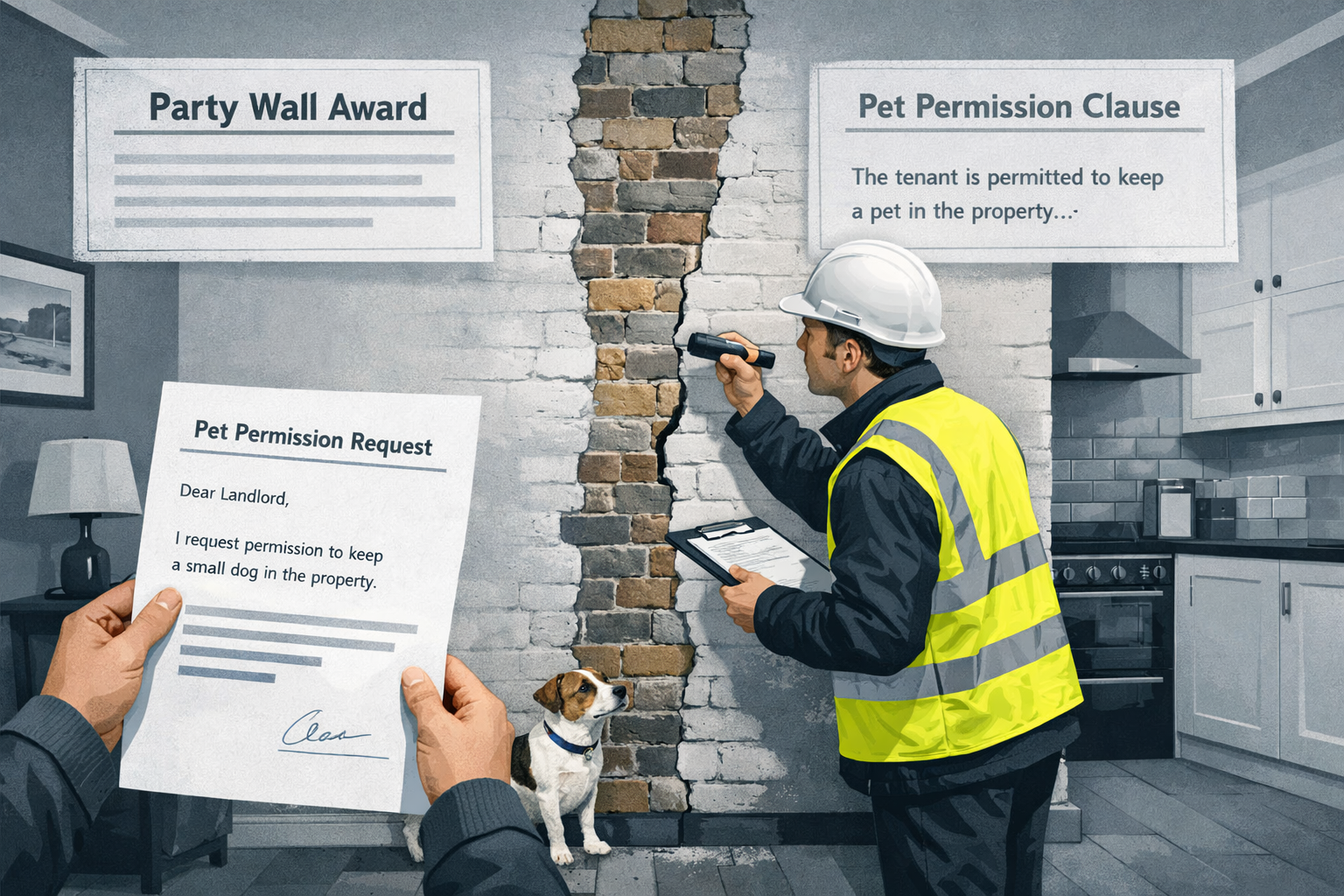
From May 2026, blanket "no pets" clauses in tenancy agreements became legally unenforceable in England — a seismic shift that is quietly reshaping how party wall surveyors must draft awards and assess damage risk. The intersection of Renters' Rights Act 2026 pet permission clauses in party wall awards and surveyor strategies for reasonable refusal assessments is one of the most underexamined compliance challenges facing the property industry right now. For surveyors working on adjoining properties where tenants now hold statutory pet rights, the implications run deep into how awards are worded, how risk is evidenced, and how disputes are resolved.
Key Takeaways 📋
- The Renters' Rights Act 2026 gives tenants a statutory right to request pets in writing; landlords must respond within 28 days with a specific, evidenced reason for any refusal [1][2].
- Blanket "no pets" policies are no longer legally sufficient — refusals must be reasonable, proportionate, and case-specific [3].
- Party wall awards must now account for pet-related damage risks in shared structures, particularly during and after building works.
- Surveyors can legitimately include pet-related clauses in awards where structural or acoustic risk is demonstrable, but must evidence their reasoning carefully.
- Ombudsman compliance requires surveyors and landlords to maintain a clear paper trail supporting any refusal or restrictive clause.
What the Renters' Rights Act 2026 Actually Changes for Pet Permissions
The Renters' Rights Act 2026 fundamentally rebalances the landlord-tenant relationship around pet ownership. Under the new framework, tenants have a statutory right to request permission to keep a pet in writing. Once that request is submitted, landlords have a 28-day window to respond [1]. Silence or a vague refusal is no longer acceptable.
Crucially, any refusal must be:
- ✅ Specific — citing the actual reason relevant to the property or tenancy
- ✅ Proportionate — not disproportionate to the actual risk posed
- ✅ Evidenced — supported by facts, not assumptions
- ❌ Not blanket — a standard "no pets" clause without further reasoning will not satisfy the Act [2]
"The days of a landlord simply writing 'no pets' in a tenancy agreement and expecting that to hold are over. The Act demands reasoned, individualised decision-making." [3]
Landlords who refuse unreasonably risk complaints to the Private Rented Sector Ombudsman, which became mandatory for all landlords in England under the same legislative package. This creates a compliance burden that flows directly into how property professionals — including party wall surveyors — must approach their work.
For a broader understanding of how party wall matters interact with property rights, the complete guide to party wall surveys for homeowners provides essential context.
How Pet Permission Clauses Intersect with Party Wall Awards
At first glance, pet permissions and party wall awards seem like entirely separate legal territories. They are not.
Party wall awards govern the rights and obligations of adjoining owners during and after notifiable building works. They routinely address:
- Structural protection measures
- Access rights
- Schedules of condition
- Ongoing maintenance obligations
- Noise and vibration limits
When a tenant in a terraced or semi-detached property is granted — or seeks — permission to keep a pet, several party wall-relevant risks emerge, particularly in the context of active building works or recently completed renovations.
The Structural Risk Overlap
| Risk Factor | Party Wall Relevance | Pet-Specific Concern |
|---|---|---|
| Vibration damage | High — excavation and drilling | Dogs scratching at skirting boards, floor edges |
| Moisture ingress | Medium — waterproofing works | Urine damage to subfloor near party wall |
| Acoustic transmission | High — shared wall construction | Animal noise amplified through thin party walls |
| Schedule of Condition accuracy | Critical | Pre-existing pet damage misattributed to works |
The Schedule of Condition — a document typically appended to a party wall award — records the state of a neighbouring property before works begin. If a tenant keeps pets and there is existing damage (scratched doors, stained floors, gnawed skirting), this must be meticulously recorded. Failure to do so can result in the building owner being held liable for pre-existing pet damage after works complete.
To understand how party wall awards are structured and what they must contain, see this complete guide to party wall awards for property owners.
Surveyor Strategies for Reasonable Refusal Assessments Under the Renters' Rights Act 2026
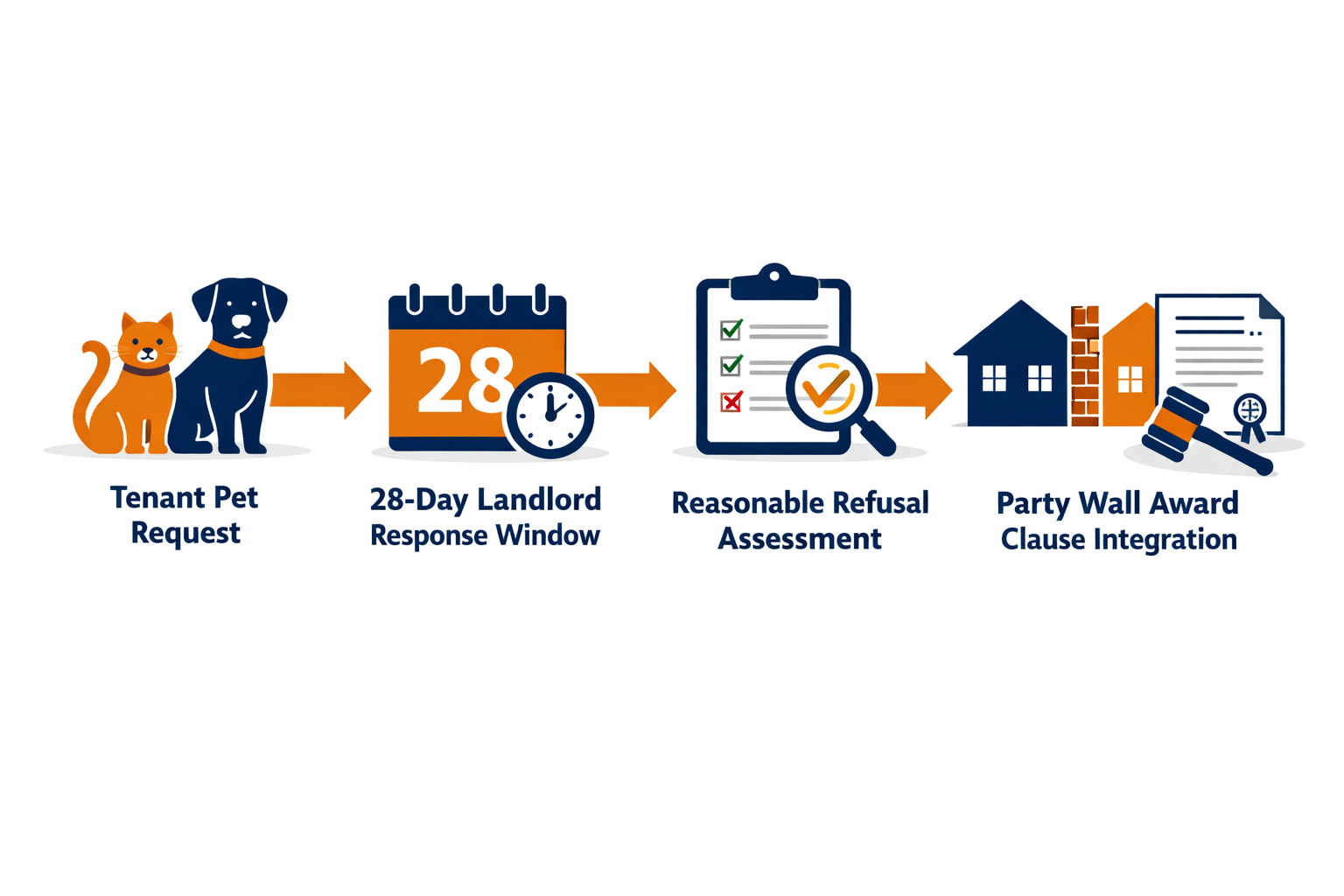
This is where Renters' Rights Act 2026 pet permission clauses in party wall awards and surveyor strategies for reasonable refusal assessments demand the most professional attention. Surveyors are increasingly being asked — formally or informally — to provide technical evidence that supports or challenges a landlord's refusal of a pet request, particularly when that refusal relates to structural or building condition concerns.
Strategy 1: Build a Structural Evidence File 🏗️
A surveyor's assessment of "reasonable refusal" must be grounded in observable, documented structural conditions. This means:
- Conducting a thorough inspection of the party wall and adjoining structures
- Identifying any existing vulnerabilities (e.g., cracked plaster, weak subfloor, poor damp-proofing)
- Documenting how a specific type of pet could realistically worsen those conditions
- Referencing relevant sections of the Party Wall etc. Act 1996 where applicable
A generic statement that "pets may cause damage" will not satisfy ombudsman scrutiny. The evidence must be property-specific.
Strategy 2: Differentiate Between Pet Types in Clauses
Not all pets carry the same structural risk. A party wall award clause that treats a goldfish identically to a large dog is unlikely to survive challenge. Surveyors drafting or advising on award clauses should consider:
- Large dogs: Higher risk of scratching, impact damage, and subfloor moisture exposure near party walls
- Cats: Lower structural risk but potential for scratching at plaster or timber near shared walls
- Small caged animals: Minimal structural risk; refusal based on these is harder to justify
- Reptiles/aquatic pets: Humidity and water risk relevant in properties with damp-party-wall histories
This proportionality principle mirrors the Act's requirement that refusals be case-specific rather than categorical [2].
Strategy 3: Integrate Pet Clauses Explicitly into the Award
Where a surveyor determines that pet-related risks are genuinely relevant to the works or the shared structure, those concerns should be written explicitly into the party wall award rather than left as informal advice. Appropriate clauses might include:
- A requirement that the tenant/owner maintains the party wall face in good condition throughout the works period
- A prohibition on certain activities near the party wall that could be exacerbated by pet presence
- A post-works inspection clause that specifically notes any new pet-related damage for attribution purposes
For guidance on how awards are drafted and what clauses are typically included, this party wall contract guide and award template is a valuable reference.
Strategy 4: Use the Schedule of Condition as a Pet-Damage Baseline
One of the most practical tools available to surveyors is the Schedule of Condition. In the context of the Renters' Rights Act 2026, this document takes on added importance. A thorough schedule should:
- Photograph and describe all existing pet-related damage before works begin
- Note the presence of pets on the premises
- Record any pet-specific modifications (e.g., cat flaps in party walls, dog kennels against shared fences)
This baseline protects all parties: the building owner cannot be blamed for pre-existing pet damage, and the tenant's pet-keeping rights cannot be used to obscure genuine works-related harm.
For more on schedules of condition and their role in protecting property owners, visit Notting Hill Surveyors' schedule of condition service.
Strategy 5: Prepare for Ombudsman Scrutiny 📝
The mandatory Private Rented Sector Ombudsman introduced alongside the Renters' Rights Act 2026 has real teeth. Surveyors who provide technical opinions in support of pet refusals — whether in award clauses or separate reports — must ensure their reasoning is:
- Written in plain, accessible language
- Free from assumptions or generalisations
- Cross-referenced with inspection findings
- Consistent with RICS professional standards
Surveyors acting as expert witnesses in pet-related disputes should be aware that their reports may be submitted directly to the ombudsman. The expert witness services available from qualified chartered surveyors can provide the level of rigour these situations demand.
Practical Scenarios: Where the Two Regimes Collide
Scenario A: Loft Conversion in a Terraced House 🏠
A building owner in a mid-terrace property serves a party wall notice for a loft conversion. The adjoining owner is a tenant who, under the Renters' Rights Act 2026, has recently been granted permission to keep a large dog. The surveyor conducting the party wall inspection notes:
- Existing scratches on the party wall plasterwork at skirting level
- A small area of moisture near the base of the party wall (possibly dog-related)
Surveyor action: Record all findings in the Schedule of Condition with photographs. Include a clause in the award noting the pre-existing condition. Recommend the building owner's contractor avoids disturbing the lower section of the party wall where possible.
Scenario B: Landlord Seeks Surveyor Support for Pet Refusal
A landlord receives a pet request from a tenant in a ground-floor flat with a shared party wall. The landlord wants to refuse on the grounds that the party wall is in poor condition. The surveyor is asked to provide a technical opinion.
Surveyor action: Inspect the party wall, document specific vulnerabilities, and produce a written report identifying the specific structural risks that a large dog would pose. A vague letter will not suffice — the ombudsman will expect evidence [3].
To understand the full legal framework governing party wall disputes and how surveyors navigate them, the comprehensive guide to party wall dispute resolution is essential reading.
Common Mistakes Surveyors Must Avoid ⚠️

Understanding Renters' Rights Act 2026 pet permission clauses in party wall awards and surveyor strategies for reasonable refusal assessments also means knowing what not to do:
- Issuing blanket pet-exclusion clauses in awards without structural justification — these mirror the very blanket bans the Act prohibits
- Failing to update Schedules of Condition when pets are present on the premises
- Conflating tenant rights with building owner rights — the Act governs the landlord-tenant relationship, but the Party Wall etc. Act 1996 governs the building owner-adjoining owner relationship; these are distinct
- Providing informal verbal opinions on pet refusals without written documentation — this creates professional liability exposure
- Ignoring the ombudsman compliance dimension entirely — surveyors whose reports are used in landlord decisions are indirectly subject to scrutiny
For surveyors seeking to understand their full legal responsibilities under the Party Wall etc. Act 1996, this guide to surveyor roles, responsibilities, and legal requirements is highly recommended.
The Bigger Picture: A New Standard of Care for Surveyors
The Renters' Rights Act 2026 does not directly amend the Party Wall etc. Act 1996. However, it creates a new context in which party wall surveyors operate. Tenants now have enforceable rights that intersect with the physical fabric of shared structures. Landlords face ombudsman oversight. And surveyors sit at the intersection of both.
The professional standard of care expected of a party wall surveyor in 2026 now includes:
- Awareness of the Renters' Rights Act 2026 pet permission framework [1][2]
- Ability to assess pet-related structural risks with specificity
- Competence in drafting award clauses that are proportionate and evidenced
- Readiness to support or challenge refusals with written, inspected findings
This is not an optional upgrade — it is a baseline expectation for any surveyor working on residential party wall matters in England.
For those looking to find a qualified professional in their area, this guide to finding qualified party wall surveyors near you is a practical starting point.
Conclusion: Actionable Next Steps for Surveyors and Property Owners
The convergence of Renters' Rights Act 2026 pet permission clauses in party wall awards and surveyor strategies for reasonable refusal assessments is not a theoretical concern — it is an active compliance challenge in 2026. Here is what professionals and property owners should do now:
For Party Wall Surveyors:
- ✅ Review all standard award templates and update Schedule of Condition protocols to include pet presence documentation
- ✅ Build a checklist for pet-specific structural risk assessment tied to property type and pet category
- ✅ Ensure any written opinion supporting a pet refusal is inspection-based, specific, and proportionate
- ✅ Stay current with ombudsman guidance and RICS professional standards as they evolve
For Landlords:
- ✅ Do not rely on party wall concerns as a pretext for pet refusal without commissioning a proper surveyor's report
- ✅ Respond to all pet requests within the 28-day statutory window [1]
- ✅ Keep a documented paper trail for every decision
For Tenants:
- ✅ Submit pet requests in writing, specifying the type and breed of pet
- ✅ If refused, ask for the specific reason in writing — vague refusals can be challenged [2][3]
- ✅ Be aware that party wall works may affect your rights temporarily, but do not extinguish them
The property industry is adapting to a more rights-conscious rental landscape. Surveyors who embrace this shift — and develop the skills to navigate it — will be better placed to serve their clients, avoid disputes, and uphold the professional standards the sector demands.
References
[1] Have The Renters Rights Changes Changed The Rules On Pets – https://www.landlordstudio.com/uk-blog/have-the-renters-rights-changes-changed-the-rules-on-pets
[2] The Right To Request Pets Under The Renters Rights Act – https://www.chaseevans.com/news-and-insights/the-right-to-request-pets-under-the-renters-rights-act/
[3] Renters Rights Act Pets – https://www.remedylegal.ai/journal/renters-rights-act-pets
[4] Watch – https://www.youtube.com/watch?v=rVat8TD4IBE
