
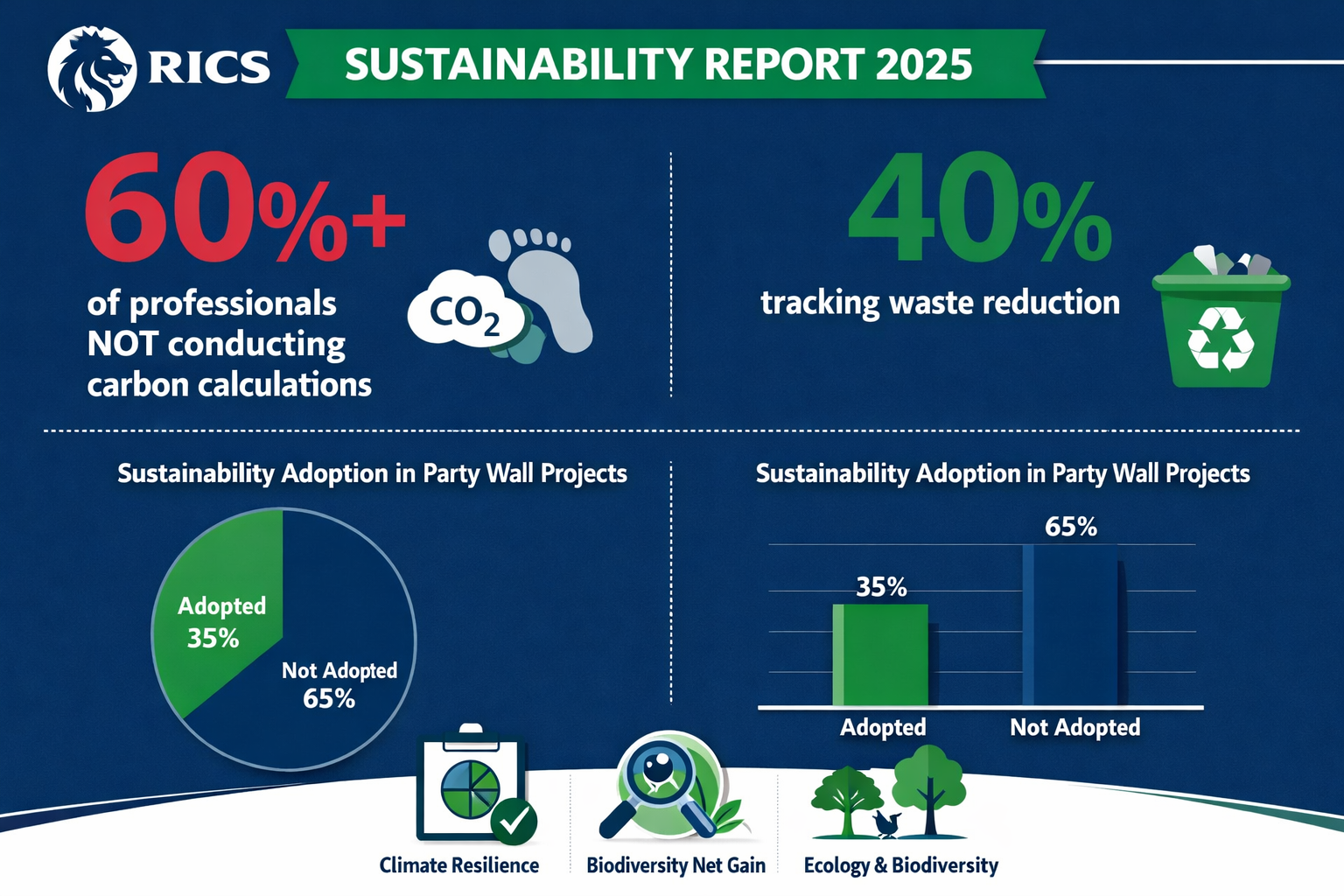
More than 60% of surveying professionals admit they conduct carbon calculations and climate resilience assessments on fewer than half their projects—or not at all.[2] This stark finding from the RICS Sustainability Report 2025 arrives at a critical juncture for the UK's built environment. As the nation races toward net zero targets, party wall disputes increasingly involve green retrofit installations that demand new protocols, updated award clauses, and sustainability-focused resolution frameworks.
Integrating RICS Sustainability Report 2025 into Party Wall Awards: 2026 Protocols for Green Retrofit Disputes represents a fundamental shift in how surveyors, building owners, and legal professionals approach boundary works. The convergence of sustainability imperatives with traditional party wall procedures creates both challenges and opportunities for practitioners navigating retrofit projects in 2026.
Key Takeaways
- Sustainability gaps persist: Over 60% of professionals fail to conduct carbon assessments regularly, creating risks in party wall retrofit disputes[2]
- New award clauses required: 2026 protocols demand specific provisions for biodiversity net gain (BNG), embodied carbon, and climate resilience in boundary works
- Consultation shapes practice: RICS's draft 8th edition of Party Wall Legislation and Procedure provides framework for sustainability integration[1]
- Dispute resolution evolves: Green retrofit conflicts require specialized knowledge combining traditional party wall expertise with environmental assessment capabilities
- Documentation standards rise: Carbon calculations, waste reduction tracking, and data-sharing become essential components of compliant party wall awards
Understanding the RICS Sustainability Report 2025 Context
The RICS Sustainability Report 2025 delivers a comprehensive assessment of how the built environment sector adopts sustainable practices.[2] For party wall surveyors, the findings reveal significant implementation gaps that directly impact retrofit project delivery.
Critical Sustainability Metrics for Party Wall Work
The report highlights several concerning trends:
Carbon Assessment Deficiencies 🌍
More than 60% of surveying professionals report conducting carbon calculations and climate resilience assessments in less than half of their projects or not at all.[2] This creates substantial risks when party wall works involve:
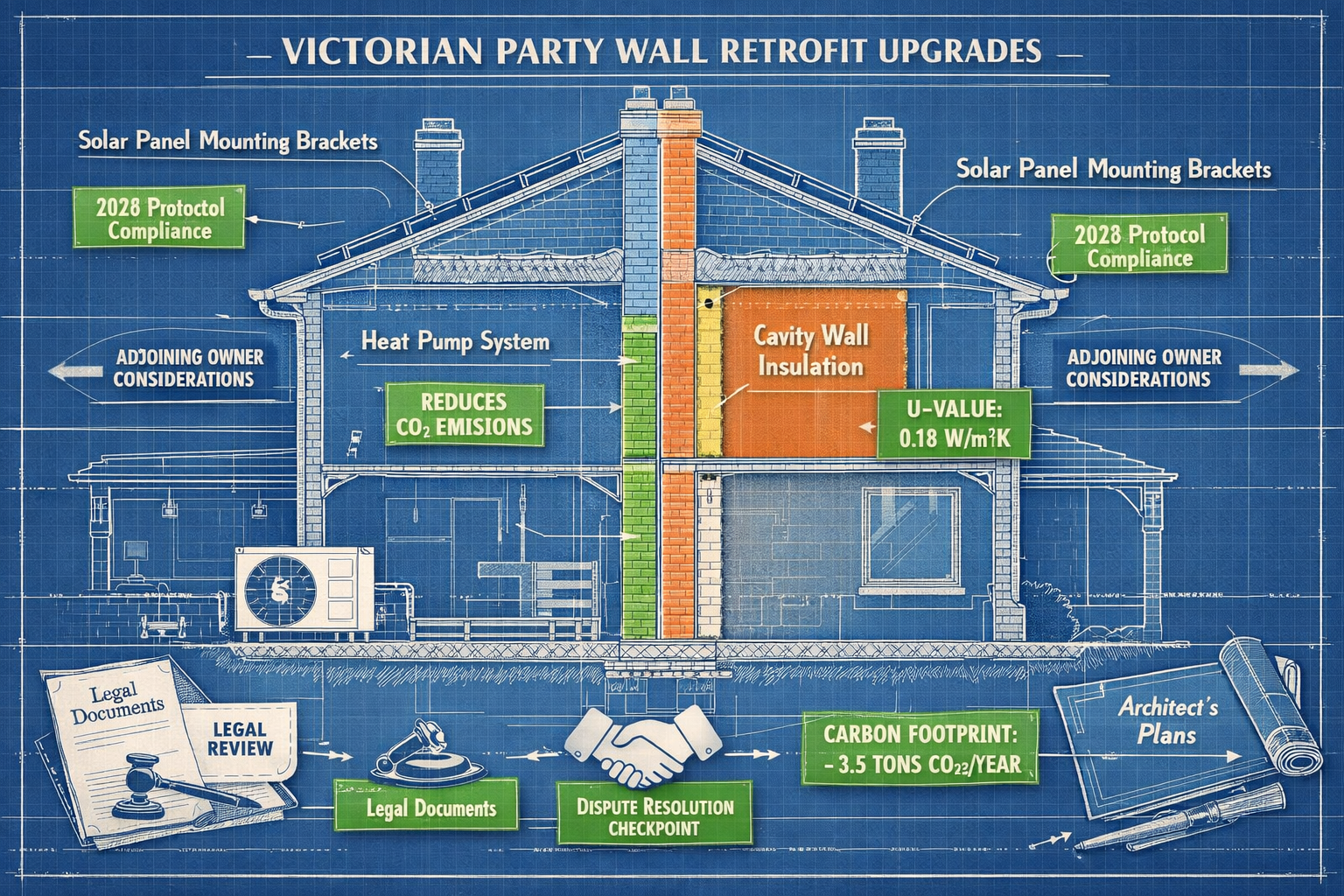
- Heat pump installations requiring structural modifications
- Solar panel mounting systems affecting party structures
- External wall insulation extending across boundaries
- Ventilation systems penetrating party walls
Positive Waste Reduction Trends ♻️
Approximately 40% of professionals now track waste reduction and engage in regular data-sharing.[2] This represents progress but leaves significant room for improvement in party wall contexts where:
- Demolition of existing structures generates substantial waste
- Retrofit materials require careful specification
- Circular economy principles demand material reuse considerations
- Construction waste impacts both adjoining owners
Bridging Sustainability and Party Wall Practice
The integration challenge centers on incorporating environmental considerations into party wall awards without compromising the legal framework established by the Party Wall etc. Act 1996. Traditional awards focus on:
- Structural integrity and safety
- Rights of access and working hours
- Compensation for damage or loss
- Condition schedules and monitoring
New sustainability requirements demand additional provisions addressing:
✅ Embodied carbon calculations for materials used in party wall works
✅ Biodiversity net gain obligations for boundary landscaping and structures
✅ Climate resilience measures protecting both properties from future environmental risks
✅ Circular economy compliance through material selection and waste management
✅ Energy performance impacts on adjoining properties
Integrating RICS Sustainability Report 2025 into Party Wall Awards: Key Protocol Updates
The draft 8th edition of RICS Party Wall Legislation and Procedure[1] provides the foundation for incorporating sustainability principles into party wall practice. Surveyors must now balance traditional dispute resolution with environmental accountability.
Carbon Assessment Clauses for 2026 Awards
Mandatory Carbon Calculations
Party wall awards in 2026 should include specific clauses requiring:
| Assessment Type | Application | Documentation Required |
|---|---|---|
| Embodied Carbon | All structural materials | EPD certificates, carbon factors |
| Operational Carbon | HVAC systems, heat pumps | Energy modeling, performance data |
| Whole Life Carbon | Major retrofit works | Lifecycle assessment reports |
| Carbon Offset | Where reduction insufficient | Verified offset schemes, costs |
Building owners proposing works must provide carbon assessments before party wall notices are served. This allows adjoining owners to:
- Evaluate environmental impacts alongside structural concerns
- Request alternative low-carbon solutions
- Negotiate carbon reduction measures
- Establish baseline data for future disputes
Sample Award Language:
"The Building Owner shall provide a detailed embodied carbon assessment for all materials to be used in the party wall works, calculated in accordance with RICS Professional Standard: Whole Life Carbon Assessment for the Built Environment. The assessment shall be shared with the Adjoining Owner not less than 14 days prior to commencement."
Biodiversity Net Gain (BNG) Provisions
The Environment Act 2021 mandates 10% biodiversity net gain for most development. Party wall works involving boundary structures increasingly trigger BNG requirements, particularly for:
- Garden walls and boundaries affecting habitat connectivity
- Shared chimneys providing nesting sites for protected species
- Foundations and excavations impacting soil ecology
- Drainage works affecting water-dependent ecosystems
BNG Award Clauses Must Address:
🌱 Pre-works ecological surveys and habitat assessments
🌱 Mitigation measures for protected species displacement
🌱 Enhancement features (bat boxes, swift bricks, green walls)
🌱 30-year habitat management and monitoring plans
🌱 Off-site compensation where on-site gain impossible
For party wall surveyors, this requires collaboration with ecologists and environmental consultants. Awards should specify:
- Who commissions ecological assessments (typically the building owner)
- Cost allocation for surveys and mitigation measures
- Access arrangements for ongoing habitat monitoring
- Dispute resolution mechanisms for BNG compliance failures
Climate Resilience and Adaptation Measures
The RICS Sustainability Report 2025 emphasizes climate resilience assessments.[2] Party wall awards must now consider how retrofit works affect both properties' ability to withstand:
Flood Risk 💧
- Drainage modifications affecting water flow
- Damp-proofing systems at party wall junctions
- Sustainable drainage system (SuDS) integration
- Below-ground waterproofing shared between properties
Thermal Performance 🌡️
- Insulation continuity across party walls
- Thermal bridging at junctions
- Overheating risk from retrofit measures
- Ventilation strategy coordination
Structural Resilience 🏗️
- Wind loading from rooftop installations
- Seismic considerations for retrofit additions
- Material durability under climate change scenarios
- Maintenance access for long-term resilience
Awards should include climate resilience schedules documenting:
- Current climate vulnerabilities identified
- Proposed mitigation measures in the works
- Monitoring requirements post-completion
- Responsibility allocation for future adaptation
2026 Protocols for Green Retrofit Disputes
Green retrofit disputes differ fundamentally from traditional party wall conflicts. They involve technical complexity, regulatory uncertainty, and longer-term environmental considerations that challenge conventional resolution approaches.
Common Green Retrofit Dispute Scenarios
Heat Pump Installation Conflicts
Air source heat pumps frequently trigger party wall disputes involving:
- Noise and vibration affecting adjoining properties
- Visual impact of external units on shared boundaries
- Structural modifications for pipework and mounting systems
- Planning permission interactions with party wall rights
Resolution Protocol:
- Pre-notice acoustic assessment demonstrating compliance with WHO noise guidelines
- Alternative positioning evaluation minimizing adjoining owner impact
- Vibration isolation specifications in award schedules
- Performance monitoring clauses with remediation triggers
- Cost-sharing provisions where works benefit both properties
Solar Panel and Mounting Disputes
Rooftop solar installations on party wall structures raise concerns about:
- Structural loading and party wall capacity
- Water ingress risk from penetrations
- Maintenance access requirements
- Fire safety considerations
- End-of-life removal and reinstatement
Awards must specify:
✓ Structural engineer certification of load capacity
✓ Waterproofing warranties with joint property coverage
✓ Access protocols for maintenance and emergency removal
✓ Decommissioning bonds ensuring future reinstatement funding
✓ Insurance requirements covering sustainability-specific risks
External Wall Insulation (EWI) Boundary Issues
EWI systems extending across boundaries create disputes regarding:
- Land encroachment where insulation projects beyond the boundary
- Appearance changes affecting adjoining property aesthetics
- Fire safety at party wall junctions
- Moisture management and condensation risk
Resolving party wall disputes involving EWI requires:
Boundary agreements establishing permitted encroachment limits
Fire barrier specifications meeting Building Regulations Part B
Hygrothermal modeling demonstrating moisture safety
Long-term maintenance access provisions
Aesthetic approval processes for adjoining owners
Specialized Surveyor Competencies for Green Disputes
Traditional party wall expertise must expand to encompass:
| Competency Area | Knowledge Requirements | Application |
|---|---|---|
| Building Physics | U-values, thermal bridging, airtightness | Insulation disputes, condensation issues |
| Renewable Energy | Heat pump COP, solar yield calculations | Installation feasibility assessments |
| Environmental Law | BNG regulations, carbon reporting duties | Compliance verification, award clauses |
| Circular Economy | Material reuse, waste hierarchy | Specification review, waste management |
| Climate Science | Flood risk, overheating, resilience | Long-term impact assessment |
Surveyors lacking these competencies should engage specialist consultants and include their reports as award appendices. The RICS registered valuers framework provides guidance on professional collaboration.
Award Documentation Standards for Sustainability
2026 protocols demand enhanced documentation within party wall awards:
Mandatory Sustainability Appendices:
📋 Appendix S1: Carbon Assessment Report
- Embodied carbon calculations for all materials
- Operational carbon impact modeling
- Comparison with baseline and alternatives
- Offset proposals where applicable
📋 Appendix S2: Biodiversity Net Gain Statement
- Pre-works habitat condition assessment
- BNG calculation using Defra metric
- Enhancement and compensation proposals
- 30-year management plan summary
📋 Appendix S3: Climate Resilience Schedule
- Current vulnerability assessment
- Proposed resilience measures
- Monitoring and maintenance requirements
- Responsibility allocation matrix
📋 Appendix S4: Circular Economy Statement
- Material sourcing and specifications
- Waste reduction strategy
- Reuse and recycling provisions
- End-of-life decommissioning plan
📋 Appendix S5: Energy Performance Impact Assessment
- Effects on adjoining property energy efficiency
- Thermal bridging analysis
- Overheating risk evaluation
- Ventilation strategy coordination
These appendices transform party wall awards from purely structural documents into comprehensive sustainability records.
Practical Implementation Strategies for Surveyors
Surveyors must develop systematic approaches to integrate RICS Sustainability Report 2025 findings into daily practice while maintaining compliance with the Party Wall etc. Act 1996.
Pre-Notice Sustainability Screening
Before serving party wall notices, building owners should complete a sustainability screening assessment covering:
Step 1: Carbon Impact Evaluation
- Calculate embodied carbon of proposed materials
- Model operational carbon changes
- Identify low-carbon alternatives
- Estimate carbon offset requirements
Step 2: Biodiversity Assessment
- Commission preliminary ecological appraisal
- Identify protected species and habitats
- Determine BNG baseline and requirements
- Plan enhancement measures
Step 3: Climate Resilience Review
- Assess current climate vulnerabilities
- Evaluate how works affect resilience
- Plan adaptation measures
- Consider long-term maintenance needs
Step 4: Regulatory Compliance Check
- Verify Building Regulations compliance
- Confirm planning permission alignment
- Check environmental permit requirements
- Review local authority sustainability policies
This screening informs party wall notice content and enables early identification of potential disputes.
Negotiation Frameworks for Green Retrofit Conflicts
When disputes arise, surveyors should employ structured negotiation frameworks:
The Four-Stage Sustainability Negotiation Model:
Stage 1: Information Sharing 📊
- Exchange all sustainability assessments
- Clarify regulatory requirements
- Identify common ground on environmental goals
- Establish technical baseline understanding
Stage 2: Impact Assessment 🔍
- Jointly evaluate effects on both properties
- Quantify environmental benefits and risks
- Consider cumulative impacts with other works
- Assess long-term implications
Stage 3: Solution Development 💡
- Brainstorm alternative approaches
- Model different scenarios
- Evaluate cost-benefit trade-offs
- Identify win-win sustainability outcomes
Stage 4: Agreement Formalization ✍️
- Draft detailed award clauses
- Specify monitoring and verification
- Establish dispute escalation procedures
- Document sustainability commitments
This approach aligns with local party wall surveyor best practices while incorporating environmental considerations.
Cost Allocation for Sustainability Measures
A contentious issue in green retrofit disputes involves who pays for sustainability assessments and measures. The 2026 protocols suggest:
Building Owner Responsibilities:
- Carbon assessments for proposed works
- BNG surveys and enhancement measures
- Climate resilience measures benefiting their property
- Compliance with minimum regulatory standards
Shared Cost Scenarios:
- Measures benefiting both properties equally
- Enhanced specifications exceeding minimum standards at adjoining owner request
- Monitoring systems providing mutual protection
- Dispute resolution costs for sustainability disagreements
Adjoining Owner Responsibilities:
- Independent verification of building owner assessments (if desired)
- Enhanced specifications beyond regulatory requirements
- Aesthetic preferences exceeding functional needs
Awards should include sustainability cost schedules clearly allocating expenses and establishing payment mechanisms.
Technology and Data Management
The 40% of professionals tracking waste reduction and engaging in data-sharing[2] demonstrate the importance of digital tools for sustainability integration:
Recommended Technology Solutions:
🖥️ Carbon Calculation Software – Automated embodied carbon assessment
🖥️ BNG Metric Tools – Biodiversity unit calculations and tracking
🖥️ Building Performance Modeling – Energy and climate resilience simulation
🖥️ Document Management Systems – Centralized sustainability record-keeping
🖥️ Monitoring Platforms – Post-completion performance verification
Surveyors should specify in awards which platforms will be used for ongoing data collection and sharing between parties.
Legal and Regulatory Considerations
Integrating RICS Sustainability Report 2025 into Party Wall Awards: 2026 Protocols for Green Retrofit Disputes operates within complex legal frameworks requiring careful navigation.
Party Wall Act 1996 Constraints
The Party Wall etc. Act 1996 provides the statutory framework but predates modern sustainability requirements. Key considerations:
Statutory Purpose Limitations
The Act addresses structural and access matters, not environmental performance. Sustainability provisions must be framed as:
- Protective measures preventing damage from green retrofit installations
- Specification details ensuring work quality and longevity
- Access arrangements for ongoing monitoring and maintenance
- Compensation mechanisms for sustainability-related losses
Consent Requirements
Adjoining owners cannot unreasonably withhold consent, but may request:
- Alternative sustainable solutions with equivalent performance
- Enhanced environmental protections beyond minimum standards
- Additional monitoring and verification measures
- Financial security for long-term environmental commitments
Award Enforceability
Sustainability clauses must be specific, measurable, and enforceable to withstand legal challenge. Vague environmental aspirations lack enforceability.
Building Regulations and Planning Interactions
Green retrofit works typically require:
Building Regulations Approval covering:
- Part L (Conservation of fuel and power)
- Part F (Ventilation)
- Part C (Site preparation and resistance to contaminants and moisture)
- Part B (Fire safety) for external insulation systems
Planning Permission for:
- Solar panels and renewable energy installations
- External wall insulation altering appearance
- Heat pumps in conservation areas
- Works affecting listed buildings
Party wall awards should reference but not duplicate these approvals, confirming:
✓ Necessary consents obtained before commencement
✓ Award specifications align with approved plans
✓ Compliance monitoring includes regulatory requirements
✓ Variations requiring amended approvals
Professional Indemnity Insurance Implications
Sustainability integration creates new liability exposures for surveyors:
Emerging Risk Areas:
- Incorrect carbon calculations leading to regulatory non-compliance
- BNG assessment errors resulting in enforcement action
- Climate resilience failures causing future damage
- Technology specification mistakes affecting performance
Surveyors should:
🛡️ Verify PI coverage extends to sustainability advice
🛡️ Document competency limitations and consultant reliance
🛡️ Maintain detailed records of sustainability assessments
🛡️ Use clear disclaimer language for long-term predictions
🛡️ Engage specialist consultants for complex environmental matters
When choosing a party wall surveyor, clients should verify sustainability competencies and appropriate insurance coverage.
Future Developments and Emerging Trends
The integration of sustainability into party wall practice will continue evolving as regulations tighten and net zero deadlines approach.
Anticipated Regulatory Changes
Upcoming Developments:
📅 2027: Mandatory whole life carbon assessments for all major works
📅 2028: Enhanced BNG requirements (15% net gain)
📅 2029: Climate resilience standards for retrofit projects
📅 2030: Circular economy compliance mandatory for construction waste
Party wall protocols must remain flexible to accommodate these changes. The RICS consultation on the 8th edition[1] provides opportunities for practitioner input on future-proofing guidance.
Technology Innovation Impact
Emerging technologies will transform sustainability integration:
Artificial Intelligence 🤖
- Automated carbon calculation from specifications
- Predictive modeling of climate resilience
- Dispute risk assessment and early warning
- Optimal solution recommendation engines
Digital Twins 🏘️
- Virtual modeling of party wall works
- Real-time performance monitoring
- Scenario testing for sustainability measures
- Integrated data management across property lifecycle
Blockchain ⛓️
- Immutable sustainability records
- Transparent carbon offset verification
- Smart contracts for automated compliance
- Secure data sharing between parties
Surveyors should monitor these developments and consider pilot implementations in appropriate cases.
Professional Development Requirements
The competency gap revealed by the RICS Sustainability Report 2025[2] demands urgent professional development:
Essential Training Areas:
- Carbon literacy and calculation methodologies
- Biodiversity net gain assessment and planning
- Climate resilience and adaptation strategies
- Circular economy principles and applications
- Green building technologies and performance
RICS and other professional bodies should develop specialized party wall sustainability qualifications recognizing expertise in this emerging field.
Conclusion
Integrating RICS Sustainability Report 2025 into Party Wall Awards: 2026 Protocols for Green Retrofit Disputes represents a necessary evolution of party wall practice. The findings that over 60% of professionals fail to conduct regular carbon assessments[2] while 40% successfully track waste reduction[2] demonstrate both the urgency and the possibility of change.
Key Implementation Priorities:
✅ Embed sustainability screening in pre-notice procedures
✅ Develop standardized award clauses for carbon, BNG, and climate resilience
✅ Build surveyor competencies through targeted professional development
✅ Adopt digital tools for assessment, monitoring, and data sharing
✅ Establish collaborative frameworks with environmental specialists
The draft 8th edition of Party Wall Legislation and Procedure[1] provides the foundation, but practitioners must actively shape its development through consultation engagement and innovative practice.
Actionable Next Steps
For Building Owners:
- Commission sustainability assessments before serving party wall notices
- Engage surveyors with demonstrated green retrofit expertise
- Budget for enhanced documentation and monitoring requirements
- Consider voluntary sustainability enhancements beyond minimum standards
For Adjoining Owners:
- Request comprehensive sustainability information early in the process
- Seek independent verification of environmental claims where appropriate
- Negotiate monitoring and remediation provisions in awards
- Understand long-term maintenance and access implications
For Surveyors:
- Complete sustainability-focused CPD and training
- Develop consultant networks for specialized assessments
- Create template award clauses for common green retrofit scenarios
- Participate in RICS consultations to shape emerging guidance
- Invest in technology platforms supporting sustainability integration
For the Profession:
- Contribute to RICS consultation on the 8th edition
- Share case studies and best practices through professional forums
- Develop specialized sustainability qualifications for party wall work
- Advocate for regulatory clarity on sustainability-party wall interactions
The transition to net zero demands that party wall practice evolve beyond traditional structural concerns to embrace environmental accountability. By systematically integrating the insights from the RICS Sustainability Report 2025 into daily practice, surveyors can ensure that boundary works contribute to—rather than hinder—the UK's climate goals.
The protocols outlined here provide a roadmap for 2026 and beyond, but success ultimately depends on professional commitment to continuous improvement, collaborative problem-solving, and recognition that sustainable party wall practice serves the long-term interests of all parties and the broader environment.
For comprehensive guidance on party wall procedures, consult our party wall award guidance and explore resources on party wall consent requirements.
References
[1] Rics Launches Consultation On Updated Party Wall Practice Guidance – https://www.rics.org/news-insights/rics-launches-consultation-on-updated-party-wall-practice-guidance
[2] Sustainability Report 2025 – https://www.rics.org/news-insights/current-topics-campaigns/sustainability/sustainability-report-2025
[3] Sustainability Report 2025 – https://www.rics.org/content/dam/ricsglobal/documents/reports/Sustainability-report-2025.pdf
[4] rics – https://www.rics.org
