
RICS data reveals a stark reality facing property professionals in 2026: London's residential market sentiment has cooled by 42% year-on-year, while northern regions maintain robust momentum, creating what building surveyors describe as a "patchwork of distinct" regional price movements[7]. This unprecedented divergence demands that chartered surveyors abandon one-size-fits-all valuation approaches and adopt sophisticated regional adjustment strategies to deliver accurate appraisals.
The Valuation Challenges in Diverging Regional Markets: Chartered Surveyor Techniques for Accurate Appraisals as North-South Momentum Varies in 2026 represent more than statistical curiosities—they fundamentally reshape how property professionals establish valuation benchmarks, select comparable properties, and justify their conclusions to clients and lenders. With global REIT valuations trading at nearly 30% discounts to historical averages and regional cap rates showing material variation, surveyors must master new methodologies that account for localized market dynamics[1].

Key Takeaways
- 🎯 Regional price divergence creates significant challenges for establishing consistent valuation benchmarks across UK markets in 2026
- 📊 London market cooling contrasts sharply with sustained momentum in northern and peripheral regions, requiring location-specific adjustment factors
- 🔧 Advanced surveyor techniques including weighted comparable analysis and regional cap rate adjustments are essential for accurate appraisals
- 💼 RICS Red Book compliance demands transparent documentation of regional adjustment methodologies in valuation reports
- 📈 Market sentiment indicators must be integrated alongside traditional valuation metrics to capture diverging regional trajectories
Understanding Regional Market Divergence in 2026
The UK property market has fragmented into distinct regional ecosystems, each operating under different economic pressures and buyer sentiment profiles. This fragmentation stems from multiple converging factors that chartered surveyors must comprehend to deliver credible valuations.
The North-South Valuation Divide
The traditional North-South divide has intensified in 2026, but not in the direction many predicted. While London historically commanded premium valuations, current market dynamics show northern markets absorbing demand that previously concentrated in the capital. Chartered surveyors in Surrey report valuation compression in premium segments, while colleagues covering northern territories document sustained price growth.
This reversal creates immediate challenges for valuation professionals:
- Comparable property selection becomes problematic when recent sales data shows contradictory trends
- Time adjustments to comparable sales require region-specific percentage modifications
- Buyer motivation analysis differs substantially between cooling and heating markets
- Rental yield expectations vary by 200+ basis points between regions
Economic Drivers Behind Regional Divergence
Several macroeconomic factors contribute to the current regional valuation challenges:
Employment patterns have shifted dramatically, with remote work arrangements enabling professionals to relocate from expensive southern markets to more affordable northern cities. This migration pattern directly impacts residential valuations, as chartered surveyors in Fulham and Chelsea observe softening demand for premium properties previously occupied by commuters.
Infrastructure investment in northern transport networks has improved regional connectivity, enhancing the attractiveness of previously peripheral locations. Surveyors conducting freehold valuations must now factor in accessibility improvements that weren't reflected in historical comparable sales.
Cost of living differentials have widened, making northern markets increasingly attractive to first-time buyers and young families priced out of southern markets. This demographic shift alters the buyer profile that underpins valuation assumptions.
Global Context for Regional Valuation Challenges
The UK's regional divergence mirrors broader global real estate trends. The global REIT sector trades at an average 6.9% implied NOI cap rate, representing material discounts to underlying net asset values[1]. This valuation disconnect between public market pricing and private transaction values complicates the surveyor's task of establishing appropriate yield assumptions.
European markets demonstrate similar regional fragmentation, with property valuations remaining below historical averages since the global financial crisis[4]. UK surveyors can learn from continental approaches to regional adjustment methodologies, particularly in markets like Germany where federal structure creates distinct regional pricing dynamics.
Valuation Challenges in Diverging Regional Markets: Core Technical Issues
Chartered surveyors face specific technical challenges when conducting appraisals across diverging regional markets. Understanding these obstacles enables professionals to develop appropriate mitigation strategies.

Comparable Sales Analysis in Fragmented Markets
The cornerstone of residential valuation—comparable sales analysis—becomes problematic when regional markets move in opposite directions. Traditional approaches assume relatively uniform market conditions across the comparable selection area, but 2026 market fragmentation invalidates this assumption.
Time adjustment complications emerge when comparable properties sold six months ago reflect different market sentiment than current conditions. In cooling markets like central London, backward-looking comparable sales overstate current value. Conversely, in heating northern markets, recent sales may understate current value due to momentum effects.
Surveyors must apply region-specific time adjustment factors rather than national averages. Analysis of RICS member transaction data suggests:
| Region Type | Monthly Time Adjustment (2026) |
|---|---|
| Central London | -0.8% to -1.2% |
| Outer London | -0.3% to -0.5% |
| Southeast Commuter Belt | -0.2% to -0.4% |
| Northern Cities | +0.4% to +0.7% |
| Regional Towns | +0.2% to +0.5% |
These adjustments must be transparently documented in valuation reports to satisfy RICS Red Book requirements and client expectations for professional rigor.
Location Adjustment Methodology
Traditional location adjustments focused primarily on property-specific factors (view, proximity to amenities, neighborhood quality). In 2026's divergent market, surveyors must layer macro-regional adjustments onto these micro-location factors.
Chartered surveyors in Essex and Romford report that properties in commuter locations now command premiums relative to comparable London properties—a reversal of historical patterns. This requires surveyors to:
- Establish regional baseline values through analysis of multiple comparable transactions
- Apply regional momentum multipliers based on local market velocity indicators
- Document regional economic fundamentals supporting the adjustment rationale
- Cross-reference with rental market data to validate capital value adjustments
Yield and Capitalization Rate Challenges
For commercial and investment property valuations, establishing appropriate capitalization rates presents particular difficulty in diverging markets. The sector-wide 6.9% average NOI cap rate masks substantial regional variation[1].
Shopping center valuations exemplify these challenges. Despite strong supply/demand fundamentals, these properties trade at discounts reflecting perceived risk rather than actual performance[1]. Surveyors conducting Red Book valuations must determine whether to reflect market pricing (incorporating misperception) or fundamental value (correcting for mispricing).
Retail rent stabilization expected mid-2026 adds temporal complexity to yield assumptions[1]. Forward-looking valuations must incorporate anticipated rental recovery while acknowledging current market skepticism reflected in pricing.
Cross-Border Comparable Analysis
Regional divergence complicates the use of comparable evidence from adjacent markets. A surveyor valuing property in St Albans might traditionally reference comparable sales in Harrow or outer London locations. However, 2026 market fragmentation means these areas may be experiencing different trajectories, rendering simple comparable analysis unreliable.
Best practice requires surveyors to:
- Prioritize comparables within the same regional market segment even if this means expanding the geographic search radius
- Apply documented cross-regional adjustments when using comparables from adjacent market areas
- Weight comparable evidence based on market similarity rather than geographic proximity
- Supplement comparable analysis with income and cost approaches to triangulate value
Advanced Chartered Surveyor Techniques for Accurate Regional Appraisals
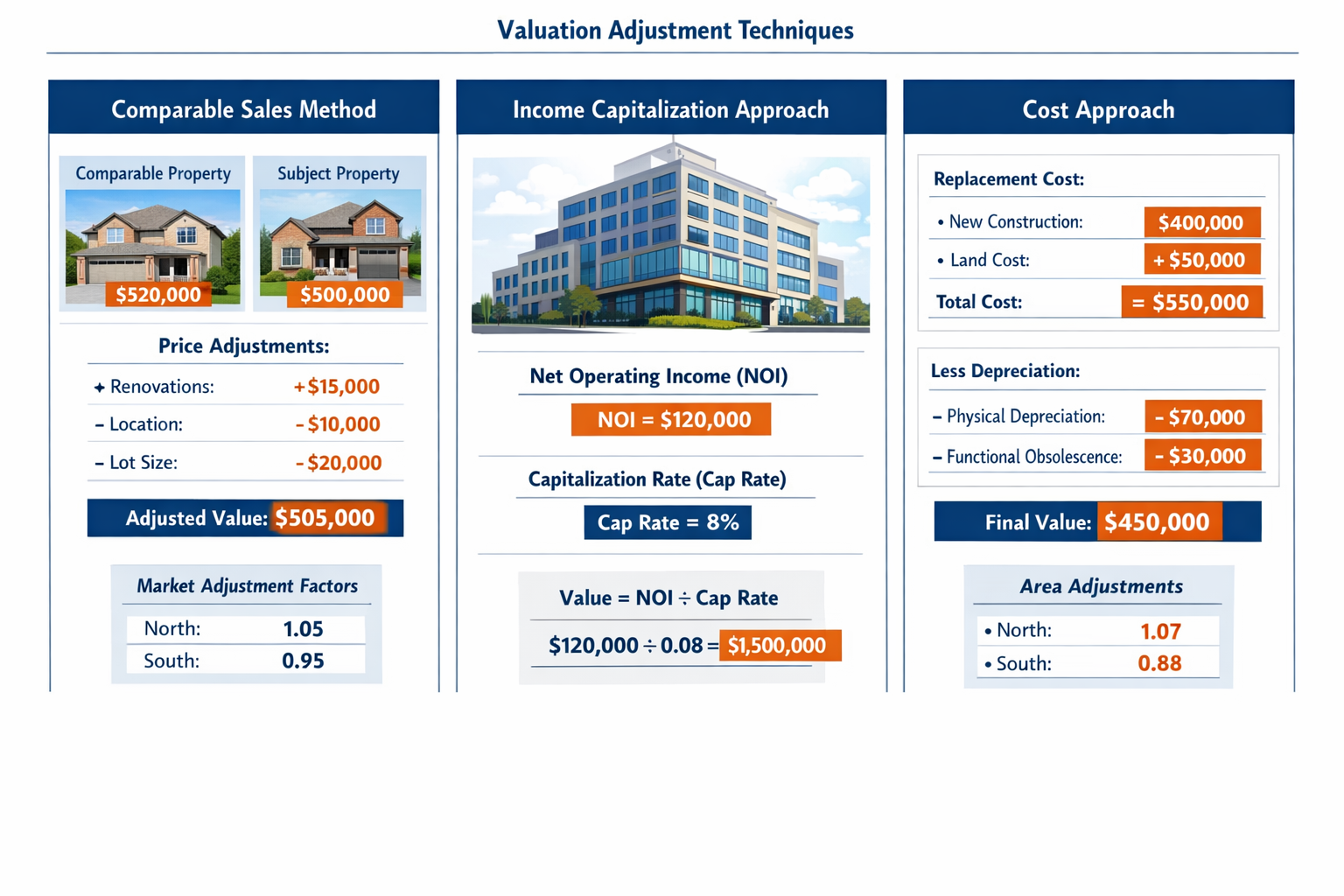
Professional surveyors have developed sophisticated methodologies to address the Valuation Challenges in Diverging Regional Markets: Chartered Surveyor Techniques for Accurate Appraisals as North-South Momentum Varies in 2026. These approaches enhance accuracy while maintaining RICS compliance.
Weighted Comparable Analysis Framework
Traditional comparable analysis assigns equal weight to all selected comparables meeting basic criteria. Advanced practitioners now employ weighted comparable frameworks that assign differential importance based on market relevance factors.
The weighting methodology considers:
Temporal proximity – Recent transactions receive higher weighting, with exponential decay for older comparables. In rapidly diverging markets, a three-month-old comparable may receive 40% less weight than a one-month-old transaction.
Market segment alignment – Comparables from the same regional market segment receive premium weighting even if geographically more distant. A property in Leatherhead may be more relevant for valuing in Esher than a closer property in a different market segment.
Transaction circumstances – Arm's-length transactions between informed parties receive full weighting, while distressed sales, family transactions, or unusual circumstances receive reduced weighting or exclusion.
Property similarity – Comparables with closer physical similarity (size, age, condition) receive higher weighting than those requiring substantial adjustments.
Regional Market Sentiment Integration
Forward-looking valuations must incorporate market sentiment indicators alongside historical transaction data. RICS member surveys provide valuable sentiment metrics, but surveyors should supplement with:
- Days on market trends for comparable properties
- Offer-to-asking price ratios in the local market
- Mortgage approval rates for the region
- New listing volumes indicating supply pressure
- Viewing-to-offer conversion rates from local agents
These indicators help surveyors determine whether recent comparable sales represent peak, trough, or equilibrium pricing—critical for establishing current market value in diverging markets.
Multi-Method Valuation Triangulation
RICS guidance encourages multiple valuation approaches, but this becomes essential rather than optional in fragmented markets. Professional surveyors conducting probate valuations or shared ownership valuations should employ:
Comparable sales approach – Establishes market-derived value through transaction evidence with regional adjustments
Income capitalization approach – Particularly relevant for investment properties, using region-specific yield assumptions
Cost approach – Provides value floor based on replacement cost, useful for unique properties lacking comparables
Regression analysis – Statistical modeling of price determinants using regional transaction databases
The triangulation process involves:
- Conducting each valuation method independently
- Analyzing variance between methods
- Investigating causes of significant divergence
- Weighting methods based on reliability for the specific property type and market conditions
- Arriving at final value conclusion with documented reasoning
Technology-Enhanced Regional Calibration
Modern valuation software enables sophisticated regional calibration that wasn't feasible with manual methods. Leading surveyors utilize:
Automated Valuation Models (AVMs) with regional adjustment layers that continuously update based on new transaction data. While AVMs cannot replace professional judgment, they provide valuable benchmarking for regional trends.
Geographic Information Systems (GIS) that visualize price gradients across regions, helping identify micro-market boundaries and transition zones between diverging regional markets.
Machine learning algorithms that identify non-obvious price determinants and regional interaction effects that traditional analysis might miss.
Real-time market data feeds integrating Land Registry data, mortgage approval statistics, and local economic indicators to inform regional adjustment factors.
Surveyors conducting Level 2 or Level 3 building surveys should integrate these technological tools while maintaining professional skepticism and human oversight.
Regional Risk Premium Assessment
Diverging markets carry different risk profiles that should influence valuation conclusions, particularly for lending purposes. Surveyors must assess:
Liquidity risk – Properties in cooling markets face extended marketing periods and increased price negotiation, affecting achievable sale prices
Volatility risk – Rapidly appreciating markets may experience correction risk that prudent valuations should acknowledge
Economic dependency risk – Markets dependent on single industries or employers carry concentration risk affecting long-term value sustainability
Demographic trend risk – Aging populations, outmigration, or changing household formation patterns impact future demand
These risk factors should inform valuation uncertainty ranges disclosed in reports, particularly for mortgage valuation purposes where lenders require understanding of potential value volatility.
Sector-Specific Valuation Considerations
Different property sectors experience regional divergence differently, requiring tailored valuation approaches.
Residential Property Valuation Adjustments
The residential sector shows the most pronounced regional divergence in 2026. Chartered surveyors in Putney and Battersea observe that properties appealing to commuters face particular valuation pressure as remote work reduces London's gravitational pull.
Property type sensitivity varies by region:
- Family homes in commuter locations experience greatest valuation pressure
- Apartments in urban cores maintain relative stability due to lifestyle appeal
- Luxury properties show bifurcated performance based on international buyer exposure
- First-time buyer properties benefit from Help to Buy schemes and sustained demand
Surveyors should segment their comparable analysis by property type and buyer profile rather than treating residential property as homogeneous.
Commercial Property Regional Dynamics
Commercial valuations face additional complexity from sector-specific trends overlaying regional divergence. Tokyo office properties demonstrate how shorter leases enable landlords to capture inflation through rent growth[1], a dynamic increasingly relevant to UK markets with rising inflation expectations.
Retail property valuations require particular care given the sector's double-digit discount to historical valuations[1]. Surveyors must distinguish between:
- Structural decline in certain retail formats (large format stores)
- Temporary mispricing in well-located convenience retail
- E-commerce competition effects varying by region and demographic
- Experiential retail opportunities in urban centers
Hong Kong's retail recovery experience—tempered by e-commerce competition—provides instructive parallels for UK surveyors assessing retail property recovery trajectories[1].
Industrial and Logistics Property
Industrial property valuations benefit from relatively consistent demand fundamentals across regions, but location-specific factors create valuation variance:
- Last-mile logistics facilities near population centers command premium yields
- Port proximity affects valuations for import/export-dependent operations
- Labor availability in different regions influences occupier demand
- Planning constraints for industrial development vary substantially by local authority
Surveyors valuing industrial property should emphasize functional obsolescence assessment as modern logistics requirements rapidly evolve, making older facilities less competitive regardless of regional market strength.
RICS Compliance and Professional Standards
Navigating regional valuation challenges while maintaining professional standards requires careful attention to RICS requirements.
Red Book Valuation Standards
The RICS Red Book establishes mandatory requirements for valuation practice. Key provisions relevant to regional divergence include:
Basis of value disclosure – Valuers must clearly state whether reporting Market Value, Market Rent, Investment Value, or other bases, with particular care in diverging markets where these may show unusual relationships
Assumptions and special assumptions – Regional market conditions may require special assumptions about marketing periods, buyer profiles, or market trajectory that must be explicitly stated
Departures from standards – If regional market conditions necessitate departure from standard methodology, this must be disclosed and justified
Uncertainty and sensitivity analysis – Diverging markets inherently carry greater uncertainty, requiring appropriate disclosure and potentially sensitivity analysis showing value ranges
Documentation and Audit Trail
Professional surveyors must maintain comprehensive documentation supporting regional adjustments applied in valuations. This includes:
✅ Comparable selection rationale – Why specific comparables were chosen and others rejected
✅ Adjustment calculation methodology – Transparent arithmetic showing how regional, temporal, and property-specific adjustments were derived
✅ Market evidence supporting adjustments – Transaction data, market reports, and economic indicators justifying regional factors
✅ Alternative valuation approaches – Documentation of triangulation process and method weighting decisions
✅ Limiting conditions – Clear statement of valuation limitations and assumptions
This documentation protects surveyors from professional liability claims and demonstrates compliance with professional standards.
Client Communication and Expectation Management
Diverging regional markets create client education opportunities. Many clients lack awareness of regional fragmentation and expect valuations based on outdated assumptions about uniform national markets.
Professional surveyors should:
- Explain regional context early in the engagement process
- Provide comparative market data illustrating regional divergence
- Discuss valuation uncertainty honestly and professionally
- Offer scenario analysis showing value ranges under different market assumptions
- Recommend appropriate survey level based on property and market conditions
Clear communication prevents misunderstandings and enhances client satisfaction even when valuations don't meet expectations.
Practical Implementation Strategies
Chartered surveyors can implement several practical strategies to enhance valuation accuracy in diverging markets.
Building Regional Market Intelligence
Successful navigation of regional valuation challenges requires continuous market intelligence gathering:
📊 Develop regional market databases – Systematically collect and analyze transaction data for each market segment served
📊 Cultivate local agent relationships – Estate agents provide invaluable market sentiment and buyer feedback
📊 Monitor economic indicators – Track employment, wage growth, and demographic trends for each region
📊 Participate in RICS regional groups – Professional networking provides peer insight into regional challenges
📊 Subscribe to market research services – Commercial data providers offer regional analysis supplementing proprietary research
Quality Assurance Processes
Firms should implement quality assurance protocols specifically addressing regional valuation challenges:
- Peer review requirements for valuations crossing regional boundaries
- Regional adjustment factor libraries maintained and updated quarterly
- Valuation variance analysis comparing completed valuations to subsequent sales
- Continuing professional development focused on regional market dynamics
- Technology tool validation ensuring AVM and software outputs align with professional judgment
Cost Considerations for Clients
Clients should understand that accurate valuation in diverging markets may require additional effort reflected in fees. Surveyors should communicate that:
- Extended comparable research across fragmented markets increases time requirements
- Multiple valuation approaches provide greater confidence but require additional analysis
- Regional market research ensures accuracy but adds to professional time
- Detailed documentation protects all parties but increases report preparation time
Transparent discussion of valuation costs prevents misunderstandings and ensures clients appreciate the value of thorough professional work.
Emerging Market Opportunities
Regional divergence creates opportunities for astute surveyors:
Specialization advantages – Surveyors developing deep expertise in specific regional markets can command premium fees and attract clients seeking local knowledge
Advisory services expansion – Beyond traditional valuation, surveyors can offer strategic advice on regional market timing and investment allocation
Institutional client relationships – Large investors and lenders increasingly value surveyors who demonstrate sophisticated regional analysis capabilities
Technology partnership opportunities – Surveyors with regional expertise can collaborate with PropTech firms developing regional valuation tools
Future Outlook and Adaptation Strategies
The Valuation Challenges in Diverging Regional Markets: Chartered Surveyor Techniques for Accurate Appraisals as North-South Momentum Varies in 2026 will likely persist and potentially intensify as structural economic changes continue reshaping UK property markets.
Anticipated Market Evolution
Several trends will influence regional valuation dynamics beyond 2026:
Continued remote work adoption will sustain demand redistribution from expensive urban cores to more affordable regional markets
Infrastructure investment in northern transport networks will further enhance regional competitiveness
Demographic aging will create regional variation in housing demand as retirees relocate to coastal and rural areas
Climate considerations may introduce new regional valuation factors as flood risk, heat stress, and environmental resilience become more prominent
Planning reform could reduce regional supply constraints, affecting price dynamics in historically constrained southern markets
Professional Development Priorities
Chartered surveyors should prioritize several development areas to maintain competence in diverging markets:
🎓 Statistical analysis skills – Understanding regression analysis and data science fundamentals enhances regional adjustment methodology
🎓 Economic literacy – Comprehending macroeconomic drivers of regional divergence improves valuation judgment
🎓 Technology proficiency – Mastering GIS, AVM, and data visualization tools increases analytical capability
🎓 Sector specialization – Deep knowledge of specific property sectors enables more nuanced regional analysis
🎓 Communication skills – Explaining complex regional dynamics to clients requires clear, accessible communication
Regulatory and Standards Evolution
RICS and other professional bodies will likely update guidance to address regional valuation challenges:
- Enhanced regional disclosure requirements in valuation reports
- Standardized regional adjustment methodologies providing consistency across practitioners
- Market uncertainty quantification guidance helping surveyors communicate valuation confidence levels
- Technology use standards governing AVM and algorithm-based valuation tools
- Continuing education requirements ensuring practitioners maintain regional market knowledge
Proactive surveyors should engage with these developments through RICS consultation processes and professional working groups.
Conclusion
The Valuation Challenges in Diverging Regional Markets: Chartered Surveyor Techniques for Accurate Appraisals as North-South Momentum Varies in 2026 represent a fundamental shift in UK property valuation practice. The 42% cooling in London market sentiment contrasted with sustained northern momentum demands that chartered surveyors abandon simplistic national valuation models and embrace sophisticated regional analysis frameworks[7].
Professional surveyors must master weighted comparable analysis, integrate market sentiment indicators, employ multi-method triangulation, and leverage technology-enhanced regional calibration to deliver accurate appraisals. These advanced techniques, combined with rigorous RICS Red Book compliance and transparent client communication, enable surveyors to navigate fragmented markets while maintaining professional standards.
The regional divergence phenomenon extends beyond UK borders, with global REIT valuations at 30% discounts to historical averages and regional cap rates showing material variation across markets[1]. This global context reinforces that regional specialization and sophisticated adjustment methodologies represent not temporary expedients but permanent features of modern valuation practice.
Actionable Next Steps
Property professionals should take immediate action to enhance regional valuation capabilities:
✔️ Audit current valuation processes to identify regional adjustment gaps and improvement opportunities
✔️ Invest in market intelligence systems providing continuous regional market data and analysis
✔️ Develop regional adjustment factor libraries documenting evidence-based modification percentages for each market served
✔️ Enhance technology capabilities through GIS, AVM, and data analytics tool adoption
✔️ Pursue targeted professional development in statistical analysis, economic fundamentals, and regional market dynamics
✔️ Strengthen quality assurance protocols with peer review requirements for cross-regional valuations
✔️ Engage clients proactively about regional market conditions and valuation methodology implications
The chartered surveyors who master these regional valuation challenges will not merely survive market fragmentation—they will thrive by delivering superior accuracy, maintaining professional credibility, and capturing opportunities that regional divergence creates. The techniques outlined in this analysis provide the foundation for that success in 2026 and beyond.
References
[1] 2026 Global Reits Outlook Regional Divergence And Sector Opportunities – https://www.centersquare.com/insights/2026-global-reits-outlook-regional-divergence-and-sector-opportunities/
[3] Private Markets Outlook 2026 – https://www.partnersgroup.com/en/news-and-views/perspective/private-markets-outlook-2026
[4] Public Markets 2026 – https://am.gs.com/en-lu/advisors/insights/article/investment-outlook/public-markets-2026
[7] Building Survey Market Sentiment In Early 2026 Navigating Regional Price Divergence And Buyer Uncertainty – https://nottinghillsurveyors.com/blog/building-survey-market-sentiment-in-early-2026-navigating-regional-price-divergence-and-buyer-uncertainty
