
The surveying profession stands at a pivotal crossroads. As artificial intelligence transforms how building defects are detected, valuations are calculated, and structural assessments are delivered, one question dominates boardrooms across the UK: How can surveyors harness AI's power without compromising professional integrity? 🏗️
The answer arrived in March 2026, when the RICS Professional Standard on Responsible AI Use in Building Surveys: Ethical Protocols for 2026 Practice officially came into effect. This groundbreaking standard represents the first comprehensive regulatory framework governing AI deployment in surveying services worldwide[3]. For building surveyors conducting Level 3 building surveys or comprehensive condition assessments, understanding these protocols isn't optional—it's essential for continued practice.
Published in September 2025 and implemented six months later, this standard establishes clear boundaries for AI integration while preserving the irreplaceable value of human expertise[2]. Whether you're a chartered surveyor evaluating adoption strategies or a property owner seeking to understand how AI affects your survey report, this guide provides the complete roadmap for ethical AI implementation in 2026 surveying practice.
Key Takeaways
- Professional judgement cannot be replaced: AI must support, never substitute, qualified surveyor decision-making, with named professionals accountable for all material outputs[2][4]
- Mandatory governance frameworks: RICS-regulated firms using AI must implement written policies, risk registers, and system assessments before deployment[1][2]
- Client transparency is non-negotiable: Written disclosure of AI use must occur before work commences, including how clients can challenge AI-influenced findings[4]
- Data privacy requires explicit consent: Confidential information cannot be uploaded to AI systems without advance written client permission and acceptable risk assessment[4]
- Material impact assessment is required: Firms must determine and document in writing whether AI use materially affects service delivery quality[1]
Understanding the RICS Professional Standard on Responsible AI Use in Building Surveys: Core Principles
The Foundation: AI as Support, Not Replacement
The cornerstone principle of the RICS Professional Standard on Responsible AI Use in Building Surveys: Ethical Protocols for 2026 Practice is unambiguous: artificial intelligence should support, but never replace, professional judgement[2]. This principle addresses a growing concern within the profession—automation bias, where practitioners assume information "must be true because the computer says it's true"[3].
For surveyors conducting construction surveys or dilapidations assessments, this means AI-generated defect detection or cost estimates must undergo rigorous professional verification. The standard embeds professional scepticism throughout, requiring surveyors to actively question, validate, and take personal responsibility for all outputs.
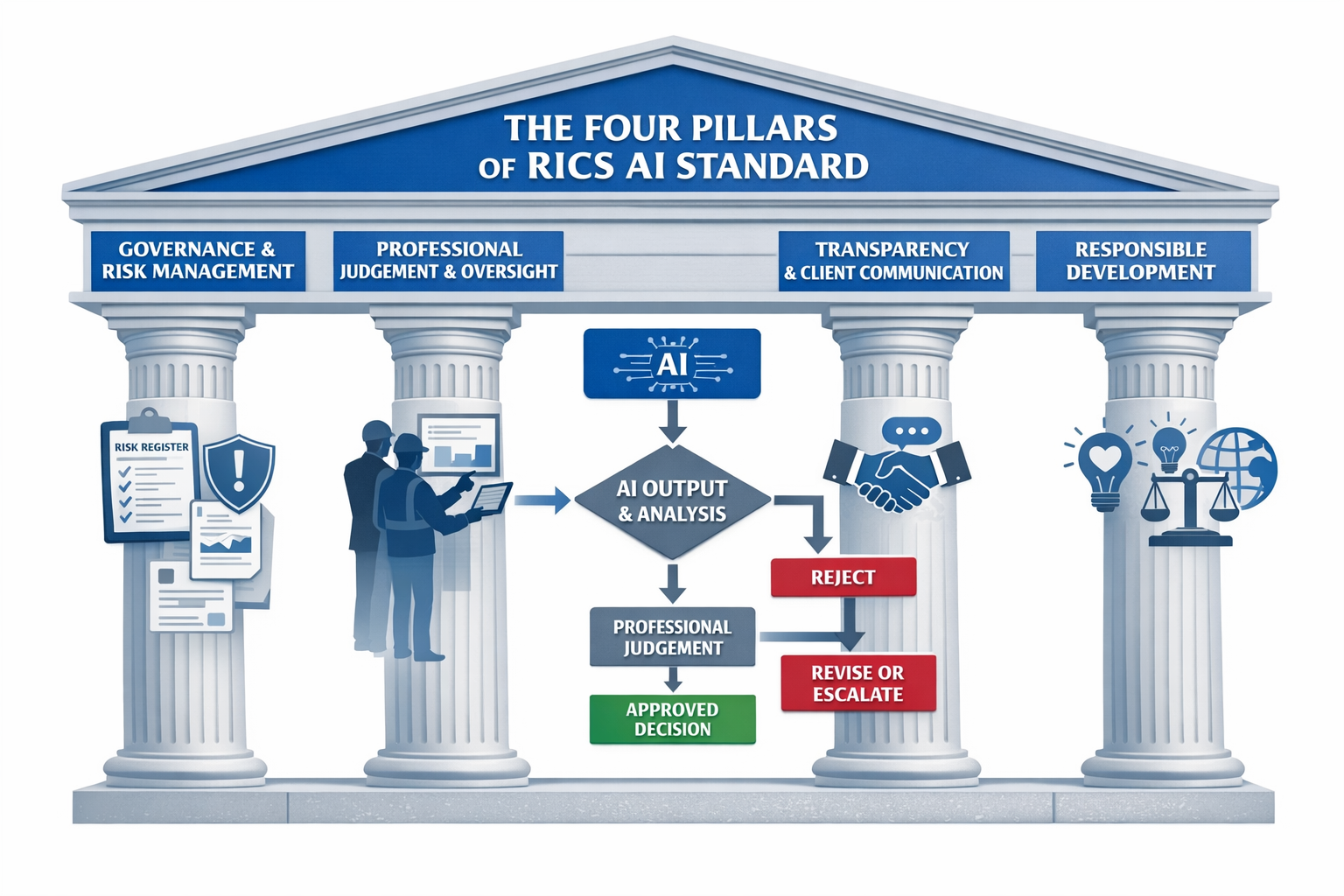
The Four Core Requirements Areas
The RICS standard establishes requirements across four interconnected domains[3][8]:
| Core Area | Key Requirements | Practical Application |
|---|---|---|
| Governance & Risk Management | Risk registers, AI use policies, system assessments | Document all AI systems, assess risks before deployment |
| Professional Judgement & Oversight | Named surveyor accountability, output verification | Qualified professional must validate all material AI outputs |
| Transparency & Client Communication | Pre-work disclosure, challenge mechanisms | Written notification to clients before AI use begins |
| Responsible Development | Ethical procurement, environmental impact, stakeholder effects | Assess why AI is most appropriate tool for each use case |
These requirements create a comprehensive framework ensuring AI enhances rather than undermines professional standards in building surveys.
Why This Standard Matters in 2026
The timing of this standard reflects surveying's rapid technological evolution. As data analytics, digital information modelling, and automated defect detection become embedded in RICS home surveys, the profession needed clear guidance balancing innovation with accountability.
Industry reception has been overwhelmingly positive, with experts describing it as a balanced response to rapid technological change[2]. Many practitioners acknowledge that AI adoption is increasingly unavoidable—making ethical frameworks not just desirable but essential for maintaining public trust.
"The standard ensures that as AI becomes more prevalent in surveying practice, the fundamental principles of professional responsibility, client service, and ethical conduct remain paramount." — RICS Official Statement[3]
Implementing the RICS Professional Standard on Responsible AI Use in Building Surveys: Practical Compliance Steps
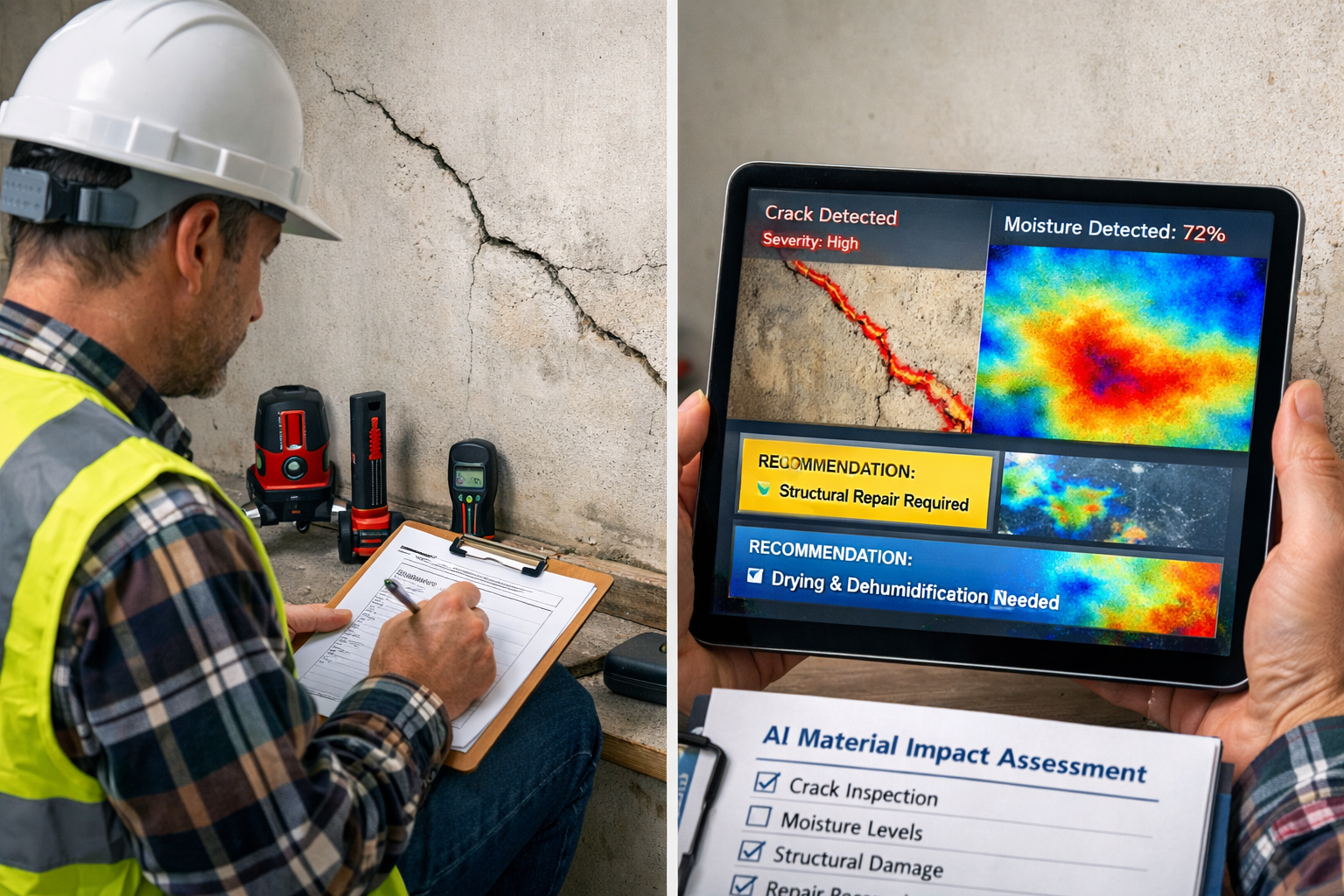
Step 1: Establish Governance Frameworks and Risk Registers
RICS-regulated firms that use or intend to use AI systems must develop and implement responsible AI use policies informed by a risk register[1][2]. This isn't a one-time exercise but an ongoing governance commitment.
Essential governance components include:
- 📋 Written AI Use Policy: Document your firm's approach to AI deployment, acceptable use cases, and prohibited applications
- ⚠️ Comprehensive Risk Register: Identify potential risks associated with each AI system, including accuracy limitations, data privacy concerns, and bias potential
- 🔍 Due Diligence Framework: Establish processes for evaluating AI vendors, systems, and tools before adoption
- 📊 Regular Review Mechanisms: Schedule periodic assessments of AI system performance and policy effectiveness
For firms conducting building surveys across London, this means documenting how AI tools for thermal imaging analysis, structural defect detection, or valuation support are assessed, approved, and monitored.
Step 2: Conduct Material Impact Assessments
A critical requirement under the RICS Professional Standard on Responsible AI Use in Building Surveys: Ethical Protocols for 2026 Practice is determining whether AI use has had a material impact on service delivery[1].
Material impact exists when AI:
- Influences final conclusions or recommendations in survey reports
- Affects valuation figures or condition ratings
- Shapes defect identification or severity assessments
- Impacts timeline, scope, or methodology of surveying services
When material impact is established, firms must record this determination and the reasoning behind it in writing[1]. This documentation serves as both compliance evidence and professional accountability trail.
Step 3: Complete System Governance Assessments
Before deploying any AI system for material use in building surveys, firms must take and record system governance assessment steps[1]. This process ensures appropriate scrutiny before technology integration.
Pre-deployment assessment checklist:
✅ Purpose Justification: Document why AI is the most appropriate tool for this specific application
✅ Capability Evaluation: Assess whether the AI system possesses necessary accuracy, reliability, and functionality
✅ Risk Analysis: Identify potential failure modes, accuracy limitations, and bias sources
✅ Data Requirements: Evaluate data quality, volume, and privacy implications
✅ Alternative Consideration: Document why traditional methods are insufficient or less appropriate
✅ Vendor Due Diligence: Verify provider credentials, system testing, and support capabilities
For surveyors evaluating AI tools for drone surveys or automated defect detection, this systematic assessment prevents premature adoption of inadequately tested technologies.
Step 4: Assign Named Surveyor Accountability
Perhaps the most significant requirement is that a named, appropriately qualified surveyor must take responsibility for reliability decisions on material AI outputs[4]. This cannot be delegated to junior staff, administrative personnel, or automated processes.
Accountability requirements include:
- 👤 Named Professional: Designate specific RICS-qualified surveyor responsible for each AI-assisted project
- 📝 Written Assessment: Document the named surveyor's verification of AI outputs
- 🔄 Sampling Protocols: Where AI use is automated or high-volume, implement statistically valid sampling for assurance
- ✍️ Personal Sign-Off: Named surveyor must personally approve final reports incorporating AI-generated content
This requirement ensures that even when AI assists with Level 3 house surveys, a qualified professional maintains ultimate responsibility for accuracy and reliability.
Step 5: Implement Data Privacy and Confidentiality Protocols
The standard establishes strict requirements for handling private and confidential data. Private and confidential data must not be uploaded to AI systems unless express written consent has been obtained in advance and the firm is satisfied the risk is acceptable[4].
Data protection protocol essentials:
🔒 Client Consent: Obtain explicit written permission before uploading property details, financial information, or personal data to AI systems
🛡️ Risk Assessment: Evaluate data security measures, storage locations, and third-party access risks
🌍 Environmental Impact: Consider the broader implications of AI system energy consumption and carbon footprint
👥 Stakeholder Effects: Assess how AI use affects property owners, tenants, and other parties
For firms handling sensitive information during dilapidations surveys, these protocols protect both client confidentiality and professional liability exposure.
RICS Professional Standard on Responsible AI Use in Building Surveys: Client Communication and Transparency Requirements
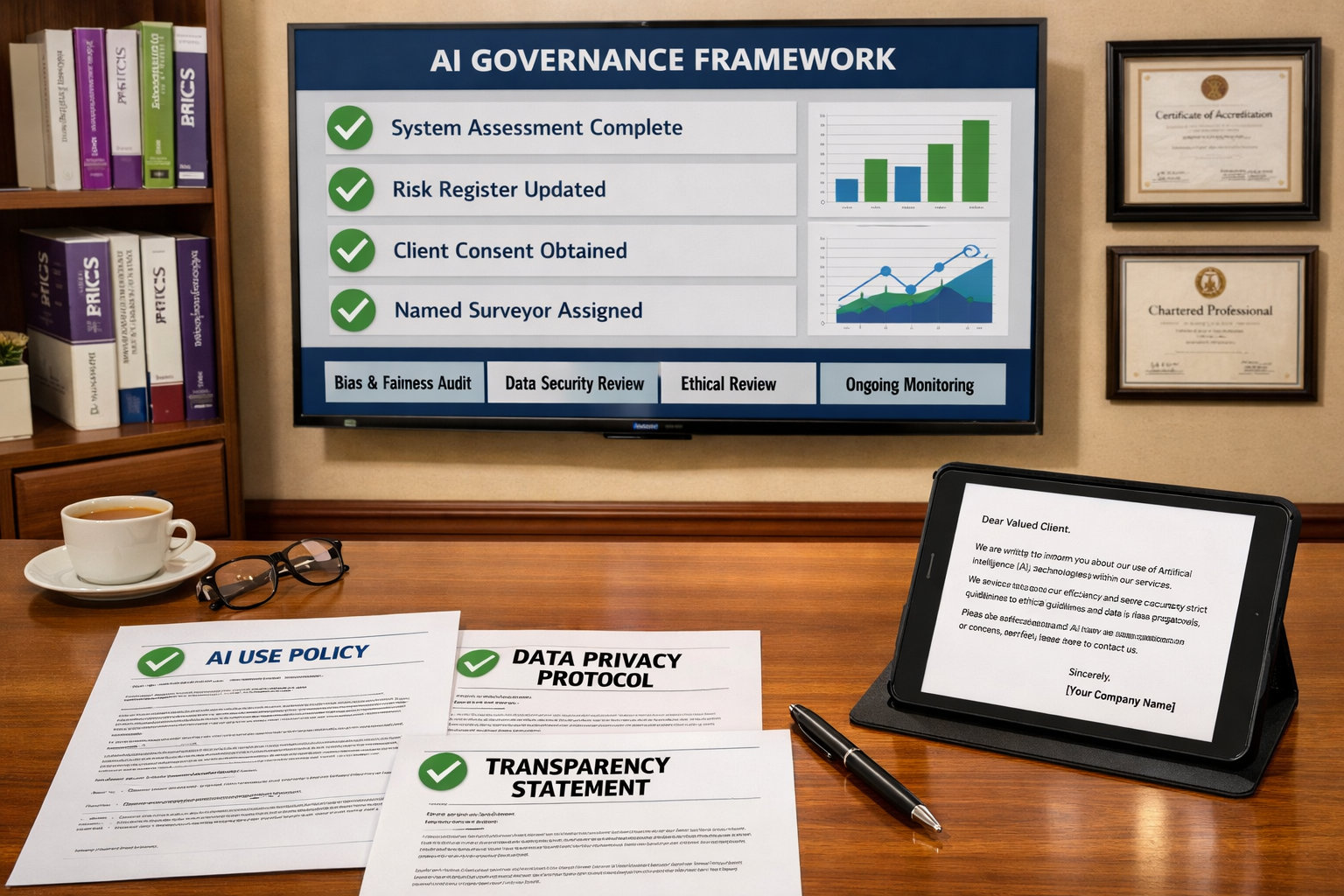
Mandatory Pre-Work Disclosure
One of the most client-focused aspects of the RICS Professional Standard on Responsible AI Use in Building Surveys: Ethical Protocols for 2026 Practice is the transparency requirement. Clients must be informed in writing before work begins when AI will shape the service they're receiving[2][4].
Effective disclosure communications should include:
- 🔔 Clear AI Use Statement: Explain which aspects of the survey will involve AI assistance
- 🎯 Purpose Explanation: Describe why AI is being used and what benefits it provides
- ⚙️ Methodology Overview: Outline how AI tools will be applied and what they will analyze
- 👨💼 Human Oversight Assurance: Emphasize that qualified professionals will verify all AI outputs
- 📞 Challenge Mechanism: Provide clear process for clients to question or challenge AI-influenced findings
For property buyers commissioning homebuyers surveys, this transparency builds trust while setting appropriate expectations about technology's role in their survey.
Sample Client Disclosure Statement
Example disclosure language for building survey engagement letters:
"This survey will utilize AI-assisted thermal imaging analysis and automated defect detection software to enhance the comprehensiveness of our inspection. All AI-generated findings will be reviewed, verified, and validated by [Named Surveyor], a qualified RICS professional with [X] years of experience. The final report reflects professional judgement informed by, but not dependent upon, AI tools. You have the right to question any findings and request additional human verification of specific areas of concern."
Challenge and Verification Rights
The standard requires firms to establish clear mechanisms for clients to challenge AI-influenced findings. This might include:
- Secondary Review: Option for different surveyor to re-examine specific findings
- Traditional Methodology: Alternative assessment using conventional techniques
- Detailed Explanation: Written justification for AI-supported conclusions
- Independent Verification: Third-party testing or analysis of questioned areas
These protections ensure clients maintain agency and confidence in survey outcomes, even when advanced technology contributes to the process.
Practical Application: AI Ethics in Valuations and Defect Detection
AI-Assisted Valuation Protocols
When AI tools support property valuations, the RICS Professional Standard on Responsible AI Use in Building Surveys: Ethical Protocols for 2026 Practice requires particularly rigorous oversight. Automated valuation models (AVMs) can process comparable sales data at scale, but professional judgement remains essential for:
- Market Context Interpretation: Understanding local market dynamics, emerging trends, and neighbourhood characteristics
- Property-Specific Adjustments: Accounting for unique features, condition variations, and special circumstances
- Assumption Validation: Verifying that AI-generated comparables are genuinely similar and relevant
- Limitation Recognition: Identifying when market conditions, property types, or data gaps make AI valuations unreliable
For RICS reinstatement cost valuations or matrimonial valuations, surveyors must document how AI-assisted analysis was verified and what professional adjustments were applied.
Defect Detection and Condition Assessment
AI-powered image recognition and thermal analysis tools increasingly assist with defect identification during building surveys. Ethical deployment requires:
Pre-Survey Planning:
- Define which defect types AI will assist with identifying
- Establish confidence thresholds for automated detection
- Plan manual verification protocols for AI-flagged issues
During Inspection:
- Use AI tools to enhance, not replace, physical inspection
- Manually verify all AI-detected defects
- Document areas where AI and professional assessment differ
Report Preparation:
- Clearly attribute findings to professional observation vs. AI assistance
- Explain severity ratings based on professional judgement
- Include limitations of AI analysis in report caveats
Surveyors conducting specific defect reports must ensure AI tools complement rather than compromise thorough professional investigation.
Compliance Checklist: Implementing RICS AI Standards in Your Practice
For RICS-Regulated Firms
✅ Governance and Policy (Complete Before AI Deployment)
- Develop written AI use policy aligned with RICS standard
- Create comprehensive risk register for all AI systems
- Establish procurement and due diligence procedures
- Designate responsible person for AI governance oversight
- Schedule regular policy review and update cycles
✅ System Assessment (For Each AI Tool)
- Document purpose and justification for AI use
- Record system governance assessment steps
- Evaluate vendor credentials and system testing
- Assess data privacy and security measures
- Determine material impact on service delivery
✅ Professional Oversight (For Each Project)
- Assign named, qualified surveyor for AI output verification
- Implement written assessment or sampling protocols
- Establish verification procedures for high-volume AI use
- Document professional validation of AI-generated content
- Maintain audit trail of accountability decisions
✅ Client Communication (Before Work Commences)
- Provide written disclosure of AI use in engagement letters
- Explain how AI will be applied and verified
- Establish clear challenge and verification mechanisms
- Obtain explicit consent for confidential data use
- Document all client communications regarding AI
✅ Data Protection and Ethics
- Secure written consent before uploading private data to AI systems
- Assess and document acceptable risk levels
- Consider environmental impact of AI system use
- Evaluate stakeholder effects and fairness implications
- Implement data minimization and retention policies
For Individual Surveyors
Personal Responsibility Checklist:
- Understand your firm's AI use policy and compliance requirements
- Never delegate professional judgement to AI systems
- Verify all material AI outputs through personal assessment
- Document your verification process and professional conclusions
- Maintain professional scepticism toward AI-generated information
- Continue professional development in AI capabilities and limitations
- Advocate for appropriate AI use within your organization
Common Challenges and Solutions
Challenge 1: Determining "Material Impact"
Issue: Firms struggle to define when AI use materially affects service delivery.
Solution: Apply this test—if removing AI from the process would significantly change your conclusions, timeline, or methodology, impact is likely material. Document your reasoning in writing[1].
Challenge 2: Balancing Efficiency with Oversight
Issue: AI promises efficiency gains, but verification requirements seem time-consuming.
Solution: Implement risk-based sampling for high-volume AI use. Focus intensive verification on high-risk, high-value, or unusual findings while using statistical sampling for routine outputs[4].
Challenge 3: Client Resistance to AI Disclosure
Issue: Some clients express concern when informed about AI use in their survey.
Solution: Frame AI as an enhancement tool that enables more comprehensive analysis while emphasizing that qualified professionals maintain ultimate responsibility. Transparency builds trust more effectively than concealment[2].
Challenge 4: Vendor Transparency Limitations
Issue: AI vendors may not disclose sufficient detail about system training, limitations, or accuracy rates.
Solution: Make vendor transparency a procurement requirement. If vendors cannot provide adequate documentation for due diligence, consider alternative providers or traditional methodologies[4].
Future Implications: AI Standards Evolution Beyond 2026
The RICS Professional Standard on Responsible AI Use in Building Surveys: Ethical Protocols for 2026 Practice represents the beginning, not the conclusion, of AI governance in surveying. As technology evolves, expect:
Emerging Developments:
- 🔄 Regular Standard Updates: RICS will likely revise requirements as AI capabilities and risks evolve
- 📚 Expanded Guidance: Sector-specific guidance for specialized survey types and AI applications
- 🎓 Enhanced CPD Requirements: Continuing professional development focused on AI competency and ethics
- 🤝 International Harmonization: Coordination with other professional bodies on AI standards
- ⚖️ Regulatory Integration: Potential incorporation of AI standards into broader regulatory frameworks
Surveyors who embrace these ethical protocols position themselves as trusted advisors capable of leveraging technology responsibly while maintaining the professional integrity that distinguishes chartered practice from automated services.
Conclusion
The RICS Professional Standard on Responsible AI Use in Building Surveys: Ethical Protocols for 2026 Practice establishes a comprehensive framework balancing innovation with accountability. By requiring governance structures, professional oversight, client transparency, and ethical development practices, the standard ensures AI enhances rather than undermines surveying excellence.
For building surveyors, compliance isn't merely regulatory obligation—it's professional opportunity. Firms that implement these protocols demonstrate commitment to quality, transparency, and client service that distinguishes them in an increasingly competitive market. Whether conducting Level 3 building surveys, valuations, or specialized assessments, ethical AI integration preserves the irreplaceable value of professional judgement while harnessing technology's analytical power.
Actionable Next Steps
For Firms:
- Audit current AI use across all service lines and document material impacts
- Develop comprehensive AI governance policy aligned with RICS requirements
- Implement risk registers for all existing and planned AI systems
- Train all surveyors on standard requirements and compliance procedures
- Update engagement letters to include required client disclosures
For Individual Surveyors:
- Review your firm's AI policy and understand your personal responsibilities
- Maintain professional scepticism toward all AI-generated outputs
- Document your verification process for AI-assisted work
- Pursue CPD opportunities focused on AI capabilities and limitations
- Advocate for ethical AI use within your professional community
The future of building surveys lies not in choosing between human expertise and artificial intelligence, but in combining both responsibly. The RICS standard provides the roadmap—implementation determines success.
References
[1] Ai Responsible Use Standard – https://ww3.rics.org/uk/en/journals/construction-journal/ai-responsible-use-standard.html
[2] Rics Introduces Global Standard For The Responsible Use Of Ai In Surveying – https://www.eddisons.com/news/rics-introduces-global-standard-for-the-responsible-use-of-ai-in-surveying
[3] Rics First Ever Standard On Responsible Ai Use Now In Effect – https://www.rics.org/news-insights/rics-first-ever-standard-on-responsible-ai-use-now-in-effect
[4] Rics Responsible Ai Standard Surveying Practice – https://thekeegansgroup.com/insight/rics-responsible-ai-standard-surveying-practice
[5] Responsible Use Of Ai – https://www.rics.org/profession-standards/rics-standards-and-guidance/conduct-competence/responsible-use-of-ai
[6] Navigating The New Rics Ai Standard What It Means For Surveyors – https://www.artefact.com/blog/navigating-the-new-rics-ai-standard-what-it-means-for-surveyors/
[7] Rics Introduces Mandatory Ai Standard For Surveyors What Insurers And Their Clients Need To Know – https://cms.law/en/gbr/legal-updates/rics-introduces-mandatory-ai-standard-for-surveyors-what-insurers-and-their-clients-need-to-know
[8] Rics Global Standard Responsible Use Of Ai In Surveying Practice – https://www.rlb.com/europe/insight/rics-global-standard-responsible-use-of-ai-in-surveying-practice/
[9] Rics Global Standard On Responsible Ai Use In Surveying Practice Now In Effect – https://www.lexisnexis.co.uk/legal/news/rics-global-standard-on-responsible-ai-use-in-surveying-practice-now-in-effect
