
The surge in student numbers across UK university towns has triggered an unprecedented wave of property conversions and expansions. As developers and landlords race to meet demand, one critical legal requirement often determines project success or failure: compliance with the Party Wall etc. Act 1996. Understanding Party Wall Act Essentials for Student Accommodation Expansions: Survey Protocols in 2026 University Town Revivals has become crucial for anyone involved in student housing development, particularly as regulatory frameworks evolve and enforcement tightens.
The current landscape presents unique challenges. Rising student populations, combined with limited available housing stock, have pushed developers toward high-density conversions of existing terraced properties—precisely the type of work that triggers party wall requirements. With updated RICS guidance and heightened scrutiny from local authorities in 2026, getting party wall procedures right from the outset isn't just good practice—it's essential for avoiding costly disputes and project delays.
Key Takeaways
- Student accommodation expansions in university towns typically involve extensive party wall works, requiring formal notices and professional surveyor appointments under the Party Wall etc. Act 1996
- Survey protocols in 2026 demand comprehensive schedules of condition, detailed photographic evidence, and compliance with updated RICS guidance to protect all parties involved
- Early engagement with adjoining owners and proper notice periods (typically 2 months for major works) can prevent disputes and project delays in high-density student housing areas
- Professional party wall surveyors play a critical role in creating legally binding awards that specify work parameters, timelines, and dispute resolution mechanisms
- Cost responsibilities for party wall procedures generally fall on the building owner (developer), but proper documentation protects against future liability claims
Understanding the Party Wall Act Framework for Student Housing Projects
The Party Wall etc. Act 1996 provides the legal framework governing building works that affect shared walls, boundaries, and structures between properties. For student accommodation developments, this legislation becomes particularly relevant given the typical configuration of university town housing stock.
What Triggers Party Wall Requirements? 🏗️
Student accommodation projects commonly involve several types of work that activate party wall obligations:
Type 1: Work Directly to Party Walls
- Cutting into party walls for new doorways or service runs
- Inserting damp-proof courses through shared structures
- Raising party walls to accommodate additional floors
- Underpinning party walls for structural stability
Type 2: New Walls on Boundary Lines
- Constructing new party walls when extending properties
- Building walls astride the boundary between adjoining properties
- Creating separating walls in subdivided conversions
Type 3: Excavation Near Neighbouring Properties
- Digging foundations within 3 meters of adjoining structures
- Excavating within 6 meters if going deeper than neighbouring foundations
- Basement conversions for additional student accommodation space
The complexity increases in university towns where Victorian and Edwardian terraced properties dominate. These buildings often share walls with multiple neighbours, meaning a single conversion project might require notices to several adjoining owners simultaneously.
The Legal Notice Process Explained
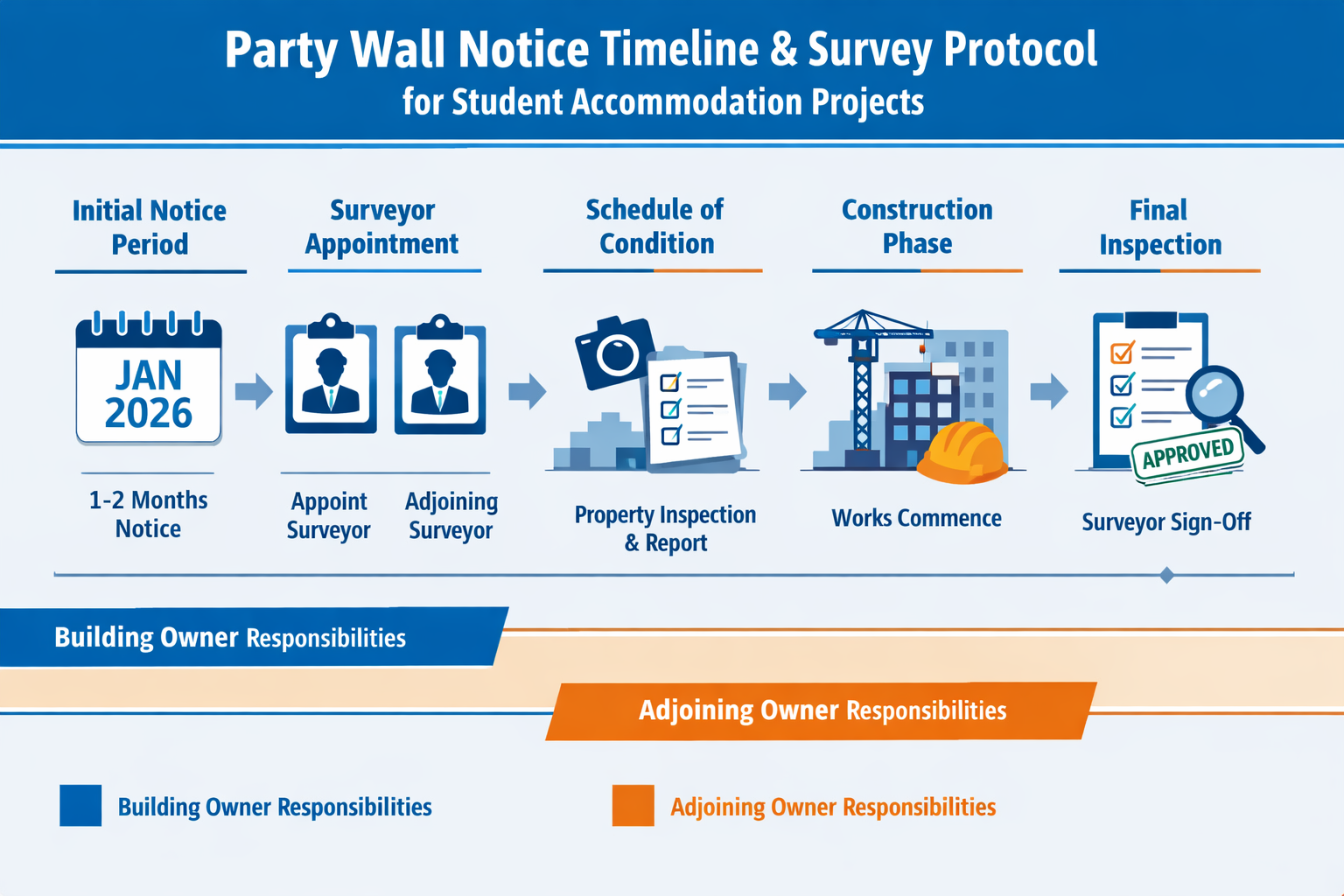
Compliance begins with serving proper notice to adjoining owners. The party wall notice requirements specify different notice periods depending on work type:
| Work Type | Notice Period | Key Requirements |
|---|---|---|
| Party Structure Notice | 2 months | Detailed plans, work description, start date |
| Party Wall Notice | 1 month | Structural alterations, raising walls |
| Excavation Notice | 1 month | Depth, proximity to boundary, foundation details |
Adjoining owners have 14 days to respond. They can either consent to the works or dissent, triggering the appointment of party wall surveyors. In student accommodation projects, where multiple properties share boundaries, coordinating these timelines becomes a critical project management task.
Party Wall Act Essentials for Student Accommodation Expansions: Survey Protocols and Best Practices
When developing student accommodation in 2026, survey protocols have evolved to address the specific challenges of high-density conversions and multi-unit developments. Professional party wall surveyors now follow enhanced procedures that reflect both RICS updates and lessons learned from recent university town projects.
The Pre-Construction Survey: Schedule of Condition
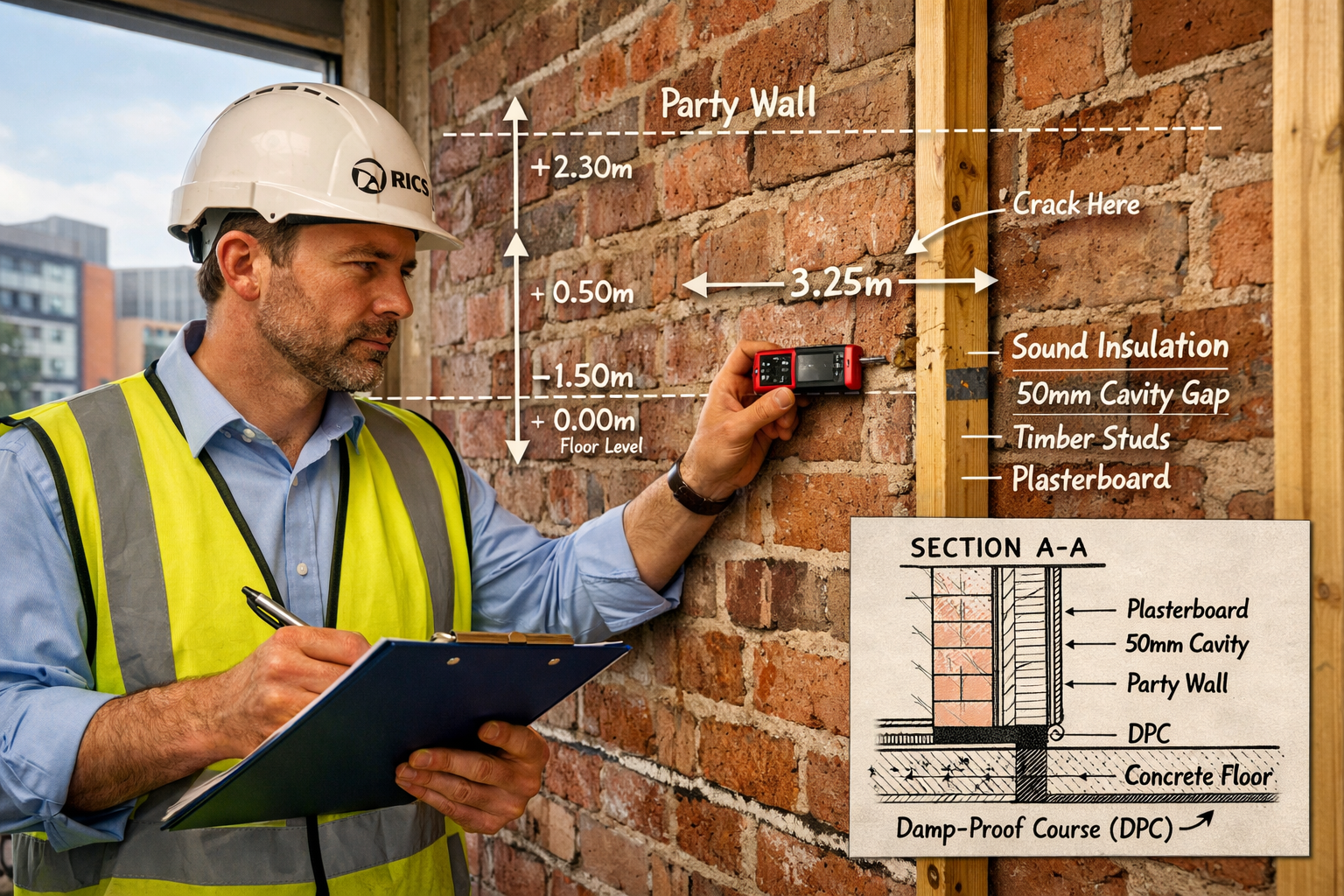
The schedule of condition represents the most critical protective measure for all parties involved. This comprehensive survey documents the existing state of adjoining properties before any work commences, establishing a baseline for assessing potential damage claims.
Essential Elements of a Robust Schedule of Condition:
✅ Photographic Evidence: High-resolution images of all rooms, external elevations, and shared structures
✅ Detailed Written Descriptions: Room-by-room condition notes, including existing cracks, settlement, and defects
✅ Structural Assessment: Evaluation of wall stability, foundation condition, and load-bearing capacity
✅ Services Documentation: Location and condition of utilities running through or near party walls
✅ Dated and Signed Records: Timestamped evidence agreed upon by all parties
In student accommodation conversions, surveyors must pay particular attention to existing damage that might be attributed incorrectly to new works. University town properties often exhibit settlement cracks, historic alterations, and wear from previous student occupancy—all of which must be clearly documented.
Survey Protocols Specific to Multi-Unit Student Developments
The conversion of single-family homes into Houses in Multiple Occupation (HMOs) or purpose-built student accommodation (PBSA) introduces additional survey considerations:
Fire Safety Integration 🔥
Party wall awards must now explicitly address fire safety requirements, particularly the maintenance of fire-resistant compartmentation between units. Surveyors document existing fire barriers and specify how party wall works will maintain or enhance fire protection.
Sound Insulation Standards 🔊
With multiple student tenants in close proximity, acoustic performance becomes paramount. Modern survey protocols include noise transmission testing and specifications for sound insulation improvements during party wall works.
Structural Loading Assessments
Converting properties to accommodate more occupants increases floor loading. Surveyors must assess whether party walls can support additional structural demands, particularly when adding extra floors or reconfiguring internal layouts.
The Party Wall Award: Legal Protection for All Parties
When adjoining owners dissent (or fail to respond to notices), surveyors prepare a party wall award—a legally binding document that governs how works proceed. Understanding what party wall surveyors do in creating these awards is essential for student accommodation developers.
Critical Components of a Party Wall Award:
- Work Description: Precise specifications of permitted alterations to party structures
- Access Rights: Terms for surveyors and contractors to inspect adjoining properties
- Working Hours: Restrictions on noisy work (crucial near student study periods)
- Protective Measures: Required precautions to prevent damage
- Dispute Resolution: Procedures for addressing disagreements during construction
- Cost Allocation: Clear statement of who pays for surveys and remedial works
In university town contexts, awards increasingly include provisions for academic calendar considerations. Developers may face restrictions during examination periods or requirements to complete disruptive works during vacation breaks.
Navigating Party Wall Act Essentials for Student Accommodation Expansions: Survey Protocols in 2026 University Town Revivals
The revival of university towns in 2026 has created a unique regulatory environment where student accommodation demand intersects with heritage conservation, community concerns, and evolving housing legislation. Recent developments, including the Renters Rights Act, have added new dimensions to party wall considerations [1][2].
The 2026 University Town Context
University towns across the UK are experiencing simultaneous pressures:
Enrollment Growth 📈
Post-pandemic recovery has driven student numbers to record levels, with many institutions expanding by 10-15% since 2023. This surge has intensified competition for accommodation near campus areas.
Housing Stock Constraints
Local planning authorities have tightened Article 4 directions limiting HMO conversions in many university neighbourhoods, forcing developers to maximize existing permitted properties through extensions and internal reconfigurations—works that invariably trigger party wall requirements.
Community Tensions
Resident concerns about "studentification" have led to increased scrutiny of development projects. Proper party wall procedures, including respectful engagement with neighbours, have become essential for maintaining community relations and securing planning approvals.
Regulatory Updates Affecting Survey Protocols
The Renters Rights Act, which received Royal Assent in early 2026, introduces changes relevant to student accommodation providers [1][2][3]. While the Act primarily addresses tenancy agreements, it has indirect implications for party wall procedures:
Enhanced Tenant Protections
Student tenants now have stronger rights regarding property condition and maintenance. This elevates the importance of comprehensive schedules of condition, as disputes about pre-existing versus construction-related damage could involve both landlords and tenants.
Purpose-Built Student Accommodation (PBSA) Exemptions
The Act maintains certain exemptions for PBSA, but developers must demonstrate proper management standards [3]. Party wall awards that include robust damage prevention and remediation protocols support compliance with these standards.
Transitional Period Considerations
With the Act's phased implementation through 2026-2027, developers must navigate overlapping regulatory frameworks [3]. Party wall procedures that exceed minimum requirements provide additional protection during this transitional period.
Best Practices for Dispute Prevention
Resolving party wall disputes consumes time and money that student accommodation projects can ill afford. Prevention strategies include:
Early Stakeholder Engagement 🤝
- Meet with adjoining owners before formal notices
- Explain project benefits and mitigation measures
- Address concerns proactively
- Provide direct contact information for project managers
Transparent Communication
- Share detailed plans and timelines
- Offer regular construction updates
- Respond promptly to neighbour queries
- Document all interactions
Professional Survey Standards
- Appoint RICS-qualified party wall surveyors with student accommodation experience
- Ensure surveyors understand local authority requirements
- Request comprehensive photographic schedules
- Verify surveyor professional indemnity insurance
Contingency Planning
- Build party wall timelines into project schedules
- Budget adequately for survey costs (typically £700-£1,500 per adjoining owner)
- Prepare alternative construction methods if disputes arise
- Maintain financial reserves for potential remedial works
Cost Considerations and Financial Planning
Understanding who pays for party wall surveyors is crucial for accurate project budgeting. The building owner (developer) typically bears all reasonable costs:
Typical Cost Breakdown for Student Accommodation Projects:
- Building Owner's Surveyor: £1,000-£2,000 per award
- Adjoining Owner's Surveyor: £700-£1,500 per adjoining owner
- Schedule of Condition: £300-£800 per property
- Party Wall Award Preparation: £500-£1,000
- Dispute Resolution (if needed): £2,000-£5,000+
For a typical terraced house conversion with two adjoining properties, total party wall costs might range from £4,000-£8,000. Larger PBSA developments with multiple boundaries can exceed £20,000 in survey fees alone.
Common Pitfalls to Avoid ⚠️
Student accommodation developers frequently encounter these party wall challenges:
Insufficient Notice Periods
Rushing notice service to meet construction deadlines often backfires. Adjoining owners who feel pressured are more likely to dissent and demand formal awards, extending timelines beyond the original schedule.
Inadequate Documentation
Poorly prepared schedules of condition leave developers vulnerable to spurious damage claims. In student areas where properties may already show wear, comprehensive photographic evidence is essential.
Ignoring Party Wall FAQs
Many developers underestimate the Act's scope, assuming minor works don't require notices. Even small penetrations through party walls for services trigger formal requirements.
Failing to Secure Access
Party wall awards grant surveyors and contractors access rights to adjoining properties for inspections. Developers who don't enforce these rights may face difficulties proving they've fulfilled protective obligations.
Overlooking No Party Wall Agreement Consequences
Proceeding without proper party wall procedures can result in injunctions halting construction, damage claims, and difficulties selling or refinancing completed developments.
Integrating Party Wall Procedures with Broader Development Requirements
Student accommodation projects involve multiple regulatory frameworks that intersect with party wall obligations. Successful developers integrate these requirements into unified project management approaches.
Coordination with Planning and Building Control
Party wall procedures run parallel to, but separate from, planning permission and building regulations approval. However, coordination yields benefits:
Timing Alignment
Serve party wall notices during planning application periods. If planning approval takes 8-12 weeks, party wall procedures can progress simultaneously, avoiding sequential delays.
Design Integration
Share structural engineer reports between building control and party wall surveyors. Coordinated technical assessments reduce duplication and ensure consistency across regulatory submissions.
Inspection Scheduling
Coordinate building control inspections with party wall surveyor visits. Joint inspections minimize disruption to ongoing construction and reduce overall professional fees.
Fire Safety and Building Regulations Compliance
The Building Safety Act and updated Approved Document B create stringent fire safety requirements for student accommodation. Party wall works must maintain or enhance fire resistance:
Compartmentation Integrity
When cutting through party walls for doorways or services, developers must install fire-rated doors, fire-stopping materials, and cavity barriers meeting current standards. Party wall awards should explicitly reference these requirements.
Inspection and Certification
Fire safety inspections must verify that party wall alterations maintain required fire resistance periods (typically 60 minutes for student accommodation). Documentation from party wall surveyors supports building control sign-off.
Acoustic Performance Standards
Building Regulations Approved Document E specifies minimum sound insulation performance for conversions to multiple dwellings. Party wall works offer opportunities to exceed these minimums:
Enhanced Sound Insulation
Modern party wall construction techniques using acoustic plasterboard, resilient bars, and mineral wool insulation can achieve sound reduction indices (Rw) of 55-60 dB, significantly better than regulatory minimums.
Testing and Verification
Pre-completion sound testing verifies acoustic performance. Party wall awards that specify acoustic targets provide clear benchmarks for construction quality.
Managing Multiple Adjoining Owners
Terraced properties in university towns often share walls with neighbours on both sides, plus potentially rear extensions adjoining multiple gardens. Managing these relationships requires systematic approaches:
Centralized Communication
Appoint a single point of contact for all party wall matters. This person—often the building owner's surveyor—coordinates notices, responses, and ongoing dialogue with all adjoining owners.
Consistent Standards
Apply identical survey protocols and protective measures across all boundaries. Inconsistent treatment can create perceptions of unfairness and increase dispute risk.
Phased Engagement
For large projects affecting many properties, consider phased construction that limits simultaneous disruption. Completing work on one boundary before starting another can maintain better neighbour relations.
Technology and Innovation in Party Wall Surveys for Student Accommodation
The party wall surveying profession has embraced technological advances that improve accuracy, efficiency, and dispute prevention—particularly valuable in high-stakes student accommodation projects.
Digital Documentation and 3D Scanning
Modern survey protocols increasingly incorporate:
360-Degree Photography
Immersive photographic records capture entire room conditions in single images, providing comprehensive evidence of pre-construction status. These records prove particularly valuable when disputes arise months or years after completion.
3D Laser Scanning
Point cloud surveys create precise three-dimensional records of existing structures, measuring wall positions, verticality, and structural alignment to millimeter accuracy. This technology excels at documenting complex party wall configurations in older university town properties.
Digital Condition Reports
Cloud-based platforms allow surveyors to create, share, and archive schedules of condition with embedded photographs, annotations, and timestamps. All parties can access records instantly, reducing disputes about documentation accuracy.
Structural Monitoring Systems
For major student accommodation projects involving significant party wall works, temporary monitoring systems provide real-time data:
Crack Monitoring
Electronic crack gauges installed on existing cracks in adjoining properties measure any movement during construction, providing objective evidence of whether works cause damage.
Vibration Monitoring
Seismograph-style sensors detect vibration levels from construction activities, ensuring compliance with party wall award restrictions and British Standards for building vibration.
Settlement Monitoring
Precise leveling surveys track any settlement in adjoining properties during excavation or underpinning works, enabling early intervention if problems develop.
Digital Communication Platforms
Successful student accommodation developers use technology to maintain transparency:
Project Websites
Dedicated websites provide adjoining owners with construction schedules, contact information, and progress updates, reducing anxiety and preventing misunderstandings.
Automated Notifications
Email or SMS alerts inform neighbours of upcoming noisy works, access requirements, or schedule changes, demonstrating respect for their daily routines.
Digital Complaint Logging
Online systems for reporting concerns ensure prompt responses and create audit trails demonstrating developer responsiveness—valuable evidence if disputes escalate.
Case Studies: Party Wall Success and Failure in University Town Projects
Real-world examples illustrate the practical importance of proper party wall procedures in student accommodation developments.
Success Story: Oxford Terraced House Conversion
A developer converting a four-bedroom Victorian terrace into eight-bedroom student accommodation in Oxford exemplified best practices:
Proactive Approach
- Served party wall notices three months before intended start date
- Hosted informal meetings with both adjoining owners
- Appointed experienced party wall surveyors with Oxford project experience
Comprehensive Documentation
- Detailed photographic schedules of condition for both adjoining properties
- 3D laser scans of party wall alignments
- Pre-construction structural surveys identifying existing cracks and settlement
Outcome
Both neighbours consented to works after reviewing detailed plans. Construction completed on schedule with zero damage claims. The developer maintained positive relationships, facilitating future projects in the area.
Cautionary Tale: Cambridge Basement Conversion Dispute
Conversely, a Cambridge student accommodation project demonstrated the costs of inadequate party wall procedures:
Problematic Approach
- Served minimum-notice party wall notices
- Appointed inexperienced surveyor to reduce costs
- Proceeded with excavation before completing schedules of condition
Consequences
- Adjoining owner obtained injunction halting works
- Extensive crack damage to neighbouring property required £45,000 repairs
- Project delayed by six months, missing academic year letting cycle
- Legal costs exceeded £30,000
Lessons
The developer's attempt to save £3,000 in survey fees ultimately cost over £75,000 in delays, repairs, and legal expenses—plus reputational damage affecting future projects.
Durham Multi-Property Development
A purpose-built student accommodation block in Durham involving party walls with four separate properties demonstrated the complexity of coordinating multiple adjoining owners:
Challenges
- Four different adjoining owners with varying concerns
- One owner initially refused access for schedule of condition
- Construction timeline pressured by university enrollment deadlines
Solutions
- Appointed single experienced surveyor to coordinate all four awards
- Offered enhanced protective measures (temporary supports, monitoring systems)
- Negotiated phased construction allowing one reluctant owner additional time
- Maintained weekly email updates to all adjoining owners
Results
All four party wall awards finalized within 10 weeks. Construction completed successfully with minor settlement in one property (documented by monitoring systems) repaired immediately at developer's expense. Total party wall costs of £18,000 represented less than 1% of project value but prevented potentially catastrophic delays.
Future Trends: Party Wall Act Essentials for Student Accommodation Expansions Beyond 2026
Looking ahead, several trends will shape party wall procedures for student accommodation developments:
Increased Regulatory Scrutiny
Local authorities in university towns are developing more sophisticated oversight of student accommodation development. Some councils now request evidence of party wall compliance as part of planning or licensing applications, elevating procedures from purely civil matters to regulatory requirements.
Sustainability and Retrofit Considerations
The UK's net-zero targets are driving energy efficiency retrofits of existing student accommodation. Many retrofit measures—external wall insulation, heat pump installations, upgraded ventilation—trigger party wall requirements. Surveyors must develop expertise in assessing how energy improvements affect party structures.
Modular and Off-Site Construction
Prefabricated student accommodation modules promise faster construction with less disruption. However, party wall issues persist where modules connect to existing structures or where crane operations affect neighbouring properties. Survey protocols are adapting to address these novel construction methods.
Enhanced Professional Standards
RICS continues updating guidance for party wall surveyors, with recent emphasis on:
- Improved dispute resolution procedures
- Enhanced professional indemnity insurance requirements
- Mandatory continuing professional development in specialist areas
- Stricter conflicts of interest policies
Developers should verify that appointed surveyors maintain current RICS accreditation and relevant specialist knowledge.
Community Benefit Agreements
Progressive developers are incorporating community benefit elements into student accommodation projects, using party wall procedures as relationship-building opportunities rather than mere legal compliance. Examples include:
- Offering adjoining owners complementary property condition surveys
- Providing temporary accommodation during disruptive works
- Contributing to neighbourhood improvement funds
- Creating good neighbour agreements extending beyond minimum legal requirements
Conclusion
Navigating Party Wall Act Essentials for Student Accommodation Expansions: Survey Protocols in 2026 University Town Revivals requires balancing legal compliance, technical expertise, and community relations. The current environment—characterized by surging student demand, constrained housing supply, and evolving regulations—makes proper party wall procedures more critical than ever.
Successful developers recognize that party wall compliance isn't merely a legal hurdle but an investment in project success. Comprehensive schedules of condition, professionally prepared awards, and respectful engagement with adjoining owners prevent disputes that can derail timelines, inflate costs, and damage reputations.
Actionable Next Steps 🎯
For Developers and Landlords:
- Engage Early: Identify party wall requirements during initial feasibility studies, not after acquiring properties
- Budget Adequately: Allocate 1-2% of project costs for party wall procedures and contingencies
- Appoint Specialists: Select RICS-qualified surveyors with student accommodation experience
- Document Everything: Invest in comprehensive photographic and technical schedules of condition
- Communicate Proactively: Treat adjoining owners as project stakeholders, not obstacles
For Property Owners Adjacent to Student Developments:
- Understand Your Rights: Review the Party Wall etc. Act 1996 guidance to understand protections available
- Respond Promptly: Meet notice deadlines to preserve your right to appoint your own surveyor
- Request Detailed Information: Ask for comprehensive work descriptions and protective measures
- Insist on Schedules of Condition: Ensure thorough documentation of your property before works commence
- Maintain Records: Keep all correspondence, photographs, and survey documents
For Professional Surveyors:
- Specialize: Develop expertise in student accommodation and university town contexts
- Stay Current: Maintain awareness of evolving regulations affecting student housing
- Embrace Technology: Incorporate digital documentation and monitoring systems
- Prioritize Prevention: Focus on dispute avoidance through comprehensive awards and clear communication
- Build Local Knowledge: Understand specific challenges in different university town markets
The revival of university towns in 2026 presents tremendous opportunities for student accommodation development. Those who master party wall procedures—treating them not as bureaucratic obstacles but as frameworks for responsible development—will distinguish themselves in this competitive market. Proper survey protocols protect all parties, maintain community relationships, and ensure that student accommodation expansions contribute positively to university town revivals.
By following the essentials outlined in this guide, developers can navigate party wall requirements confidently, adjoining owners can protect their properties effectively, and professional surveyors can deliver the expert guidance that makes successful projects possible.
References
[1] How Will Student Accommodation Be Affected By The Renters Rights Act – https://realestate.howardkennedy.com/post/102ly87/how-will-student-accommodation-be-affected-by-the-renters-rights-act
[2] Renters Rights Act Student Tenancies England – https://www.pinsentmasons.com/out-law/analysis/renters-rights-act-student-tenancies-england
[3] Purpose Built Accommodation Pbsa Navigating The Renters Rights Act Transitional Period – https://anthonygold.co.uk/insight/purpose-built-accommodation-pbsa-navigating-the-renters-rights-act-transitional-period/
[4] Alerts Realestate Impacts Of The Renters Rights Act – https://www.goodwinlaw.com/en/insights/publications/2026/01/alerts-realestate-impacts-of-the-renters-rights-act
[5] Party Wall Agreement – https://hoa.org.uk/advice/guides-for-homeowners/i-am-improving/party-wall-agreement/
[6] New Guidance Will Prevent Chaos In Student Housing Market – https://www.nrla.org.uk/news/new-guidance-will-prevent-chaos-in-student-housing-market
