
While property markets across mainland Britain struggle with stagnation and uncertainty in 2026, Northern Ireland has emerged as an unexpected outlier. Recent RICS data from February 2026 reveals that the region is bucking national trends, demonstrating firmer price growth when England, Scotland, and Wales face flat or declining valuations. This divergence presents unique challenges and opportunities for chartered surveyors working in the region. Valuing Northern Ireland's Resilient Properties in 2026: RICS Techniques Diverging from Mainland Trends requires specialized approaches that acknowledge regional market dynamics, distinct property characteristics, and local economic factors that mainland methodologies often overlook.
The implications for property professionals are significant. Surveyors accustomed to applying standardized UK-wide valuation frameworks must now adapt their techniques to capture Northern Ireland's distinctive performance. This article explores the regional outperformance strategies, specialized RICS adjustments, and practical considerations that define property valuation in Northern Ireland's resilient market.

Key Takeaways
- 🏘️ Northern Ireland demonstrates stronger price growth compared to mainland UK markets in 2026, with RICS February data showing positive momentum against national stagnation
- 📊 Regional valuation adjustments are essential for accurate property assessments, requiring surveyors to diverge from standardized mainland methodologies
- 🔍 Localized market factors including housing supply constraints, demographic shifts, and economic resilience drive Northern Ireland's outperformance
- 📋 RICS Red Book compliance demands tailored approaches that acknowledge regional market conditions while maintaining professional standards
- 💼 Surveyor expertise in Northern Ireland-specific factors becomes increasingly valuable as market divergence widens between regions
Understanding Northern Ireland's Market Resilience in 2026
Northern Ireland's property market has consistently surprised analysts throughout 2026. While the Bank of England's interest rate policies and economic uncertainty have dampened demand across England, Scotland, and Wales, Northern Ireland has maintained steady growth. The RICS Residential Market Survey for February 2026 highlighted this divergence, with Northern Ireland reporting positive price balance indicators while mainland regions showed negative or neutral readings.
Economic Drivers Behind Regional Outperformance
Several factors contribute to Northern Ireland's resilient property market:
Supply Constraints: Northern Ireland faces a more acute housing shortage than many mainland regions. New construction has not kept pace with household formation, creating sustained demand pressure that supports prices even during broader economic uncertainty.
Demographic Patterns: The region's population dynamics differ from mainland trends. Younger demographics and household formation rates remain robust, particularly in the greater Belfast area and commuter towns.
Economic Stability: Northern Ireland's economy has demonstrated surprising resilience in 2026, with employment rates holding steady and wage growth outpacing inflation in key sectors. This economic foundation supports mortgage affordability and buyer confidence.
Cross-Border Dynamics: The unique position of Northern Ireland within both UK and EU frameworks creates distinctive economic conditions that insulate the property market from some mainland pressures.
Regional Price Performance Metrics
The data from early 2026 paints a clear picture of divergence:
| Region | Q1 2026 Price Change | RICS Price Balance | Market Sentiment |
|---|---|---|---|
| Northern Ireland | +2.8% | +15 | Positive |
| England (average) | -0.3% | -8 | Cautious |
| Scotland | +0.1% | -2 | Neutral |
| Wales | -0.5% | -12 | Negative |
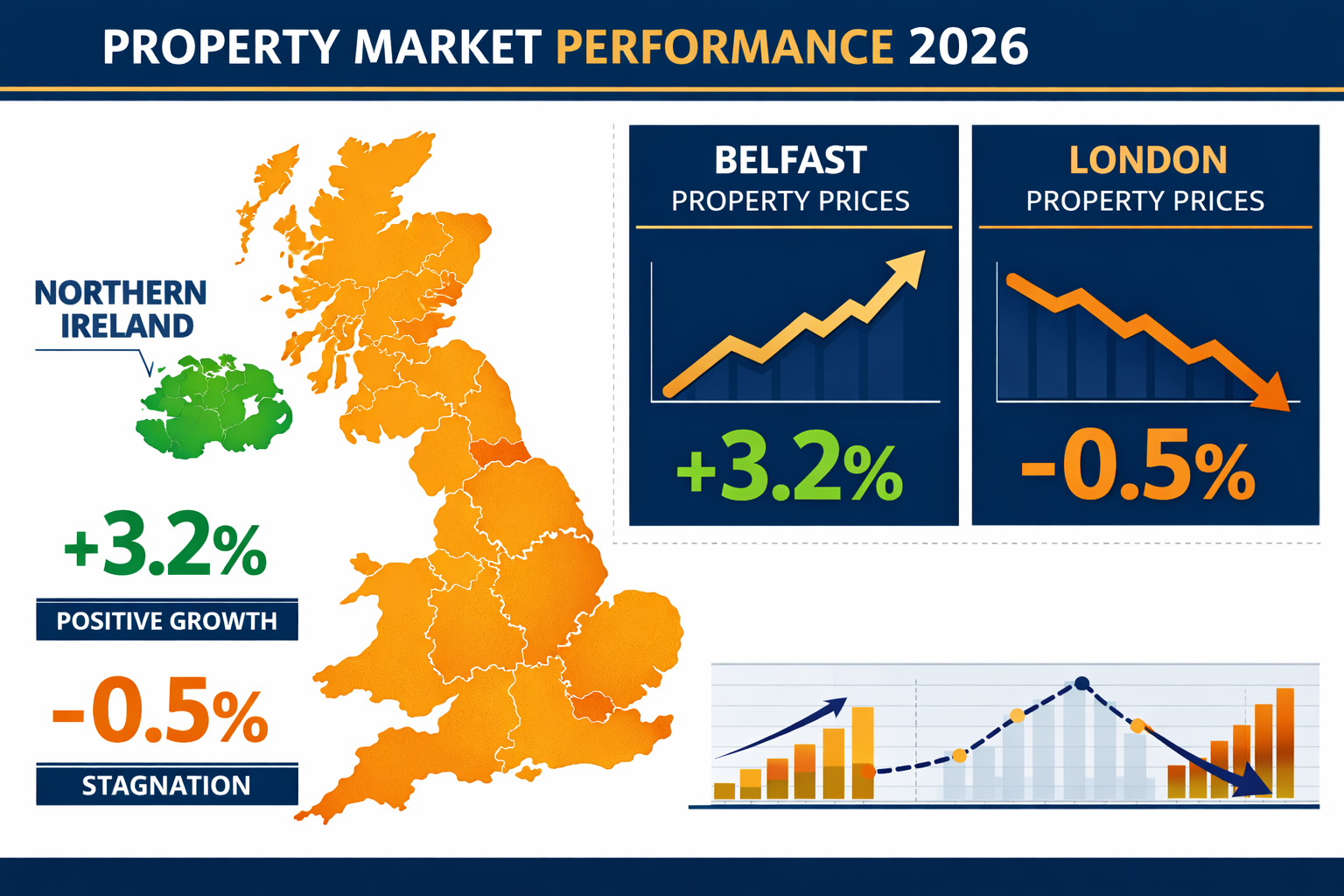
These figures demonstrate that surveyors cannot apply uniform valuation assumptions across UK regions. The RICS reinstatement cost valuation frameworks must be adapted to reflect these regional variations.
Valuing Northern Ireland's Resilient Properties: RICS Techniques and Adjustments
Professional property valuation in Northern Ireland requires chartered surveyors to balance adherence to RICS standards with recognition of regional market characteristics. The RICS Red Book provides the foundational framework, but its application must be nuanced to capture Northern Ireland's distinctive conditions.
Comparable Evidence Adjustments
The cornerstone of residential valuation—the comparable sales method—requires significant regional calibration in Northern Ireland:
Time Adjustments: With Northern Ireland experiencing positive price momentum while mainland markets stagnate or decline, time adjustments to comparable evidence must reflect local trends rather than national averages. A comparable sale from six months prior may require a positive adjustment of 1-2% in Belfast, while the same timeframe might warrant a negative adjustment in London.
Location Premiums: Northern Ireland's property market exhibits pronounced micro-market variations. The premium for properties in desirable postcodes within Belfast or commuter towns has widened in 2026, requiring surveyors to apply more substantial location adjustments than standardized models suggest.
Property Type Variations: Terraced Victorian properties and semi-detached homes—which dominate Northern Ireland's housing stock—have performed differently than the apartment-heavy markets of mainland cities. Surveyors must recognize these typological performance differences when selecting comparables.
Market Sentiment Integration
RICS guidance emphasizes the importance of market sentiment in valuation. In Northern Ireland's divergent market, this becomes particularly crucial:
Forward-Looking Indicators: While mainland markets show buyer hesitancy and falling demand indicators, Northern Ireland demonstrates sustained inquiry levels and viewing activity. Surveyors must incorporate these sentiment differences into their market value opinions, particularly for properties likely to sell within 3-6 months.
Yield Considerations: For investment properties and buy-to-let valuations, Northern Ireland's rental market strength supports tighter yields than comparable mainland markets. The relationship between rental values and capital values has remained more stable in the region.
Structural and Condition Factors
Northern Ireland's housing stock presents unique characteristics that affect valuation:
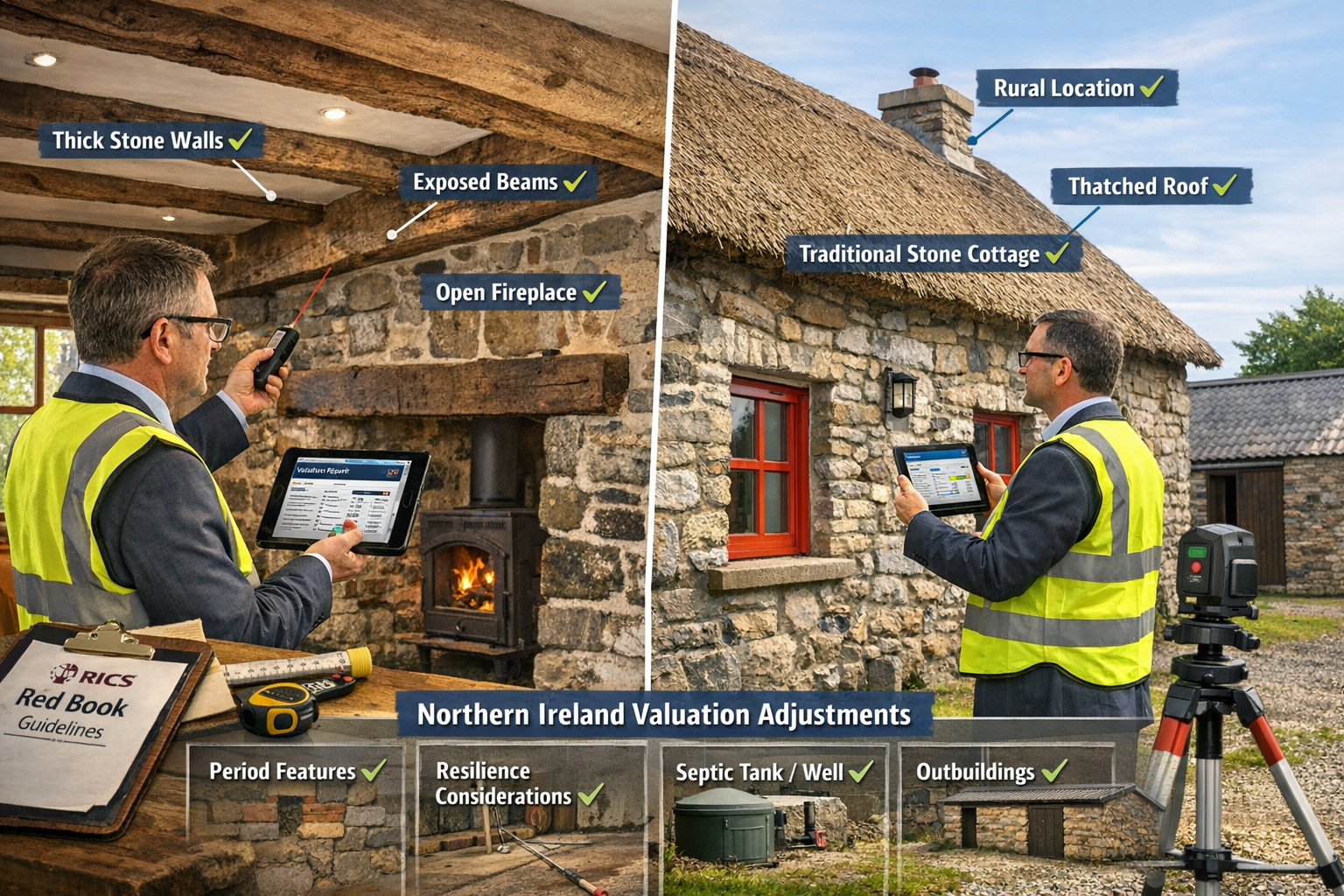
Construction Types: Traditional solid wall construction, common in Northern Ireland's older housing stock, requires different depreciation and condition assessments than cavity wall properties prevalent elsewhere. These structural differences affect both current value and future maintenance obligations.
Energy Efficiency: With Northern Ireland's climate and heating costs, energy performance certificates (EPCs) carry particular weight in buyer decision-making. Properties with poor energy ratings face steeper discounts than similar properties on the mainland, while energy-efficient homes command premiums.
Damp and Weather Exposure: Northern Ireland's climate creates specific risks for property condition. Surveyors conducting damp surveys must apply regional expertise to assess weather-related deterioration and its impact on value.
RICS Techniques Diverging from Mainland Valuation Standards
The professional challenge for surveyors in 2026 lies in maintaining RICS compliance while acknowledging that Northern Ireland's market operates under different dynamics than mainland Britain. This requires thoughtful adaptation of standard techniques.
Modified Comparable Selection Criteria
Standard RICS guidance suggests selecting comparables from within a reasonable geographic radius and timeframe. In Northern Ireland's distinct market, these parameters require adjustment:
Geographic Boundaries: Northern Ireland's smaller size and distinct sub-markets mean that surveyors may need to narrow geographic search parameters. A comparable from 5 miles away may be less relevant than mainland equivalents due to pronounced local market variations.
Transaction Volume Considerations: Some Northern Ireland localities have lower transaction volumes than mainland urban areas. Surveyors may need to extend timeframes for comparable evidence while applying appropriate time adjustments to maintain relevance.
Cross-Border Comparables: In border areas, Republic of Ireland property transactions may provide contextual market information, though direct comparability requires careful adjustment for currency, legal systems, and market conditions.
Risk Assessment and Uncertainty Adjustments
The RICS Red Book requires valuers to assess and communicate uncertainty in their valuations. Northern Ireland's divergent performance creates specific uncertainty considerations:
Market Sustainability: While current performance is strong, surveyors must consider whether Northern Ireland's outperformance is sustainable or cyclical. This affects confidence levels in forward-looking valuations, particularly for development appraisals or investment acquisitions.
Interest Rate Sensitivity: Northern Ireland's mortgage market may respond differently to future interest rate changes than mainland markets. Surveyors should consider regional mortgage availability and borrower profiles when assessing market resilience.
Political and Economic Factors: Northern Ireland's unique constitutional position creates specific risks that mainland valuations rarely encounter. While these factors have not negatively impacted the 2026 market, professional valuers must acknowledge their potential influence.
Specialized Valuation Scenarios
Certain valuation types require particularly nuanced approaches in Northern Ireland:
Lease Extension Valuations: The lease extension valuation process must account for Northern Ireland's distinct leasehold market, which operates differently than England and Wales. Deferment rates and relativity assumptions may require regional calibration.
Freehold Valuations: For properties where freehold valuation is required, Northern Ireland's market dynamics affect ground rent capitalization rates and reversion value assumptions differently than mainland equivalents.
Expert Witness Work: Surveyors providing expert witness services in Northern Ireland courts must demonstrate awareness of regional market conditions and how they diverge from UK-wide trends. Failure to acknowledge these differences can undermine credibility in legal proceedings.
Professional Competence and Local Knowledge
RICS competency frameworks emphasize the importance of local market knowledge. In 2026, this requirement takes on heightened significance:
"Surveyors operating in Northern Ireland must demonstrate not just technical proficiency, but deep understanding of regional market dynamics that increasingly diverge from mainland patterns. Generic UK-wide approaches risk material valuation errors." — RICS Regional Practice Guidance, 2026
Continuing Professional Development: Chartered surveyors working in Northern Ireland should prioritize CPD activities focused on regional market analysis, local economic indicators, and Northern Ireland-specific legal and regulatory frameworks.
Data Sources: Reliance on UK-wide property indices may misrepresent Northern Ireland's market. Surveyors should utilize regional data sources, including the Northern Ireland Housing Executive statistics, Ulster University property reports, and local estate agent intelligence.
Professional Networks: Engagement with regional RICS networks and local surveying communities provides valuable market intelligence that national organizations cannot capture. These professional connections enhance valuation accuracy through shared market knowledge.
Practical Implementation for Surveyors and Property Professionals
Understanding the theoretical differences between Northern Ireland and mainland valuation approaches is essential, but practical implementation determines professional success. Surveyors must translate regional market knowledge into actionable valuation adjustments.
Valuation Report Modifications
RICS-compliant valuation reports in Northern Ireland should explicitly address regional factors:
Market Context Sections: Reports should include dedicated sections explaining Northern Ireland's market performance relative to UK-wide trends. This contextualizes the valuation for clients who may be unfamiliar with regional dynamics.
Assumption Transparency: When valuation assumptions diverge from mainland norms—such as time adjustments, location premiums, or yield rates—reports should explicitly state these differences and provide supporting rationale.
Comparable Evidence Commentary: The comparable evidence section should explain why selected transactions reflect Northern Ireland's market conditions and how adjustments differ from standard mainland approaches.
Client Communication Strategies
Clients commissioning valuations in Northern Ireland may not appreciate the region's market divergence:
Educational Approach: Surveyors should proactively educate clients about Northern Ireland's outperformance and its implications for valuation. This prevents surprise or skepticism when valuations differ from client expectations based on mainland market news.
Comparative Context: Providing comparative data showing Northern Ireland's performance against mainland regions helps clients understand the regional basis for valuation opinions.
Risk Discussion: Transparent discussion of both opportunities and risks specific to Northern Ireland's market demonstrates professional thoroughness and manages client expectations.
Technology and Data Integration
Modern valuation practice increasingly relies on technology and data analytics:
Regional AVMs: Automated Valuation Models (AVMs) trained on UK-wide data may produce inaccurate results in Northern Ireland. Surveyors should either utilize Northern Ireland-specific AVMs or apply manual adjustments to generic models.
Comparable Databases: Building and maintaining databases of Northern Ireland transactions enables more efficient comparable selection and adjustment. Many mainland-focused databases have limited Northern Ireland coverage.
Market Monitoring Systems: Implementing systems to track Northern Ireland-specific market indicators—such as regional RICS surveys, local house price indices, and economic data—supports informed valuation judgments.
Regulatory and Compliance Considerations
Northern Ireland's distinct legal and regulatory environment affects valuation practice:
Building Regulations: Northern Ireland operates separate building regulations from England and Wales. Compliance issues or non-standard construction may have different value implications than mainland equivalents.
Planning System: The Northern Ireland planning system differs from mainland frameworks. Planning permissions, restrictions, and development potential require region-specific expertise to value accurately.
Legal Framework: Property law in Northern Ireland retains distinctions from England and Wales. Surveyors must understand how these legal differences affect property rights and, consequently, value.
Future Outlook: Sustaining Valuation Excellence Amid Divergence
As 2026 progresses, the divergence between Northern Ireland and mainland property markets shows no signs of narrowing. This creates both challenges and opportunities for the surveying profession.
Emerging Trends to Monitor
Several developments will shape Northern Ireland's property valuation landscape:
Policy Responses: UK government and Northern Ireland Executive policies aimed at addressing housing shortages may affect supply dynamics and price trajectories differently than mainland interventions.
Economic Shifts: Northern Ireland's economic performance relative to the UK as a whole will determine whether current market strength proves sustainable or cyclical.
Demographic Changes: Migration patterns, both internal UK movement and international immigration, will influence housing demand in ways that may amplify or moderate current trends.
Climate Considerations: Northern Ireland's exposure to climate-related risks, including flooding and coastal erosion, will increasingly factor into long-term property valuations as climate awareness grows.
Professional Development Priorities
Surveyors committed to excellence in Northern Ireland property valuation should focus on:
Regional Specialization: Developing deep expertise in Northern Ireland's market positions surveyors as valuable specialists rather than generalists applying mainland frameworks.
Cross-Border Knowledge: Understanding Republic of Ireland property markets and cross-border economic dynamics enhances contextual market understanding.
Scenario Planning: Developing skills in scenario analysis and sensitivity testing helps clients understand how different economic and policy outcomes might affect Northern Ireland property values.
Interdisciplinary Collaboration: Working with economists, planners, and legal professionals who specialize in Northern Ireland enhances the quality and credibility of valuation work.
Maintaining RICS Standards While Embracing Regional Differences
The fundamental challenge for surveyors is maintaining professional standards while acknowledging regional market realities:
Red Book Compliance: All valuations must comply with RICS Red Book requirements, even when regional factors require methodology adaptations. Documentation of regional considerations within the Red Book framework is essential.
Peer Review: Given the specialized nature of Northern Ireland valuations, peer review by surveyors with regional expertise provides quality assurance and professional development opportunities.
Research Contribution: Surveyors working in Northern Ireland should contribute to the professional knowledge base through case studies, market reports, and participation in RICS regional forums. This collective knowledge-sharing elevates professional practice across the region.
Conclusion
Valuing Northern Ireland's Resilient Properties in 2026: RICS Techniques Diverging from Mainland Trends represents more than a technical challenge—it exemplifies the surveying profession's fundamental commitment to accuracy, local expertise, and market-responsive practice. As Northern Ireland's property market continues to outperform mainland regions, chartered surveyors must adapt their methodologies while maintaining the rigorous standards that define professional valuation.
The divergence between Northern Ireland and mainland markets demands that surveyors move beyond standardized UK-wide approaches. Regional market dynamics, distinct property characteristics, and local economic factors require specialized knowledge and tailored techniques. Surveyors who develop this regional expertise position themselves as invaluable advisors in a market that increasingly operates according to its own logic.
Actionable Next Steps
For property professionals working in or with Northern Ireland markets:
-
Invest in Regional Knowledge: Prioritize CPD activities focused on Northern Ireland's property market, economic conditions, and regulatory environment. Subscribe to regional market reports and engage with local professional networks.
-
Review Valuation Methodologies: Audit current valuation approaches to ensure they adequately account for Northern Ireland's market divergence. Update comparable selection criteria, adjustment factors, and market assumption frameworks.
-
Enhance Client Communication: Develop clear explanations of how Northern Ireland's market differs from mainland trends. Create client-facing materials that contextualize regional valuations within broader UK property market conditions.
-
Build Regional Data Resources: Establish or enhance databases of Northern Ireland property transactions, market indicators, and comparable evidence. Invest in technology and data sources specific to the region.
-
Seek Specialist Expertise: For complex valuations or unfamiliar property types in Northern Ireland, consider engaging chartered surveyors with demonstrated regional expertise or seeking specialist advice.
-
Document Regional Factors: Ensure all valuation reports explicitly address Northern Ireland's market conditions and explain how regional factors influence valuation opinions. Transparency builds client confidence and professional credibility.
The resilience of Northern Ireland's property market in 2026 demonstrates that regional expertise matters more than ever. As market divergence continues, surveyors who embrace regional specialization while maintaining RICS standards will deliver the most accurate, valuable, and professionally credible property valuations. The future of property valuation is increasingly local, and Northern Ireland's distinctive market performance exemplifies why one-size-fits-all approaches no longer suffice in professional practice.
