
The UK's life sciences sector is experiencing unprecedented growth in 2026, transforming commercial real estate across major tech hubs and creating urgent demand for specialized laboratory facilities. As businesses rush to convert traditional office spaces into cutting-edge research labs, Party Wall Surveys for Life Sciences Lab Conversions: RICS Protocols in 2026 Infrastructure Boom have become essential safeguards for property owners and developers navigating complex structural modifications. This infrastructure transformation brings unique challenges where party wall compliance intersects with highly technical laboratory requirements, making professional surveying expertise more critical than ever [2].
Key Takeaways
- Life sciences lab conversions require specialized party wall surveys due to heavy equipment loads, vibration isolation, and enhanced ventilation systems that significantly impact shared structures
- RICS protocols in 2026 emphasize competence and professional standards for surveyors handling high-stakes life sciences developments with complex technical requirements
- Party wall awards must address laboratory-specific considerations including containment systems, structural reinforcement, and long-term maintenance obligations
- The 2026 infrastructure boom demands proactive compliance as surveying sector volumes increase and regulatory scrutiny intensifies [4]
- Strategic award drafting protects all parties in multi-million pound conversions where structural failures could compromise sensitive research operations
Understanding Party Wall Surveys for Life Sciences Lab Conversions
What Makes Lab Conversions Different? 🔬
Life sciences laboratory conversions represent a fundamentally different challenge compared to standard commercial renovations. Unlike typical office-to-residential projects, laboratory conversions impose extraordinary structural demands on existing buildings and their party walls.
Modern research facilities require:
- Heavy equipment loads: Biosafety cabinets, centrifuges, and imaging equipment can weigh several tons
- Vibration isolation: Sensitive instruments demand specialized flooring systems that transfer loads differently
- Enhanced HVAC systems: Laboratory-grade ventilation requires substantial structural penetrations through party walls
- Chemical containment: Specialized drainage and containment systems affect foundation work
- Utility upgrades: Increased electrical capacity, gas lines, and water systems necessitate extensive modifications
These technical requirements make party wall surveys absolutely essential for protecting both building owners and adjoining property owners throughout the conversion process.
The 2026 Infrastructure Boom Context
The life sciences sector's expansion in 2026 has created what industry experts describe as an infrastructure boom, particularly in established tech corridors around Cambridge, Oxford, London, and Manchester [2]. This growth coincides with broader positive trends in the surveying sector, with many lenders forecasting increased volumes and strong demand throughout 2026 [4].
Key drivers include:
- Government investment in life sciences infrastructure
- Post-pandemic acceleration of biotech research
- Venture capital flowing into UK life sciences startups
- Shortage of purpose-built laboratory space
- Favorable conversion economics for commercial property owners
This perfect storm has made Party Wall Surveys for Life Sciences Lab Conversions: RICS Protocols in 2026 Infrastructure Boom a specialized niche requiring both traditional party wall expertise and understanding of laboratory-specific technical requirements.
RICS Protocols and Professional Standards in 2026
Updated RICS Competency Requirements
The Royal Institution of Chartered Surveyors (RICS) has placed renewed emphasis in 2026 on ensuring surveyors possess the competence and training necessary to handle increasingly complex projects [4]. This focus on professional standards directly impacts how party wall surveyors approach life sciences conversions.
RICS 2026 priorities include:
- ✅ Enhanced continuing professional development (CPD) requirements for specialized sectors
- ✅ Clearer qualification pathways for graduates entering surveying practice
- ✅ Stricter competence verification for high-stakes commercial projects
- ✅ Improved professional trust through transparent standards [5]
For life sciences lab conversions, these standards mean surveyors must demonstrate:
- Technical knowledge of laboratory design requirements
- Structural engineering collaboration skills
- Understanding of biosafety regulations and containment systems
- Risk assessment capabilities for high-value research operations
- Insurance and liability awareness specific to laboratory environments
Party Wall Act 1996 Application to Lab Conversions
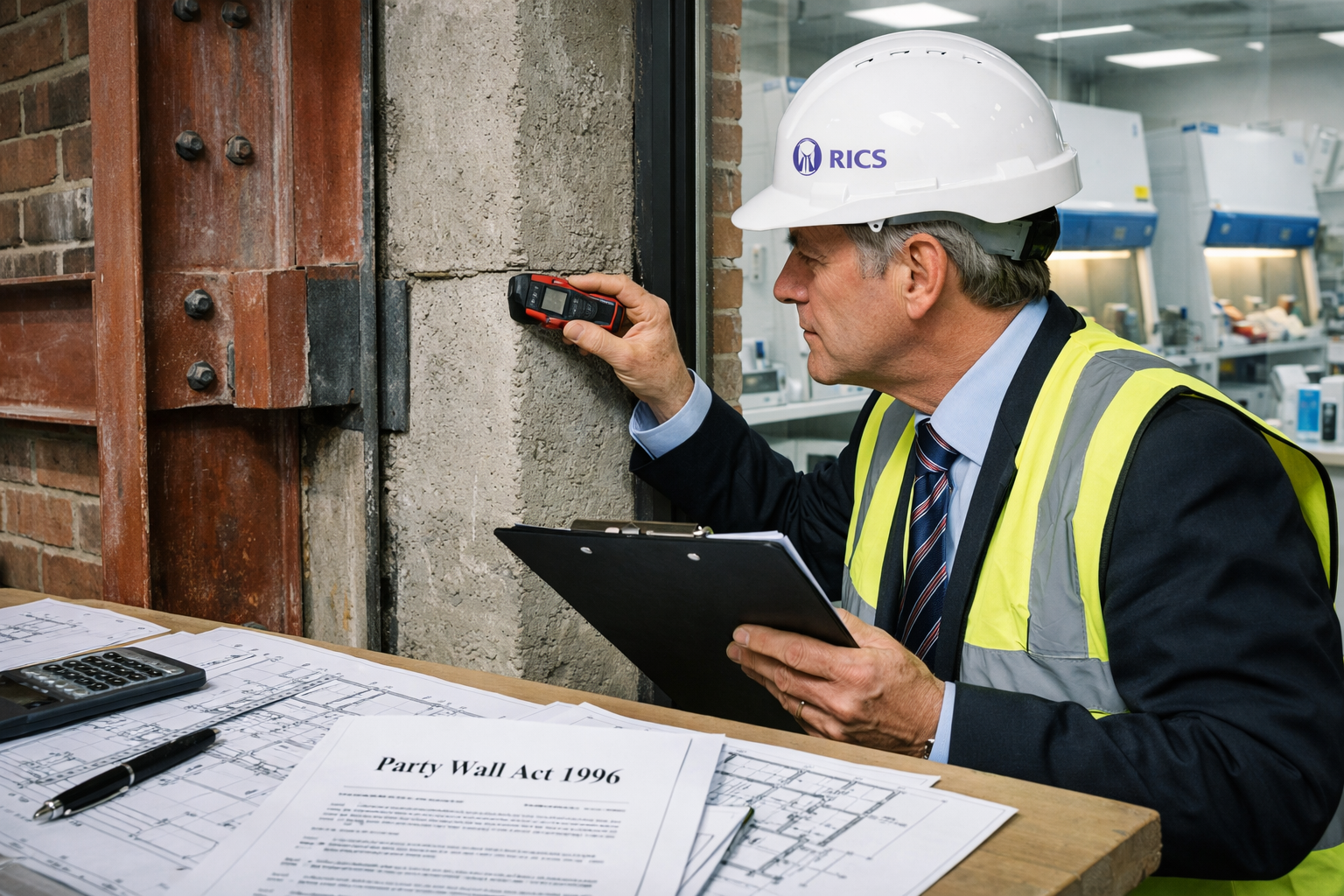
The Party Wall etc. Act 1996 provides the legal framework governing all party wall work in England and Wales. For life sciences conversions, several sections become particularly relevant:
Section 2(2) – Works to Existing Party Walls:
Laboratory conversions frequently require structural modifications including:
- Installing steel beams to support heavy equipment
- Creating penetrations for enhanced ventilation systems
- Reinforcing floors to handle increased load capacities
- Adding vibration isolation systems
Section 6 – Works Requiring Notice:
Building owners must serve proper notice when planning:
- Excavations for new drainage systems within three meters of adjoining properties
- Foundation work to support upgraded utility infrastructure
- Structural underpinning to accommodate heavier loads
Understanding when party wall agreements are legally required prevents costly delays in time-sensitive conversion projects where laboratory tenants may have committed lease start dates.
RICS Guidance on Complex Commercial Projects
RICS has developed specific guidance for surveyors handling complex commercial developments. For Party Wall Surveys for Life Sciences Lab Conversions: RICS Protocols in 2026 Infrastructure Boom, this guidance emphasizes:
| Protocol Area | Application to Lab Conversions |
|---|---|
| Pre-construction surveys | Detailed condition records of adjoining properties, including sensitive equipment that might be affected by vibration |
| Technical specifications | Collaboration with structural engineers and laboratory designers to assess party wall impacts |
| Risk mitigation | Identification of high-risk activities (e.g., core drilling through party walls for ventilation) |
| Dispute resolution | Clear procedures for addressing concerns from adjoining owners about laboratory operations |
| Award drafting | Comprehensive documentation of rights, obligations, and remedies specific to laboratory use |
Navigating the Party Wall Survey Process for Laboratory Conversions
Initial Assessment and Notice Requirements
The party wall process for life sciences conversions begins well before construction. Building owners must understand whether they need a party wall agreement and initiate the process appropriately.
Step 1: Technical Feasibility Study
Before serving notices, conduct a preliminary assessment involving:
- Structural engineers evaluating load-bearing capacity
- Laboratory designers specifying equipment and systems requirements
- Party wall surveyors identifying affected structures
- Cost consultants assessing financial implications
Step 2: Serving Party Wall Notices
Laboratory conversion projects typically require multiple notice types. Writing effective party wall letters that clearly explain the scope and nature of laboratory-specific work helps prevent misunderstandings.
The notice must include:
- Detailed description of structural modifications
- Explanation of laboratory-specific requirements (ventilation, drainage, utilities)
- Proposed timeline with critical path milestones
- Contact information for appointed surveyor
Step 3: Appointing Surveyors
Once notices are served, adjoining owners have 14 days to respond. They can either:
- Consent to the works (rare for complex laboratory conversions)
- Appoint their own surveyor
- Request the building owner's surveyor act for both parties
Given the technical complexity and high stakes, most adjoining owners appoint independent representation. Understanding what party wall surveyors do helps all parties set appropriate expectations.
Conducting Comprehensive Pre-Construction Surveys
Pre-construction condition surveys form the evidentiary foundation for Party Wall Surveys for Life Sciences Lab Conversions: RICS Protocols in 2026 Infrastructure Boom. These surveys must be extraordinarily thorough given the potential for disputes in high-value developments.
Essential survey components include:
🔍 Structural Documentation
- Detailed photography of all party walls and adjoining structures
- Video walkthroughs with timestamp verification
- Crack monitoring with precise measurements
- Settlement markers and baseline readings
🔍 Specialized Equipment Assessment
- Inventory of sensitive equipment in adjoining properties
- Vibration tolerance specifications for existing laboratory equipment
- Environmental condition baselines (temperature, humidity, air quality)
- Existing utility infrastructure mapping
🔍 Legal and Insurance Verification
- Confirmation of property ownership and leasehold interests
- Review of existing building insurance policies
- Documentation of any pre-existing disputes or claims
- Verification of compliance with existing planning permissions
The RICS building survey standards provide the professional framework for conducting these assessments with appropriate rigor.
Technical Considerations Unique to Lab Conversions
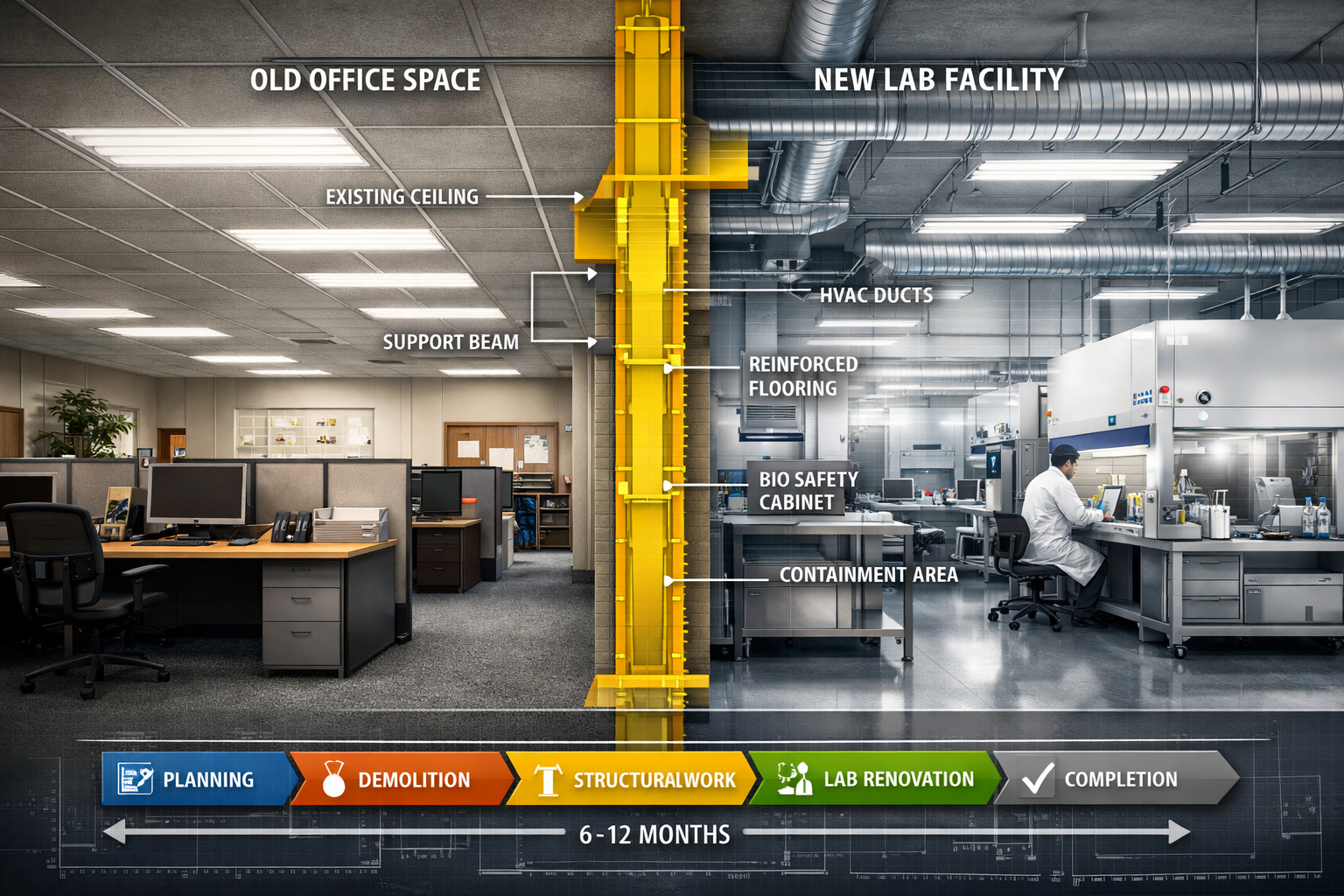
Laboratory conversions present technical challenges that standard party wall surveys rarely encounter. Surveyors must collaborate closely with specialist consultants to address:
Structural Loading Analysis
- Calculate cumulative equipment loads on party walls and shared floors
- Assess dynamic loading from centrifuges and other rotating equipment
- Evaluate vibration transmission through party structures
- Determine need for structural reinforcement or isolation systems
Ventilation and HVAC Penetrations
Life sciences facilities require 15-20 air changes per hour (compared to 2-4 for offices), necessitating:
- Large-diameter ductwork penetrating party walls
- Fire-rated seals and dampers at all penetrations
- Acoustic treatment to prevent noise transmission
- Structural support for heavy rooftop HVAC units
Containment and Safety Systems
Biosafety Level 2 (BSL-2) laboratories, common in commercial life sciences facilities, require:
- Sealed surfaces and specialized drainage
- Emergency eyewash and shower stations with dedicated plumbing
- Negative pressure systems preventing airborne contamination
- Backup power systems for critical equipment
Utility Infrastructure Upgrades
Research laboratories consume 5-10 times the electrical power of equivalent office space:
- Upgraded electrical panels and distribution
- Specialized gas supply systems (nitrogen, CO2, compressed air)
- Enhanced water treatment and purification systems
- Increased wastewater capacity for laboratory drainage
Each of these systems can impact party walls and require careful documentation in the party wall award.
Drafting Effective Party Wall Awards for High-Stakes Developments
Essential Award Components for Laboratory Conversions
A party wall award serves as the legal document governing rights, obligations, and remedies throughout the conversion project. For life sciences developments, awards must be exceptionally comprehensive given the financial stakes and technical complexity.
Critical award sections include:
1. Detailed Scope of Works
Unlike standard conversions, laboratory awards must specify:
- Precise structural modifications with engineering calculations
- Equipment installation sequences and load distribution
- Ventilation system routing through party structures
- Utility upgrade pathways and connection points
- Phasing plans that minimize disruption to adjoining properties
2. Access Rights and Protocols
Laboratory conversions often require access to adjoining properties for:
- Installing vibration monitoring equipment
- Conducting air quality testing during commissioning
- Inspecting party wall integrity during heavy equipment installation
- Emergency response if containment systems fail
Awards should establish clear protocols respecting adjoining owners' operations while ensuring building owners can complete necessary work.
3. Condition and Monitoring Requirements
Given the potential for damage from heavy equipment and structural modifications:
- Establish baseline conditions with photographic evidence
- Specify ongoing monitoring during construction (vibration, settlement, crack propagation)
- Define trigger levels requiring work stoppage and remediation
- Create clear procedures for damage assessment and compensation
4. Insurance and Indemnification
High-stakes laboratory conversions demand robust insurance provisions:
- Minimum coverage levels appropriate to project value
- Named additional insureds protecting adjoining owners
- Professional indemnity coverage for specialist consultants
- Pollution liability coverage for laboratory operations
5. Dispute Resolution Mechanisms
Despite best efforts, disputes arise in complex projects. Awards should include:
- Clear escalation procedures from site management to surveyors
- Timelines for surveyor response and decision-making
- Third surveyor appointment procedures if needed
- Costs allocation for dispute resolution
Understanding how to resolve party wall disputes before conflicts arise helps all parties maintain productive working relationships.
Addressing Laboratory-Specific Risks in Awards
Party Wall Surveys for Life Sciences Lab Conversions: RICS Protocols in 2026 Infrastructure Boom require surveyors to anticipate risks unique to laboratory environments:
⚠️ Contamination Concerns
Adjoining owners may fear chemical or biological contamination from laboratory operations. Awards should address:
- Containment system specifications and certifications
- Regular air quality monitoring protocols
- Emergency response procedures for spills or releases
- Liability allocation for contamination events
⚠️ Noise and Vibration
Laboratory equipment generates continuous noise and vibration. Consider:
- Acoustic testing requirements before and after conversion
- Vibration isolation specifications for sensitive equipment
- Operating hour restrictions during commissioning
- Remediation obligations if noise exceeds agreed thresholds
⚠️ Long-term Maintenance Obligations
Unlike standard conversions, laboratory systems require ongoing maintenance affecting party structures:
- HVAC filter replacement and duct cleaning schedules
- Vibration isolation system inspections
- Drainage system maintenance and testing
- Access rights for future repairs and upgrades
⚠️ Change of Use Implications
Converting to laboratory use may affect:
- Building insurance premiums for adjoining properties
- Planning use class restrictions
- Fire safety requirements and evacuation procedures
- Property values and marketability
Comprehensive awards acknowledge these concerns and establish fair allocation of responsibilities and costs.
Strategic Considerations for Building Owners and Developers
Cost-Benefit Analysis of Proactive Compliance
Some building owners view party wall compliance as an unnecessary expense delaying profitable laboratory conversions. This short-term thinking ignores substantial long-term risks:
Costs of Non-Compliance:
- Legal injunctions halting construction (£50,000-£200,000+ in delays)
- Retrospective party wall awards with penalty costs
- Damage claims from adjoining owners (potentially millions for laboratory disruption)
- Reputational damage affecting future development opportunities
- Criminal prosecution in extreme cases
Benefits of Proactive Party Wall Surveys:
- Predictable timelines with defined milestones
- Legal protection through properly executed awards
- Documented baseline conditions preventing spurious claims
- Professional relationships with adjoining owners
- Smooth planning and building control approvals
For a typical £2-5 million laboratory conversion, comprehensive party wall compliance costs £15,000-£40,000—representing less than 1% of project value while eliminating potentially catastrophic risks.
Selecting Qualified Surveyors for Complex Projects
Not all party wall surveyors possess the specialized knowledge required for Party Wall Surveys for Life Sciences Lab Conversions: RICS Protocols in 2026 Infrastructure Boom. When selecting professionals, consider:
Essential Qualifications:
- ✅ RICS membership with relevant specializations
- ✅ Professional indemnity insurance (minimum £2 million for commercial projects)
- ✅ Demonstrated experience with laboratory or life sciences projects
- ✅ Understanding of structural engineering principles
- ✅ Familiarity with biosafety and containment regulations
Red Flags:
- ❌ Primarily residential-focused practice
- ❌ Unwillingness to collaborate with specialist consultants
- ❌ Generic award templates without project-specific provisions
- ❌ Lack of continuing professional development in commercial sectors
Choosing the right party wall surveyors significantly impacts project success, particularly in London's competitive life sciences market.
Timing and Project Integration
Successful laboratory conversions integrate party wall compliance into overall project planning:
Optimal Timeline:
- Months 1-2: Technical feasibility and preliminary design
- Month 3: Serve party wall notices (minimum 2 months before construction)
- Months 4-5: Surveyor appointments, pre-construction surveys, award negotiation
- Month 6: Award finalization and construction commencement
- Months 7-18: Construction with ongoing monitoring
- Month 19: Final inspections and award closure
This timeline assumes cooperative adjoining owners. If neighbors refuse party wall agreements, additional time may be required for dispute resolution, though outright refusal is rare when proper procedures are followed.
Emerging Trends and Future Outlook
Regulatory Evolution in 2026
The life sciences infrastructure boom has attracted increased regulatory attention in 2026. RICS and other professional bodies are developing enhanced guidance specifically addressing laboratory conversions and their unique party wall implications [3].
Anticipated developments include:
- Standardized protocols for biosafety considerations in party wall awards
- Enhanced CPD requirements for surveyors working on life sciences projects
- Clearer guidance on insurance requirements for laboratory conversions
- Integration with planning policy supporting life sciences growth
Technology Integration in Party Wall Surveys
Modern surveying technology increasingly supports Party Wall Surveys for Life Sciences Lab Conversions: RICS Protocols in 2026 Infrastructure Boom:
- 3D laser scanning creates detailed baseline records of party structures
- Continuous vibration monitoring provides real-time alerts during construction
- Digital award management platforms streamline document sharing and approvals
- BIM integration allows precise visualization of party wall impacts
- Drone surveys assess external party walls and rooftop equipment installations
These technologies enhance accuracy while reducing survey time and costs, making comprehensive compliance more accessible for developers.
Market Dynamics and Investment Opportunities
The 2026 infrastructure boom shows no signs of slowing. Industry forecasts suggest:
- Continued strong demand for laboratory space through 2028
- Expansion beyond traditional hubs into regional cities
- Increasing sophistication of laboratory specifications
- Growing recognition of party wall compliance as value-adding rather than cost center
For property owners with suitable commercial buildings near life sciences clusters, strategic laboratory conversions represent significant value creation opportunities—provided party wall compliance is handled professionally from project inception.
Practical Guidance for Adjoining Owners
Protecting Your Interests
If you receive notice of a planned laboratory conversion affecting your property, take these steps:
1. Appoint an Independent Surveyor
Don't rely on the building owner's surveyor to protect your interests. Appoint your own qualified professional who:
- Understands laboratory-specific risks
- Has experience with commercial party wall matters
- Can assess technical specifications and identify concerns
- Will advocate for appropriate protections in the award
2. Document Existing Conditions
Conduct your own photographic survey before construction begins, focusing on:
- All party walls and adjacent structures
- Sensitive equipment or operations that could be disrupted
- Existing defects or damage that might be blamed on the conversion
- Environmental conditions (noise levels, air quality)
3. Review Insurance Coverage
Notify your insurer about the planned works and verify:
- Your coverage remains in force during construction
- Any exclusions related to neighboring construction
- Claims procedures if damage occurs
- Whether the building owner's insurance names you as additional insured
4. Understand Your Rights
The Party Wall Act provides specific protections including:
- Right to appoint your own surveyor at the building owner's expense
- Right to compensation for any damage caused
- Right to refuse unreasonable working hours or access
- Right to dispute resolution through the third surveyor mechanism
Common Concerns and How to Address Them
"Will laboratory operations contaminate my property?"
Properly designed BSL-2 facilities pose minimal contamination risk. Ensure the award requires:
- Third-party certification of containment systems
- Regular air quality monitoring with results shared
- Emergency response protocols
- Appropriate liability insurance
"What if construction damages my building?"
Comprehensive pre-construction surveys and ongoing monitoring protect you. The award should specify:
- Baseline condition documentation
- Regular inspection schedules
- Immediate notification of any damage
- Repair obligations and compensation procedures
"Can I prevent the conversion entirely?"
Generally no, if proper procedures are followed. However, you can:
- Ensure appropriate protections in the award
- Require modifications to minimize impacts
- Negotiate compensation for disruption
- Escalate concerns through the surveyor dispute process
Conclusion
Party Wall Surveys for Life Sciences Lab Conversions: RICS Protocols in 2026 Infrastructure Boom represent a critical intersection of property law, technical engineering, and professional surveying standards. As the UK's life sciences sector continues its rapid expansion throughout 2026, the demand for sophisticated laboratory facilities will only intensify, making proper party wall compliance essential for successful conversions [2].
The key to navigating these complex projects lies in:
✅ Early engagement with qualified RICS surveyors who understand both party wall law and laboratory-specific requirements
✅ Comprehensive technical assessment involving structural engineers, laboratory designers, and specialist consultants
✅ Detailed award drafting that addresses the unique risks and long-term obligations of laboratory operations
✅ Proactive communication between building owners and adjoining owners to build trust and prevent disputes
✅ Professional standards adherence aligned with RICS 2026 competency requirements and enhanced guidance [4]
For building owners and developers, investing in thorough party wall compliance from project inception protects substantial capital investments while enabling smooth conversion timelines. For adjoining owners, understanding your rights and appointing qualified representation ensures your interests are protected throughout the process.
As the surveying sector experiences renewed demand and reform in 2026 [4], professionals who develop specialized expertise in life sciences laboratory conversions will be well-positioned to serve this growing market. The infrastructure boom presents opportunities for value creation, but only when projects are executed with appropriate technical rigor and legal compliance.
Next Steps
For Building Owners Planning Laboratory Conversions:
- Engage a qualified RICS party wall surveyor with life sciences experience
- Conduct preliminary structural and technical feasibility assessments
- Develop comprehensive project timelines incorporating party wall procedures
- Serve proper notices at least 2-3 months before planned construction
- Budget appropriately for professional fees and compliance costs
For Adjoining Owners Receiving Conversion Notices:
- Appoint an independent party wall surveyor immediately
- Document existing property conditions thoroughly
- Review your insurance coverage and notify carriers
- Engage constructively with the building owner's team
- Ensure the award includes appropriate protections for your specific concerns
For Surveyors Entering This Specialized Field:
- Pursue relevant CPD in laboratory design and biosafety regulations
- Develop relationships with structural engineers and laboratory consultants
- Study successful laboratory conversion awards to understand best practices
- Stay current with RICS guidance updates throughout 2026
- Consider specialization in life sciences real estate sectors
The 2026 infrastructure boom offers unprecedented opportunities in the life sciences sector, but success requires professional expertise, technical competence, and unwavering commitment to proper party wall compliance. By following RICS protocols and engaging qualified professionals, all parties can navigate these complex conversions successfully while protecting their respective interests and contributing to the UK's thriving life sciences ecosystem.
For expert guidance on party wall surveys for your life sciences laboratory conversion project, consult with experienced RICS-qualified party wall surveyors who understand the unique demands of the 2026 infrastructure boom.
References
[1] Valuation Techniques For Stabilising National House Prices Rics January 2026 Survey Insights For Surveyors – https://nottinghillsurveyors.com/blog/valuation-techniques-for-stabilising-national-house-prices-rics-january-2026-survey-insights-for-surveyors
[2] Party Wall Surveys For Office To Lab Conversions Compliance In 2026s Life Sciences Infrastructure Push – https://nottinghillsurveyors.com/blog/party-wall-surveys-for-office-to-lab-conversions-compliance-in-2026s-life-sciences-infrastructure-push
[3] Uk Influence And Advocacy Update January 2026 – https://www.rics.org/news-insights/uk-influence-and-advocacy-update-january-2026
[4] Surveying In 2026 Reform Recovery And Renewed Demand – https://www.lrg.co.uk/news-and-insights/surveying-in-2026-reform-recovery-and-renewed-demand/
[5] Sparks Of 2026 9 Rics And The Return Of Professional Trust In Retrofit – https://www.refurbandretrofit.com/sparks-of-2026-9-rics-and-the-return-of-professional-trust-in-retrofit/
