
As UK homeowners increasingly choose to extend rather than move in 2026, understanding party wall surveying has become essential for avoiding costly delays and neighbour disputes. Whether planning a loft conversion, rear extension, or basement excavation, navigating the Party Wall etc. Act 1996 correctly can mean the difference between a smooth project and months of frustration. This Party Wall Surveying for UK Home Extensions: A Practical 2026 Guide for Loft, Rear and Basement Projects provides homeowners with a step-by-step roadmap through notices, awards, and common pitfalls—ensuring your extension project starts on the right legal footing.
Key Takeaways
- Serve formal notice 2-3 months before starting work: Two months for wall alterations, three months for excavations near boundaries—this is a legal requirement, not optional[1]
- Neighbours have 14 days to respond: Written consent avoids surveyor costs; silence or dissent triggers the formal Party Wall Award process[1][3]
- Building owners typically pay all surveyor fees: Expect £1,000+ for awards, with hourly rates ranging from £90-£450 depending on location and complexity[2]
- Schedule of condition protects both parties: Professional photographic evidence before work begins prevents disputes over damage claims[2]
- Party wall procedures run separately from planning permission: Compliance with the Act is independent of building regulations and planning approvals[4]
Understanding Party Wall Surveying for UK Home Extensions
What Qualifies as Party Wall Work?
The Party Wall etc. Act 1996 governs building work affecting shared walls, boundaries, and excavations near neighbouring properties. For home extensions, three specific notice types apply depending on your project scope.
Loft conversions requiring party wall procedures include:
- Raising the height of a party wall (even by a single course of bricks)
- Installing steel beams into or onto shared walls
- Cutting into party walls for new structural openings
- Underpinning shared chimney stacks
Rear extensions trigger party wall requirements when:
- Building up to or astride the boundary line
- Inserting damp-proof courses into party walls
- Cutting into shared walls for new doorways or windows
- Creating new foundations within three meters of a neighbour's structure
Basement excavations need formal notices if:
- Digging within three meters of a neighbour's foundation and going deeper than their foundation level
- Excavating within six meters and cutting a 45-degree plane from their foundation base[1]
Minor works like plastering, electrical installations, and fitting kitchen units do not require party wall agreements, even if the wall is shared[3]. Understanding when a party wall agreement is legally required helps homeowners avoid unnecessary costs.
The Role of Party Wall Surveyors in Extension Projects
Party wall surveyors act as impartial professionals ensuring both building and adjoining owners' interests are protected throughout construction. Their responsibilities extend far beyond simple paperwork.
Key surveyor functions include:
| Function | Purpose | Benefit |
|---|---|---|
| Pre-work inspection | Document existing condition with photographs | Establishes baseline evidence |
| Award preparation | Detail permitted works, access rights, timings | Legally binding framework |
| Dispute resolution | Mediate disagreements over methods or damage | Avoids court proceedings |
| Post-work verification | Confirm compliance and assess any damage | Determines remediation costs |
You can appoint either one agreed surveyor acting for both parties, or separate surveyors—one for each owner. The agreed surveyor approach costs approximately £1,000 for standard residential extensions, while appointing two surveyors doubles expenses as each charges separately[2]. Crucially, the agreed surveyor must remain independent and cannot be the same professional handling your architectural or structural design work[3].
For detailed information about surveyor responsibilities, review our guide on what party wall surveyors do.
Common Misconceptions About Party Wall Requirements
Myth #1: "Planning permission covers party wall requirements"
Reality: The Party Wall Act operates completely independently from planning permission and building regulations. You must comply with all three separately[4].
Myth #2: "Friendly neighbours don't need formal procedures"
Reality: Even with excellent neighbour relations, formal written notice protects both parties. Verbal agreements hold no legal weight under the Act[1].
Myth #3: "Neighbours can block my extension by refusing consent"
Reality: Neighbours cannot prevent lawful development. Their dissent simply triggers the surveyor appointment process, which then determines how work proceeds safely[3]. Learn more about this in our article on whether neighbours can legally refuse party wall agreements.
Myth #4: "Only owner-occupiers need notification"
Reality: Adjoining owners include leaseholders, long-term tenants, and their landlords or freeholders—potentially multiple parties per property[1].
Step-by-Step Party Wall Notice Process for Loft, Rear and Basement Extensions
Determining Which Notice Type Your Extension Requires
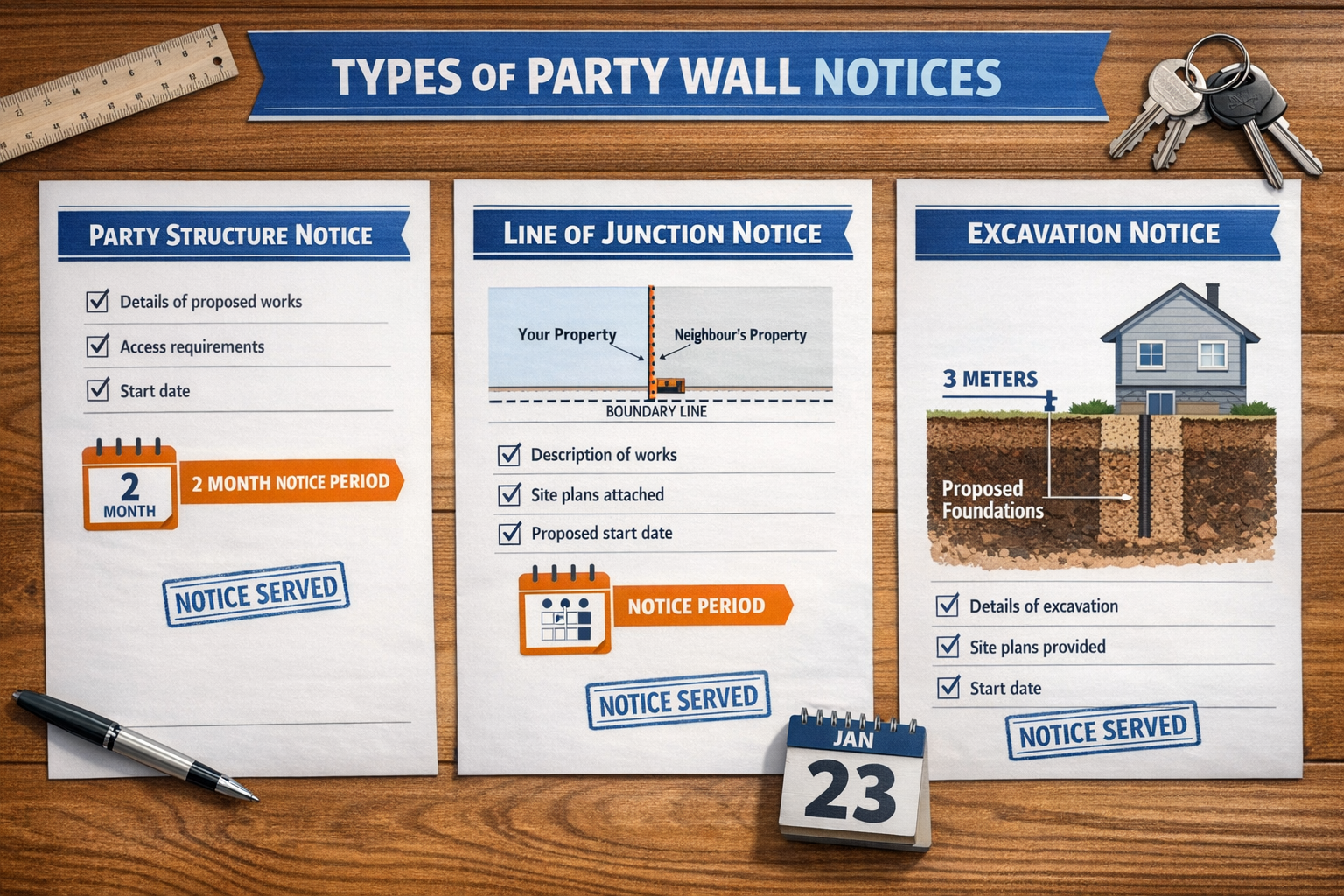
The Party Wall etc. Act 1996 specifies three distinct notice types, each with different timing requirements and purposes.
Party Structure Notice applies when:
- Building on, cutting into, or altering a party wall
- Raising party walls for loft conversions
- Inserting beams or damp-proof courses
- Timeline: Serve at least 2 months before starting work[1]
Line of Junction Notice covers:
- Building a new wall directly on the boundary line
- Constructing foundations astride the boundary
- Timeline: Serve at least 1 month before starting work[1]
Excavation Notice (Section 6) is required for:
- Basement excavations within 3 meters of a neighbour's foundation, going deeper than their foundation
- Excavations within 6 meters that cut below a 45-degree plane from their foundation base
- Timeline: Serve at least 1 month before starting work[1]
Many extension projects require multiple notice types. For example, a rear extension with basement excavation typically needs both a Party Structure Notice (for the wall work) and an Excavation Notice (for the dig). Once served, you have up to 12 months to commence the notified works[1].
How to Prepare and Serve Formal Party Wall Notices
Proper notice preparation prevents delays and legal complications. While templates exist, notices must contain specific information to be valid.
Essential notice contents:
- ✅ Building owner's full name and address
- ✅ Detailed description of proposed works
- ✅ Drawings showing the work in relation to the party wall
- ✅ Proposed start date (must be at least 2-3 months ahead)
- ✅ Statement of the relevant section of the Act
- ✅ Clear explanation of the neighbour's rights to respond
Service methods (use at least two for proof):
- Hand delivery with signed acknowledgment
- Recorded delivery post with tracking
- Email with read receipt (if neighbour agrees to electronic service)
For detailed guidance on notice preparation, consult our article on how to write a party wall letter.
⚠️ Critical timing consideration: Count the notice period from when your neighbour receives the notice, not when you send it. Always add extra days for postal delays.
Understanding the 14-Day Response Window
After receiving your notice, adjoining owners have exactly 14 days to respond in one of three ways[1][3]:
Option 1: Written Consent ✅
The neighbour agrees to the works in writing. Technically, no surveyor is required, though obtaining a schedule of condition remains advisable to document the property's pre-work state[3].
Option 2: Counter-Notice 📝
The neighbour consents but requests specific conditions—for example, limiting work hours, requiring additional protection measures, or specifying access arrangements. This triggers negotiation, often requiring surveyor involvement.
Option 3: Dissent or No Response ⚠️
Either active disagreement or silence after 14 days creates a "dispute" under the Act. This automatically triggers the formal Party Wall Award process, requiring surveyor appointment[1].
What happens with no response?
Many homeowners mistakenly assume silence means consent. Under the Act, failure to respond within 14 days constitutes dissent, requiring you to appoint a surveyor to prepare an Award before work can legally commence[3].
The Party Wall Award: What to Expect
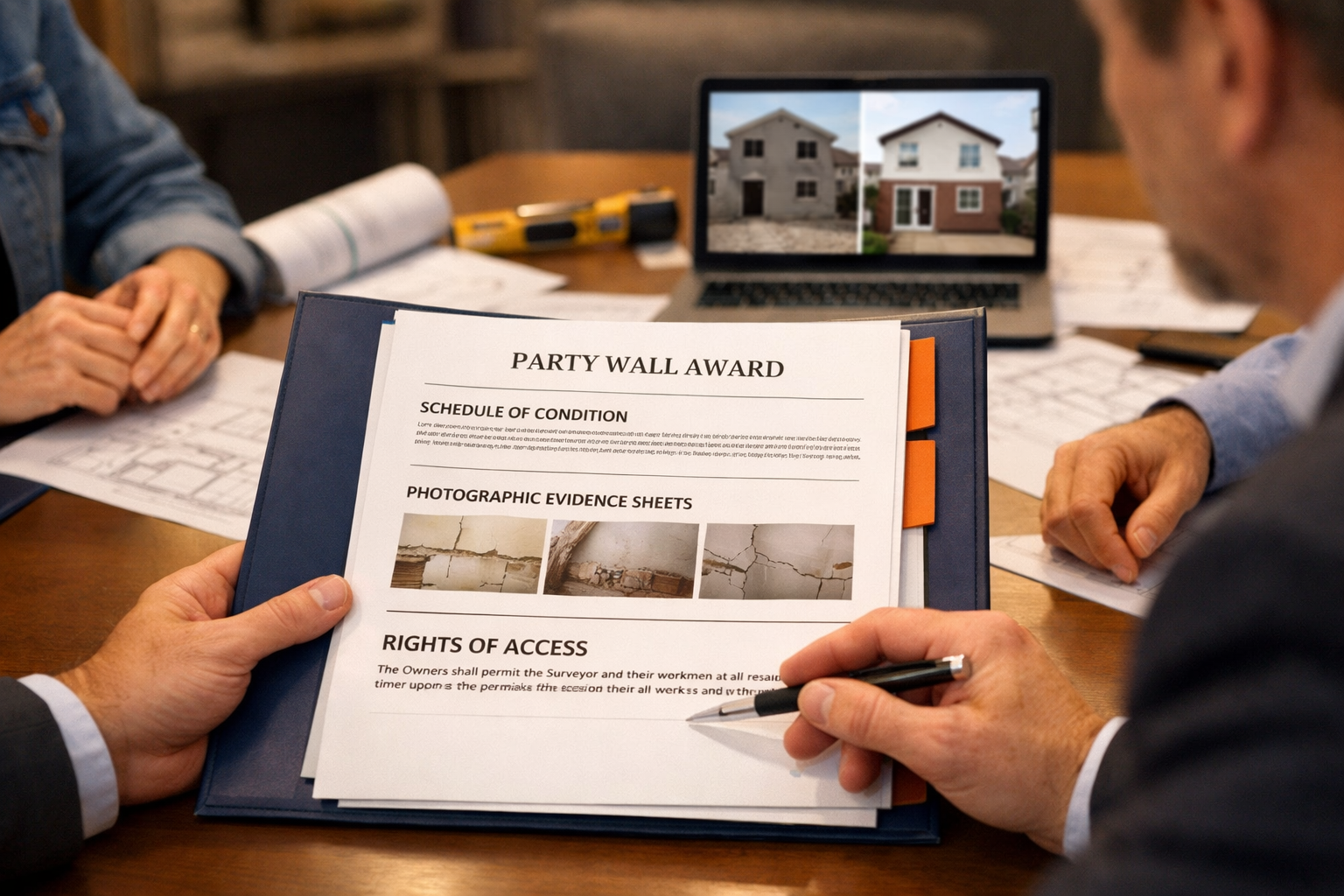
When neighbours dissent or fail to respond, surveyors prepare a Party Wall Award—a legally binding document that permits work to proceed under specified conditions.
Standard Award components include:
📋 Schedule of Condition
Detailed photographic survey of the adjoining property's current state, room by room, documenting all existing cracks, defects, and finishes. This evidence proves invaluable if damage claims arise during construction[2].
🔧 Scope of Works
Precise description of permitted works, construction methods, and any restrictions on techniques or materials.
⏰ Working Hours and Access
Specified times when noisy work is permitted and arrangements for surveyors to access neighbouring properties for inspections.
💰 Cost Allocation
Statement of who pays surveyor fees and under what circumstances costs might be shared (rare, typically only when repairs benefit both properties)[2].
🛡️ Damage Resolution Process
Procedures for reporting, investigating, and remedying any damage caused by the works.
For comprehensive information about awards, see our complete guide to party wall awards.
The Award becomes legally binding once served on both parties. Either party can appeal to the County Court within 14 days if they believe the Award is unfair, though this is uncommon with properly appointed surveyors.
Practical Considerations for Loft, Rear and Basement Extension Projects
Loft Conversion Party Wall Challenges
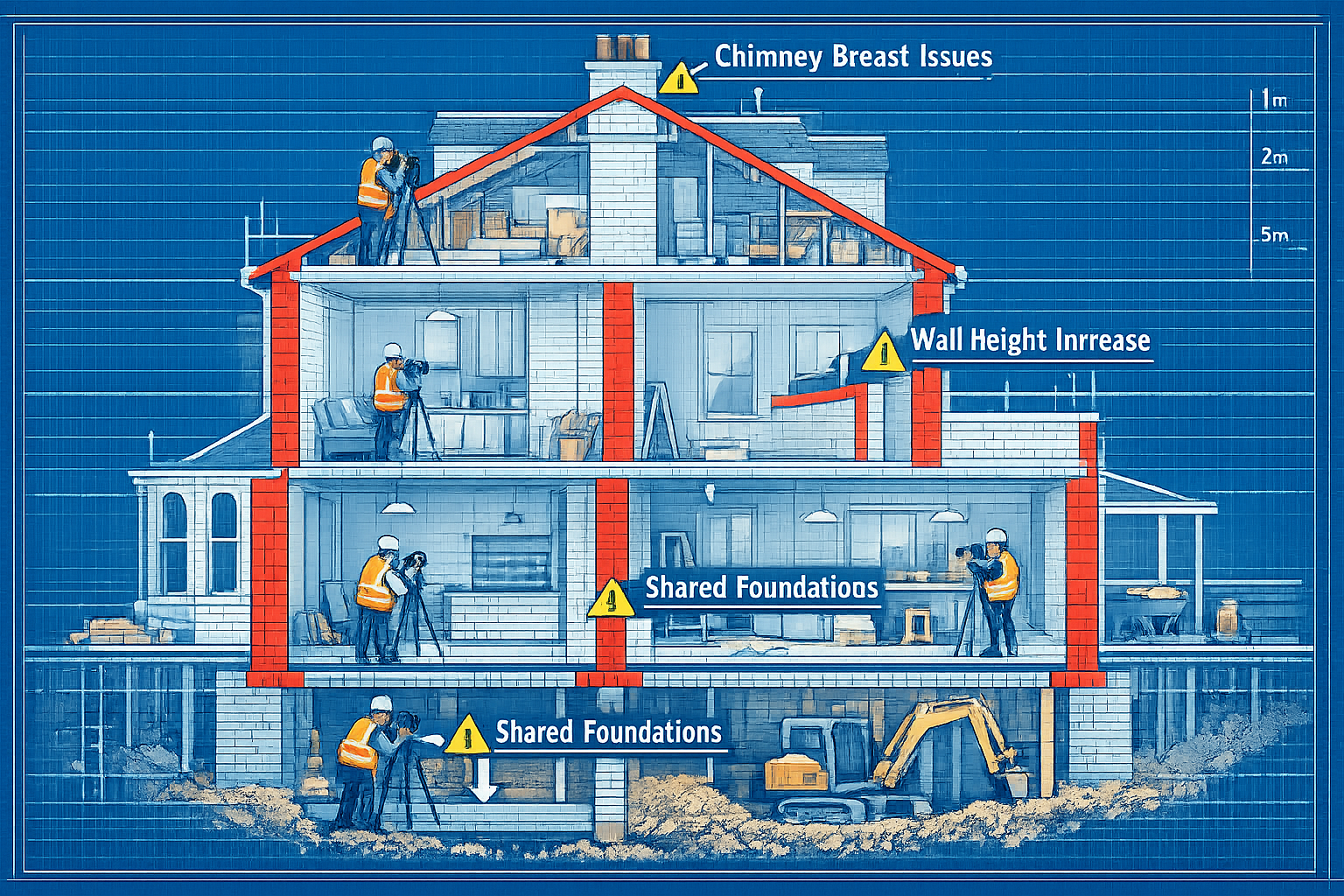
Loft conversions present unique party wall complications, particularly in terraced and semi-detached properties where roof structures often interconnect.
Common loft conversion triggers:
🏠 Party wall height increases
Even raising the wall by a single brick course to accommodate headroom requires a Party Structure Notice. Many Victorian and Edwardian terraces have party walls that don't extend to roof level, necessitating upward extension[1].
🔥 Shared chimney modifications
Removing or altering chimney breasts on party walls requires notice, even if the chimney is disused. For specific guidance, review information about party wall considerations for shared chimneys.
⚡ Steel beam insertions
Installing structural steel beams into party walls to support new floor joists always requires formal procedures, as this constitutes cutting into the party structure.
Best practice tip: Engage your party wall surveyor during the design phase. They can advise on construction methods that minimize neighbour impact while ensuring compliance—potentially avoiding objections that delay projects.
Rear Extension Party Wall Specifics
Single-story rear extensions frequently trigger party wall requirements, especially in urban areas where properties share boundaries.
Key rear extension considerations:
📏 Foundation proximity
If your new extension foundations fall within three meters of your neighbour's existing foundations and go deeper, you need an Excavation Notice—even if the extension itself doesn't touch the party wall[1].
🧱 Building up to the boundary
Constructing directly against the boundary line (common in terraced properties maximizing space) requires a Line of Junction Notice, regardless of whether you're touching an existing party wall.
🚪 Existing party wall alterations
Knocking through an existing party wall to expand your kitchen into the new extension space requires a Party Structure Notice for the structural opening.
Cost consideration: Rear extensions often require multiple notice types. Budget for combined surveyor fees of £1,200-£1,800 when both Party Structure and Excavation Notices apply[2]. Understanding who pays for party wall surveyors helps with accurate project budgeting.
Basement Excavation Party Wall Requirements
Basement conversions represent the most complex party wall scenario, with excavation depths and proximity to neighbouring foundations creating significant risk.
Critical basement considerations:
📐 The 3-meter and 6-meter rules
- Within 3 meters of a neighbour's foundation: Notice required if digging deeper than their foundation level
- Within 3-6 meters: Notice required if excavation cuts below a 45-degree plane drawn downward from the bottom of their foundation[1]
These rules apply even when working entirely within your own property boundaries—the concern is undermining neighbouring structures.
🏗️ Underpinning requirements
Basement excavations frequently require underpinning of party walls. The Award must specify underpinning methods, temporary support measures, and monitoring procedures to detect any settlement.
💧 Waterproofing and drainage
While not strictly party wall matters, surveyors often include conditions about waterproofing methods to prevent moisture migration into neighbouring basements or foundations.
Timeline reality check: Basement projects with party wall complications typically add 3-4 months to project timelines:
- 3 months for Excavation Notice period
- 2-4 weeks for Award preparation
- Ongoing inspection requirements during excavation
Managing Costs, Disputes and Timeline Expectations
Party Wall Surveyor Costs in 2026
Understanding surveyor fee structures helps homeowners budget accurately for extension projects.
Typical cost ranges (2026 estimates based on 2024-2025 data):
| Service | Cost Range | Notes |
|---|---|---|
| Agreed Surveyor (simple extension) | £900-£1,200 | Single-story rear extension, cooperative neighbours |
| Agreed Surveyor (complex project) | £1,500-£2,500 | Basement excavation, multiple notices, detailed inspections |
| Two Surveyors (building owner's) | £1,200-£2,000 | Building owner pays for both surveyors typically |
| Two Surveyors (adjoining owner's) | £1,000-£1,800 | Also paid by building owner in most cases |
| Hourly consultation rates | £90-£450/hour | Geographic variation: London higher than regions[2] |
Who pays? Building owners (those undertaking the work) bear all surveyor costs in the vast majority of cases. The only exception occurs when work is necessary due to defects or repairs that benefit both properties—a determination made by the surveyor[2].
For current pricing information, see our 2024 party wall surveyor cost guide and general cost information.
Preventing and Resolving Common Party Wall Disputes
Proactive communication and proper procedures prevent most disputes before they escalate.
Top dispute triggers and solutions:
🔊 Noise and working hours
Problem: Unrestricted construction noise damages neighbour relations.
Solution: Include specific working hour restrictions in the Award (typically 8am-6pm weekdays, 8am-1pm Saturdays, no Sundays/bank holidays).
🏚️ Property damage claims
Problem: Neighbours attribute pre-existing cracks to your construction work.
Solution: Comprehensive schedule of condition with dated photographs provides irrefutable evidence of pre-work property state[2].
🚫 Access refusal
Problem: Neighbours deny access for pre-work inspections or monitoring.
Solution: Party Wall Awards legally grant access rights at reasonable times with appropriate notice. Persistent refusal can lead to court enforcement.
⏱️ Timeline disagreements
Problem: Neighbours object to project duration.
Solution: Award should specify expected completion timeframe and procedures for extensions if delays occur.
When disputes do arise, the appointed surveyor(s) mediate and make binding determinations. Only if surveyor decisions are challenged do cases proceed to County Court—a rare outcome with properly qualified professionals. For comprehensive dispute resolution strategies, consult our guide on resolving party wall disputes.
Realistic Timeline Planning for Extensions with Party Wall Procedures
Incorporating party wall requirements into project schedules prevents frustrating delays.
Typical timeline breakdown:
Months 1-2: Pre-Construction Phase
- Week 1-2: Finalize extension designs and appoint party wall surveyor
- Week 3-4: Prepare and serve formal notices to neighbours
- Week 5-12: 2-3 month statutory notice period runs
Month 3: Response and Award Phase
- Week 1-2: Neighbour response period (14 days)
- Week 3-6: If dissent, Award preparation including schedule of condition inspections
Month 4+: Construction Phase
- Pre-start: Final Award served, construction can legally commence
- Ongoing: Periodic surveyor inspections during critical phases
- Post-completion: Final inspection and damage assessment (if any)
Fast-track scenario (neighbour consents immediately):
Minimum 2 months from notice to construction start for wall works, 3 months for excavations[1].
Worst-case scenario (dispute with two surveyors appointed):
4-5 months from initial notice to construction commencement, plus potential delays if third surveyor required to resolve surveyor disagreements.
Pro tip: Serve party wall notices simultaneously with submitting planning applications. The timelines often run in parallel, preventing party wall procedures from extending your overall project duration.
Conclusion
Successfully navigating party wall surveying for UK home extensions in 2026 requires understanding three fundamental principles: early notification, proper documentation, and professional guidance. Whether planning a loft conversion, rear extension, or basement excavation, serving formal notices 2-3 months before starting work isn't merely good practice—it's a legal requirement that protects both you and your neighbours.
The Party Wall etc. Act 1996 provides a clear framework that, when followed correctly, allows extension projects to proceed smoothly while safeguarding neighbouring properties. Remember that party wall procedures operate independently from planning permission and building regulations, requiring separate compliance. While surveyor costs of £1,000-£2,500 may seem substantial, they represent essential insurance against disputes that could cost tens of thousands in legal fees and construction delays.
Next Steps for Your Extension Project
Immediate actions:
- Review your extension plans against the three notice types to determine requirements
- Identify all adjoining owners who need notification (including leaseholders and landlords)
- Appoint a qualified party wall surveyor before finalizing construction designs
- Prepare and serve notices at least 2-3 months before your planned start date
- Document everything with photographs and written records
For professional assistance with your party wall surveying needs, contact our experienced team who can guide you through every stage of the process. With proper planning and expert support, your home extension project can proceed on schedule while maintaining positive neighbour relations and full legal compliance.
References
[1] Party Wall Guide – https://www.squarepointsurveyors.co.uk/party-wall-guide/
[2] Party Wall Surveyor Cost – https://hoa.org.uk/advice/guides-for-homeowners/i-am-improving/party-wall-surveyor-cost/
[3] Party Wall Agreement – https://hoa.org.uk/advice/guides-for-homeowners/i-am-improving/party-wall-agreement/
[4] Party Wall Act – https://southernbcp.co.uk/Homeowners/Party-Wall-Act
