
The property surveying industry stands at a transformative crossroads in 2026. What once required days of manual data entry, countless hours of analysis, and significant risk of human error has been fundamentally reimagined through artificial intelligence and machine learning technologies. How AI and Machine Learning Are Revolutionizing Property Survey Data Processing in 2026 represents more than just technological advancement—it marks a paradigm shift in how surveyors gather, analyze, and interpret property data with unprecedented speed and accuracy.
Traditional property surveying methods involved surveyors spending 4-8 hours manually abstracting a single lease document, meticulously cross-referencing property records, and relying on limited comparable sales data to form valuations. Today, AI-powered platforms complete these same tasks in 15-30 minutes while achieving accuracy rates of 95-99%[4]. This dramatic transformation has reduced due diligence timelines by over 60% while simultaneously improving data reliability[2].
The integration of machine learning into property survey workflows has unlocked capabilities that seemed impossible just a few years ago: predictive risk assessment for environmental hazards, automated pattern detection across millions of data points, and real-time market analysis that updates continuously rather than providing static snapshots. For professional surveyors, understanding and implementing these technologies has become essential to remaining competitive in an increasingly data-driven real estate landscape.
Key Takeaways
✅ Dramatic efficiency gains: AI has reduced lease abstraction time from 4-8 hours to 15-30 minutes per document while maintaining 95-99% accuracy rates, representing the highest-impact use case in real estate operations[4].
✅ Enhanced risk prediction: Machine learning algorithms can now predict environmental hazards including flooding and landslides using historical data patterns, enabling proactive risk mitigation strategies[3].
✅ Multidimensional data synthesis: Modern AI systems incorporate economic indicators, environmental factors, neighborhood quality metrics, and visual property data—far beyond the handful of comparable sales traditional methods relied upon[1].
✅ Continuous market monitoring: AI-driven valuations provide real-time assessments with daily updates achieving accuracy within 3-4% of actual leased rents, replacing outdated static snapshot approaches[4].
✅ Practical implementation pathways: Surveyors can integrate AI tools through phased adoption, starting with automated data extraction and progressively incorporating predictive analytics and risk assessment capabilities.
Understanding the Foundation: How AI and Machine Learning Transform Survey Data Processing
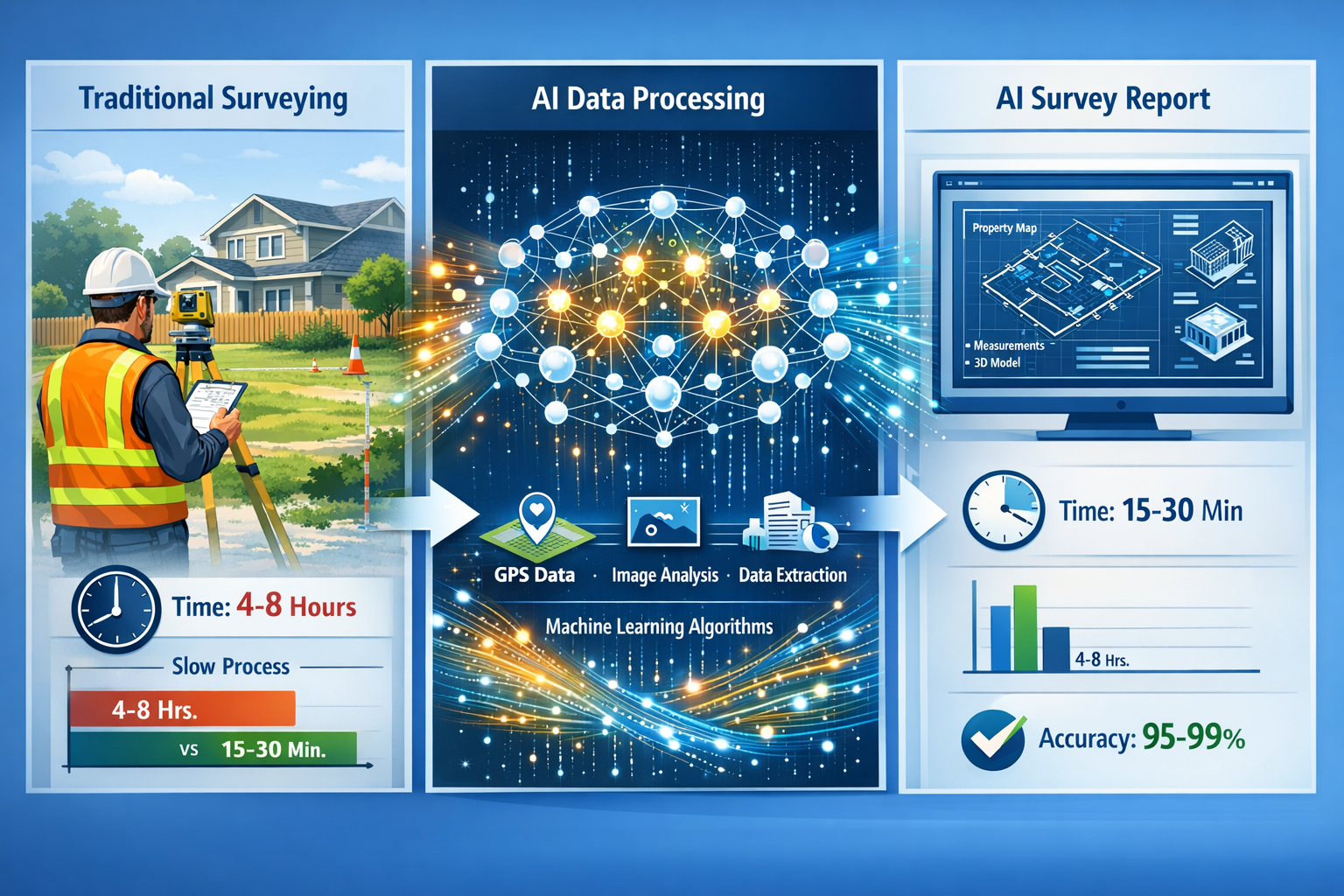
The Traditional Survey Data Processing Challenge
Property survey data processing has historically been one of the most labor-intensive aspects of real estate operations. Surveyors faced multiple challenges that constrained both efficiency and accuracy:
Manual data entry errors plagued traditional workflows, with human operators transcribing information from multiple sources including public records, physical property inspections, and historical documentation. Each transcription point introduced potential inaccuracies that could compound throughout the analysis process.
Limited data synthesis capabilities meant that traditional systems could only incorporate a narrow range of variables. Most valuations relied on basic property metrics and a handful of comparable sales, missing crucial contextual factors that influence property values[1].
Time-consuming verification processes required surveyors to manually cross-reference data from multiple sources, often taking days or weeks to complete comprehensive due diligence on complex properties.
Static analysis snapshots provided only historical perspectives, offering limited insight into future market trends or emerging risk factors that could affect property values.
The AI and Machine Learning Revolution in Property Surveys
The transformation brought by AI and machine learning addresses each of these traditional limitations while introducing entirely new capabilities. Modern AI-powered survey platforms leverage several key technologies:
Natural Language Processing (NLP) enables systems to read and interpret unstructured documents including lease agreements, property descriptions, and legal documents with human-level comprehension. This technology powers the dramatic reduction in lease abstraction time from hours to minutes[4].
Computer Vision analyzes property images, aerial photography, and satellite imagery to extract valuable insights about property condition, surrounding development, and environmental factors that might affect valuation or risk assessment.
Predictive Analytics uses historical data patterns to forecast future trends, identify emerging risks, and model how changing economic conditions might affect specific properties or neighborhoods differently[1].
Anomaly Detection Algorithms continuously monitor data streams to flag inconsistencies, unusual patterns, or potential errors that human analysts might overlook, particularly in complex rent rolls and multi-property portfolios[2].
For surveyors conducting building surveys or commercial property assessments, these technologies represent fundamental improvements in both capability and efficiency.
Real-World Performance Metrics
The impact of AI on property survey data processing can be quantified through impressive performance improvements:
| Metric | Traditional Method | AI-Powered Method | Improvement |
|---|---|---|---|
| Lease abstraction time | 4-8 hours per document | 15-30 minutes | 90-95% reduction[4] |
| Market analysis duration | Days to weeks | Under 1 minute | 98% reduction[4] |
| Due diligence timeline | Weeks | Hours to days | 60%+ reduction[2] |
| Rent survey coverage | Limited sampling | 35+ million units | Comprehensive scale[4] |
| Data accuracy rate | 85-90% (manual) | 95-99% | 5-10% improvement[4] |
| Rent estimate accuracy | ±10-15% variance | ±3-4% variance | 3x more precise[4] |
These metrics demonstrate that How AI and Machine Learning Are Revolutionizing Property Survey Data Processing in 2026 extends beyond mere automation—it represents a qualitative leap in what's possible within property analysis workflows.
Automated Pattern Detection and Data Synthesis: The Core of AI-Powered Surveying
Multidimensional Data Integration
One of the most significant advantages AI brings to property survey data processing is the ability to synthesize information from vastly more sources than traditional methods could accommodate. Modern machine learning systems incorporate:
Economic Indicators 📊
- Interest rate trends and forecasts
- Employment statistics at neighborhood and regional levels
- Income distribution patterns
- Economic development initiatives
- Commercial activity indicators
Environmental Factors 🌍
- Flood risk assessments using historical weather data
- Landslide susceptibility based on geological surveys
- Proximity to environmental hazards
- Urban development projects and infrastructure improvements
- Green space availability and environmental quality metrics
Neighborhood Quality Metrics 🏘️
- School ratings and educational performance data
- Crime statistics and safety trends
- Walkability scores and transportation access
- Amenity proximity (shopping, healthcare, recreation)
- Community demographic trends
Visual and Descriptive Data 📸
- Property condition assessment from images
- Architectural style and quality indicators
- Maintenance level evaluation
- Comparable property visual analysis
- Satellite imagery for context and development tracking
Traditional valuation systems relied on only a handful of comparable sales and basic property metrics[1]. By contrast, machine learning platforms can process thousands of data points instantly, identifying correlations and patterns that would be impossible for human analysts to detect manually.
This comprehensive approach proves particularly valuable for structural surveys and commercial building surveys, where multiple factors interact to influence property value and risk profiles.
Automated Data Extraction and Cross-Verification
AI systems have revolutionized how surveyors extract and verify property data through several automated processes:
Intelligent Document Processing eliminates manual data entry by automatically reading and extracting relevant information from:
- Lease agreements and rental contracts
- Property deeds and title documents
- Historical survey reports
- Municipal records and permits
- Environmental assessment reports
- Insurance documentation
The system doesn't just extract text—it understands context, recognizing that "monthly rent" in one document corresponds to "rental income" in another, automatically reconciling terminology differences across sources.
Multi-Source Cross-Referencing provides automated verification by comparing data from:
- Public property records
- Aerial imagery and satellite data
- Market transaction databases
- Municipal assessment records
- Third-party data providers
- Historical survey archives
When discrepancies arise, AI systems flag them for human review rather than allowing errors to propagate through the analysis. This approach eliminates manual data entry errors through consistent financial modeling and automated validation[2].
Continuous Data Updates ensure survey information remains current through:
- Daily market data refreshes
- Real-time public record monitoring
- Automated comparable property tracking
- Economic indicator integration
- Environmental risk database updates
This continuous monitoring capability means that AI-driven valuations provide updated assessments rather than static snapshots[1], a critical advantage in rapidly changing real estate markets.
Pattern Recognition Beyond Human Capability
Machine learning algorithms excel at identifying subtle patterns and correlations that human analysts might miss, even with extensive experience. Examples include:
Early Market Trend Detection 📈
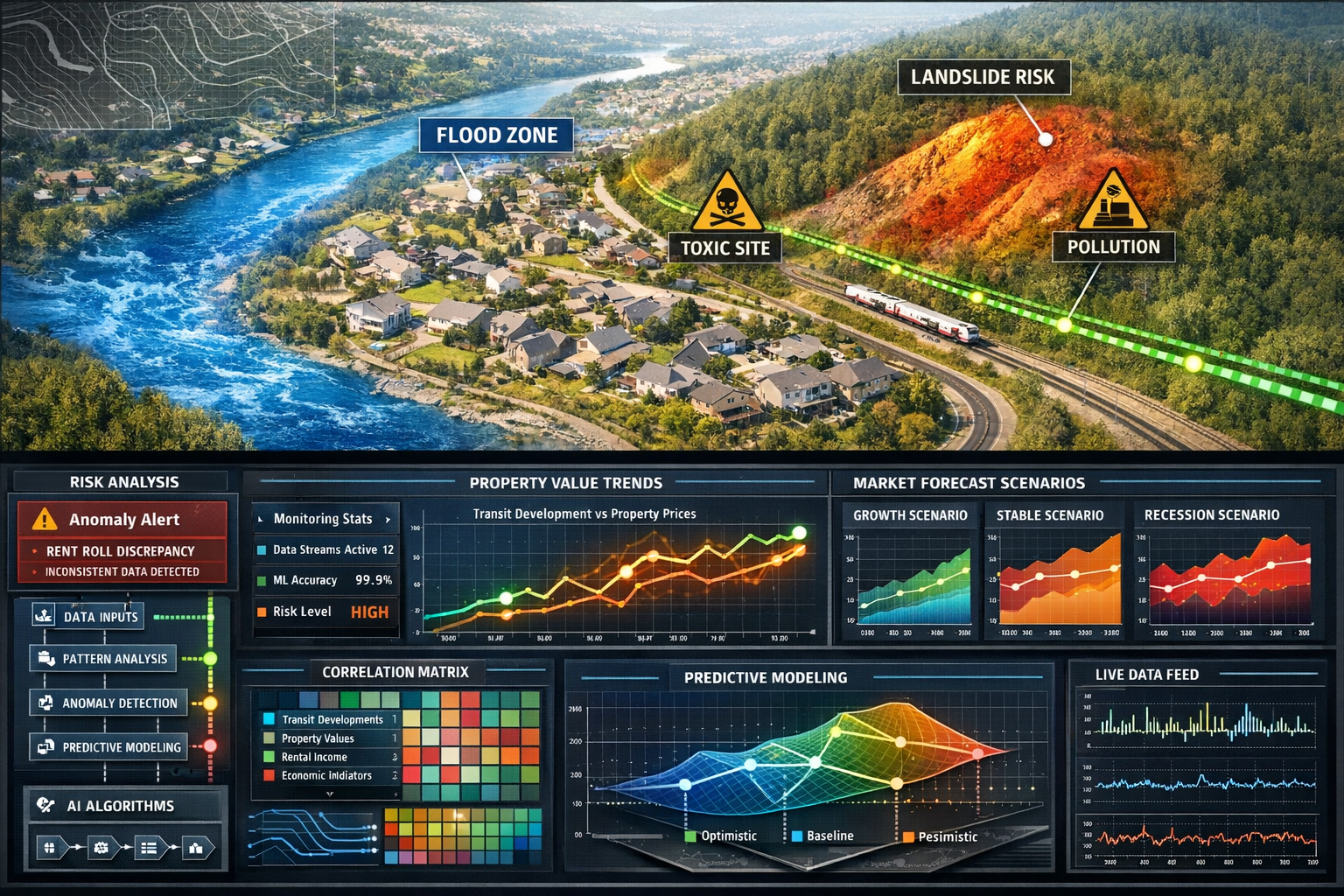
AI systems can recognize that proximity to new transit lines raises property values months before sales data reflects this change[1]. By analyzing planning documents, construction permits, and historical patterns from similar developments in other areas, machine learning models predict value impacts before they become obvious in transaction data.
Seasonal and Cyclical Patterns
Algorithms identify complex seasonal variations in property values, rental rates, and market activity that vary by property type, location, and economic conditions. These patterns inform more accurate timing recommendations for property transactions.
Micro-Market Differentiation
Rather than treating entire neighborhoods uniformly, AI systems identify micro-markets within broader areas where specific characteristics create distinct value patterns. A property three blocks from another might perform very differently based on subtle factors like street configuration, parking availability, or proximity to specific amenities.
Risk Correlation Identification
Machine learning models discover non-obvious risk correlations, such as how certain property characteristics correlate with insurance claims, maintenance issues, or tenant turnover rates. These insights enable more sophisticated risk assessment than traditional methods allow.
For surveyors conducting Level 3 building surveys, these pattern recognition capabilities provide deeper insights into property condition, potential issues, and long-term value trajectories.
Predictive Risk Assessment: AI-Powered Environmental and Market Hazard Detection
Environmental Risk Prediction and Mitigation
One of the most valuable applications of How AI and Machine Learning Are Revolutionizing Property Survey Data Processing in 2026 lies in predictive risk assessment. Machine learning algorithms can now predict potential hazards including flooding, landslides, and other environmental risks using historical data[3], transforming how surveyors evaluate property safety and long-term viability.
Flood Risk Prediction 💧
AI systems analyze multiple data sources to assess flood vulnerability:
- Historical flood event records spanning decades
- Topographical data and watershed analysis
- Climate change projections and rainfall pattern shifts
- Infrastructure capacity (drainage systems, flood barriers)
- Soil composition and absorption characteristics
- Development patterns affecting water flow
Rather than relying solely on static flood zone maps, machine learning models provide dynamic risk assessments that account for changing environmental conditions and infrastructure development. These predictions help surveyors identify properties where flood risk may be increasing or decreasing over time.
Landslide and Geological Hazard Assessment 🏔️
Machine learning platforms evaluate landslide susceptibility by analyzing:
- Geological composition and soil stability data
- Slope angles and terrain characteristics
- Vegetation cover and root system stability
- Historical landslide events in similar conditions
- Rainfall patterns and saturation levels
- Seismic activity and earthquake risk
These assessments prove particularly valuable for properties in hillside locations or areas with complex geological characteristics where traditional visual inspections might miss subtle risk indicators.
Environmental Contamination Detection
AI systems can flag potential contamination risks by analyzing:
- Historical property use and industrial activity
- Proximity to known contamination sites
- Soil and groundwater testing patterns
- Regulatory violation records
- Aerial imagery showing land use changes over time
This capability helps surveyors conducting dilapidation surveys identify properties requiring additional environmental investigation before transactions proceed.
Anomaly Detection in Property Data
Machine learning algorithms excel at identifying inconsistencies and anomalies that might indicate problems, fraud, or data quality issues:
Rent Roll Analysis 🏢
AI systems flag unusual patterns in rental income data:
- Rental rates significantly above or below market comparables
- Unusual lease term structures
- Inconsistent rent escalation clauses
- Suspicious vacancy patterns
- Tenant concentration risks
These ML algorithms flag inconsistencies in rent rolls and leases that humans might overlook[2], particularly in large commercial properties with hundreds of tenants where manual review becomes impractical.
Property Condition Anomalies
Computer vision and data analysis identify potential issues:
- Maintenance patterns inconsistent with property age
- Repair costs significantly above or below comparable properties
- Unusual insurance claim histories
- Discrepancies between reported and observed conditions
- Structural elements showing accelerated deterioration
Market Behavior Anomalies
Predictive models detect unusual market activity:
- Transaction prices significantly deviating from predicted values
- Rapid value changes without corresponding market drivers
- Unusual buyer or seller behavior patterns
- Market manipulation indicators
For professionals providing chartered surveyor services, these anomaly detection capabilities add a critical layer of due diligence protection for clients.
Scenario Modeling for Future Market Conditions
Perhaps the most forward-looking aspect of AI in property surveying is the ability to model how changing conditions might affect properties differently:
Economic Scenario Analysis 📊
Predictive models simulate impacts of various economic changes:
- Rising or falling interest rates on property values
- Employment shifts affecting rental demand
- Income changes influencing affordability
- Economic development initiatives transforming neighborhoods
- Inflation impacts on operating costs and rental rates
These models can simulate how changing economic conditions—such as rising mortgage rates—would affect specific neighborhoods differently[1], enabling surveyors to provide clients with forward-looking valuations rather than purely historical assessments.
Infrastructure Development Modeling
AI systems predict how planned infrastructure changes will impact properties:
- New transportation links (rail stations, highways)
- Commercial development projects
- School construction or closures
- Healthcare facility additions
- Retail and entertainment venue development
Regulatory Change Impact Assessment
Machine learning models evaluate how regulatory changes might affect property values:
- Zoning modifications
- Building code updates
- Environmental regulations
- Tax policy changes
- Rent control or tenant protection laws
Climate Change Adaptation Scenarios
Long-term predictive models assess climate change impacts:
- Sea level rise effects on coastal properties
- Changing weather pattern impacts
- Temperature shift effects on energy costs
- Water availability and drought risk
- Wildfire susceptibility changes
This scenario modeling capability transforms property surveying from a backward-looking historical analysis into a forward-looking strategic assessment that helps clients make better-informed decisions about property investments and risk management.
Practical Implementation: How Surveyors Can Integrate AI into Their Workflows
Phased Adoption Strategy for AI Integration
For surveyors looking to implement How AI and Machine Learning Are Revolutionizing Property Survey Data Processing in 2026 into their practices, a phased approach minimizes disruption while maximizing benefits:
Phase 1: Automated Data Extraction 🚀
Start with AI tools that automate the most time-consuming manual tasks:
- Lease abstraction platforms that reduce document processing time by 90%+[4]
- Automated property record retrieval from public databases
- Document digitization and intelligent filing systems
- Basic data validation and cross-referencing tools
This initial phase delivers immediate time savings with minimal workflow disruption, allowing teams to redirect hours previously spent on manual data entry toward higher-value analysis activities.
Phase 2: Enhanced Data Analysis 📈
Incorporate AI-powered analytical capabilities:
- Market comparable analysis tools that generate rent comparables in under one minute[4]
- Automated property valuation models (AVMs) with multidimensional data inputs
- Neighborhood analysis platforms incorporating economic and demographic data
- Visual property assessment using computer vision
These tools enhance the quality and depth of analysis while further reducing time requirements, enabling surveyors to provide more comprehensive insights to clients.
Phase 3: Predictive Analytics and Risk Assessment 🔮
Implement advanced machine learning capabilities:
- Environmental risk prediction platforms
- Market trend forecasting tools
- Anomaly detection systems for data quality assurance
- Scenario modeling for economic and regulatory changes
This phase transforms survey practices from reactive to proactive, enabling surveyors to identify risks and opportunities before they become apparent through traditional analysis methods.
Phase 4: Continuous Monitoring and Integration 🔄
Establish ongoing AI-powered monitoring systems:
- Real-time market data feeds with daily updates[4]
- Automated alert systems for significant market changes
- Portfolio-wide risk monitoring for multi-property clients
- Integration with client property management systems
This final phase creates a continuous intelligence capability that provides ongoing value to clients beyond discrete survey engagements.
Selecting the Right AI Tools for Property Surveying
The AI tools market for real estate has expanded dramatically, with platforms offering varying capabilities and specializations. Key considerations when selecting tools include:
Data Coverage and Quality 📊
- Geographic coverage matching your service area
- Property type specialization (residential, commercial, industrial)
- Data source diversity and update frequency
- Historical data depth for trend analysis
Top AI platforms for real estate now cover over 35 million residential units nationwide and 2.2 million properties[4], providing comprehensive market coverage for most surveying needs.
Accuracy and Validation ✅
- Published accuracy rates and validation methodologies
- Independent verification of performance claims
- Error handling and quality assurance processes
- Transparency in algorithmic decision-making
Leading platforms achieve accuracy rates of 95-99% for lease abstraction[4] and within 3-4% for rent estimates[4], setting benchmarks for acceptable performance levels.
Integration Capabilities 🔗
- Compatibility with existing survey software and workflows
- API availability for custom integrations
- Export formats and data portability
- Cloud-based vs. on-premise deployment options
User Experience and Training 👥
- Interface intuitiveness and learning curve
- Training resources and documentation quality
- Customer support responsiveness
- User community and knowledge sharing
Cost Structure and ROI 💰
- Pricing models (per-property, subscription, usage-based)
- Implementation costs and timeline
- Ongoing maintenance and update expenses
- Expected time savings and efficiency gains
For surveyors providing homebuyer surveys or specialized services like roof surveys, selecting tools with appropriate specialization ensures maximum value.
Overcoming Implementation Challenges
Despite the clear benefits, surveyors face several challenges when implementing AI technologies:
Data Quality and Standardization 🎯
AI systems require clean, standardized data to function optimally. Surveyors should:
- Audit existing data for completeness and accuracy
- Establish data standardization protocols
- Implement data governance policies
- Create feedback loops for continuous quality improvement
Staff Training and Change Management 👨🏫
Successful AI adoption requires team buy-in and capability development:
- Provide comprehensive training on new tools and workflows
- Communicate the benefits clearly to reduce resistance
- Start with enthusiastic early adopters as champions
- Gradually expand adoption as comfort levels increase
- Emphasize that AI augments rather than replaces human expertise
Regulatory and Professional Standards Compliance ⚖️
Ensure AI implementation aligns with professional requirements:
- Verify that AI-assisted surveys meet RICS standards
- Maintain appropriate professional oversight of AI outputs
- Document AI tool usage in survey reports
- Ensure data privacy and security compliance
- Stay informed about evolving regulatory guidance on AI use
Balancing Automation with Professional Judgment 🤝
AI should enhance, not replace, professional surveyor expertise:
- Use AI for data processing and pattern identification
- Apply professional judgment to interpret AI outputs
- Verify critical findings through traditional methods when appropriate
- Maintain transparency with clients about AI tool usage
- Take responsibility for all survey conclusions regardless of AI involvement
The architecture, engineering, and construction sector has been relatively slow to adapt AI technologies[7], but early adopters gain significant competitive advantages through enhanced efficiency and analytical capabilities.
GPS and Field Data Collection Optimization
AI and machine learning extend beyond office-based data analysis to optimize field survey operations:
GPS Signal Prediction and Route Optimization 🛰️
Machine learning models can predict when and where GPS signal outages might occur in challenging terrain and optimize survey team routes accordingly, reducing time spent navigating difficult terrain[6]. This capability proves particularly valuable for:
- Rural property surveys in areas with inconsistent GPS coverage
- Urban canyon environments where tall buildings interfere with signals
- Forested or mountainous terrain with natural signal obstacles
- Large property surveys requiring efficient coverage planning
Automated Zone Classification 🗺️
Supervised learning models can label and differentiate survey zones for construction, conservation, or agricultural use at scale[6], enabling:
- Faster preliminary site assessments
- Automated land use verification
- Regulatory compliance checking
- Environmental sensitivity identification
Field Data Quality Assurance ✓
AI algorithms can analyze field-collected data in real-time to:
- Identify measurement inconsistencies requiring re-verification
- Flag incomplete data collection before leaving the site
- Suggest additional data points needed for comprehensive analysis
- Validate measurements against expected ranges
These field optimization capabilities complement office-based analytical tools, creating an end-to-end AI-enhanced surveying workflow that improves efficiency at every stage.
The Broader Context: AI Integration Across Real Estate Operations

Industry-Wide AI Adoption Trends
How AI and Machine Learning Are Revolutionizing Property Survey Data Processing in 2026 represents just one component of a broader transformation across the entire real estate industry:
Property Management Automation 🏢
AI platforms now handle routine property management tasks:
- Tenant screening and credit analysis
- Maintenance request prioritization and routing
- Lease renewal optimization
- Rent pricing recommendations based on market conditions
Investment Analysis and Portfolio Management 💼
Institutional investors leverage AI for:
- Portfolio optimization and rebalancing
- Acquisition target identification
- Risk-adjusted return forecasting
- Market timing recommendations
Development and Construction 🏗️
AI supports development decisions through:
- Site selection analysis
- Highest and best use determination
- Construction cost estimation
- Project timeline optimization
Transaction Facilitation 🤝
Real estate transactions benefit from AI through:
- Automated document review and due diligence
- Pricing strategy optimization
- Buyer-property matching algorithms
- Transaction risk assessment
Artificial intelligence has significant implications for real estate across all these domains[8], creating an interconnected ecosystem where survey data feeds into broader analytical frameworks.
Integration with Traditional Surveying Expertise
The most effective approach combines AI capabilities with traditional surveying expertise rather than viewing them as competing alternatives:
AI Handles:
- High-volume data processing
- Pattern recognition across large datasets
- Continuous market monitoring
- Routine calculations and comparisons
- Initial risk flagging and anomaly detection
Human Surveyors Provide:
- Professional judgment and interpretation
- Context understanding and local market knowledge
- Complex problem-solving for unusual situations
- Client relationship management and communication
- Ethical oversight and quality assurance
- Regulatory compliance verification
This complementary relationship enables surveyors to focus on high-value activities that require human expertise while delegating time-consuming data processing tasks to AI systems.
For instance, when conducting party wall surveys or managing party wall disputes, AI can rapidly analyze historical settlement data and comparable situations, but experienced surveyors remain essential for negotiating solutions and ensuring compliance with the Party Wall Act.
Future Developments on the Horizon
Looking beyond 2026, several emerging developments promise to further transform property survey data processing:
Enhanced Computer Vision 👁️
Next-generation image analysis will:
- Detect subtle structural defects invisible to human inspection
- Assess material quality and remaining useful life
- Identify building code violations automatically
- Generate 3D property models from simple photographs
Natural Language Interaction 💬
Conversational AI interfaces will enable:
- Voice-commanded survey report generation
- Natural language queries of property databases
- Automated client communication and updates
- Intelligent survey report summarization
Blockchain Integration 🔗
Distributed ledger technology will provide:
- Immutable property history records
- Automated smart contract execution for transactions
- Transparent data provenance and verification
- Reduced fraud risk through cryptographic validation
Internet of Things (IoT) Integration 📡
Connected building sensors will enable:
- Real-time property condition monitoring
- Predictive maintenance scheduling
- Energy efficiency optimization
- Continuous valuation updates based on actual performance data
Quantum Computing Applications ⚛️
As quantum computing becomes commercially viable:
- Complex scenario modeling will execute exponentially faster
- Portfolio optimization will consider vastly more variables
- Risk assessment will incorporate unprecedented data volumes
- Market predictions will achieve new levels of sophistication
These developments will continue the trajectory established by current AI and machine learning applications, further enhancing surveyor capabilities and client value.
Conclusion: Embracing the AI Revolution in Property Surveying
How AI and Machine Learning Are Revolutionizing Property Survey Data Processing in 2026 represents a fundamental transformation in how property professionals gather, analyze, and interpret data. The evidence is compelling: 90-95% reductions in processing time[4], accuracy improvements to 95-99%[4], and 60%+ reductions in due diligence timelines[2] demonstrate that AI delivers tangible, measurable benefits to surveying practices.
The revolution extends far beyond simple automation. Machine learning enables predictive risk assessment for environmental hazards[3], multidimensional data synthesis incorporating economic, environmental, and social factors[1], and continuous market monitoring that replaces static snapshots with dynamic, real-time intelligence[4]. These capabilities transform surveying from a backward-looking historical analysis into a forward-looking strategic advisory service.
For property surveyors, the question is no longer whether to adopt AI technologies, but rather how quickly and effectively to integrate them into existing workflows. The competitive advantages accrue to early adopters who combine AI capabilities with traditional surveying expertise, creating a powerful synergy that delivers superior client value.
Actionable Next Steps for Surveyors
Immediate Actions (Next 30 Days): 🎯
- Assess current workflows to identify the most time-consuming manual tasks that AI could automate
- Research AI platforms specializing in property survey data processing, focusing on tools with proven accuracy rates above 95%[4]
- Calculate potential ROI by estimating time savings from reducing lease abstraction from hours to minutes[4]
- Identify pilot projects suitable for initial AI tool testing with limited risk
Short-Term Implementation (3-6 Months): 📅
- Select and implement automated data extraction tools for lease abstraction and document processing
- Train staff on new AI platforms, starting with enthusiastic early adopters
- Establish data quality protocols to ensure AI systems receive clean, standardized inputs
- Monitor performance metrics comparing AI-assisted workflows to traditional methods
- Gather client feedback on enhanced service delivery and insights
Medium-Term Development (6-12 Months): 📈
- Expand AI capabilities to include predictive analytics and risk assessment tools
- Integrate AI outputs with existing survey reporting frameworks
- Develop specialized expertise in interpreting and validating AI-generated insights
- Create marketing materials highlighting AI-enhanced service capabilities
- Build strategic partnerships with AI platform providers for ongoing support and development
Long-Term Strategic Positioning (12+ Months): 🚀
- Establish continuous monitoring systems for portfolio clients requiring ongoing intelligence
- Develop proprietary methodologies combining AI capabilities with firm-specific expertise
- Contribute to industry standards development for AI use in property surveying
- Invest in emerging technologies including enhanced computer vision and IoT integration
- Build thought leadership through case studies demonstrating AI implementation success
The transformation of property survey data processing through AI and machine learning is not a distant future possibility—it's happening now in 2026. Surveyors who embrace these technologies position themselves at the forefront of industry evolution, delivering superior value to clients while building more efficient, scalable, and competitive practices.
The revolution is here. The question is: will you lead it, follow it, or be left behind by it?
For professional guidance on implementing modern surveying approaches, explore our comprehensive resources on building surveys, commercial property surveys, and chartered surveyor services to see how traditional expertise and cutting-edge technology combine to deliver exceptional results.
References
[1] How Ai And Machine Learning Are Reshaping Property Valuations In 2026 – https://www.thepaintedhinge.com/how-ai-and-machine-learning-are-reshaping-property-valuations-in-2026/
[2] Ai Property Analysis – https://www.growthfactor.ai/blog-posts/ai-property-analysis
[3] The Future Of Land Surveying Technology And Upcoming Trends In 2026 – https://metricop.com/blogs/land-surveying/the-future-of-land-surveying-technology-and-upcoming-trends-in-2026
[4] Best Ai Tools For Real Estate – https://www.v7labs.com/blog/best-ai-tools-for-real-estate
[6] Ai Machine Learning Impact Gps Data Processsing – https://www.baselineequipment.com/ai-machine-learning-impact-gps-data-processsing
[7] Architecture Engineering Construction Sector Slow To Adapt Ai Survey Shows – https://www.asce.org/publications-and-news/civil-engineering-source/article/2025/12/18/architecture-engineering-construction-sector-slow-to-adapt-ai-survey-shows
[8] Artificial Intelligence And Its Implications For Real Estate – https://www.jll.com/en-us/insights/artificial-intelligence-and-its-implications-for-real-estate
