
Institutional investors now control just 0.55% of the single-family housing market—approximately 450,000 properties nationwide—yet their influence on professional standards and due diligence practices far exceeds their market share. As the Institutional and Professional Landlord Investment Surge 2026: Building Survey Standards for Portfolio Expansion accelerates, these sophisticated investors are establishing rigorous building survey protocols that separate professional portfolio management from traditional buy-to-let approaches.
The gap between institutional-grade property assessment and casual landlord practices has never been wider. While mom-and-pop landlords often rely on basic visual inspections or forgo surveys entirely, institutional investors are implementing comprehensive building survey frameworks that include thermal imaging, structural engineering assessments, and predictive maintenance modeling. This professional approach to portfolio expansion in 2026 reflects both risk management imperatives and the operational efficiencies that allow institutional players to operate at lower margins than smaller competitors[1].

Key Takeaways
✅ Institutional investors maintain sub-1% market share but set professional standards for building surveys that influence the entire rental sector, with ownership concentrated in just 22 counties nationwide at 5-10% levels[1]
✅ Survey depth requirements differ dramatically between institutional portfolios (requiring Level 3 comprehensive surveys, structural reports, and ongoing condition monitoring) versus accidental landlords (often using basic homebuyer surveys or no surveys)
✅ Geographic investment concentration in Sun Belt and Midwest markets like Indianapolis and Nashville drives demand for qualified chartered surveyors who understand institutional documentation standards[2][3]
✅ Commercial real estate values projected to appreciate 4.9% in 2026 after three years of underperformance, creating urgency for thorough building surveys before portfolio acquisitions[5]
✅ Regulatory scrutiny intensifying with Sen. Elizabeth Warren demanding data from 14 major landlords in March 2026, making defensible survey documentation critical for institutional investors[7]
Understanding the Institutional and Professional Landlord Investment Surge 2026
The landscape of rental property investment has fundamentally transformed. Institutional investors with 1,000 or more homes own 450,000 single-family properties—representing just 0.55% of the total market—while smaller landlords holding 10-99 homes control 1.88 million properties (2.3%)[1]. This concentration reveals an important truth: institutional investors aren't dominating numerically, but they're revolutionizing operational standards.
The Data Behind Investment Flows
Recent research demolishes common misconceptions about institutional investor impact. For every property purchased by institutional investors, homeowner-occupied homes fell by only 0.22, but total rental supply expanded by 0.5 homes per institutional purchase[1]. This net housing expansion contradicts the "crowding out" narrative that dominates public discourse.
Geographic concentration remains remarkably limited. Only 22 counties nationwide have institutional ownership rates between 5% and 10% of single-family rentals, with none exceeding 10%[1]. The highest concentration exists in Atlanta at approximately 4% of total single-family homes—hardly the market dominance suggested by political rhetoric.
Why Building Survey Standards Matter More Than Market Share
The Institutional and Professional Landlord Investment Surge 2026: Building Survey Standards for Portfolio Expansion isn't about volume—it's about methodology. Institutional investors operate at lower margins than mom-and-pop owners, potentially reducing rents through operational efficiencies[1]. These efficiencies begin with comprehensive building assessments that identify maintenance requirements, structural risks, and capital expenditure forecasts before acquisition.
Professional landlords understand that a thorough Level 3 building survey isn't an expense—it's an investment in portfolio stability. The survey reveals hidden defects, quantifies repair costs, and provides negotiating leverage that can reduce purchase prices by amounts far exceeding survey fees.
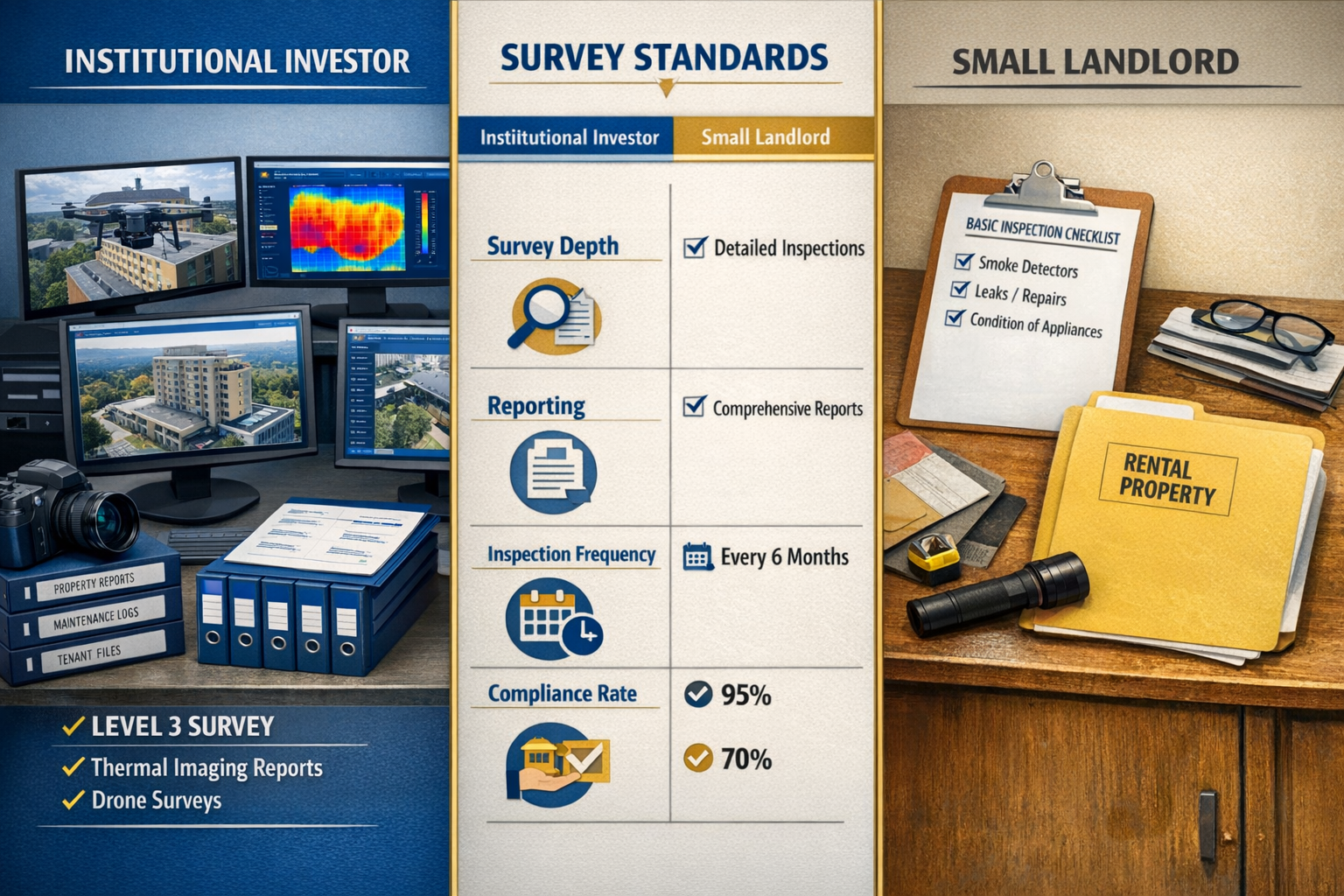
Survey Depth Requirements: Institutional Standards vs. Accidental Landlords
The divergence between professional and amateur approaches to property assessment defines the current market. Institutional investors implement standardized due diligence protocols across entire portfolios, while individual landlords often make acquisition decisions based on cursory inspections or emotional responses to properties.
Institutional Survey Protocols
Professional landlords acquiring properties in 2026 typically require:
🏗️ Comprehensive Structural Assessment
- Full structural surveys conducted by chartered surveyors
- Detailed foundation inspections including subsidence risk evaluation
- Roof structure analysis with remaining lifespan estimates
- Load-bearing wall assessments for future modification potential
🔍 Advanced Diagnostic Technology
- Thermal imaging to identify insulation deficiencies and moisture penetration
- Drone surveys for roof and chimney condition assessment
- Moisture meter readings throughout the property
- Electrical installation condition reports (EICR)
📋 Regulatory Compliance Documentation
- Energy Performance Certificate (EPC) ratings with improvement pathways
- Asbestos surveys for properties built before 2000
- Fire safety assessments for multi-unit buildings
- Dilapidations surveys documenting baseline conditions
💰 Financial Modeling Integration
- Capital expenditure forecasts for 5-10 year holding periods
- Maintenance reserve calculations based on survey findings
- Risk-adjusted return projections incorporating survey-identified issues
- Portfolio-level aggregation of survey data for strategic planning
Accidental Landlord Approaches
In contrast, individual landlords—particularly those who inherited properties or retained former residences—often approach building surveys with significantly less rigor:
- Basic homebuyer surveys that miss critical structural issues
- No survey at all for inherited or retained properties
- Visual inspections only without diagnostic equipment
- Reactive maintenance rather than predictive planning
- Single-property perspective without portfolio-level risk management
This gap in survey standards creates tangible financial consequences. Research from chartered surveyors across London indicates that properties purchased without comprehensive surveys experience 40-60% higher unexpected maintenance costs in the first three years of ownership compared to those with thorough pre-acquisition assessments.
The Cost-Benefit Analysis
| Survey Type | Typical Cost | Issues Identified | Average Negotiation Leverage | ROI Multiplier |
|---|---|---|---|---|
| Level 3 Building Survey | £800-£1,500 | Major structural, hidden defects, all systems | £5,000-£25,000 price reduction | 5-15x |
| Level 2 Homebuyer Survey | £400-£800 | Visible defects, obvious issues | £1,000-£5,000 price reduction | 2-5x |
| Basic Valuation | £250-£400 | Market value only, minimal inspection | Minimal | <1x |
| No Survey | £0 | Unknown risks | None | Negative ROI |
Institutional investors consistently choose comprehensive surveys because they understand portfolio-level risk. A single missed structural issue can eliminate profits across multiple properties. Professional standards demand thorough commercial building surveys that quantify risks before capital deployment.

Geographic Concentration and Survey Demand in 2026 Markets
The Institutional and Professional Landlord Investment Surge 2026: Building Survey Standards for Portfolio Expansion follows distinct geographic patterns that create regional variations in survey demand and professional standards.
Sun Belt and Midwest Investment Hotspots
Indianapolis: The Cash Flow Champion 🏆
Indianapolis has emerged as the leading market for institutional investors seeking cash flow rather than speculative appreciation[2]. The city's price-to-rent ratio, diverse economy anchored by healthcare (Indiana University Health, Community Health Network) and pharmaceutical manufacturing (Eli Lilly), plus landlord-friendly state policies create ideal conditions for portfolio expansion[3].
Survey demand in Indianapolis reflects the city's building stock characteristics:
- High proportion of early 20th-century housing requiring specialized period property surveys
- Basement moisture issues common due to regional water table conditions
- Foundation settlement concerns in clay soil areas
- Older mechanical systems requiring detailed condition assessments
Nashville: Appreciation and Demographics
Nashville attracts institutional capital through its tech and healthcare boom, young demographics, and high rental demand[2]. The city's rapid growth creates unique survey challenges:
- New construction requiring snagging surveys and warranty documentation
- Rapid neighborhood transitions demanding careful location risk assessment
- Mixed-age building stock requiring varied survey approaches
- Higher-end rental properties needing premium finish condition documentation
Texas and Florida Dominance
These states claim 10 of the top 15 investment cities due to no state income tax policies[3]. Survey considerations in these markets include:
- Hurricane and flood risk assessments for coastal properties
- Foundation issues related to expansive soils (particularly Texas)
- Rapid construction quality variations requiring thorough inspections
- Climate-specific building envelope performance evaluation
Regional Survey Standard Variations
Survey requirements and professional standards vary significantly by region:
London and Southeast England
- Chartered surveyors in areas like Islington, Battersea, and East London face complex Victorian and Edwardian building stock
- Leasehold complications requiring specialized valuation expertise
- Conservation area restrictions affecting modification potential
- High property values justifying comprehensive survey investment
Suburban Growth Markets
- Chartered surveyors in Ealing, Putney, and Clapham handle mixed residential stock
- Transport infrastructure improvements driving investment
- Conversion and extension potential requiring structural assessments
- Rental yield calculations incorporating local market dynamics
Commuter Belt Expansion
- Chartered surveyors in Watford, Harpenden, and Guildford serve growing institutional interest
- Modern housing estates with different survey priorities
- Commuter demand patterns affecting investment viability
- Lower per-property values requiring efficient survey processes
Commercial Real Estate Recovery Driving Survey Demand
Commercial real estate values are projected to appreciate 4.9% in 2026 after three years of underperformance, with prices troughing in late 2024[5]. This recovery is driving increased transaction volume and corresponding survey demand.
CRE transaction activity has been increasing since a 2023 low, with redemption queue pressure easing (ODCE queue declined from 19% NAV in 2023 to 12% currently)[5]. This liquidity improvement enables institutional investors to execute portfolio expansion strategies that were deferred during the 2022-2024 correction period.

Regulatory Scrutiny and Documentation Requirements
The political environment surrounding institutional landlord investment has intensified dramatically in 2026. On March 30, 2026, Sen. Elizabeth Warren sent letters to 14 major real estate companies—including Blackstone, Greystar, and Starwood Capital—demanding business practice and portfolio data as Congress debates a bipartisan ban on institutional investors[7].
The Documentation Imperative
This regulatory scrutiny makes comprehensive building survey documentation more critical than ever. Institutional investors must demonstrate:
📊 Transparent Acquisition Processes
- Independent third-party survey reports for all acquisitions
- Documented decision-making frameworks based on objective criteria
- Clear audit trails showing survey findings influenced purchase prices
- Standardized assessment protocols applied consistently across portfolios
🛡️ Tenant Protection Standards
- Pre-tenancy condition documentation preventing deposit disputes
- Maintenance response protocols based on survey-identified priorities
- Safety compliance documentation (gas, electrical, fire)
- Habitability standards exceeding minimum legal requirements
💼 Professional Management Evidence
- Ongoing condition monitoring schedules
- Preventive maintenance programs based on survey recommendations
- Capital expenditure tracking against survey-projected needs
- Tenant satisfaction metrics correlated with property condition
Survey Frequency Standards
Institutional investors typically implement survey schedules that far exceed individual landlord practices:
Acquisition Phase:
- Comprehensive Level 3 survey before purchase
- Specialist reports for identified concerns (structural engineer, damp specialist)
- Environmental assessments for contamination risks
- Boundary and title verification surveys
Operational Phase:
- Annual condition inspections for all properties
- Triennial comprehensive re-surveys
- Post-tenancy condition assessments
- Immediate specialist surveys following tenant-reported issues
Disposition Phase:
- Pre-sale condition documentation
- Comparable property analysis
- Repair vs. sell-as-is financial modeling
- Warranty and liability documentation
This systematic approach to building surveys creates defensible documentation should regulatory authorities question acquisition practices or tenant treatment.
The Economic Case for Survey Investment
The Institutional and Professional Landlord Investment Surge 2026: Building Survey Standards for Portfolio Expansion is fundamentally driven by economic logic rather than regulatory compliance alone.
Risk Mitigation Economics
Comprehensive surveys reduce portfolio-level risk through several mechanisms:
🎯 Acquisition Price Optimization
Survey findings provide objective evidence for price negotiations. A £1,200 survey identifying £15,000 in necessary repairs delivers immediate 12.5x return through purchase price reduction.
⚙️ Maintenance Cost Predictability
Survey-based maintenance forecasting reduces unexpected capital calls by 40-60% compared to reactive approaches. This predictability improves cash flow stability and investor confidence.
📈 Asset Value Preservation
Properties maintained according to survey recommendations retain value better than neglected assets. The depreciation differential typically exceeds survey costs within 3-5 years.
⚖️ Liability Risk Reduction
Documented survey findings and responsive maintenance reduce tenant injury claims and regulatory violations. Legal defense costs for a single serious incident often exceed a decade of survey expenses.
Operational Efficiency Gains
Institutional investors leverage survey data for operational advantages:
- Standardized vendor management based on survey-identified common issues
- Bulk purchasing of materials for portfolio-wide maintenance programs
- Predictive analytics identifying building types with highest maintenance costs
- Portfolio optimization through strategic disposition of high-maintenance assets
These efficiencies explain how institutional investors operate at lower margins than individual landlords while maintaining superior property conditions[1].
Choosing the Right Survey Approach for Portfolio Expansion
Professional landlords expanding portfolios in 2026 must match survey depth to property characteristics and investment strategy.
Survey Selection Framework
For Standard Residential Properties:
- Level 3 building surveys for pre-1950s construction
- Level 2 surveys for modern properties in good condition
- Understanding the differences between Level 2 and Level 3 surveys ensures appropriate selection
For Specialized Properties:
- Commercial building surveys for mixed-use or retail-residential buildings
- Non-standard construction surveys for properties with unusual building methods
- Structural engineering reports for properties with visible structural concerns
For Specific Concerns:
- Subsidence surveys for properties in clay soil areas or with visible cracking
- Drainage surveys for properties with historical drainage issues
- Schedule of condition documentation for baseline tenant liability establishment
Working with Professional Surveyors
Institutional investors maximize survey value by:
Establishing Clear Objectives
- Define specific concerns based on property type and location
- Communicate investment strategy (hold period, exit plans)
- Request format specifications for portfolio management integration
- Specify required turnaround times for competitive offer situations
Leveraging Surveyor Expertise
- Request market-specific insights beyond technical findings
- Ask for comparable property analysis
- Seek renovation/improvement recommendations with ROI estimates
- Obtain referrals to specialist consultants when needed
Building Long-Term Relationships
- Develop preferred surveyor panels for consistent standards
- Negotiate volume pricing for portfolio acquisitions
- Establish streamlined communication protocols
- Create feedback loops improving survey relevance over time
Conclusion: Professionalizing Landlord Investment Through Survey Standards
The Institutional and Professional Landlord Investment Surge 2026: Building Survey Standards for Portfolio Expansion represents a maturation of the rental housing sector. While institutional investors control less than 1% of single-family properties[1], their professional approaches to building assessment are establishing new standards that benefit the entire market.
The evidence contradicts popular narratives: institutional investors follow price increases rather than drive them, expand total rental supply rather than contract it, and operate more efficiently than small landlords[1]. These advantages stem directly from systematic approaches to property assessment and maintenance—approaches anchored in comprehensive building surveys.
As commercial real estate values recover with projected 4.9% appreciation in 2026[5] and investment activity gradually increases from 2023 lows[5], the gap between professional and amateur landlord practices will only widen. Regulatory scrutiny from policymakers like Sen. Warren[7] makes defensible documentation through thorough surveys more critical than ever.
Actionable Next Steps
For professional landlords expanding portfolios in 2026:
✅ Establish survey standards appropriate to your property types and investment strategy, prioritizing comprehensive building surveys over basic valuations
✅ Build surveyor relationships in target markets, whether London, North London, West London, or commuter belt areas
✅ Implement documentation systems that aggregate survey findings across portfolios for strategic insights and regulatory compliance
✅ Calculate true survey ROI including price negotiation leverage, maintenance cost reduction, liability risk mitigation, and asset value preservation
✅ Differentiate your approach from accidental landlords through professional survey protocols that demonstrate commitment to property quality and tenant safety
The institutional and professional landlord investment surge of 2026 isn't about market dominance—it's about operational excellence. Building survey standards sit at the foundation of that excellence, separating sustainable portfolio businesses from amateur property speculation. As the sector professionalizes, those who invest in comprehensive property assessment will build more resilient, profitable, and defensible rental portfolios.
References
[1] Ppi Investment In Single Family Housing – https://www.progressivepolicy.org/wp-content/uploads/2026/02/PPI_Investment-in-Single-Family-Housing.pdf
[2] Best Real Estate Investment Markets For Cash Flow And Growth In 2026 – https://www.noradarealestate.com/blog/best-real-estate-investment-markets-for-cash-flow-and-growth-in-2026/
[3] Best Places To Invest In Real Estate In Complete Investment Guide – https://www.amerisave.com/learn/best-places-to-invest-in-real-estate-in-complete-investment-guide
[5] Jan 2026 Cre Housing Chartbook – https://investments.metlife.com/content/dam/metlifecom/us/investments/insights/research-topics/real-estate/images-new/Article/us-commercial-real-estate-chartbook-january-2026/jan-2026-cre-housing-chartbook.pdf
[7] Elizabeth Warren Investor Ban Corporate Landlords – https://www.realtor.com/news/real-estate-news/elizabeth-warren-investor-ban-corporate-landlords/
