
Property transaction volumes in the UK surged by 23% between 2024 and 2026, placing unprecedented pressure on surveying practices to deliver faster, more accurate building assessments. Yet this acceleration coincides with a critical regulatory milestone: the Royal Institution of Chartered Surveyors (RICS) has now mandated its first-ever global professional standard for responsible artificial intelligence use in surveying practice. As AI-powered tools for defect detection—from thermal imaging drones to machine learning algorithms identifying structural anomalies—become increasingly sophisticated, the challenge isn't whether to adopt these technologies, but how to implement them ethically while maintaining professional accountability. Implementing RICS Responsible AI Standards in 2026 Building Surveys: Ethical Tools for Defect Detection and Reporting represents the essential framework for balancing technological advancement with professional integrity.
The stakes are substantial. AI systems can now identify damp, mould, subsidence indicators, and structural defects with remarkable speed, yet these same systems carry inherent risks: algorithmic bias, erroneous outputs, data protection vulnerabilities, and the potential erosion of professional judgement. The RICS standard addresses these concerns head-on, establishing mandatory requirements across governance, transparency, client communication, and responsible development that every RICS-regulated firm must now follow.
Key Takeaways
✅ Mandatory compliance: All RICS-regulated firms using AI systems with material impact on service delivery must create written risk registers, implement governance policies, and complete pre-implementation assessments before deployment.
✅ Professional accountability preserved: AI assists but never replaces professional judgement—surveyors remain fully accountable for all advice provided, regardless of technological tools used.
✅ Client transparency required: Firms must communicate AI usage to clients in writing and in advance, detailing specific applications, limitations, and risk management approaches.
✅ Data protection paramount: Express written consent required before uploading stakeholder data to AI systems, with documented risk assessments for every data transfer.
✅ Practical implementation pathway: The standard provides clear frameworks for integrating AI tools like drone surveys and defect detection analytics while maintaining ethical standards in building surveys and reporting.
Understanding the RICS Responsible AI Standard Framework
The RICS Responsible AI Standard, which came into effect in late 2024, establishes the profession's first comprehensive regulatory framework for artificial intelligence deployment. This groundbreaking standard applies to all RICS members and regulated firms globally, creating uniform expectations regardless of geographic location or practice size.[3]
Four Core Requirement Areas
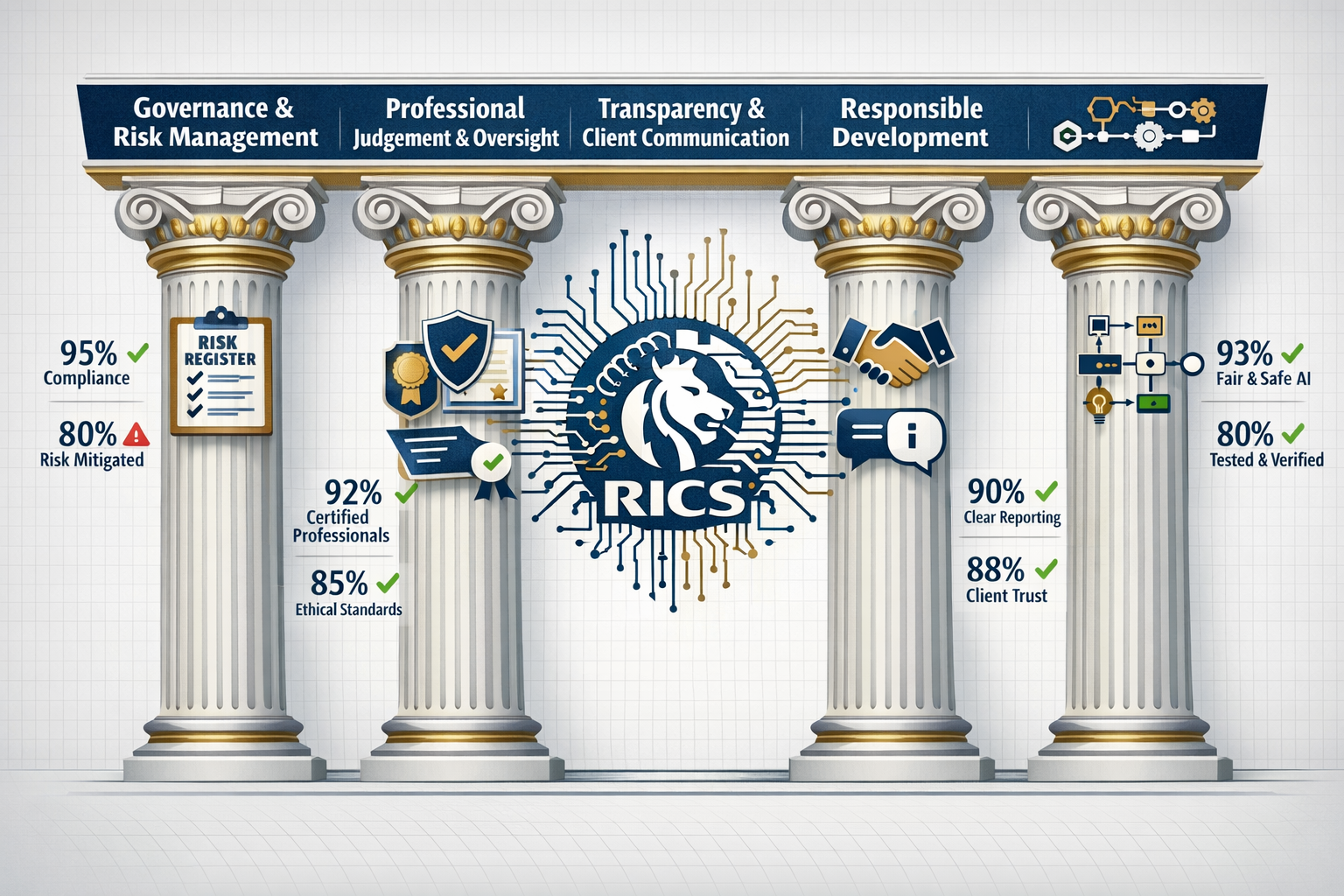
The standard establishes requirements across four interconnected domains that form the foundation for implementing RICS Responsible AI Standards in 2026 Building Surveys: Ethical Tools for Defect Detection and Reporting:[1][2]
1. Governance and Risk Management 🛡️
RICS-regulated firms must create and maintain written risk registers documenting overarching risks inherent in AI systems. These registers must specifically address:
- Inherent bias in AI algorithms
- Erroneous or misleading outputs
- Data security and privacy vulnerabilities
- System reliability and consistency issues
- Professional liability exposure
2. Professional Judgement and Oversight 👨💼
The standard embeds a fundamental principle: AI assists professional practice but does not replace it. Surveyors remain personally accountable for every piece of professional advice, regardless of the tools employed. This requirement ensures that technology augments rather than supplants human expertise in Level 3 building surveys and other comprehensive assessments.[3]
3. Transparency and Client Communication 📋
Members and firms must clearly communicate to clients when and for what purpose AI will be used. This communication must occur in writing and in advance of service delivery, with contractual documentation detailing specific AI applications and limitations.
4. Responsible Development of AI 🔧
While primarily focused on third-party AI system usage, the standard also provides guidance for firms developing proprietary AI tools, establishing minimum due diligence and testing requirements before deployment.
Material Impact Determination
A critical threshold concept within the standard is material impact—defined as AI outputs capable of influencing service delivery. RICS members and regulated firms must:[1][2]
- Determine whether AI outputs have material impact on their specific services
- Make a written record of that determination
- Document the reasoning behind the assessment
- Review determinations regularly as AI usage evolves
For building surveys, material impact typically applies when AI systems contribute to defect identification, risk categorization, cost estimation, or reporting recommendations that directly inform client decisions.
Implementing RICS Responsible AI Standards in 2026 Building Surveys: Practical Applications
The integration of AI technologies in building surveys offers transformative potential for defect detection accuracy and reporting efficiency. However, successful implementation requires careful adherence to RICS standards while leveraging technology's advantages.
Drone Surveys and Aerial Inspection Technologies
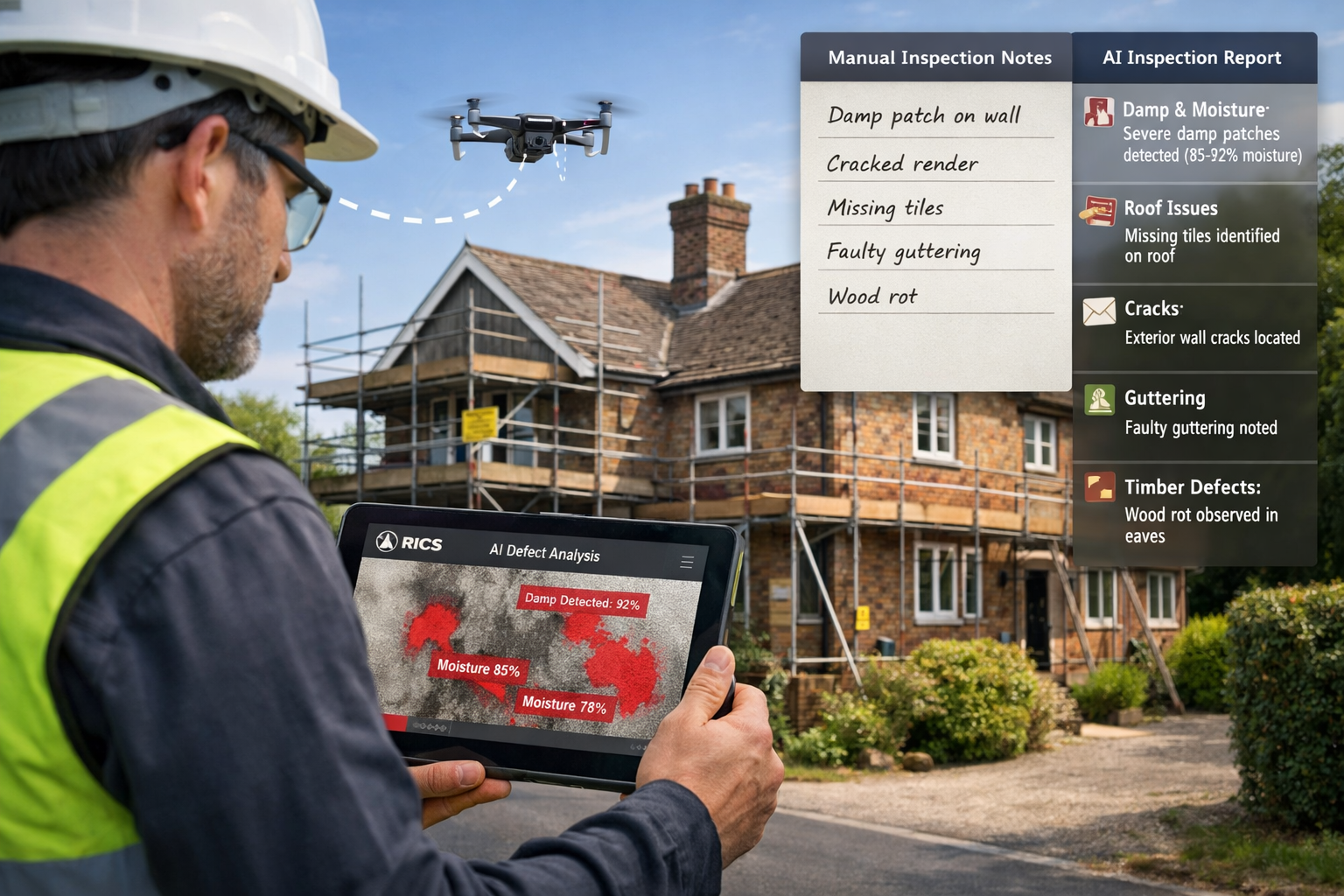
Drone surveys have revolutionized access to difficult-to-reach building elements—roofs, chimneys, high-level facades, and tall structures. When implementing drone-based AI systems for roof surveys, RICS-compliant practices must address:
Pre-Implementation Requirements:
- Complete written governance assessment documenting drone AI capabilities and limitations
- Establish protocols for professional review of AI-generated imagery analysis
- Create client communication templates explaining drone usage and AI processing
- Obtain express written consent before capturing and processing property imagery
- Document data storage, processing location, and retention policies
Operational Best Practices:
- Use AI image analysis to identify potential defects (missing tiles, cracked flashings, vegetation growth)
- Always verify AI findings through professional interpretation and cross-reference with other evidence
- Document confidence levels for AI-identified defects in survey reports
- Maintain human oversight for all risk categorization and repair priority decisions
- Record AI system version, training data characteristics, and known limitations in working papers
AI-Powered Defect Detection for Damp and Mould
Machine learning algorithms can now analyze thermal imaging, moisture meter readings, and visual patterns to identify damp and mould issues with increasing sophistication. For comprehensive building surveys, implementing these tools ethically requires:
Risk Register Documentation:
- Algorithmic bias potential (e.g., systems trained primarily on modern construction may underperform on period properties)
- False positive rates and their implications for client decision-making
- False negative risks and associated professional liability
- Data privacy concerns when uploading thermal imagery containing identifiable features
Professional Oversight Protocols:
- Establish minimum professional verification requirements for AI-flagged defects
- Define circumstances requiring invasive investigation regardless of AI confidence scores
- Create escalation procedures when AI outputs conflict with professional observation
- Document reasoning when professional judgement overrides AI recommendations
Client Communication Standards:
- Explain AI's role in initial defect identification versus professional diagnosis
- Clarify that AI analysis supplements but doesn't replace physical inspection
- Disclose AI system limitations regarding specific building types or defect categories
- Provide written information about AI decision-making processes upon request[2]
Structural Analysis and Subsidence Detection
AI systems analyzing crack patterns, settlement indicators, and historical movement data offer valuable insights for subsidence surveys. However, these applications carry particularly high material impact given the financial and safety implications.
Enhanced Due Diligence Requirements:
When implementing AI for structural defect analysis, firms must:
- Validate AI training data relevance to UK building stock and geological conditions
- Establish confidence thresholds below which AI outputs trigger mandatory specialist referral
- Document AI system limitations regarding specific structural systems or building ages
- Maintain detailed records of AI-assisted analyses for professional indemnity purposes
- Implement regular accuracy audits comparing AI predictions against subsequent investigations
Integration with Traditional Survey Methodologies
The most effective implementation of RICS Responsible AI Standards in 2026 Building Surveys balances technological tools with established professional practices. For commercial building surveys and residential assessments alike, this means:
Hybrid Inspection Protocols:
- Use AI for initial defect screening and prioritization
- Apply professional expertise for verification, diagnosis, and causation analysis
- Employ traditional investigation methods (invasive testing, specialist referrals) when AI confidence is low
- Cross-reference AI findings against building history, maintenance records, and contextual factors
Quality Assurance Frameworks:
- Implement peer review processes for high-value surveys using significant AI input
- Track AI system performance over time, documenting accuracy rates and failure modes
- Establish continuous professional development requirements for AI tool proficiency
- Create feedback loops to improve AI system selection and configuration
Mandatory Compliance Requirements for RICS-Regulated Firms
Beyond best practices, the RICS standard establishes specific mandatory requirements that all regulated firms must fulfill when implementing AI systems with material impact on service delivery.
Written Policy Development
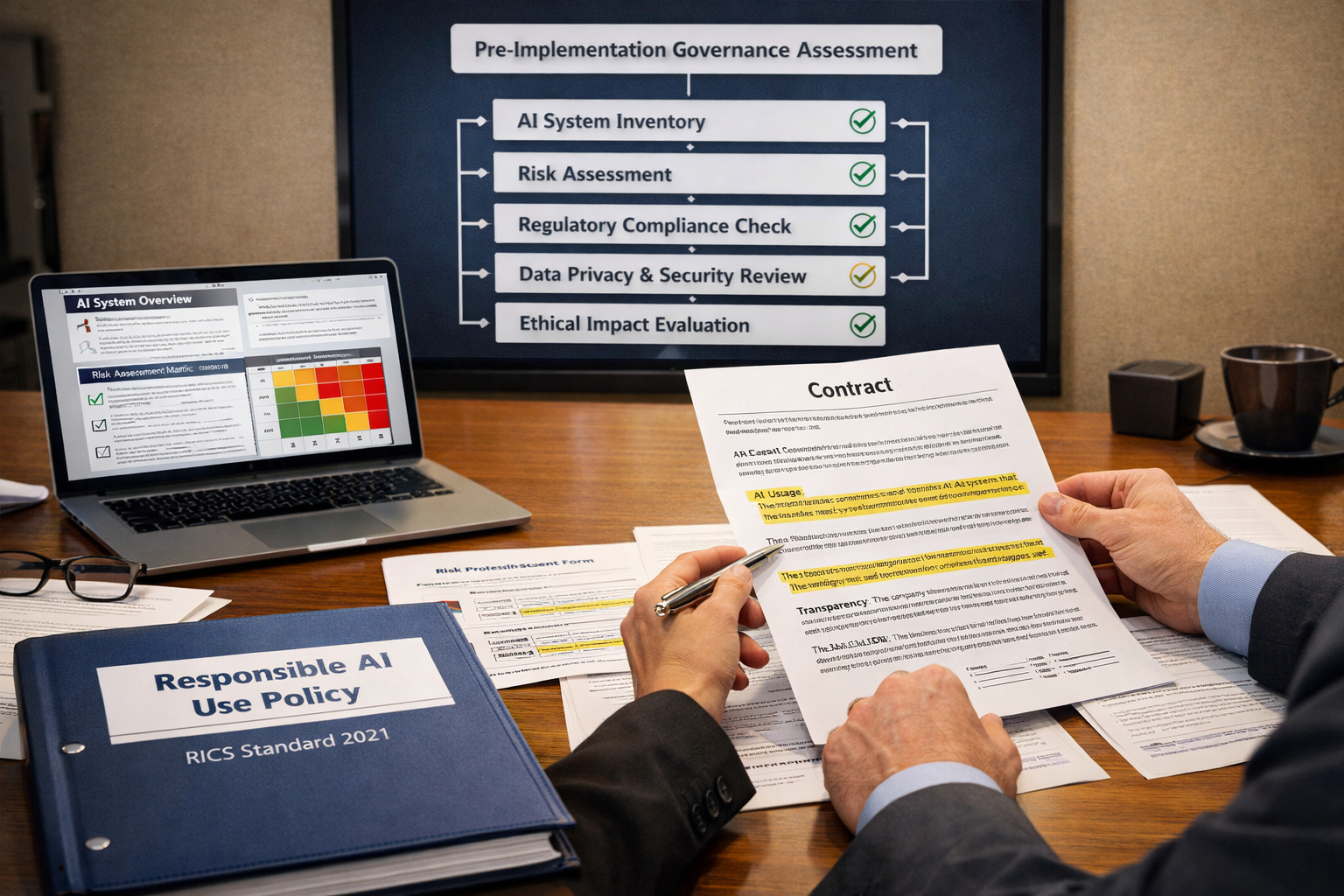
All RICS-regulated firms using or intending to use AI systems must develop and implement written responsible AI use policies.[1] These policies must be:
- Informed by risk registers documenting identified AI-related risks
- Developed before AI deployment rather than retrospectively
- Regularly reviewed and updated as AI usage evolves
- Accessible to all staff involved in AI-assisted service delivery
- Aligned with broader firm governance and quality management systems
Essential Policy Components:
| Policy Element | Required Content |
|---|---|
| Scope Definition | Which AI systems are covered; which services involve AI |
| Risk Management | How identified risks are monitored and mitigated |
| Professional Oversight | Minimum human review requirements for AI outputs |
| Client Communication | Templates and protocols for AI disclosure |
| Data Protection | Consent procedures; data handling safeguards |
| Training Requirements | Staff competency standards for AI tool usage |
| Incident Response | Procedures when AI errors or failures occur |
| Audit and Review | Frequency and scope of policy effectiveness assessment |
Pre-Implementation Governance Assessment
Before deploying AI systems with material impact, firms must complete minimum governance assessment steps, recorded in writing:[1][2]
Step 1: System Characterization
- Document AI system type, vendor, and intended application
- Identify specific survey activities where AI will be used
- Determine material impact status with supporting reasoning
Step 2: Due Diligence Review
- Assess AI system training data quality and relevance
- Evaluate vendor reputation, support capabilities, and longevity
- Review system testing, validation, and performance metrics
- Examine data processing locations and security measures
Step 3: Risk Identification
- Analyze potential bias sources and implications
- Assess error probability and consequence severity
- Evaluate data protection and privacy risks
- Consider professional liability exposure
Step 4: Mitigation Planning
- Define professional oversight requirements
- Establish output verification protocols
- Create client communication procedures
- Implement data protection safeguards
Step 5: Documentation
- Record all assessment findings in writing
- Obtain appropriate internal approvals
- Create implementation guidance for surveyors
- Establish monitoring and review schedules
Client Communication and Transparency Obligations
The standard imposes specific requirements for client communication that go beyond general professional conduct expectations:[2]
Advance Written Notification:
Firms must inform clients in writing and in advance when AI will be used, including:
- The specific purposes for which AI will be employed
- Which aspects of the survey will involve AI assistance
- How AI outputs will be integrated into professional advice
- Any implications for service delivery timelines or costs
Contractual Documentation:
Terms of engagement must detail:
- AI applications relevant to the specific instruction
- Data that will be processed through AI systems
- Client consent requirements for data upload and processing
- Limitations of AI systems being employed
Information Provision Upon Request:
When clients request additional information, firms must provide written details about:[2]
- AI system type and characteristics (e.g., machine learning image analysis, pattern recognition algorithms)
- Basic operational principles in accessible language
- Known limitations and constraints specific to the client's property or survey type
- Due diligence processes undertaken before AI deployment
- Risk identification and management approaches implemented by the firm
- Decision-making about output reliability including verification protocols
This transparency requirement ensures clients can make informed decisions about engaging firms using AI tools and understand the basis for advice provided.
Data Protection and Consent Requirements
Perhaps the most stringent requirement addresses data handling:[2]
Express Written Consent Mandatory:
Firms must obtain express written consent from affected stakeholders before uploading data to AI systems. This applies to:
- Property imagery (photographs, thermal images, drone footage)
- Building plans and technical drawings
- Client personal information
- Tenant or occupier details
- Third-party property information
Risk Assessment Obligation:
Before any data upload, firms must take reasonable steps to ensure the upload poses no unacceptable risk regarding:
- Data security during transmission and storage
- Unauthorized access or data breaches
- Inappropriate AI system use of data (e.g., for training without permission)
- Compliance with UK GDPR and Data Protection Act 2018
- Third-party rights and confidentiality obligations
Documentation Requirements:
Firms must maintain written records of:
- Consent obtained from all relevant parties
- Risk assessments conducted before data uploads
- Data processing agreements with AI vendors
- Data retention and deletion policies
- Incident response procedures for data breaches
For homebuyer surveys and other residential instructions, this means obtaining clear client consent before uploading property images to cloud-based AI analysis platforms—a practice that may seem routine but carries significant regulatory weight under the RICS standard.
Practical Implementation Challenges and Solutions
While the RICS standard provides clear requirements, practical implementation presents several challenges that firms must navigate thoughtfully.
Challenge 1: Determining Material Impact
The Issue: Many AI applications in surveying exist on a spectrum—some clearly have material impact (defect detection algorithms), while others are ambiguous (AI-powered scheduling tools, automated report formatting).
The Solution:
- Adopt a conservative approach: when in doubt, treat AI usage as having material impact
- Create an internal classification framework with examples
- Document reasoning for each determination
- Review classifications quarterly as AI usage evolves
- Seek professional guidance for borderline cases
Challenge 2: Vendor Transparency Limitations
The Issue: Many AI vendors treat algorithms as proprietary, limiting firms' ability to conduct thorough due diligence on training data, bias testing, or decision-making processes.
The Solution:
- Prioritize vendors committed to transparency and willing to provide detailed system documentation
- Request third-party validation reports or independent testing results
- Negotiate contractual terms requiring vendor disclosure of material system changes
- Implement enhanced professional oversight when vendor transparency is limited
- Consider developing internal AI capabilities for critical applications
- Document transparency limitations in risk registers and client communications
Challenge 3: Balancing Efficiency with Oversight
The Issue: AI's value proposition often centers on efficiency gains, yet robust professional oversight can diminish these benefits, creating tension between commercial pressures and compliance requirements.
The Solution:
- Reframe AI as augmentation rather than automation—tools that enhance rather than replace professional work
- Focus AI deployment on genuinely time-consuming tasks (initial defect screening, data organization) while preserving human effort for high-value activities (diagnosis, risk assessment, client advice)
- Invest in staff training to maximize AI tool proficiency, reducing oversight time requirements
- Develop efficient verification protocols (risk-based sampling, confidence threshold triggers) rather than universal manual checks
- Communicate value proposition to clients as enhanced accuracy and thoroughness rather than merely faster delivery
Challenge 4: Small Firm Resource Constraints
The Issue: Comprehensive governance frameworks, written policies, and detailed risk registers may seem disproportionately burdensome for small practices or sole practitioners.
The Solution:
- Utilize RICS guidance documents and templates to reduce policy development effort
- Focus documentation on actual AI systems used rather than theoretical scenarios
- Leverage industry collaboration—share policy templates and due diligence findings with professional peers
- Consider AI deployment selectively for highest-value applications rather than comprehensive adoption
- Engage professional indemnity insurers early to understand coverage implications and leverage their risk management resources
- Remember that proportionality applies—simpler AI applications require correspondingly simpler governance documentation
Future-Proofing AI Implementation in Building Surveys
The RICS standard represents the current regulatory baseline, but AI technology and professional expectations continue evolving rapidly. Forward-thinking firms should consider additional measures beyond minimum compliance.
Emerging AI Applications on the Horizon
Predictive Maintenance Analytics: AI systems analyzing building performance data to predict future defect emergence and maintenance requirements will become increasingly sophisticated. Firms should prepare governance frameworks for these predictive tools, particularly regarding professional liability when predictions prove inaccurate.
Integrated Building Information Modeling (BIM): AI-enhanced BIM systems that compare as-built conditions against design specifications will streamline dilapidations surveys and condition assessments. Implementation will require careful attention to data accuracy, system interoperability, and professional interpretation of variance analysis.
Natural Language Processing for Report Generation: AI tools that transform surveyor observations into structured reports will continue advancing. While potentially valuable for efficiency, firms must ensure these tools don't inadvertently introduce standardized language that fails to capture property-specific nuances or creates unintended professional commitments.
Continuous Improvement Framework
Implementing RICS Responsible AI Standards in 2026 Building Surveys: Ethical Tools for Defect Detection and Reporting should be viewed as an ongoing process rather than a one-time compliance exercise:
Quarterly Review Cycle:
- Assess AI system performance against documented expectations
- Update risk registers based on operational experience
- Refine professional oversight protocols based on error patterns
- Review client feedback regarding AI transparency communications
- Update policies to reflect new AI applications or retired systems
Annual Strategic Assessment:
- Evaluate AI contribution to service quality and business objectives
- Benchmark AI governance practices against industry developments
- Review professional indemnity insurance coverage adequacy
- Assess staff training needs and competency development
- Consider emerging AI technologies for potential adoption
Continuous Professional Development:
- Ensure all surveyors using AI tools receive regular training updates
- Participate in RICS guidance webinars and industry forums
- Share lessons learned within the firm and broader professional community
- Stay informed about regulatory developments and standard updates
- Develop internal expertise in AI ethics and responsible deployment
Building Client Trust Through Transparency
Beyond regulatory compliance, thoughtful AI implementation can strengthen client relationships and competitive positioning:
Proactive Communication: Rather than treating AI disclosure as a regulatory burden, frame it as a value proposition—explaining how AI enhances survey thoroughness, identifies defects that might be missed through traditional methods alone, and provides clients with more comprehensive information for decision-making.
Educational Approach: Provide clients with accessible explanations of AI's role in their specific survey, including concrete examples of how technology and professional expertise combine to deliver superior outcomes. For Level 2 surveys and Level 3 surveys, this might include explaining how thermal imaging AI helps identify hidden damp patterns that visual inspection alone might miss.
Demonstrable Quality: Track and share (in aggregate, anonymized form) data demonstrating AI's contribution to defect detection accuracy, such as the percentage of AI-flagged issues confirmed upon professional investigation, or examples where AI identified defects that traditional methods might have overlooked.
Conclusion
The convergence of rising property transaction volumes, increasingly sophisticated AI technologies, and the new RICS Responsible AI Standard creates both opportunity and obligation for surveying practices in 2026. Implementing RICS Responsible AI Standards in 2026 Building Surveys: Ethical Tools for Defect Detection and Reporting is no longer optional—it's a mandatory professional requirement that shapes how firms deploy drone inspections, AI-powered defect detection, and automated analytics while preserving the fundamental principle that technology assists but never replaces professional judgement.
The path forward requires deliberate, documented, and transparent AI implementation. Firms must create comprehensive risk registers, develop written policies, complete pre-implementation governance assessments, obtain proper client consent, and maintain robust professional oversight of all AI outputs. These requirements apply equally to commercial building surveys, residential assessments, and specialized instructions like subsidence investigations.
Yet compliance alone shouldn't be the goal. The most successful firms will view the RICS standard as a foundation for building genuinely ethical, effective AI practices that enhance service quality, strengthen client trust, and position the profession to leverage technological advancement responsibly. By balancing innovation with accountability, transparency with efficiency, and automation with professional expertise, surveying practices can harness AI's transformative potential while upholding the professional standards that protect clients and the public interest.
Actionable Next Steps
For RICS-Regulated Firms:
- Audit current AI usage across all service lines to identify systems with material impact on service delivery
- Create or update written risk registers documenting AI-related risks specific to your practice
- Develop comprehensive AI use policies covering governance, oversight, transparency, and data protection
- Review and revise client communication templates to ensure advance written notification of AI usage
- Implement data consent procedures before uploading any property or client information to AI systems
- Establish professional oversight protocols defining minimum verification requirements for AI outputs
- Schedule quarterly compliance reviews to ensure ongoing adherence as AI usage evolves
For Individual Surveyors:
- Familiarize yourself thoroughly with the RICS Responsible AI Standard requirements
- Understand your firm's AI policies and your personal responsibilities for compliance
- Document your professional review of all AI-generated outputs in working papers
- Never rely solely on AI findings without independent professional verification
- Communicate transparently with clients about AI's role in your survey work
- Pursue continuous professional development in AI technologies and ethical deployment
- Raise concerns promptly if you observe AI usage that may not comply with RICS standards
The future of building surveys lies not in choosing between traditional professional expertise and advanced AI technologies, but in thoughtfully integrating both within an ethical framework that prioritizes accuracy, transparency, and client service. The RICS Responsible AI Standard provides the roadmap—successful implementation requires commitment, diligence, and ongoing attention as both technology and professional expectations continue to evolve.
References
[1] Ai Responsible Use Standard – https://ww3.rics.org/uk/en/journals/construction-journal/ai-responsible-use-standard.html
[2] Responsible Use Of Artificial Intelligence In Surveying Practice September 2025 – https://www.rics.org/content/dam/ricsglobal/documents/standards/Responsible-use-of-artificial-intelligence-in-surveying-practice_September-2025.pdf
[3] Rics First Ever Standard On Responsible Ai Use Now In Effect – https://www.rics.org/news-insights/rics-first-ever-standard-on-responsible-ai-use-now-in-effect
