
Eleven months. That is how long London house prices have now fallen on an annual basis, according to the Office for National Statistics, yet owners of £2 million-plus homes in Notting Hill and Kensington are bracing for a tax bill that assumes their property is still rising in value. With the Autumn Budget 2026 property tax prime London homeowners debate reaching fever pitch, the gap between falling prices and rising tax exposure has rarely looked sharper.
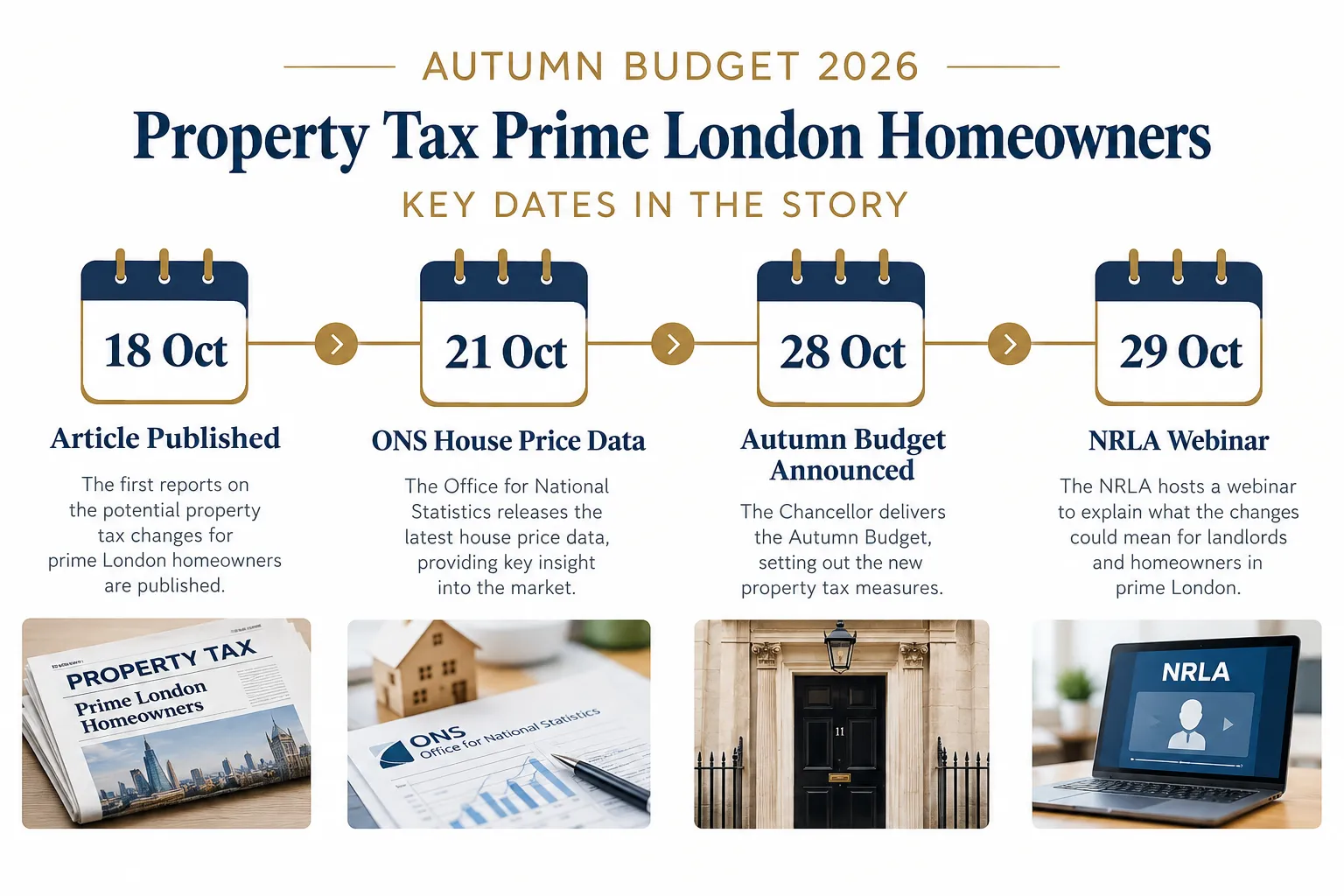
Chancellor John Healey will deliver the Budget on 28 October 2026, just ten days from today. For owners, buyers and landlords of high-value homes across prime west London, this is the moment to separate confirmed policy from speculation, and to understand why an accurate, evidence-based valuation matters more than ever.
This article reflects the published facts available as of 18 October 2026. Nothing here is tax advice. Readers should take professional tax advice before making decisions based on Budget announcements.
Key Takeaways
- The High Value Council Tax Surcharge ("mansion tax") on £2 million-plus homes is confirmed, starting April 2028, with charges of £2,500 to £7,500 a year; a lower £1.5 million threshold has reportedly been ruled out.
- Capital Gains Tax changes affecting landlords and second-home owners are reportedly being modelled, but nothing is confirmed and it is unclear whether residential property would be included.
- Scrapping or replacing stamp duty with an annual land value tax has been ruled out for this Budget, the Prime Minister reportedly said "that won't be happening."
- London average house prices fell 3.3% year on year to £569,000 in July 2026, the eleventh consecutive month of annual declines, even as prime central London reportedly saw a quarterly rise in October 2026.
- Owners near the £2 million threshold should consider an up-to-date RICS valuation to support their position ahead of any council tax revaluation, probate planning or CGT base-cost calculations.
What's Confirmed vs Speculation Ahead of the Autumn Budget 2026
Separating fact from rumour is the single most useful thing a prime London homeowner can do right now. The confirmed measure is the High Value Council Tax Surcharge, which takes effect from April 2028 for English homes valued at £2 million or more, with annual charges ranging from £2,500 to £7,500. Reports that the threshold could be lowered to £1.5 million, with higher charges attached, have reportedly been ruled out.
Everything else sits in the speculation column. The Treasury is reportedly modelling Capital Gains Tax changes that could affect landlords and second-home owners, though whether residential property would be caught remains unclear. Reports of a 10% inheritance tax levy on estates to fund social care have been met with government statements that there are "no plans" for a 10% "death tax" on all estates. A council tax overhaul, potentially a percentage-based charge on high-value homes followed by a revaluation of the 1991 bands, is rumoured but not confirmed, according to the NRLA.
For anyone weighing a sale, a purchase, or estate planning around this Autumn Budget 2026 property tax prime London homeowners story, the distinction between confirmed and speculative measures should shape how much weight each rumour is given.
The £2m Mansion Tax and Falling Prime London Values
This is where the numbers get genuinely interesting for prime west London. The mansion tax threshold is fixed in cash terms at £2 million, but London values have been moving in the opposite direction. ONS data puts the average London house price at £569,000 in July 2026, down 3.3% year on year, the eleventh consecutive month of annual falls, and £19,000 below the July 2025 peak. The RICS September survey recorded a price balance of -32% for London, notably weaker than the national average.
Yet prime central London tells a slightly different story. Knight Frank reported a quarterly rise in prime central London prices in October 2026, without giving a specific figure. That divergence between the broader London market and the prime core matters enormously for homes sitting close to the £2 million line.
Consider a Notting Hill or Kensington property bought several years ago that may have crossed £2 million at the market peak but could now sit either side of that threshold. Being a few thousand pounds above or below £2 million determines whether a £2,500 to £7,500 annual surcharge applies from 2028. That makes an accurate, evidence-based valuation, rather than a rough online estimate, essential for owners near the margin. The same applies to probate valuations and CGT base-cost figures, where an incorrect starting value can distort tax calculations for years. A chartered surveyor's report, such as those produced through our complete guide to home surveying, provides a defensible, documented valuation rather than a guess.
Capital Gains Tax: What Landlords Should Watch For
Landlords and second-home owners in Kensington and Chelsea, where average private rents are the highest in the UK at £3,690, according to the ONS, and Rightmove records London asking rents at a record £2,825 per month, are watching the CGT speculation closely. Current residential CGT rates stand at 18% for basic-rate taxpayers and 24% for higher and additional-rate taxpayers. One option reportedly floated is aligning CGT more closely with income tax rates, though it remains unclear whether residential property would be affected, and nothing is confirmed.
Some landlords are reportedly weighing whether to sell before or after 28 October, depending on how the rules land. This is a general market observation, not a recommendation: any decision to sell, hold or restructure a portfolio should be made only after professional tax advice tailored to individual circumstances. For landlords assessing property condition before a sale or letting, a dilapidations survey can also clarify liabilities that affect net proceeds.
Propertymark has separately urged the Chancellor to re-link Local Housing Allowance to market rents at the Budget, a measure that would affect rental affordability rather than ownership taxation, but is relevant context for landlords assessing demand in prime west London.
Why Ruling Out Stamp Duty Reform Changes the Calculus
For much of this year, speculation that stamp duty and council tax could be scrapped entirely and replaced with an annual property or land value tax encouraged many owners to delay moving. HomeOwners Alliance research found that over 800,000 homeowners shelved moving plans because of stamp duty uncertainty. That speculation has reportedly been ruled out for this Budget, with the Prime Minister stating, according to the NRLA, "That won't be happening."
HomeOwners Alliance chief executive Paula Higgins said, "we're calling on the Chancellor to not treat homeowners as cash cows."
With wholesale stamp duty reform off the table, the "wait and see" strategy that has held back parts of the market loses much of its justification. Owners who paused moving plans in anticipation of a land value tax now have more clarity, even if other measures remain uncertain.
Other Measures: Inheritance Tax, Council Tax, and Housing Schemes
Beyond CGT and stamp duty, three further areas are worth monitoring on Budget day.
Inheritance tax. Reports of a 10% levy on estates to fund social care have circulated, but the government maintains it has "no plans" for a 10% "death tax" applied across all estates. For prime London families with significant property wealth, this remains an area to watch rather than plan around.
Council tax. A broader overhaul is rumoured, potentially starting with a percentage-based charge on high-value homes, followed later by a revaluation of the outdated 1991 bands. No confirmed approach exists yet, according to the NRLA.
Your First Home scheme. Full details of this scheme, offering a 2.5% deposit and a 20% equity loan on new-build homes, are expected at the Budget. While aimed primarily at first-time buyers rather than prime London's existing owners, it may influence new-build pricing and demand across west London.
Landlords and freeholders managing structural or boundary matters during this period of uncertainty may also find it useful to review guidance on party wall awards before committing to renovation or extension works that could affect valuation.
Budget Day Checklist for Prime London Homeowners
On 28 October, prime London owners, buyers and landlords should look out for:
- Confirmation of the £2m mansion tax detail, any changes to the £2,500 to £7,500 charging bands.
- Any CGT announcement, rate changes, and whether residential property is explicitly included or excluded.
- Inheritance tax clarification, whether the "no plans" position on a 10% levy holds.
- Council tax overhaul signals, any move toward a percentage-based charge or 1991 band revaluation.
- Your First Home scheme details, deposit and equity loan terms for new-builds.
- Local Housing Allowance, whether Propertymark's call to re-link LHA to market rents is addressed.
The National Residential Landlords Association is holding a webinar on 29 October to unpack the Budget's implications for landlords, which may be useful for portfolio owners in the days immediately after.

Frequently Asked Questions
Is the £2 million mansion tax definitely happening?
Yes, the High Value Council Tax Surcharge is confirmed policy, starting April 2028, with charges of £2,500 to £7,500 a year for homes valued at £2 million or more in England.
Will Capital Gains Tax definitely rise at this Budget?
No, this is speculation. The Treasury is reportedly modelling changes, but nothing is confirmed, and it is unclear whether residential property would be affected.
Could stamp duty be abolished?
No. Replacing stamp duty and council tax with an annual land value tax has reportedly been ruled out for this Budget.
Why does a professional valuation matter if the mansion tax doesn't start until 2028?
Because threshold eligibility, probate valuations and CGT base costs often rely on an accurate value at a specific date, and prime London values have been moving unevenly, falling broadly across London while reportedly rising quarterly in the prime core.
Is a 10% inheritance tax on all estates confirmed?
No. The government has stated it has "no plans" for a 10% "death tax" on all estates, despite reports of such a proposal to fund social care.
Where can I get an independent valuation for Budget-related planning?
A RICS chartered surveyor can provide an evidence-based valuation; see guidance on desktop house valuations for a faster assessment option.
Conclusion
Ten days out from the Autumn Budget, the honest picture for prime London homeowners is a mix of one confirmed measure and several open questions. The £2 million mansion tax is locked in for April 2028. Capital Gains Tax, inheritance tax and council tax reform remain speculative. Stamp duty reform has reportedly been ruled out, removing one major source of uncertainty that had stalled over 800,000 house moves nationally.
Against a backdrop of falling average London prices but a reportedly firmer prime central market, the practical next step for owners near the £2 million threshold, landlords weighing a sale, or families planning estates is straightforward: commission an accurate, documented valuation rather than relying on estimates, and take professional tax advice before acting on any Budget announcement. Notting Hill Surveyors can support that evidence base with RICS chartered valuations ahead of, and after, 28 October, see our chartered surveyors in west London page for more on how valuation evidence is prepared.