
Over 700 people were killed or injured in the Grenfell Tower fire of 2017 — a catastrophe traced directly to combustible cladding. Nearly a decade later, cladding and balcony inspections remain one of the most technically demanding and legally consequential areas of building survey practice. For surveyors, property managers, and building owners operating in 2026, the stakes have never been higher, and the protocols have never been more precise.
Cladding and Balcony Inspections: Essential Protocols for 2026 Building Survey Compliance now sit at the intersection of evolving legislation, advanced inspection technology, and buyer-driven safety demands. Whether assessing a high-rise residential block or a converted Victorian terrace with a timber-framed balcony, surveyors must deploy the right tools, follow the right procedures, and phrase their reports in ways that protect both clients and themselves.
Key Takeaways
- Cladding and balcony inspections are legally mandated components of building surveys in 2026, with non-compliance carrying significant financial and legal penalties.
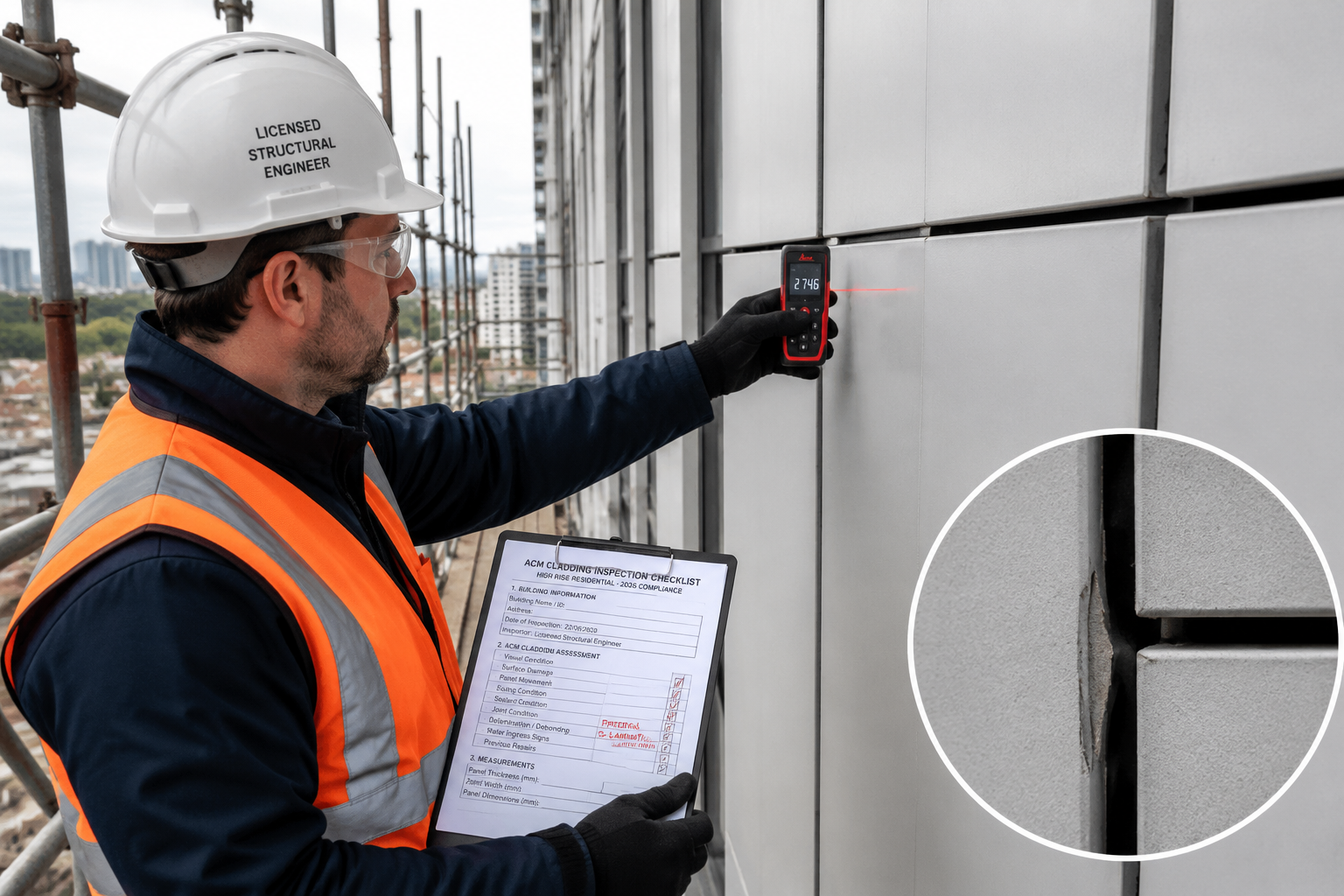
- Laser measurement tools and drone technology have transformed how surveyors assess high-risk exterior elevated elements safely and accurately.
- Both UK and international frameworks (including SB 721 and SB 326 in California) set minimum inspection frequencies, qualified inspector requirements, and repair timelines.
- Report language must clearly flag when specialist follow-up is needed, protecting surveyors from liability and helping buyers make informed decisions.
- Insurance coverage for residential and commercial buildings increasingly depends on documented proof of cladding and balcony compliance.
Why Cladding and Balcony Compliance Became Non-Negotiable in 2026
The regulatory landscape surrounding building envelopes has tightened considerably since the post-Grenfell reforms. In the UK, the Building Safety Regulator's 2023-2026 strategic plan explicitly requires comprehensive assessments of building envelopes — including cladding systems, insulation layers, and balcony structures — to demonstrate fire resistance and structural integrity [6]. This has elevated cladding compliance from a discretionary check to a mandatory survey component for higher-risk buildings.
Internationally, the pattern is consistent. In California, Senate Bill 721 (SB 721) requires that exterior elevated elements (EEEs) — balconies, decks, stairways, and walkways made of wood or wood-based materials elevated more than six feet above ground — be inspected every six years, with at least 15% of each element type assessed per inspection cycle [4]. The deadline for multifamily rental buildings was extended to January 1, 2026, under Assembly Bill 2579 [1]. For condominium associations under SB 326, the compliance deadline passed on January 1, 2025, meaning any association yet to complete inspections is now formally out of compliance and exposed to legal liability [2].
These frameworks share a common logic: periodic, documented inspections by qualified professionals, with mandatory repair timelines and penalties for inaction. In the UK context, surveyors conducting Level 3 building surveys are expected to apply equivalent rigour when assessing cladding and balcony conditions on residential and commercial properties.
"Non-compliance can result in penalties up to $500 per day, and insurers are increasingly requiring proof of compliance before renewing master policies." [4][5]
What Counts as a High-Risk Exterior Elevated Element
The following elements consistently appear in compliance frameworks as requiring formal inspection:
| Element Type | Typical Risk Factors | Inspection Priority |
|---|---|---|
| ACM/HPL cladding panels | Fire spread, delamination | High |
| Timber-framed balconies | Rot, moisture ingress, fixing failure | High |
| Concrete balconies | Spalling, rebar corrosion | Medium-High |
| External stairways | Connection failure, surface degradation | Medium |
| Walkways and corridors | Deflection, waterproofing failure | Medium |
| Insulation layers behind cladding | Combustibility, compression | High |
Hands-On Inspection Techniques: Laser Tools, Drones, and Physical Access
The practical execution of cladding and balcony inspections in 2026 relies on a combination of traditional access methods and advanced remote sensing technology. Surveyors who understand how to integrate these tools produce more accurate reports and reduce personal risk when working at height.
Laser Measurement and Thermal Imaging
Laser distance meters and 3D laser scanners have become standard tools for assessing cladding alignment, panel gaps, and deflection in balcony structures. A laser scanner can capture millimetre-level deviations across an entire facade in a single session, flagging areas where panels have shifted, fixings have failed, or the substrate has moved. This data is far more defensible in a report than a visual estimate.
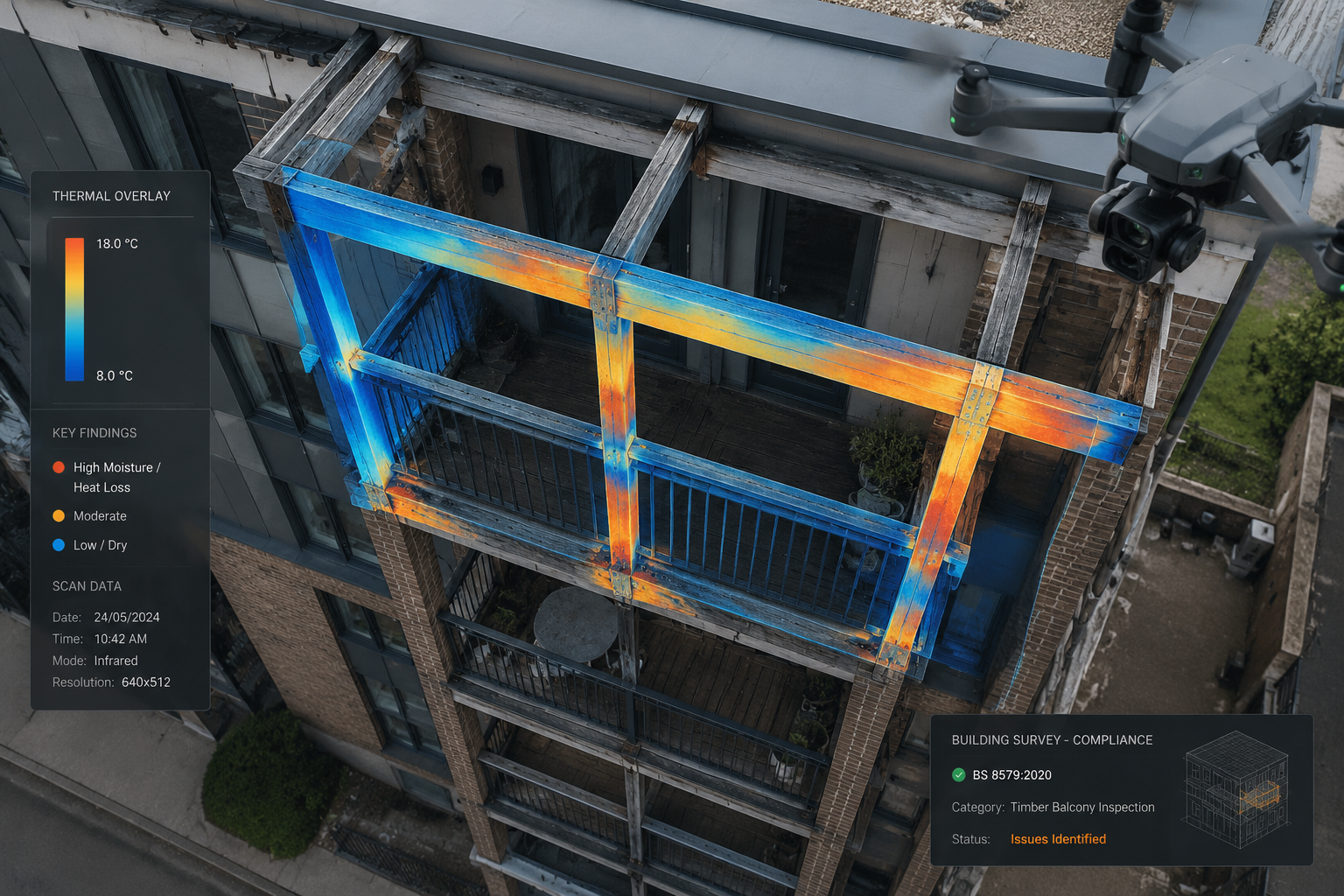
Thermal imaging cameras add another layer of diagnostic value. By detecting heat differentials across a building envelope, they reveal:
- Moisture trapped behind cladding panels
- Missing or compressed insulation sections
- Thermal bridges that indicate structural discontinuities
- Areas of potential fire compartmentation failure
For balcony inspections, thermal imaging can identify moisture ingress at the junction between the balcony slab and the external wall — one of the most common failure points in both new-build and older stock.
Drone Surveys for Inaccessible Elevations
Drone technology has transformed the inspection of high-rise cladding systems. Where scaffold access would previously take days to erect and cost thousands of pounds, a qualified drone operator can capture high-resolution imagery of an entire building facade within hours. The drone survey services now available to building surveyors allow close-up visual inspection of cladding joints, fixings, sealant lines, and panel surfaces at heights that would otherwise require specialist rope access.
Key capabilities of modern inspection drones include:
- 4K close-range photography for cladding joint and fixing assessment
- Thermal imaging payloads for moisture and insulation mapping
- Photogrammetry software to generate 3D facade models
- Video documentation for report annexes and client presentations
Under both UK and international frameworks, drone-captured evidence is increasingly accepted as supporting documentation in formal inspection reports, provided the operator holds appropriate Civil Aviation Authority (CAA) or equivalent certification.
Physical Access and Sampling Protocols
Despite the power of remote tools, physical access remains essential for certain assessments. Under SB 721 protocols, inspectors must physically assess a minimum of 15% of each EEE type [4]. In UK practice, a comprehensive building survey for a property with balconies or cladded facades should include direct tactile assessment where safe access is available.
Physical inspection steps for balconies include:
- Visual check of the balcony soffit for staining, cracking, or spalling
- Tap testing of concrete surfaces to identify hollow or delaminated areas
- Probe testing of timber elements to assess moisture content and rot
- Fixing inspection — checking bolts, brackets, and anchors for corrosion or movement
- Drainage assessment — verifying falls, outlets, and waterproofing upstands
- Load-bearing check — assessing whether deflection under load is within acceptable limits
For cladding systems, physical inspection should include checking panel fixing points, sealant integrity, cavity barriers, and any visible signs of fire damage or previous remediation work.
Report Phrasing, Specialist Referrals, and Compliance Documentation
The quality of a building survey report is ultimately measured by how clearly it communicates risk and directs the reader toward appropriate action. For cladding and balcony inspections, imprecise language is not just a professional failing — it can expose surveyors to negligence claims and leave buyers unaware of potentially life-threatening defects.
Flagging Specialist Needs in Survey Reports
A core principle of Cladding and Balcony Inspections: Essential Protocols for 2026 Building Survey Compliance is that surveyors must know the boundaries of their own expertise and report accordingly. When a surveyor identifies cladding that may contain aluminium composite material (ACM) with an unconfined polyethylene core, or a balcony with structural movement beyond surface-level defects, the report must clearly state that specialist investigation is required.
Recommended report phrasing patterns include:
- "The cladding system observed on the [north/south/east/west] elevation appears consistent with [material type]. Confirmation of cladding composition and fire performance data should be obtained from the building owner or freeholder prior to exchange of contracts."
- "Visible cracking and staining to the balcony soffit indicate potential reinforcement corrosion. A structural engineer's assessment is recommended before the property is occupied or transferred."
- "No evidence of cavity barrier installation was visible at the inspection points accessed. A fire safety engineer should review the full building envelope before reliance is placed on the building's fire resistance rating."
These phrasings serve three purposes: they protect the surveyor, they inform the buyer, and they create a clear audit trail for compliance purposes.
The Role of Photographic Evidence
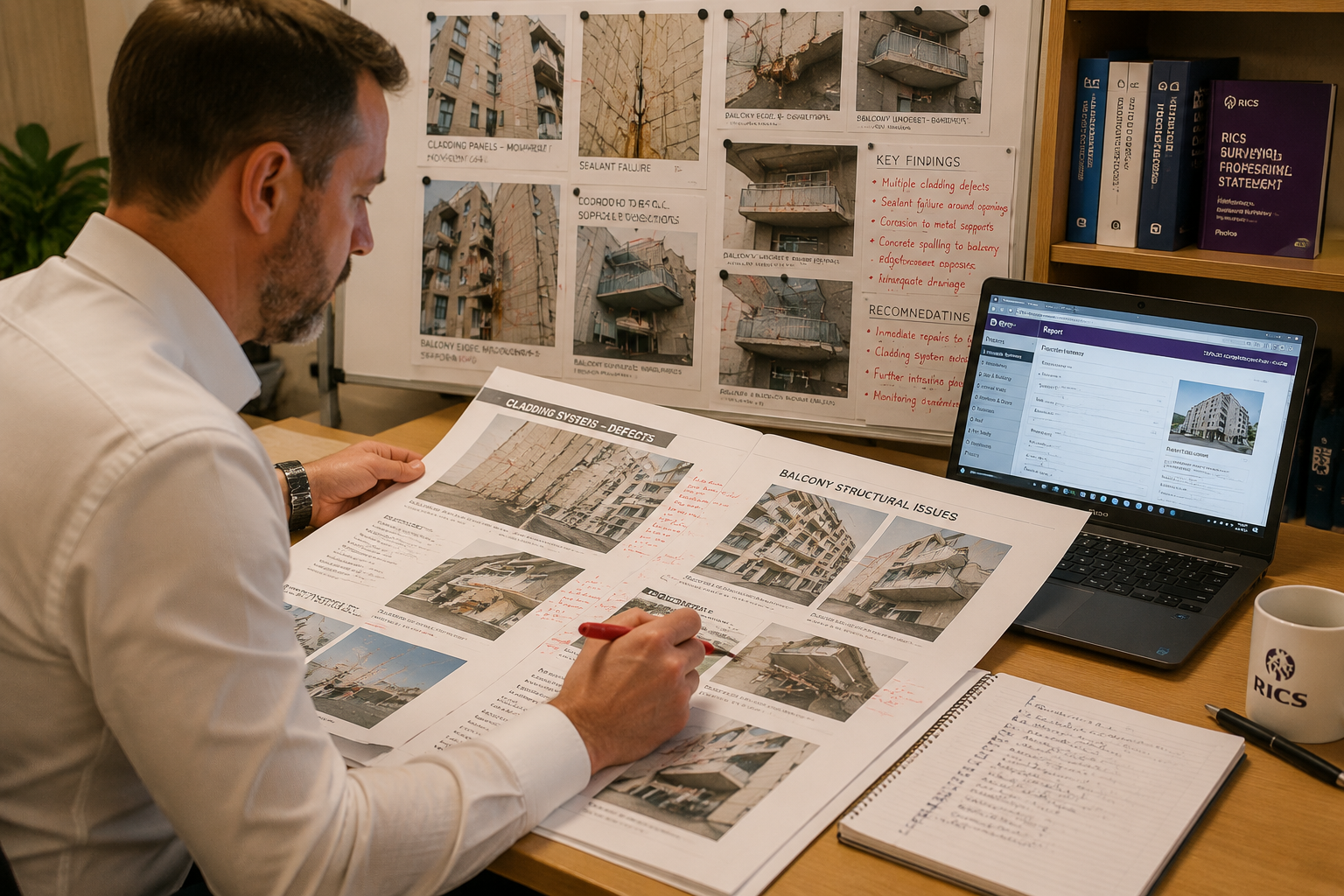
Every cladding and balcony inspection report should be supported by a comprehensive photographic annex. Under SB 721 requirements, inspection reports must include supporting photographs alongside findings and recommendations [4]. UK best practice aligns with this standard.
Photographs should capture:
- Overall elevation views showing cladding coverage
- Close-up images of fixing points, joints, and sealant lines
- Any visible defects with a scale reference (ruler or coin)
- Balcony soffit, edge detail, and drainage points
- Any previous repair work or remediation evidence
For surveyors working on properties covered by the UK's Building Safety Act 2022, photographic documentation forms part of the building's safety case and must be retained accordingly.
Insurance Implications of Non-Compliance
The financial consequences of inadequate cladding and balcony inspection documentation extend well beyond repair costs. As of 2026, insurers are requiring proof of compliance with relevant inspection frameworks before renewing homeowners association master policies [5]. For UK leaseholders and freeholders, EWS1 (External Wall System) form requirements — while subject to ongoing revision — continue to affect mortgage availability on properties with cladding concerns.
For commercial properties, a RICS commercial building survey that fails to adequately address cladding compliance may result in the insurer disputing a fire-related claim on the grounds that known risks were not documented and remediated.
Key insurance risk triggers in 2026:
- ACM cladding with PE core (Category 3 under BRE classification)
- Timber-framed balconies with no documented inspection in the past six years
- Missing or inadequate cavity barriers identified in any inspection
- Lack of documented repair completion within required timelines [4]
Compliance Frameworks: UK and International Standards Side by Side
Understanding how UK requirements compare to international frameworks helps surveyors contextualise their practice and advise clients with international property portfolios.
UK Building Safety Act 2022 and BSR Requirements
The Building Safety Act 2022 created the Building Safety Regulator (BSR) as the competent authority for higher-risk buildings (HRBs) — defined as residential buildings over 18 metres or seven storeys. For these buildings, cladding and balcony assessments form part of the mandatory building safety case, which must be submitted to the BSR and kept current [6].
For lower-risk buildings, the Fire Safety (England) Regulations 2022 require responsible persons to conduct regular checks of external walls and report findings to the local fire and rescue service where cladding concerns are identified.
California SB 721 and SB 326: A Useful Benchmark
The California framework offers a useful structural model for understanding best practice in periodic inspection regimes:
| Requirement | SB 721 (Rental Apartments) | SB 326 (Condominiums) |
|---|---|---|
| Compliance deadline | January 1, 2026 [1] | January 1, 2025 [2] |
| Inspection frequency | Every 6 years | Every 9 years |
| Minimum sample size | 15% of each EEE type [4] | Statistical sample per engineer |
| Qualified inspectors | Licensed architects, structural engineers, certified building inspectors [4] | Licensed architects or structural engineers |
| Repair timeline (unsafe conditions) | 120 days [4] | 180 days |
| Penalty for non-compliance | Up to $500/day [4] | Legal liability, HOA exposure |
Cities such as Long Beach have implemented dedicated balcony hazard reporting programmes, encouraging property owners to proactively identify and report risks before formal inspection deadlines [3]. This proactive model is increasingly being adopted in UK local authority frameworks.
Who Qualifies to Conduct Inspections
Both UK and Californian frameworks are explicit: inspections must be conducted by qualified professionals. In the UK, this means RICS-accredited chartered surveyors with demonstrable competence in building pathology and fire safety assessment. Buyers seeking assurance should engage surveyors who can demonstrate specific experience with cladding systems and exterior elevated structures, rather than relying on a standard valuation or basic condition report.
For properties where cladding or balcony concerns are identified during an initial survey, commissioning a specific defect report from a specialist provides the detailed analysis needed to quantify repair costs and compliance obligations.
Practical Checklist for 2026 Cladding and Balcony Inspections
The following checklist consolidates current best practice for surveyors and property managers conducting or commissioning inspections [7]:
Pre-Inspection Preparation
- Obtain existing building documentation (fire safety reports, previous inspection records, EWS1 forms)
- Confirm cladding material specifications from building owner or freeholder
- Identify all exterior elevated elements and plan access strategy
- Confirm drone operator certification if aerial inspection is planned
On-Site Inspection
- Conduct visual survey of all accessible cladding elevations
- Deploy thermal imaging camera for moisture and insulation mapping
- Physically assess minimum 15% sample of each balcony/deck type
- Document all findings with dated, geotagged photographs
- Test balcony fixings, drainage, and structural connections
- Check for cavity barriers at floor levels and around openings
Report Preparation
- Classify each defect by severity (immediate risk, monitor, maintenance required)
- Use clear specialist referral language where findings exceed surveyor competence
- Include photographic annex with scale references
- State compliance status relative to applicable regulatory framework
- Recommend repair timelines aligned with statutory requirements
Post-Report Actions
- Ensure client understands insurance implications of any flagged defects
- Advise on engagement of structural engineer or fire safety engineer where required
- Retain full inspection documentation as part of building safety case
Conclusion
Cladding and balcony inspections are no longer peripheral elements of a building survey — they are central to buyer safety, legal compliance, and insurance validity in 2026. Surveyors who master the combination of laser measurement tools, drone technology, and precise report language are best positioned to meet the demands of a market where buyers, lenders, and insurers all require documented evidence of building envelope safety.
Actionable next steps for surveyors and property owners:
- Audit your current inspection protocols against the 2026 checklist above and identify any gaps in technology use or report phrasing.
- Commission a Level 3 building survey for any property with cladded facades or exterior elevated structures before exchange of contracts — see the complete guide to Level 3 building surveys for what to expect.
- Engage a qualified chartered surveyor with specific cladding and balcony competence — explore chartered surveyor services to find the right professional for your property type.
- Document everything — from drone footage to repair completion certificates — and retain records as part of the building's ongoing safety case.
- Do not wait for a compliance deadline to trigger action. Proactive inspection and remediation consistently costs less than emergency repair, legal penalty, or insurance dispute.
The tools and frameworks exist. The only variable is whether they are applied with the rigour and expertise that 2026 building survey compliance demands.
References
[1] Inspections Of Balconies Decks And Other Exterior Elements – https://www.oaklandca.gov/Planning-Building/Building-Construction-Permits-Inspections/Building-Inspections/Inspections-of-Balconies-Decks-and-other-Exterior-Elements?utm_source=openai
[2] Exterior Elevated Elements Inspection Re – https://www.cityofsanmateo.org/4875/Exterior-Elevated-Elements-Inspection-Re?utm_source=openai
[3] Balcony Hazard Reporting – https://www.longbeach.gov/lbcd/enforcement/balcony-hazard-reporting/?utm_source=openai
[4] Sb721 Balcony Inspection Law – https://www.californiacoastalrealestate.com/blog/sb721-balcony-inspection-law?utm_source=openai
[5] California Sb 326 Balcony Roof Deck Inspection – https://roofvista.com/resources/guides/california-sb-326-balcony-roof-deck-inspection?utm_source=openai
[6] Fire Safety And Cladding Compliance In Building Surveys 2026 Risk Assessment Protocols For High Rise And Converted Properties – https://princesurveyors.co.uk/blog/fire-safety-and-cladding-compliance-in-building-surveys-2026-risk-assessment-protocols-for-high-rise-and-converted-properties/?utm_source=openai
[7] Balcony Inspection Checklist A Property Owners Guide 2026 Edition – https://www.vulcanvents.com/balcony-inspection-checklist-a-property-owners-guide-2026-edition/?utm_source=openai
