
{"cover":"Professional landscape format (1536×1024) hero image with bold text overlay: 'Energy Performance Certificates in Party Wall Awards: 2026 Retrofit Compliance' in extra large 70pt white bold sans-serif font with dark semi-transparent overlay box, centered upper third. Background shows a split-view of two adjoining terraced London townhouses with visible external wall insulation and EPC rating chart overlay, warm amber and slate blue color palette, editorial magazine quality, high contrast, architectural photography style.","content":["Detailed landscape format (1536×1024) infographic-style illustration showing an EPC energy rating chart (A through G bands in green-to-red gradient) overlaid on a cross-section diagram of a party wall between two semi-detached homes, with insulation layers labeled, SAP 10.3 methodology notation, surveyor clipboard in foreground, clean white background with teal and charcoal accents, technical but accessible visual style, data-driven aesthetic.","Landscape format (1536×1024) overhead flat-lay composition showing a party wall award legal document alongside a printed EPC certificate, surveyor's checklist with retrofit measures listed (external wall insulation, loft insulation, heat pump), measuring tape, architectural drawings, and a pen, on a dark oak desk surface, warm studio lighting, professional property surveying aesthetic, rich browns and cream tones.","Landscape format (1536×1024) scene showing two neighbours and a party wall surveyor in discussion outside adjoining Victorian terraced houses undergoing retrofit work, scaffolding visible, external wall insulation boards being installed, surveyor holding a tablet displaying EPC data and compliance charts, golden hour lighting, documentary photography style, muted urban color palette with green sustainability accents."]
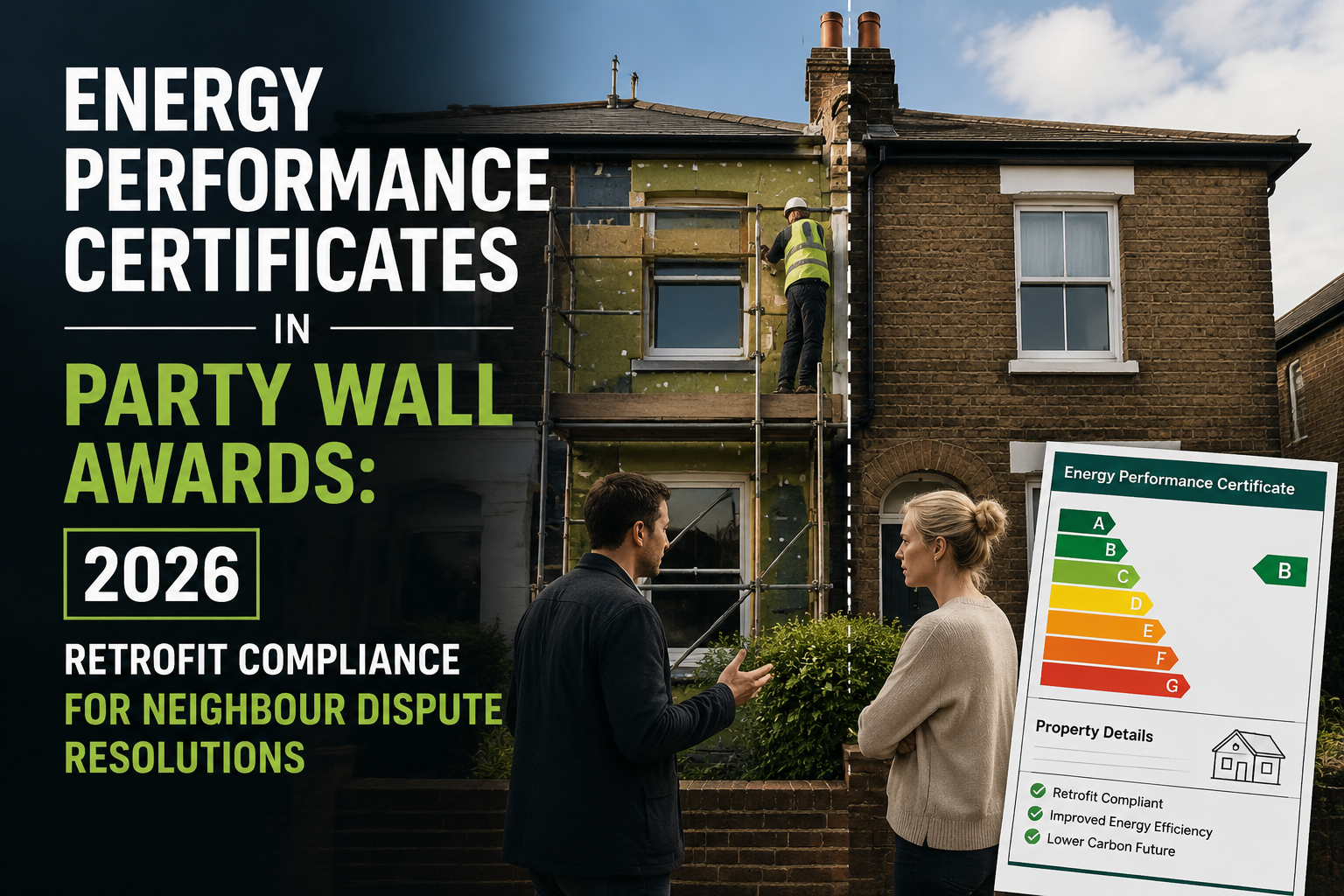
Approximately 460,000 Energy Performance Certificates were lodged in England and Wales between January and March 2026 alone — yet the legal framework governing how EPC data feeds into party wall disputes has lagged far behind the pace of retrofit activity [4]. That gap is closing fast, and property owners, surveyors, and developers who ignore it risk costly disputes, delayed projects, and awards that fail to hold up under scrutiny.
The intersection of Energy Performance Certificates in Party Wall Awards: 2026 Retrofit Compliance for Neighbour Dispute Resolutions is now one of the most technically demanding areas in residential property law. When a homeowner installs external wall insulation, upgrades a shared chimney breast, or retrofits a floor slab that abuts a neighbour's property, the Party Wall etc. Act 1996 is triggered — and the resulting award must increasingly account for energy performance obligations under the latest building regulations.
This article explains exactly how EPC data integrates into party wall schedules, what surveyors must include in 2026 compliance checklists, and how both building owners and adjoining owners can protect their interests when retrofit works become the subject of a neighbour dispute.
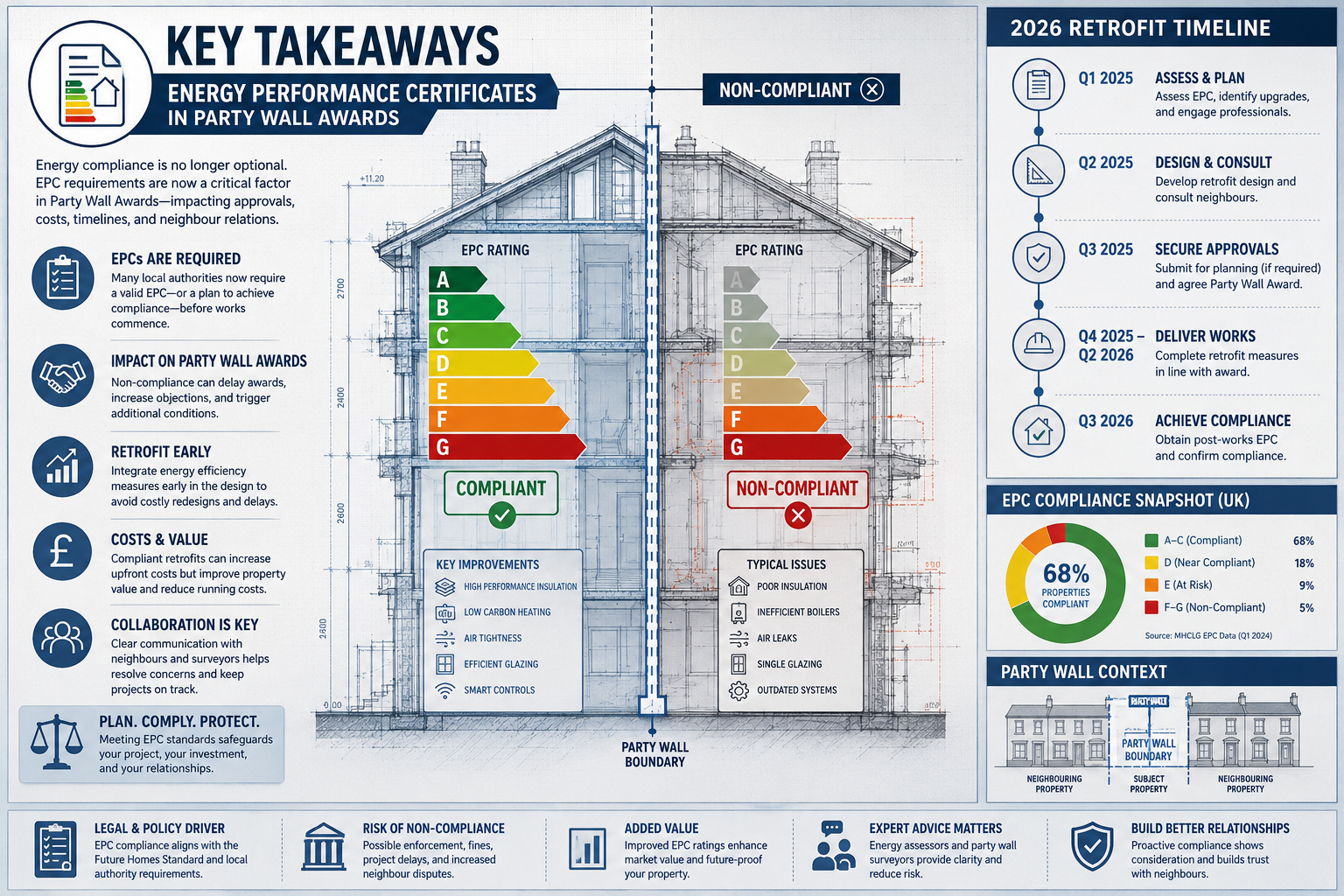
Key Takeaways
- EPC data and SAP 10.3 methodology are now directly relevant to party wall awards where retrofit works affect shared or adjoining structures.
- RICS guidance recommends embedding sustainability clauses — covering embodied carbon, operational carbon, and green material specifications — into party wall awards for retrofit projects.
- The Regulatory Policy Committee confirmed in April 2026 that the Energy Performance of Buildings Regulations 2012 remain fit for purpose, reinforcing their role in dispute resolution contexts.
- Surveyors should use a structured EPC-informed checklist when assessing the impact of energy upgrades on party walls, including pre- and post-works condition records.
- Adjoining owners have legitimate grounds to request EPC-related conditions within an award, particularly where insulation or airtightness measures could affect their property's thermal performance or moisture balance.
Why EPC Data Now Belongs in Party Wall Schedules
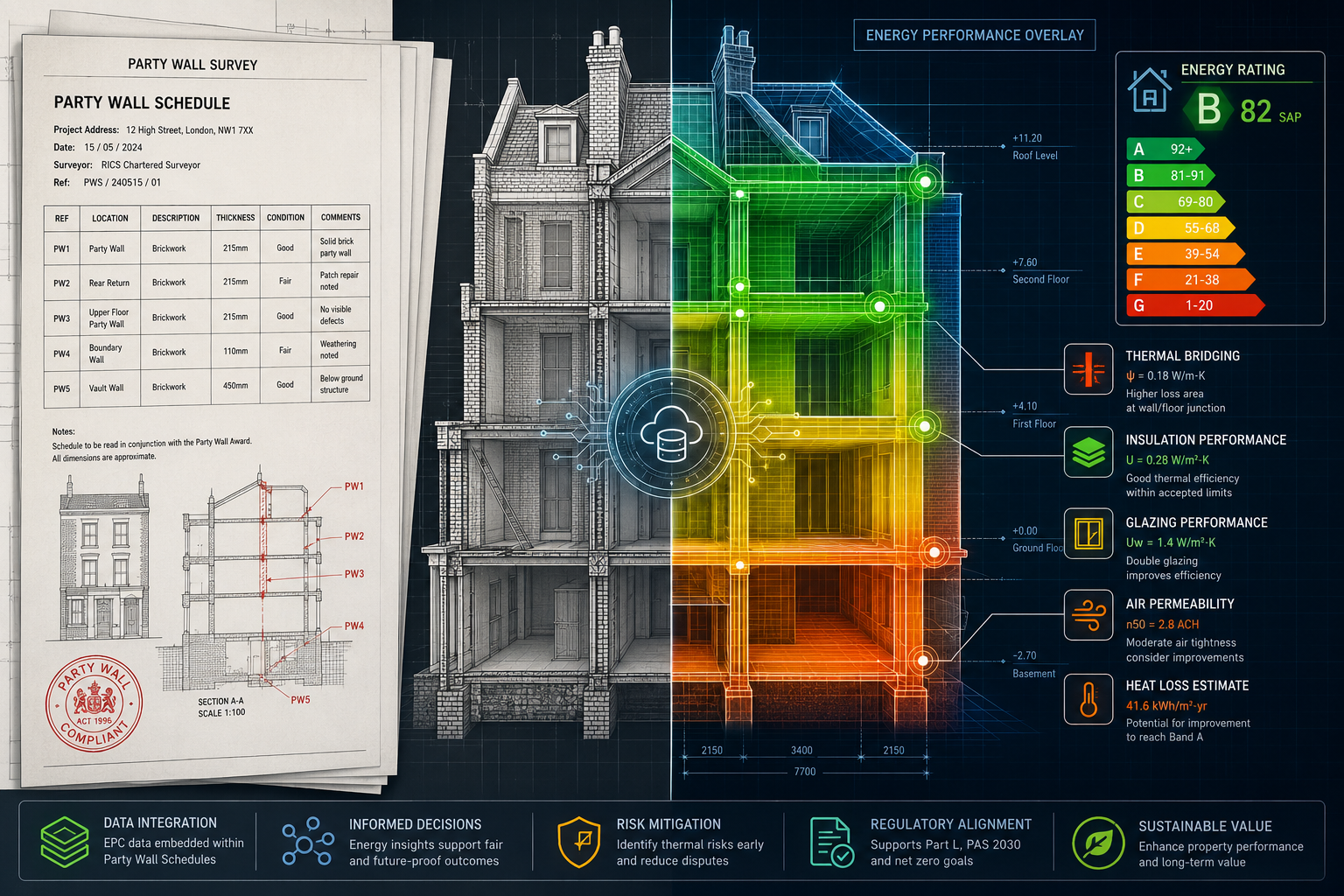
For most of the Party Wall etc. Act's existence, energy performance was treated as a planning or building regulations matter — entirely separate from the dispute resolution process between neighbours. That separation is no longer tenable.
The UK government updated the Standard Assessment Procedure from SAP 10.2 to SAP 10.3 in March 2026, revising how the energy performance of buildings is calculated for compliance with the Building Regulations 2010 [3]. These changes directly affect retrofit specifications. When a building owner proposes to install external wall insulation on a party wall, the insulation specification is now assessed against SAP 10.3 benchmarks. If that specification is inadequate — or if it creates interstitial condensation risks on the adjoining owner's side — the party wall award is the appropriate instrument to address it.
RICS has responded by recommending that party wall awards for green builds and retrofit projects incorporate sustainability clauses that address:
- Embodied carbon thresholds for materials used on or adjacent to party walls
- Operational carbon impacts, particularly where heating system changes affect shared flues or chimneys
- Whole Life Carbon Assessment methodology as a benchmark for material specification [1]
This is not merely aspirational guidance. Where a building owner's retrofit works would demonstrably degrade the energy performance of an adjoining property — for example, by removing a shared chimney that the neighbour relies on for a wood-burning stove, or by applying insulation that traps moisture in a shared wall — the adjoining owner has grounds to request conditions within the award that mitigate those impacts.
The Role of the Schedule of Condition
A schedule of condition has always been a core component of a well-drafted party wall award. In 2026, that schedule must extend beyond structural condition to capture the pre-works energy performance baseline of affected elements. This means:
- Recording the existing U-values of party walls, floors, and roofs where works will alter thermal performance
- Noting any existing EPC rating and the relevant SAP inputs for the adjoining property
- Documenting existing moisture levels, particularly in solid walls, before insulation is applied
Without this baseline, it becomes impossible to attribute any post-works deterioration in energy performance — or any moisture-related damage — to the building owner's retrofit. For a detailed understanding of how condition records protect both parties, see the schedule of condition guidance available from qualified surveyors.
The 2026 Surveyor Checklist: Valuing Energy Upgrades Amid Disputes
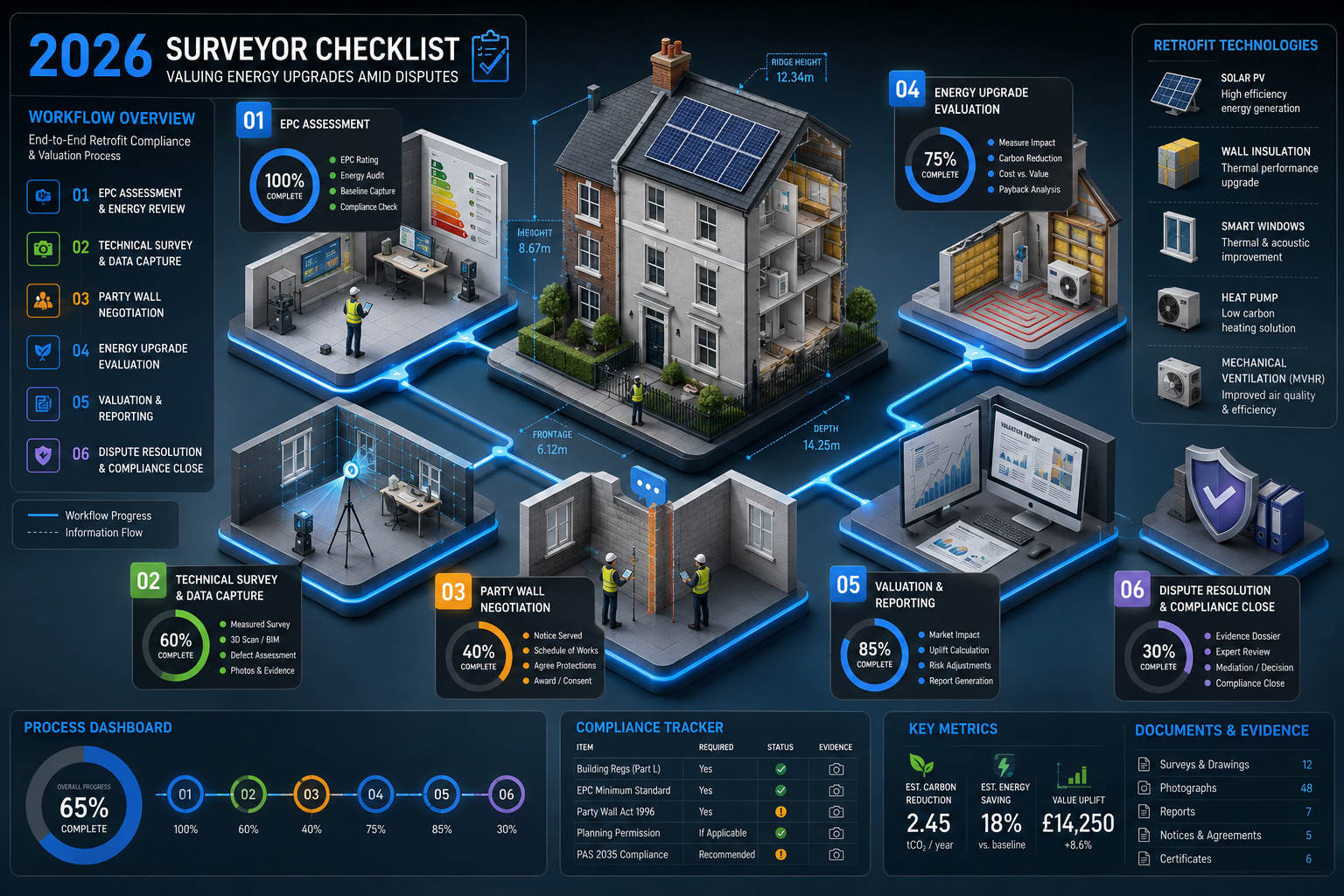
When Energy Performance Certificates in Party Wall Awards: 2026 Retrofit Compliance for Neighbour Dispute Resolutions becomes a live issue on a project, surveyors need a structured approach. The following checklist reflects current best practice under updated RICS guidance and the revised SAP 10.3 framework.
Pre-Award Assessment
| Checklist Item | Purpose |
|---|---|
| Obtain current EPC for building owner's property | Establish pre-works energy rating and SAP score |
| Obtain current EPC for adjoining owner's property | Identify any shared elements contributing to their rating |
| Review proposed retrofit specification against SAP 10.3 | Confirm compliance with updated calculation methodology |
| Assess embodied carbon of proposed materials | Align with RICS sustainability clause recommendations |
| Check for shared thermal elements (party walls, floors, chimneys) | Identify where works may affect adjoining property's energy performance |
| Commission moisture risk assessment for shared walls | Prevent interstitial condensation disputes post-works |
| Review local authority retrofit guidance | Waltham Forest and other boroughs have published updated 2026 advice [8] |
Drafting the Award: Sustainability Conditions
A party wall award for a retrofit project should, where relevant, include conditions that:
- Specify the minimum thermal performance standard for any insulation applied to or adjacent to the party wall, expressed as a U-value
- Require that materials meet stated embodied carbon thresholds, referenced to the Whole Life Carbon Assessment methodology
- Prohibit specifications that would create a condensation risk on the adjoining owner's side of the wall
- Require a post-works EPC to be lodged for the building owner's property, confirming that the intended energy improvement has been achieved
- Address any changes to shared flues, chimneys, or ventilation paths that could affect the adjoining owner's ability to heat their home efficiently
For a comprehensive understanding of what a party wall award can and cannot require, the complete guide to party wall awards for UK homeowners provides essential context.
Post-Works Verification
The award should also specify a post-works inspection protocol. This is particularly important for retrofit projects because:
- Thermal bridging defects at junctions between new insulation and existing party wall construction may not be visible without thermal imaging
- Airtightness improvements on one side of a party wall can alter pressure differentials, potentially driving moisture into the adjoining property
- SAP 10.3 calculations assume correct installation; a poorly installed measure may achieve a lower energy improvement than modelled, creating a discrepancy between the lodged EPC and actual performance [2]
The Department for Energy Security and Net Zero's 2026 research into EPC accuracy identified precisely these kinds of discrepancies between modelled and monitored energy use, underscoring the importance of post-works verification rather than reliance on the certificate alone [2].
Navigating Neighbour Disputes When Retrofit Triggers the Party Wall Act
Energy Performance Certificates in Party Wall Awards: 2026 Retrofit Compliance for Neighbour Dispute Resolutions becomes most contentious when neighbours disagree about whether a proposed retrofit measure is appropriate, safe, or fair. Understanding the common flashpoints helps both parties approach the process constructively.
Common Retrofit Dispute Scenarios
External Wall Insulation (EWI) on a Party Wall
EWI is one of the most common retrofit measures for solid-wall terraced and semi-detached properties. When applied to a wall that is shared with or immediately adjacent to a neighbour's property, the Party Wall etc. Act is engaged. The adjoining owner may object if:
- The insulation specification risks trapping moisture in the shared wall
- The works will reduce the thickness of an already narrow passageway or affect boundary positions
- The building owner has not served a valid party wall notice
If no notice has been served, the adjoining owner should understand their rights — the no party wall notice served guidance explains the available remedies in detail.
Shared Chimney Retrofits
Chimney stacks and flues that serve both properties present particular complexity. A building owner who wishes to decommission a shared chimney as part of a heat pump retrofit must consider the adjoining owner's continued use of that flue. The party wall shared chimneys resource outlines the specific obligations that apply.
Floor Slab Insulation
Ground floor insulation is increasingly common in whole-house retrofit programmes. Where a floor slab is shared with or bears against an adjoining property, the works fall within the Act's scope. A solid floor slab survey should be commissioned before works commence to establish the baseline condition and identify any shared structural elements.
The Adjoining Owner's Rights
An adjoining owner is not simply a passive participant in the party wall process. In the context of retrofit disputes, they have the right to:
- Dissent from the proposed works and appoint their own surveyor
- Request conditions within the award that protect their property's energy performance and structural integrity
- Require a post-works EPC to demonstrate that the building owner's works have not degraded the adjoining property's thermal envelope
- Seek compensation if the works cause damage, including damage to insulation, plasterwork, or moisture management systems on their side of the wall
"An adjoining owner who understands EPC methodology is far better placed to negotiate meaningful protective conditions in a party wall award than one who treats energy performance as someone else's problem."
The Regulatory Policy Committee's April 2026 review confirmed that the Energy Performance of Buildings Regulations 2012 remain fit for purpose and continue to provide a robust framework for assessing energy performance in building projects [5]. This means that EPC-related conditions in party wall awards have a solid regulatory foundation.
When Disputes Escalate
Where the two appointed surveyors cannot agree on the terms of an award — particularly on sustainability conditions or the adequacy of a retrofit specification — the matter is referred to a Third Surveyor. In 2026, Third Surveyors are increasingly being asked to adjudicate on technical questions involving SAP calculations, U-value specifications, and embodied carbon assessments.
For a detailed walkthrough of the dispute resolution process, the comprehensive guide to party wall dispute resolution covers the full range of scenarios from initial notice through to Third Surveyor determination. Understanding what constitutes a party wall dispute is also essential before either party commits to a formal position.
The Cost Dimension
Retrofit-related party wall disputes can be significantly more expensive than standard structural disputes because of the technical expertise required. Surveyors may need to engage specialist energy assessors, thermal imaging contractors, or structural engineers to advise on specific aspects of the award. Property owners should factor these costs into their retrofit budgets from the outset. The cost of party wall guidance provides a realistic overview of what to expect.
The Retrofit Academy's 2026 awards programme, which celebrated excellence in residential decarbonisation, highlighted that the most successful retrofit projects were those where neighbour engagement and legal compliance were treated as integral to the project design — not afterthoughts [6]. The CIBSE Building Performance Awards 2026 shortlist similarly featured projects where measured energy performance outcomes were documented and verified, rather than simply modelled [7].
Conclusion
The integration of Energy Performance Certificates in Party Wall Awards: 2026 Retrofit Compliance for Neighbour Dispute Resolutions is no longer an emerging trend — it is a present reality that every surveyor, building owner, and adjoining owner involved in retrofit works must understand.
Actionable next steps for building owners:
- Before serving a party wall notice for any retrofit project, obtain the current EPC for your property and identify which proposed measures will affect shared or adjoining elements.
- Engage a qualified party wall surveyor who has demonstrable experience with SAP 10.3 methodology and RICS sustainability clause guidance.
- Commission a schedule of condition that includes thermal performance baselines, not just structural condition records.
- Budget for a post-works EPC to confirm that the intended energy improvement has been achieved and that no adverse impacts on the adjoining property have occurred.
Actionable next steps for adjoining owners:
- Do not consent to proposed retrofit works without reviewing the specification against current energy performance standards.
- Appoint your own surveyor if you have any concerns about how the works might affect your property's thermal envelope or moisture management.
- Request that the award includes specific conditions on material specifications, condensation risk, and post-works verification.
- Seek expert witness support if the dispute reaches the Third Surveyor stage and involves complex technical questions about energy performance.
The updated SAP 10.3 methodology, the Regulatory Policy Committee's endorsement of the EPC framework, and RICS's sustainability clause guidance collectively create a coherent set of tools for managing retrofit compliance within party wall disputes. Using them effectively requires technical knowledge, careful documentation, and early engagement — but the result is an award that genuinely protects both parties and supports the UK's broader decarbonisation goals.
References
[1] Sustainability Clauses In Party Wall Awards 2026 Rics Guidance For Green Builds – https://partywallsurveyorlondon.uk/blogs/sustainability-clauses-in-party-wall-awards-2026-rics-guidance-for-green-builds/?utm_source=openai
[2] Energy Performance Certificate Epc Accuracy Research – https://www.gov.uk/government/publications/energy-performance-certificate-epc-accuracy-research?utm_source=openai
[3] Notice Of Approval Of The Methodologies Of Calculation Of The Energy Performance Of New Buildings To Demonstrate Compliance With The Building Regulati – https://www.gov.uk/government/publications/methodologies-for-expressing-the-energy-performance-of-buildings-in-england-and-wales-notice-of-approval-24-march-2026/notice-of-approval-of-the-methodologies-of-calculation-of-the-energy-performance-of-new-buildings-to-demonstrate-compliance-with-the-building-regulati?utm_source=openai
[4] Energy Performance Of Buildings Certificates Statistical Release January To March 2026 England And Wales – https://www.gov.uk/government/statistics/energy-performance-of-building-certificates-in-england-and-wales-january-to-march-2026/energy-performance-of-buildings-certificates-statistical-release-january-to-march-2026-england-and-wales?utm_source=openai
[5] Rpc Opinion Energy Performance Of Buildings Post Implementation Review – https://www.gov.uk/government/publications/rpc-opinion-energy-performance-of-buildings-post-implementation-review?utm_source=openai
[6] Retrofit Academy Awards 2026 Now Open – https://retrofitacademy.org/retrofit-academy-awards-2026-now-open/?utm_source=openai
[7] Cibse Building Performance Awards 2026 Shortlist Announced – https://www.cibse.org/policy-advocacy/news/cibse-building-performance-awards-2026-shortlist-announced/?utm_source=openai
[8] Identifying Measures Your Home – https://www.walthamforest.gov.uk/housing/energy-efficiency/retrofit-advice/identifying-measures-your-home?utm_source=openai
