
A single decision made before building work begins can mean the difference between a £1,000 surveyor fee and a £15,000 dispute bill. That decision is whether to appoint one agreed party wall surveyor or allow the process to escalate into a full three-surveyor tribunal. Understanding the Agreed vs Three Surveyor Party Wall Models: Cost Comparisons and Dispute Avoidance in 2026 is not just a matter of legal compliance — it is a financial and strategic choice that affects every UK homeowner planning work near a shared boundary.
The Party Wall etc. Act 1996 governs these arrangements, and while it provides a clear framework, the cost gap between its two primary models is striking. This article breaks down how each model works, what it costs, and how to keep disputes from escalating in the first place.
Key Takeaways
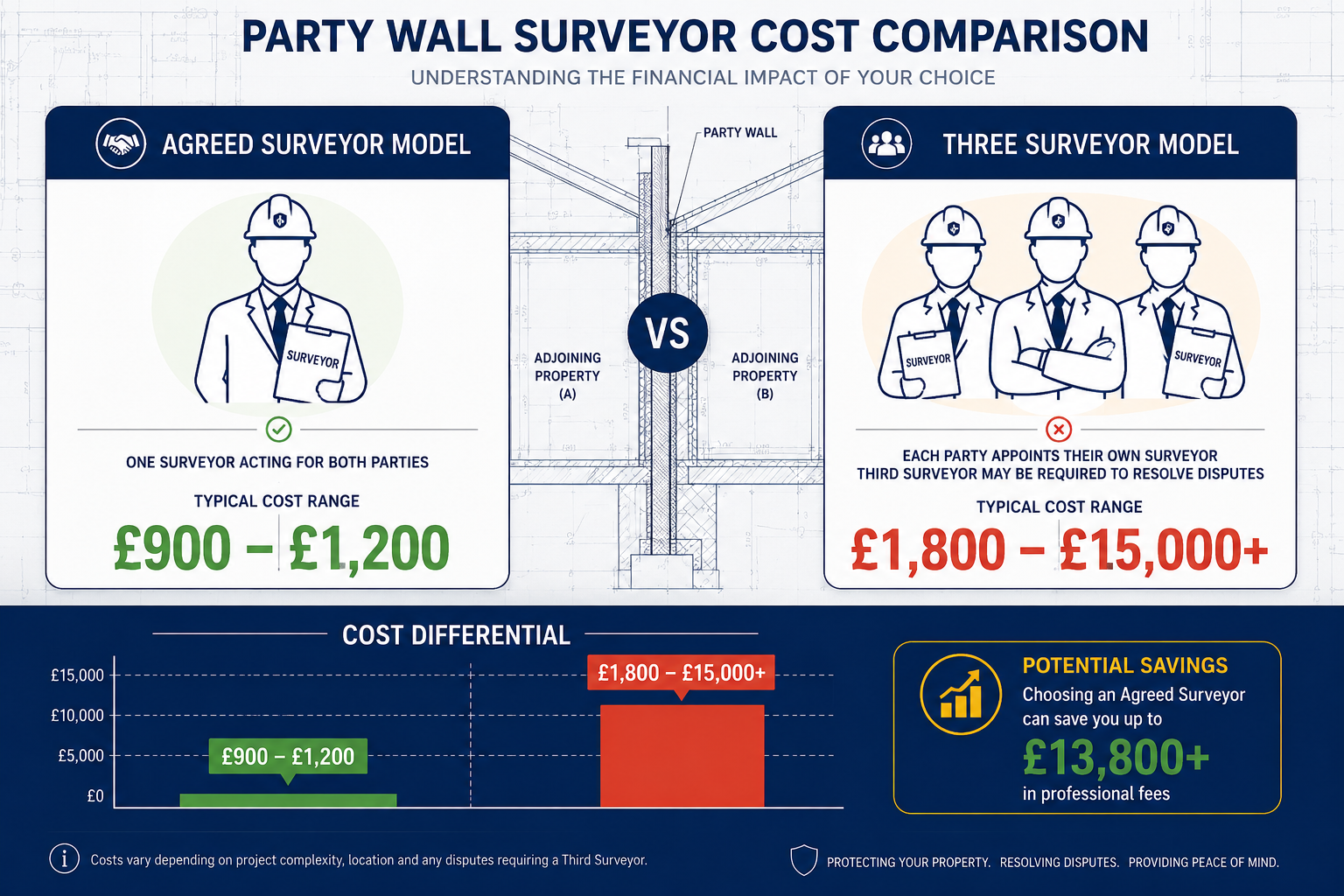
- An agreed surveyor arrangement typically costs £900 to £1,200 for a standard project, while a three-surveyor scenario can exceed £15,000 for complex works.
- The building owner is legally responsible for all surveyor fees under the Party Wall etc. Act 1996, including the adjoining owner's surveyor and any third surveyor.
- Appointing a single agreed surveyor is the most cost-effective and relationship-preserving approach available to building owners.
- The three-surveyor model exists as a dispute resolution safety net, not as a default process — but costs escalate quickly once it is triggered.
- Early communication with adjoining owners is the single most effective dispute avoidance strategy in 2026.
How the Party Wall Act Structures Surveyor Appointments
Before comparing costs, it is essential to understand how the Act creates the two models that sit at the heart of the Agreed vs Three Surveyor Party Wall Models: Cost Comparisons and Dispute Avoidance in 2026 debate.
When a building owner serves a valid party wall notice and the adjoining owner dissents — or fails to respond within 14 days — a dispute is deemed to exist under the Act. At that point, surveyors must be appointed. The Act provides two routes:
Route 1 — The Agreed Surveyor
Both parties jointly appoint a single impartial surveyor. This person acts for both the building owner and the adjoining owner simultaneously. Their role is to produce a fair party wall award that protects both sides.
Route 2 — Two Appointed Surveyors (and a potential Third)
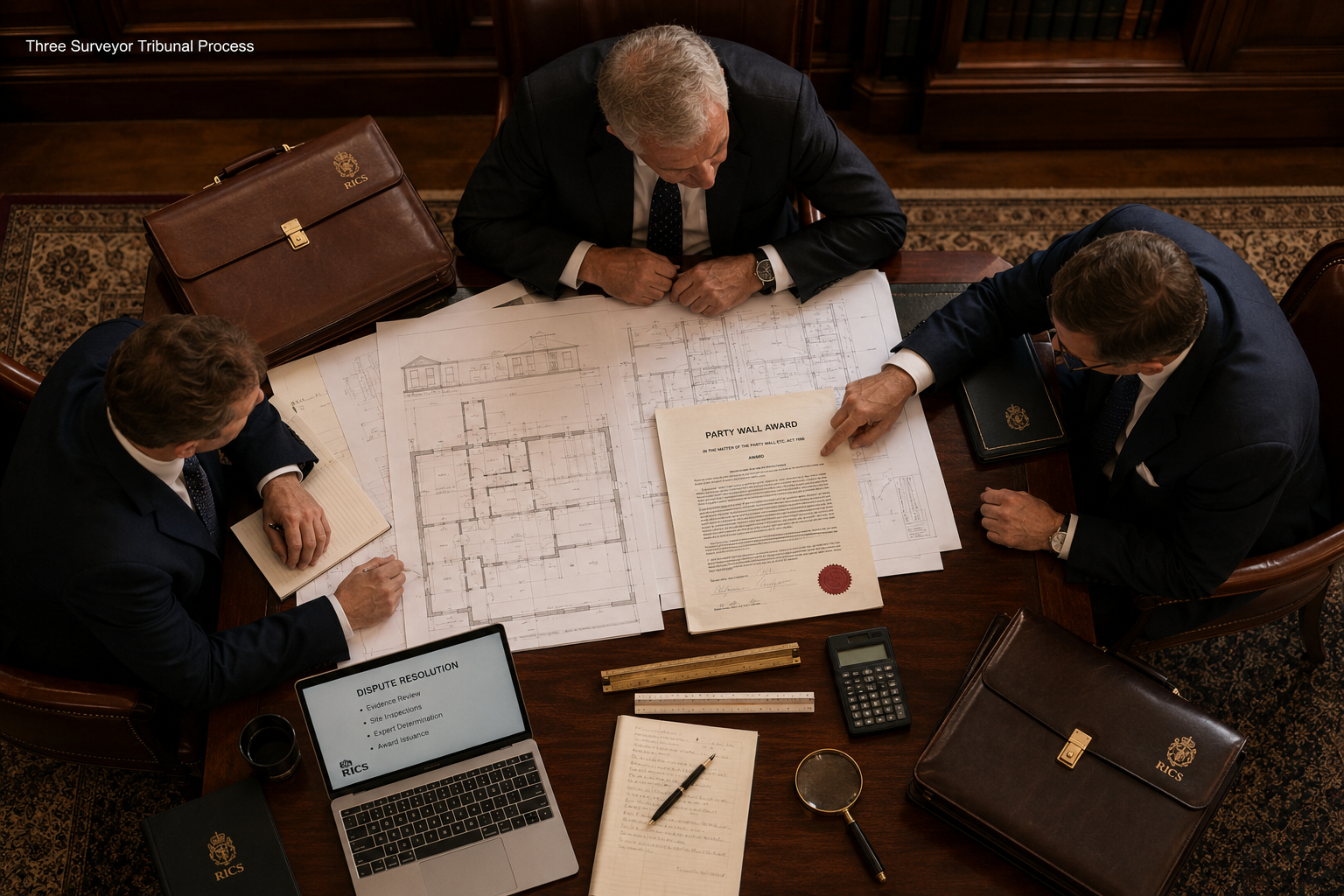
Each party appoints their own surveyor. Those two surveyors work together to produce an agreed award. If they cannot agree on any point, either surveyor may call upon a pre-selected third surveyor to make a binding determination. This is the three-surveyor model.
Understanding what a party wall surveyor does in each of these roles is essential before committing to either route.
When Is a Surveyor Appointment Actually Required?
Not every party wall notice leads to a surveyor appointment. If the adjoining owner provides written consent within 14 days of receiving a notice, no award is needed and no surveyor fees arise. This is the cheapest outcome of all. For a full breakdown of when formal procedures become legally mandatory, see when a party wall agreement is legally required in the UK.
Agreed vs Three Surveyor Party Wall Models: Cost Comparisons and Dispute Avoidance in 2026 — The Numbers in Detail
The Agreed Surveyor Model: Costs and Advantages
The agreed surveyor model is widely regarded as the gold standard for cost efficiency. A single professional handles the entire process — inspecting the property, preparing a schedule of condition, drafting the party wall award, and managing correspondence between both parties.
Typical costs for an agreed surveyor in 2026:
| Project Type | Agreed Surveyor Cost |
|---|---|
| Single-storey extension | £700 – £1,000 |
| Loft conversion | £900 – £1,200 |
| Basement excavation (straightforward) | £1,200 – £2,000 |
| Multiple adjoining owners | Add £400-£700 per additional owner |
For a loft conversion, the agreed surveyor model typically costs between £900 and £1,200 — roughly half the cost of appointing separate surveyors for the same project [1].
Key advantages of the agreed surveyor model:
- Single fee rather than two separate invoices
- Faster turnaround — one professional coordinates the entire process
- Reduced potential for procedural disagreements
- Better for neighbourly relations
- The surveyor's impartiality is built into the appointment from the start
Party wall surveyors in England and Wales generally charge between £90 and £450 per hour, depending on location and project complexity [2]. In London and the South East, fees sit at the higher end of this range. A party wall award in London may cost between £1,500 and £3,000 under the agreed model for more complex projects, while similar services in other regions typically range from £700 to £1,500 [5].
The Three-Surveyor Model: When Costs Escalate
The three-surveyor model begins when each party appoints their own surveyor. The costs immediately double in theory — two surveyors are now billing for their time. For a loft conversion that would have cost £900 to £1,200 under the agreed model, the same project can cost £1,800 to £2,400 when each party appoints separately [1].
But the real cost risk emerges if the two appointed surveyors cannot reach agreement. At that point, either surveyor may refer the matter to the pre-selected third surveyor. Third surveyors are typically senior professionals with specialist dispute resolution experience, and they charge accordingly [2].
Typical costs in a three-surveyor scenario:
| Scenario | Estimated Total Cost |
|---|---|
| Two surveyors reach agreement | £1,800 – £4,000 |
| Third surveyor involved (straightforward) | £4,000 – £8,000 |
| Third surveyor involved (basement/complex) | £10,000 – £15,000+ |
Complex projects such as basement excavations can see total costs exceeding £15,000 when a third surveyor is involved [1]. These figures do not include any legal costs if a party chooses to challenge an award in the County Court.
Who Pays? The Building Owner's Legal Exposure
Under the Party Wall etc. Act 1996, the building owner is generally responsible for all surveyor fees. This includes the adjoining owner's surveyor fees and any third surveyor costs [3]. This is a critical point that many building owners overlook when they assume the adjoining owner will share the financial burden.
The fees determined by surveyors are legally enforceable. If an adjoining owner fails to pay any expenses required under the award, the building owner retains sole ownership of any work carried out until payment is made [2]. This legal enforceability cuts both ways — it protects the process but also confirms that the building owner cannot simply walk away from escalating costs.
"The building owner bears the financial risk of the entire surveyor appointment process. Choosing the agreed model is not just a preference — it is a direct cost control measure."
Geographic Variations in 2026
Location significantly affects fees. London and the South East consistently attract the highest surveyor rates, reflecting higher living costs, greater property values, and more complex urban building conditions. Homeowners in areas such as South East London or West London should budget at the upper end of any published range.
Dispute Avoidance Strategies: Practical Steps for 2026
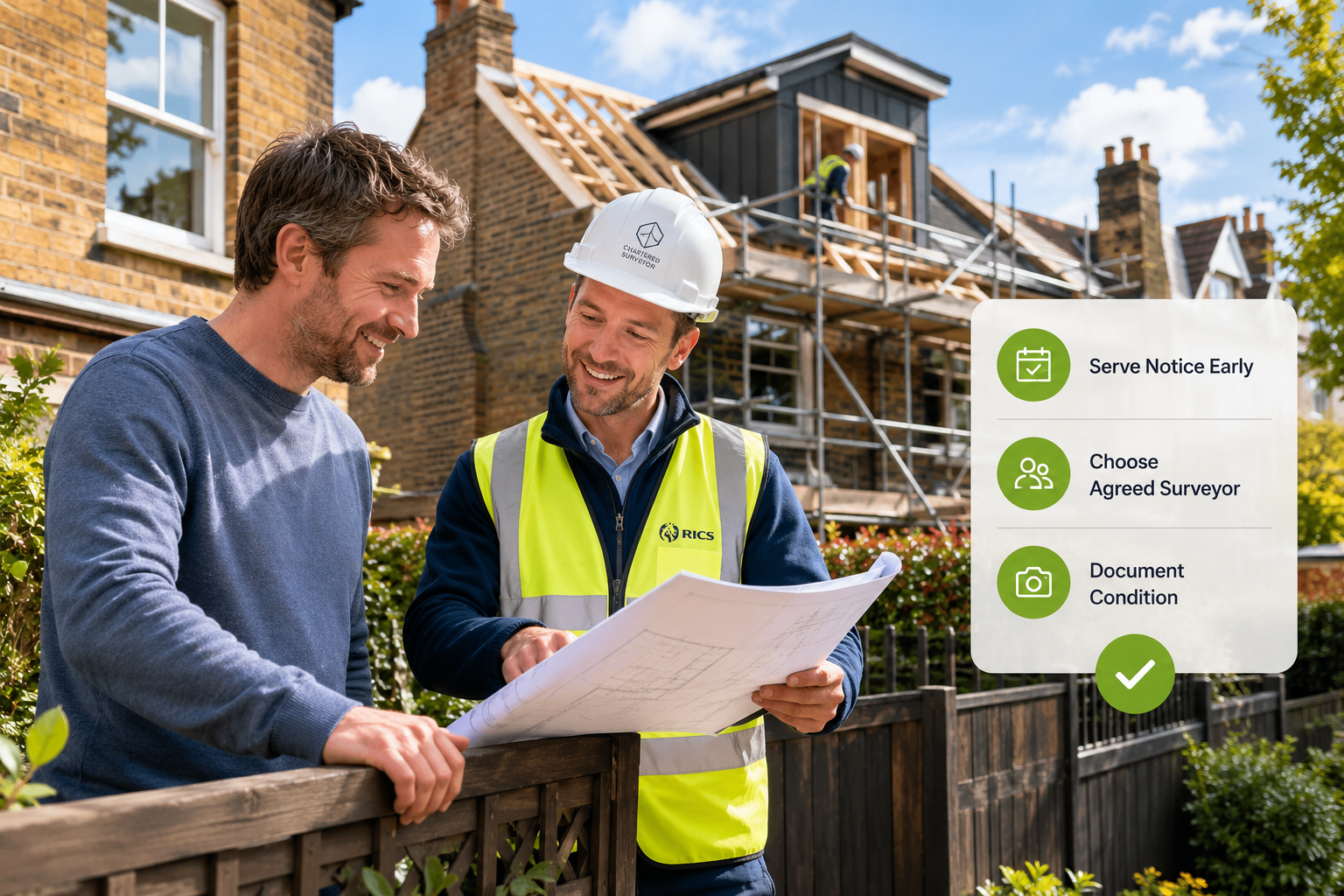
Understanding the cost gap between the two models makes dispute avoidance a clear financial priority. The following strategies are the most effective ways to keep party wall matters from escalating.
Serve Notices Early and Correctly
Errors in the notice itself — wrong dates, missing details, or failure to identify the correct works — can invalidate the process and force a restart. Serving correct notices with adequate lead time (at minimum two months before notifiable works begin for most projects) gives adjoining owners time to consider their response without feeling pressured. For a full guide to party wall act notices and how to respond, the process is more straightforward than many assume.
Communicate Before Serving Notice
The most effective dispute avoidance step costs nothing. Speaking to neighbours before serving formal notice — explaining the works, the timeline, and the surveyor process — dramatically increases the likelihood of consent. When neighbours feel informed rather than ambushed, they are far more likely to agree to a single surveyor or to consent outright.
Early and open negotiations with adjoining owners to appoint a single agreed surveyor is the most cost-effective strategy available. This approach not only reduces expenses but also fosters better neighbourly relations and expedites the party wall process [1].
Select an Impartial, RICS-Accredited Agreed Surveyor
If the agreed surveyor route is chosen, the selection of the right professional is critical. The agreed surveyor must be genuinely impartial — they cannot favour either party. RICS (Royal Institution of Chartered Surveyors) accreditation provides a baseline assurance of professional standards and ethical conduct.
When selecting an agreed surveyor, consider:
- RICS membership and relevant party wall experience
- Familiarity with the specific type of works (loft, basement, extension)
- Local knowledge of the area and common construction practices
- Clear fee transparency before appointment
- References from previous party wall appointments
For complex projects, working with chartered surveyors who have demonstrable experience in party wall matters reduces the risk of procedural errors that can trigger disputes.
Understand the Schedule of Condition
A thorough schedule of condition — a photographic and written record of the adjoining property's existing state before works begin — is one of the most powerful dispute prevention tools available. It provides objective evidence if the adjoining owner later claims damage was caused by the building works.
Without a schedule of condition, any crack or defect that appears during or after construction becomes a potential dispute point. With one in place, the burden of proof becomes much clearer. For guidance on resolving party wall disputes when they do arise, having documented evidence from the outset is invaluable.
Multiple Adjoining Owners: Plan for Additional Costs
When a project affects more than one adjoining property — common with terraced houses or flats — costs can multiply significantly. Each additional property may require separate notices and potentially separate surveyor appointments [4]. A building owner undertaking a rear extension on a mid-terrace property may need to serve notices on two neighbours, potentially resulting in two separate agreed surveyor appointments or, in a worst case, two sets of appointed surveyors.
Planning for this scenario from the outset — and budgeting accordingly — prevents financial surprises mid-project.
The Third Surveyor's Role: Arbitrator of Last Resort
The third surveyor is a unique figure in the party wall process. Unlike the two appointed surveyors who represent their respective clients, the third surveyor acts as an impartial arbitrator. Their selection typically happens at the same time as the two appointed surveyors are named — before any dispute actually arises — so that there is no delay if a referral becomes necessary [6].
The third surveyor does not become involved unless called upon by either of the two appointed surveyors. Their determination on any referred matter is binding on both parties, though either party retains the right to appeal to the County Court within 14 days of an award being made [6].
The third surveyor's key characteristics:
- Must be independent of both parties and both appointed surveyors
- Typically a senior, highly experienced party wall professional
- Charges higher hourly rates reflecting specialist expertise [2]
- Their decisions carry the same legal weight as a full party wall award
- Cannot be the same person as either appointed surveyor
The third surveyor mechanism is designed to resolve disputes efficiently, but the cost and time implications of reaching that stage are significant. It is a safety net, not a preferred route.
For a deeper understanding of what a party wall award contains and how it protects both parties, reviewing the award structure before any surveyor is appointed is worthwhile.
Agreed vs Three Surveyor Party Wall Models: Cost Comparisons and Dispute Avoidance in 2026 — A Side-by-Side Summary
The following table consolidates the key differences between the two models for quick reference:
| Factor | Agreed Surveyor Model | Three-Surveyor Model |
|---|---|---|
| Number of surveyors | 1 | 2 (potentially 3) |
| Typical cost range | £700 – £2,000 | £1,800 – £15,000+ |
| Who pays | Building owner | Building owner (all fees) |
| Speed | Faster | Slower (especially if third surveyor involved) |
| Dispute risk | Lower | Higher |
| Neighbourly relations | Generally preserved | Can be adversarial |
| Best suited for | Most residential projects | Complex disputes, high-value works |
| RICS involvement | Recommended | Mandatory for third surveyor |
For homeowners in areas with high property values and dense housing — such as those working with local party wall surveyors in London — the agreed model offers the most predictable cost outcome.
Conclusion
The financial case for the agreed surveyor model in 2026 is compelling. A single impartial professional, appointed jointly by both parties, consistently delivers faster outcomes, lower costs, and better neighbourly relations than the three-surveyor alternative. The cost difference is not marginal — it can represent a tenfold increase in fees for complex projects that escalate to a third surveyor determination.
Actionable next steps for building owners in 2026:
- Speak to neighbours before serving any formal notice — consent eliminates surveyor fees entirely.
- Serve notices correctly and with adequate lead time to avoid procedural disputes.
- Propose a jointly appointed, RICS-accredited agreed surveyor in writing as part of the initial notice communication.
- Commission a thorough schedule of condition before any works begin to protect against damage claims.
- Budget for additional surveyor appointments if more than one adjoining property is affected.
- If the three-surveyor model becomes unavoidable, agree on a third surveyor selection early to avoid delays.
The Party Wall etc. Act 1996 provides a robust framework for managing shared boundary works. Using it intelligently — by choosing the agreed surveyor route wherever possible — is the most effective way to protect both budget and relationships in 2026.
References
[1] Agreed Surveyors Vs Three Surveyor Scenarios Cost Benefit Analysis For 2026 Party Wall Disputes – https://partywallsurveyorlondon.uk/blogs/agreed-surveyors-vs-three-surveyor-scenarios-cost-benefit-analysis-for-2026-party-wall-disputes/?utm_source=openai
[2] The Third Surveyor In Party Wall Disputes Role And Selection – https://legalclarity.org/the-third-surveyor-in-party-wall-disputes-role-and-selection/?utm_source=openai
[3] Who Pays For A Party Wall Surveyor A Guide To Cost Responsibilities – https://nottinghillsurveyors.com/blog/who-pays-for-a-party-wall-surveyor-a-guide-to-cost-responsibilities?utm_source=openai
[4] Cost Of A Party Wall Surveyor – https://manchestersurveyors.com/cost-of-a-party-wall-surveyor/?utm_source=openai
[5] How Much Does Party Wall Surveyor Cost – https://www.metsurveyors.co.uk/post/how-much-does-party-wall-surveyor-cost?utm_source=openai
[6] Party Wall Disputes The Third Surveyor – https://www.isurv.com/info/390/features_archive/11143/party_wall_disputes_the_third_surveyor?utm_source=openai
