
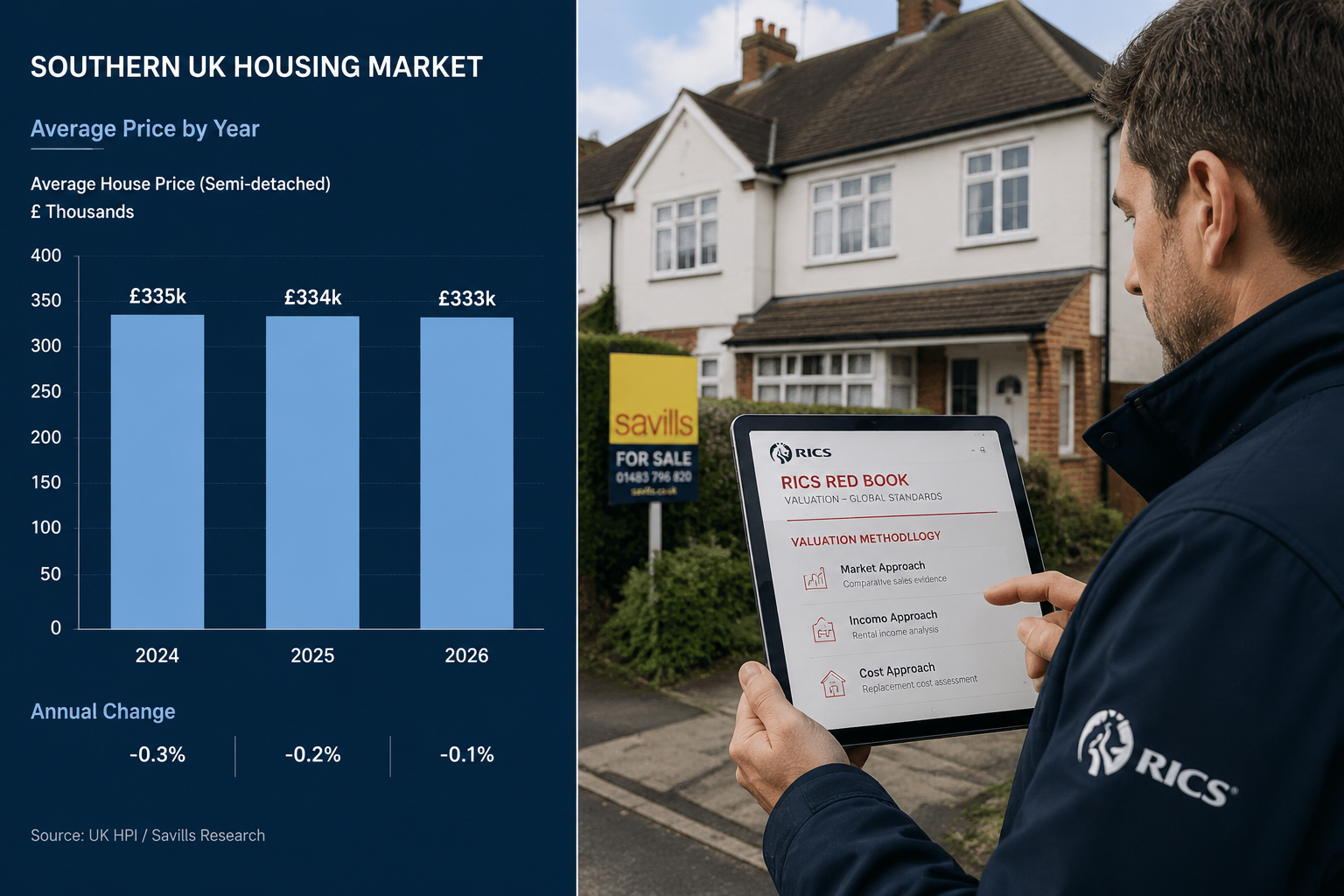
Enquiry volumes across London and the South East dropped by an estimated 15% in early 2026 compared to the same period in 2024 — and yet median asking prices have barely moved. That gap between buyer hesitancy and seller expectation is precisely where the discipline of valuing stabilising southern properties: low-growth strategies and negotiation tactics for 2026 surveyors becomes most critical. When markets stall, the surveyor's role shifts from simply reporting a number to actively defending it.

Key Takeaways
- Southern UK property markets in 2026 are characterised by flat price growth, reduced buyer enquiries, and elevated inventory in certain segments, demanding more rigorous valuation methods.
- "Price bunching" — the clustering of comparable sales within a narrow band — is a core analytical tool for surveyors working in low-growth conditions.
- RICS Red Book methodology provides the professional framework that protects valuers and clients alike when market signals are ambiguous.
- Negotiation in a stabilising market requires surveyors to quantify buyer incentives and structural defects with greater precision than in a rising market.
- Understanding the broader southern property landscape, from Sun Belt cooling in the US to South East London flat price dynamics, helps contextualise local conditions for clients.
Understanding the 2026 Southern Property Landscape
The term "southern properties" spans a wide geography, and in 2026 that breadth matters. In the United States, Sun Belt metros that surged during the pandemic boom are now cooling noticeably. Data from April 2026 shows coastal markets regaining momentum while inland southern metros face pushback from buyers unwilling to absorb high prices alongside mortgage rates averaging 6.3% nationally [3][4]. Cities like Jacksonville and Orlando remain relative bright spots due to affordability and employment growth [5], while Dallas-Fort Worth continues to attract net inward migration driven by job opportunity [7].
In the UK context, the pattern rhymes. London and the South East — the primary focus for UK-based surveyors — are experiencing what analysts describe as a "soft plateau." Prices are not collapsing, but they are not growing either. Sellers anchored to 2022 peak valuations are meeting buyers who have recalibrated their expectations around persistent mortgage costs and cost-of-living pressures.
What does stabilisation actually look like in practice?
- Transaction volumes falling 10–15% below five-year averages
- Days on market extending from 30–45 days to 60–90 days in many South East postcodes
- A widening gap between asking price and achieved price, often 3–6%
- Increased use of buyer incentives such as stamp duty contributions and furnished packages
For surveyors operating across South West London or South East London, these dynamics are not abstract. They translate directly into how comparable evidence is selected, weighted, and presented in a formal valuation report.
The Florida Parallel: What Stabilisation Data Tells Surveyors
South Florida's February 2026 data provides a useful international reference point. Single-family home closed sales rose 4.7% year-over-year to 2,633 transactions, with the median price reaching $660,000 — a 3.1% gain [1]. On the surface, that looks healthy. But the condo segment tells a more nuanced story: sales volumes rose 7.2% while median prices fell 1.4% to $340,000, with inventory at 11.3 months of supply [1]. That divergence — volume up, price down — is the hallmark of a stabilising market where buyers have regained leverage in specific segments.
UK surveyors should note the structural lesson: stabilisation is rarely uniform across property types. Flats and maisonettes in South East London are experiencing dynamics closer to the Florida condo market than the detached family home market. This segmentation must be reflected in comparable selection.
Core Valuation Strategies for Low-Growth Southern Markets
Valuing stabilising southern properties requires a more forensic approach than a rising market demands. When prices are climbing, a surveyor can rely on a broad sweep of recent comparables and apply a modest upward adjustment. When growth stalls, that shortcut becomes a liability.

Price Bunching Analysis
"Price bunching" refers to the phenomenon where a significant proportion of comparable sales cluster within a tight price range — often within 2–3% of each other — regardless of minor differences in property condition or specification. In a stabilising market, this clustering intensifies because sellers are reluctant to price below a psychological threshold (such as £500,000 or £750,000) and buyers are equally reluctant to pay above it.
For surveyors, identifying a price bunch means:
- Mapping all comparables within a 0.5-mile radius over the past 6 months onto a price-per-square-foot grid
- Identifying the modal band — the range where the greatest number of transactions cluster
- Assessing whether the subject property sits within, above, or below that band based on objective physical and locational factors
- Documenting the rationale for any departure from the modal band in the valuation report
This approach is consistent with RICS Red Book (RICS Valuation — Global Standards) requirements for transparency and evidential support. It also provides defensible reasoning when a mortgage lender or client challenges a figure that sits below the seller's expectation.
Adjusting for Market Conditions: The Time-Weighting Problem
In a fast-rising market, a comparable from six months ago needs an upward time adjustment. In a stabilising market, that same comparable may need a downward adjustment — or no adjustment at all. Many surveyors default to upward adjustments out of habit, which can result in systematic overvaluation in flat conditions.
A practical framework for time-weighting in 2026:
| Market Condition | Comparable Age | Adjustment Direction | Typical Range |
|---|---|---|---|
| Rising (3%+ annual growth) | 3–6 months | Upward | +1.5–3% |
| Flat (0–1% annual growth) | 3–6 months | Neutral or slight downward | 0 to -1% |
| Cooling (-1% or below) | 3–6 months | Downward | -1 to -3% |
| Stabilising (mixed signals) | 3–6 months | Case-by-case, documented | Variable |
Surveyors working across Surrey or Sussex should apply particular scrutiny to comparables from mid-2024, when brief optimism around rate cuts temporarily inflated achieved prices. Using those figures without downward adjustment in 2026 conditions would misrepresent current market value.
Structural Defects and Their Amplified Impact
In a rising market, buyers absorb the cost of defects with relative ease — they expect to spend on renovation and trust that the market will recover the investment. In a stabilising market, defect costs are not absorbed; they are deducted. Surveyors must therefore apply more rigorous cost-of-repair analysis.
A full structural survey becomes especially valuable in this environment. Rather than flagging a damp issue as a general concern, the 2026 surveyor should provide a costed range — even if approximate — so that the valuation adjustment is transparent and defensible. For complex cases involving subsidence or ground movement, a subsidence survey provides the specialist evidence needed to justify significant downward adjustments.
"In a flat market, every pound of defect cost comes directly off the offer price. The surveyor who quantifies defects precisely gives their client the strongest negotiating position."
Negotiation Tactics: How Surveyors Add Value Beyond the Number
The valuation figure is the starting point, not the end point. In a stabilising market, the surveyor's ability to support negotiation — whether acting for buyer or lender — becomes a genuine differentiator.
Quantifying Buyer Incentives
Sellers in a slow market frequently offer incentives: stamp duty contributions, white goods packages, or agreed snagging works on new builds. These incentives have real monetary value that must be reflected in the valuation.
For example, a seller offering to contribute £15,000 toward stamp duty on a £500,000 property is effectively accepting a net price of £485,000. If the surveyor values the property at £500,000 without acknowledging this incentive structure, the mortgage lender is exposed to an inflated loan-to-value ratio. RICS guidance is clear: incentives that reduce the net consideration must be disclosed and reflected in the reported figure.
Surveyors working on new build assessments should be particularly alert to developer incentive packages, which are common in a cooling market and can significantly distort headline price data.
Using Valuation Reports as Negotiation Tools
A well-constructed valuation report is not merely a compliance document — it is a negotiation instrument. When a surveyor identifies a material defect, a price bunch below the asking price, or a comparable that directly undermines the seller's expectation, that evidence can be used by the buyer's solicitor or mortgage broker to renegotiate terms.
Effective negotiation-supporting reports include:
- A clear statement of the RICS-compliant market value figure
- A schedule of material defects with estimated remediation costs
- A comparable evidence table showing the price band within which the subject property falls
- Commentary on current market conditions, including days-on-market data and any observed price reductions in the local area
For surveyors who also provide expert witness reports, the same rigour applied in litigation contexts should be brought to standard valuation work in a stabilising market — because the risk of challenge is meaningfully higher when prices are contested.
Handling Seller Resistance and Down-Valuations
Down-valuations — where the surveyor's figure falls below the agreed purchase price — are more common in stabilising markets. They create friction between buyer, seller, and lender, and surveyors sometimes face pressure to revise upward.
The professional response is straightforward: the valuation must reflect market evidence, not commercial pressure. RICS members are bound by the Red Book and their professional obligations. A surveyor who inflates a figure to preserve a transaction exposes themselves to negligence claims and regulatory sanction.
Practical steps when facing seller resistance:
- Prepare a clear written summary of the comparable evidence supporting the valuation
- Invite the seller or their agent to submit additional comparables for consideration
- Review any new evidence objectively and document the outcome
- If the valuation stands, communicate the decision with professional courtesy but without concession
Surveyors based in Chartered Surveyors South East London or South West London will encounter this dynamic regularly in 2026, given the concentration of sellers who purchased at or near peak prices in 2021–2022.
RICS-Backed Methods That Protect Accuracy in Cautious Markets
The RICS Red Book (formally, RICS Valuation — Global Standards 2022, updated with 2024 amendments) remains the definitive framework for UK residential and commercial valuation. In a stabilising market, adherence to its principles is not just a professional obligation — it is a practical shield.
The Comparative Method in Flat Markets
The comparative method — matching the subject property against recent sales of similar properties — is the most commonly used approach in residential valuation. In a rising market, it is relatively forgiving. In a flat market, the quality of comparable selection becomes paramount.
Key principles for 2026 application:
- Prioritise comparables within the last three months over those from six to twelve months ago
- Weight comparables by similarity of property type, size, condition, and location — not merely proximity
- Disclose any adjustments made and the rationale for each
- Where fewer than three strong comparables exist, document the limitation explicitly
For commercial properties, the investment method and profits method may be more appropriate, particularly where income streams are the primary value driver.
Monitoring and Ongoing Valuation
In a market where conditions are shifting month by month, a single point-in-time valuation has a shorter shelf life than in a stable or rising market. Surveyors should advise clients accordingly, and where ongoing monitoring is appropriate — for example, in development finance or portfolio management contexts — monitoring surveys provide a structured mechanism for tracking value changes over time.
Florida Realtors noted in January 2026 that easing mortgage rates and improving sales were beginning to stabilise the market, but emphasised that local factors remain the dominant driver of individual property values [2]. The same principle applies in the UK: national trends provide context, but postcode-level evidence determines the figure.
Affordability as a Value Anchor
Nationally in the US, the typical monthly mortgage payment is projected to fall below 30% of household income for the first time since 2022, based on a projected average mortgage rate of 6.3% and 2.2% home price growth [3]. This affordability improvement is a meaningful tailwind for stabilising markets — it suggests that the floor is firming even if the ceiling is not rising.
In the UK, a similar dynamic is emerging as fixed-rate mortgage products become more competitive. Surveyors should incorporate affordability metrics — local income multiples, mortgage cost-to-income ratios — into their market commentary sections, as these factors directly influence the depth of buyer demand that underpins value.
Conclusion: Actionable Steps for Surveyors in 2026
The discipline of valuing stabilising southern properties: low-growth strategies and negotiation tactics for 2026 surveyors is ultimately about precision under pressure. When markets are rising, imprecision is forgiving. When they are flat or cooling, it is not.
Actionable next steps for surveyors working in southern markets in 2026:
- Audit your comparable selection process. Ensure that time-weighting adjustments reflect current market direction, not habitual upward bias.
- Adopt price bunching analysis as a standard tool in your valuation methodology, particularly for flats and maisonettes where segment-level divergence is most pronounced.
- Quantify defects with cost estimates wherever possible, giving clients a defensible basis for negotiation.
- Disclose all seller incentives in accordance with RICS guidance, ensuring that headline prices are not mistaken for net market value.
- Document everything. In a market where down-valuations are more frequent and challenges more likely, a well-evidenced report is the surveyor's most important professional asset.
- Stay current with local market data. Monthly transaction volumes, days-on-market trends, and price reduction frequencies in your specific postcodes are more valuable than national headline figures.
The surveyors who will serve their clients best in 2026 are those who combine rigorous RICS-compliant methodology with the commercial awareness to explain, defend, and where appropriate, deploy their valuations as active tools in the negotiation process.
References
[1] South Florida Real Estate Report February 2026 – https://www.bythesearealty.com/blog/south-florida-real-estate-report-february-2026/?utm_source=openai
[2] Florida Housing Enters 2026 Firmer Ground – https://www.floridarealtors.org/news-media/news-articles/2026/01/florida-housing-enters-2026-firmer-ground?utm_source=openai
[3] Housing Forecast 2026 Mortgage Rates Affordability Improves – https://www.realtor.com/news/trends/housing-forecast-2026-mortgage-rates-affordability-improves/?utm_source=openai
[4] The Hottest And Coldest Housing Markets Of 2026 Ranked – https://www.inman.com/2026/04/10/the-hottest-and-coldest-housing-markets-of-2026-ranked/?utm_source=openai
[5] Southern Real Estate Markets 2026 Forecast – https://marcelohomes.com/2025/10/31/southern-real-estate-markets-2026-forecast/?utm_source=openai
[6] Watch – https://www.youtube.com/watch?v=Kfh9pxpolBU&utm_source=openai
[7] Watch – https://www.youtube.com/watch?v=DoEyKg86DlM&utm_source=openai
