
More than 40% of all party wall notices served in London relate to rear extensions and side returns — projects that builders and homeowners routinely describe as straightforward. Yet these same projects generate a disproportionate share of structural damage claims, neighbour disputes, and costly legal proceedings. The label "routine" can be dangerously misleading. Party wall surveying for rear extensions and side returns: the real structural risks behind 'routine' works is a subject that deserves far more rigorous attention than most homeowners give it before the first spade enters the ground.
Key Takeaways
- Rear extensions and side returns frequently trigger obligations under the Party Wall etc. Act 1996, even when the works appear minor.
- Foundation excavation within 3 metres of a neighbour's structure is one of the most common — and most underestimated — structural risks.
- Side return extensions require steel beams that, if incorrectly specified or installed, can cause cracking, settlement, and long-term movement.
- A formal Schedule of Condition survey before works begin is essential protection for both the building owner and the adjoining owner.
- Failing to serve the correct notices, or starting work before the statutory period expires, can result in injunctions, project delays, and significant financial liability.
Why 'Simple' Extensions Are Rarely Simple Under the Party Wall Act
Most homeowners approach a rear extension or side return project with a focus on planning permission, build costs, and design. The legal and structural obligations under the Party Wall etc. Act 1996 are often treated as an afterthought — or worse, ignored entirely.
The Act covers three distinct categories of work, each with its own notice requirements:
| Notice Type | Trigger | Notice Period |
|---|---|---|
| Section 1 Notice | New wall on or astride the boundary | 1 month |
| Section 3 Notice (Party Structure Notice) | Works to an existing party wall or structure | 2 months |
| Section 6 Notice | Excavation within 3m or 6m of a neighbour's building | 1 month |
For a typical rear extension on a terraced or semi-detached property, it is entirely possible that all three notice types are required simultaneously. The rear wall of the original house is often a party wall. The new extension may be built up to or on the boundary. And the new foundations almost always involve excavation close to the neighbour's existing footings. [1]
Understanding what a party wall surveyor does — and when their involvement becomes legally mandatory — is the first step every building owner should take before submitting a planning application.
Foundation Excavation: The Most Underestimated Risk in Rear Extensions
The Section 6 Trigger and What It Really Means
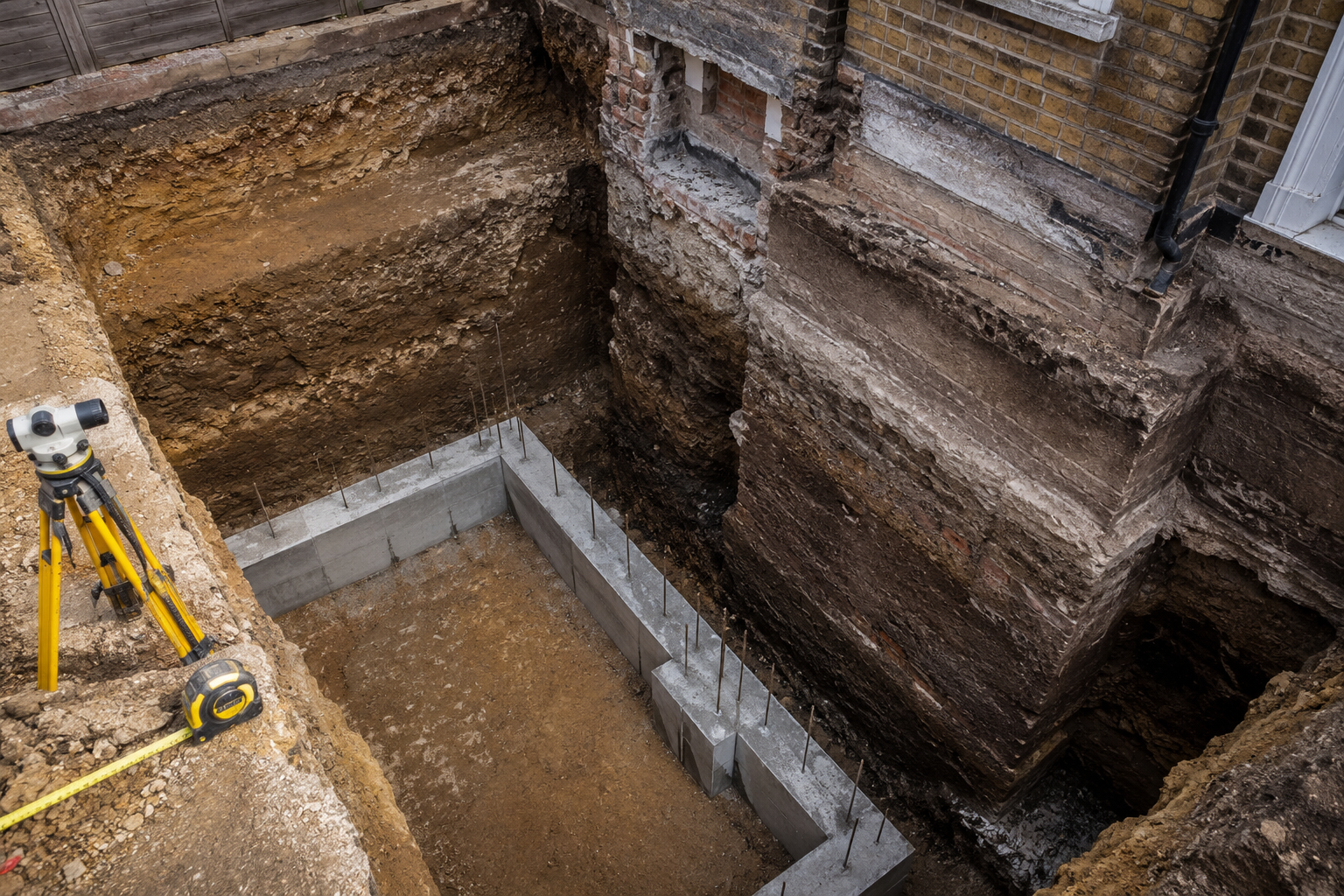
Section 6 of the Party Wall etc. Act 1996 is triggered when excavation takes place within 3 metres of an adjoining owner's building, and the new foundations will be deeper than the existing ones. It is also triggered within 6 metres if the excavation falls within a 45-degree line drawn from the bottom of the neighbour's foundations. [2]
In practice, this applies to the vast majority of rear extensions in older UK housing stock. Victorian and Edwardian terraces — which make up a substantial proportion of London's housing — typically have shallow strip foundations, often no deeper than 600mm to 900mm. Modern building regulations require new foundations to be considerably deeper, particularly where trees are present or ground conditions are poor. The differential between old and new foundation depths is precisely what creates risk.
What can go wrong:
- Removal of lateral earth support, causing the neighbour's foundations to shift
- Vibration from excavation equipment loosening mortar joints in old brickwork
- Changes to groundwater drainage patterns, leading to differential settlement
- Undermining of existing shallow footings during trenching
A Section 6 notice must be accompanied by plans and sections showing the depth and position of the proposed excavation. If the adjoining owner dissents, a Party Wall Award must be agreed before work proceeds. [2]
Why Pre-Works Condition Surveys Are Non-Negotiable
One of the most effective tools in managing excavation risk is a thorough Schedule of Condition survey, carried out before any ground is broken. This document — ideally photographic, detailed, and signed off by both parties — records the existing state of the neighbour's property. It covers cracks, settlement patterns, damp, and any pre-existing structural movement.
Without this baseline record, any crack that appears during or after construction becomes a potential dispute. The neighbour may claim the crack is new; the building owner may insist it was pre-existing. Without documentary evidence, the argument is unresolvable and frequently ends in litigation.
A schedule of condition report prepared by a qualified surveyor provides that evidence. It protects the building owner from spurious claims and gives the adjoining owner genuine reassurance that their property is being monitored.
Side Return Extensions: Steel Beams, Load Paths, and the Risks Nobody Talks About
The Structural Logic of a Side Return
A side return extension fills in the narrow alleyway that runs alongside many Victorian terraced houses. The appeal is obvious: it can add significant floor area to a kitchen or living space without requiring planning permission in many cases. [5]
However, the structural reality is considerably more complex than the clean architectural drawings suggest. When the original side wall of the house is removed or partially removed to open up the new extension, the loads it was carrying — from floors, roof structures, and sometimes chimney stacks — must be redirected. This is typically achieved using steel beams, commonly referred to as RSJs (Rolled Steel Joists) or universal beams. [3]
The critical structural risks include:
- Beams that are undersized for the actual load, leading to deflection and cracking
- Inadequate padstones or bearing points where the beam sits on masonry
- Temporary propping failures during the removal of the existing wall
- Unforeseen loads from chimney breasts or upper floor structures not accounted for in the design
- Differential settlement between the new extension slab and the original house foundations
The Role of Structural Engineering
The involvement of a qualified structural engineer is not optional for side return works — it is essential. Beam sizing calculations must account for dead loads, live loads, wind loads, and any point loads from above. [3]
A party wall surveyor working on a side return project should review the structural engineer's drawings as part of the Award process. The Award itself can and should include specific clauses relating to:
- The sequence of temporary propping and wall removal
- Monitoring requirements during and after beam installation
- Crack monitoring pins to be installed on the party wall before works begin
- The right of the adjoining owner's surveyor to inspect at key stages
For a comprehensive understanding of what a formal Party Wall Award covers and how it protects both parties, the complete guide to party wall awards provides detailed practical guidance.
Shared Chimneys and Party Structures
Side return extensions frequently affect shared chimney stacks and other party structures. A chimney breast removed on the ground floor of the extension may be structurally connected to a chimney stack that serves the neighbour's property above. [6]
This is a common source of serious structural problems. If the chimney stack loses its support at lower levels, it can become unstable, crack, or in extreme cases, partially collapse. The party wall surveyor must identify all such shared structures during the initial inspection and ensure the Award includes provisions for their protection, support, and — where necessary — agreed alteration.
Party Wall Surveying for Rear Extensions and Side Returns: Getting the Award Right
What a Well-Drafted Award Must Cover
The Party Wall Award is the legally binding document that governs how works affecting a party wall or boundary are to be carried out. For rear extensions and side returns, a poorly drafted Award is almost as dangerous as no Award at all. Understanding party structure notices is a prerequisite to understanding what the Award needs to address.
A robust Award for these project types should include:
- Working hours — specifying permitted construction times to minimise disturbance
- Method of excavation — hand digging within specified distances of existing foundations
- Temporary propping schedule — detailed sequence for supporting existing structures
- Crack monitoring — installation of tell-tales or demec gauges on the party wall, with agreed inspection intervals
- Right of access — the adjoining owner's surveyor's right to inspect at key construction stages
- Damage provisions — the process for assessing and making good any damage caused
- Completion notice — formal notification when notifiable works are finished
Common Procedural Failures That Lead to Disputes
Party wall surveying for rear extensions and side returns: the real structural risks behind 'routine' works are compounded when procedural errors occur early in the process. The most frequent mistakes include: [1]
- Serving notice too late — notices must be served the statutory period before works begin, not when convenient
- Incorrect notice type — serving only a Section 3 notice when a Section 6 notice is also required
- Failing to notify all affected neighbours — a rear extension may affect both the directly adjoining neighbour and the neighbour at the end of the garden
- Starting work before the notice period expires — this is a common cause of injunctions
- Assuming consent — silence from a neighbour is not consent; it triggers the dispute resolution process
If works proceed without proper notice, the building owner has no legal protection. The adjoining owner can apply to court for an injunction to stop the works. To understand the full consequences of proceeding without an agreement, the detailed guidance on what happens with no party wall agreement sets out the legal exposure clearly.
Cost Realities for 2026
Budgeting for party wall procedures is a practical necessity, not an optional extra. In 2026, the cost of a party wall agreement varies depending on the complexity of the works and the number of adjoining owners involved.
| Scenario | Approximate Cost |
|---|---|
| Agreed surveyor (both parties use one surveyor) | £800 – £1,200 |
| Each party appoints own surveyor | £1,400 – £3,000+ total |
| Third surveyor required to resolve dispute | Additional £500 – £1,500+ |
Where an adjoining owner appoints their own surveyor, the building owner is typically responsible for paying that surveyor's reasonable fees. [3] This is an important planning consideration — budget for it from the outset. For a detailed cost breakdown, the guide on who pays for a party wall surveyor explains the fee responsibilities under the Act.
Risk Assessment Best Practice: A Step-by-Step Framework
Effective risk management for rear extension and side return projects follows a clear sequence. Deviating from this sequence — usually by skipping steps to save time or money — is the primary cause of structural damage and legal disputes.
Step 1 — Pre-design structural assessment
Before finalising the design, commission a structural engineer to assess the existing building, party wall construction, and ground conditions. This informs foundation design and beam specifications.
Step 2 — Identify all notifiable works
Work through the Act systematically. Identify which sections are triggered, which neighbours must be notified, and what information must accompany each notice.
Step 3 — Serve notices at the correct time
Allow for the statutory notice periods in the project programme. A two-month notice period for party structure works means notices should be served well before the anticipated start date.
Step 4 — Commission a Schedule of Condition survey
Before any work begins, document the condition of all affected neighbouring properties. Photographs, crack surveys, and written descriptions should be compiled into a formal report.
Step 5 — Agree the Party Wall Award
Work with the appointed surveyor(s) to produce an Award that addresses all identified risks with specific, enforceable provisions.
Step 6 — Install monitoring before works begin
Crack monitoring pins, tell-tales, or electronic sensors should be in place on the party wall and any vulnerable neighbouring structures before excavation or demolition starts.
Step 7 — Conduct staged inspections
Key construction milestones — excavation completion, foundation pour, beam installation, wall removal — should each be inspected by the surveyor before the next stage proceeds.
Step 8 — Post-completion review
A final inspection after practical completion confirms the condition of the adjoining property and formally closes out the party wall process.
For projects in London and the surrounding areas, working with local party wall surveyors who understand the specific characteristics of local housing stock — foundation types, soil conditions, construction periods — adds significant practical value to this process.
Conclusion
Party wall surveying for rear extensions and side returns: the real structural risks behind 'routine' works are neither rare nor unpredictable. They follow recognisable patterns — shallow foundations meeting deep excavations, steel beams bearing on old masonry, shared chimney stacks losing support — and they are manageable when identified early and addressed systematically.
The consequences of treating these projects as routine are well documented: cracked brickwork, structural movement, neighbour disputes, injunctions, and in the worst cases, serious damage to properties that can cost tens of thousands of pounds to remediate.
Actionable next steps for building owners planning a rear extension or side return in 2026:
- Engage a qualified party wall surveyor at the design stage, not after planning permission is granted
- Commission a structural engineer to assess foundation depths and beam requirements before finalising drawings
- Identify all notifiable works under the Act and serve the correct notices with adequate lead time
- Budget for party wall agreement costs, including the possibility that neighbours will appoint their own surveyors
- Insist on a pre-works Schedule of Condition survey covering all affected properties
- Ensure the Party Wall Award contains specific, enforceable clauses for monitoring, access, and damage remediation
Taking these steps does not slow a project down. It protects the investment, maintains neighbourly relations, and ensures that what begins as a routine extension does not become an expensive structural emergency.
References
[1] partywallspecialists – https://partywallspecialists.com/?p=31026&utm_source=openai
[2] Party Wall Survey For Rear Extensions In London – https://www.houricanassociates.com/party-wall-surveyor-services/party-wall-survey-for-rear-extensions-in-london/?utm_source=openai
[3] Side Return Extension Cost Uk 2026 – https://www.mybuildally.co.uk/blog/side-return-extension-cost-uk-2026?utm_source=openai
[4] Party Wall Surveying For Basement Conversions Navigating Deeper Excavations In Stabilising Southern Markets – https://www.canterburysurveyors.com/blog/party-wall-surveying-for-basement-conversions-navigating-deeper-excavations-in-stabilising-southern-markets/?utm_source=openai
[5] Side Return Extensions – https://www.granddesignsmagazine.com/renovate/extend/side-return-extensions/?utm_source=openai
[6] Party Wall Extensions And Conversions – https://www.squarepointsurveyors.co.uk/party-wall-extensions-and-conversions/?utm_source=openai
