
Fewer than one in three telecoms operators installing rooftop 5G equipment in 2026 have correctly identified all their party wall obligations before works begin — a gap that is generating a rising volume of neighbour disputes, injunctions, and costly remediation claims across the UK. As the national 5G rollout accelerates and demand for full-fibre connectivity intensifies, the intersection of digital infrastructure and property law has become one of the most technically demanding areas of party wall practice. Understanding the full scope of Party Wall Notices for Fibre Optic and 5G Antenna Installations: 2026 Survey Protocols for Roof and Boundary Works is no longer optional for building owners, telecoms contractors, or the surveyors advising them.
Key Takeaways
- Rooftop 5G antenna bases, ballast frames, and grillage on shared or structurally continuous roofs are routinely treated as notifiable under the Party Wall etc. Act 1996 in 2026.
- A "tripartite" notification structure covering Section 1, Section 2, and Section 6 notices is now standard practice for large-scale digital infrastructure retrofits.
- Pre-works roof surveys must now include load-path mapping, deck core sampling, wind-uplift checks, and waterproofing continuity assessments.
- Boundary-adjacent fibre ducts do not automatically trigger the Act, but excavations for cabinets or plinths within 3-6 metres of neighbouring foundations will.
- Failing to serve correct notices exposes building owners and operators to injunctions, structural damage claims, and the full cost of retrospective surveys.
Why Digital Infrastructure Now Triggers Party Wall Obligations
The Party Wall etc. Act 1996 was designed with traditional construction in mind — extensions, basement digs, loft conversions. Yet its core provisions are technology-neutral. Any works that cut into, raise, thicken, or otherwise structurally alter a party structure fall within its scope, regardless of whether the purpose is residential or commercial, structural or digital.
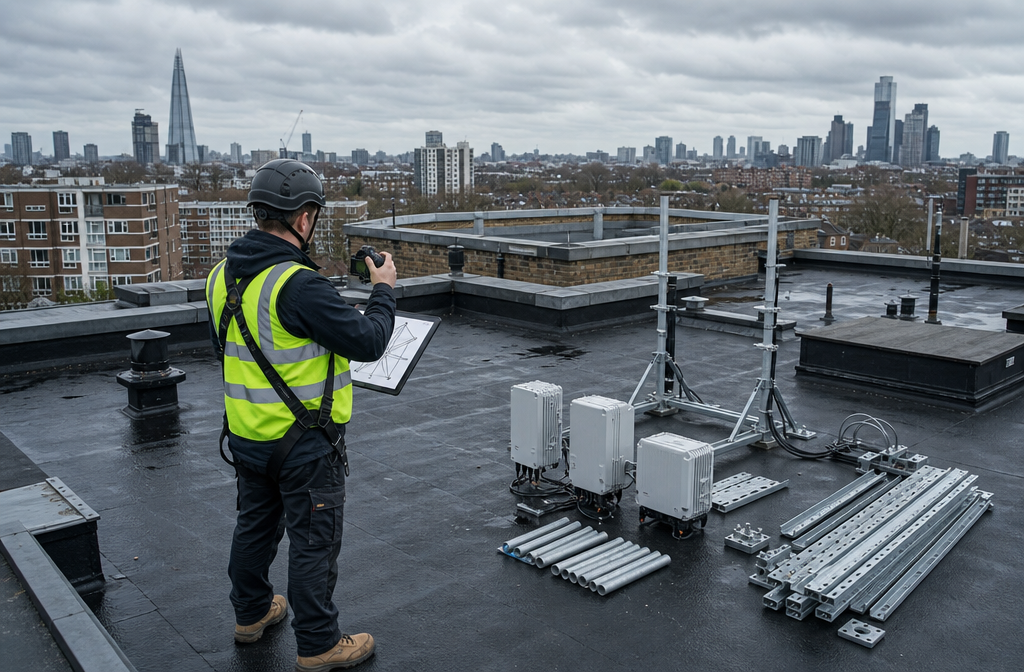
In 2026, this principle is being applied with increasing rigour to telecoms installations. A March 2026 technical note on Party Wall Notices for Digital Infrastructure Retrofits confirms that adding 5G antenna steelwork, ballast frames, or grillage to a shared or continuous flat roof is now routinely treated by party wall surveyors as notifiable under sections 2(2)(f) to (n) of the Act [2]. The reasoning is straightforward: even where no penetrations are made, load paths from heavy ballast frames bear on shared structural elements, altering the stress distribution across the party structure.
This shift in practice has caught many operators off guard. Telecoms engineers have historically treated "non-penetrating" rooftop mounts as outside the scope of building regulations and planning, let alone party wall law. However, 2026 survey protocols have moved decisively in the other direction [2].
For a thorough grounding in how the Act applies to structural works more broadly, the complete guide to party wall surveys for homeowners provides essential context.
What Counts as a "Party Structure" in a Telecoms Context
The term "party structure" in the Act covers walls, floors, and other structures separating buildings or parts of buildings in different ownership. In multi-occupancy blocks — the primary target for 5G small cell and fibre retrofits — this includes:
- Flat roofs that are structurally continuous across two or more titles
- Party walls in stair cores and riser shafts used for cable management
- Floor slabs where fibre riser penetrations are cut through shared elements
- Boundary walls on or near the line of junction used to support antenna brackets
Where any of these elements are affected, the Act is engaged, and notices must be served before works commence.
The 2026 Tripartite Notification Structure for Digital Retrofits
For large blocks being retrofitted with both fibre and 5G equipment simultaneously, a single notice rarely covers all the works. The 2026 standard, as documented in technical guidance on party wall notices for digital infrastructure retrofits, has evolved into a structured three-part notification approach [2]:
| Notice Type | Trigger | Typical Digital Infrastructure Scenario |
|---|---|---|
| Section 1 | New wall on or astride boundary line | Boundary-line cabinets, new wall-on-line bases for small cells |
| Section 2 | Works to existing party structure | Rooftop antenna bases, riser penetrations, stair core cable trays |
| Section 6 | Excavation within 3-6 m of neighbour's structure | Cabinet foundations, joint box excavations, mast footings |
This tripartite structure reflects the reality that a single telecoms installation project may involve all three categories of work simultaneously. Failing to serve the correct notice for each category leaves the building owner exposed to injunctions and claims for damage to neighbouring property.
For a detailed breakdown of what each type of notice requires and how neighbours should respond, the guide to party wall act notices is an authoritative starting point.
Section 2 Notices: Rooftop Antenna Bases and Riser Works
Section 2 notices are the most frequently required in digital infrastructure projects. They cover the full range of works to existing party structures, including cutting into, raising, or otherwise altering them. In 2026, the following works are consistently triggering Section 2 notices [2]:
- Installing antenna steelwork and ballast frames on shared flat roofs
- Breaking out sections of party walls in stair cores to create new cable trays
- Cutting through party floor slabs for fibre riser enlargements
- Attaching antenna brackets to shared boundary walls
The notice must be served at least two months before the proposed start date, and the adjoining owner has 14 days to consent or dissent. Where dissent is registered, the matter proceeds to a party wall award — a formal document binding on both parties.
Section 6 Notices: Excavations Near Neighbouring Foundations
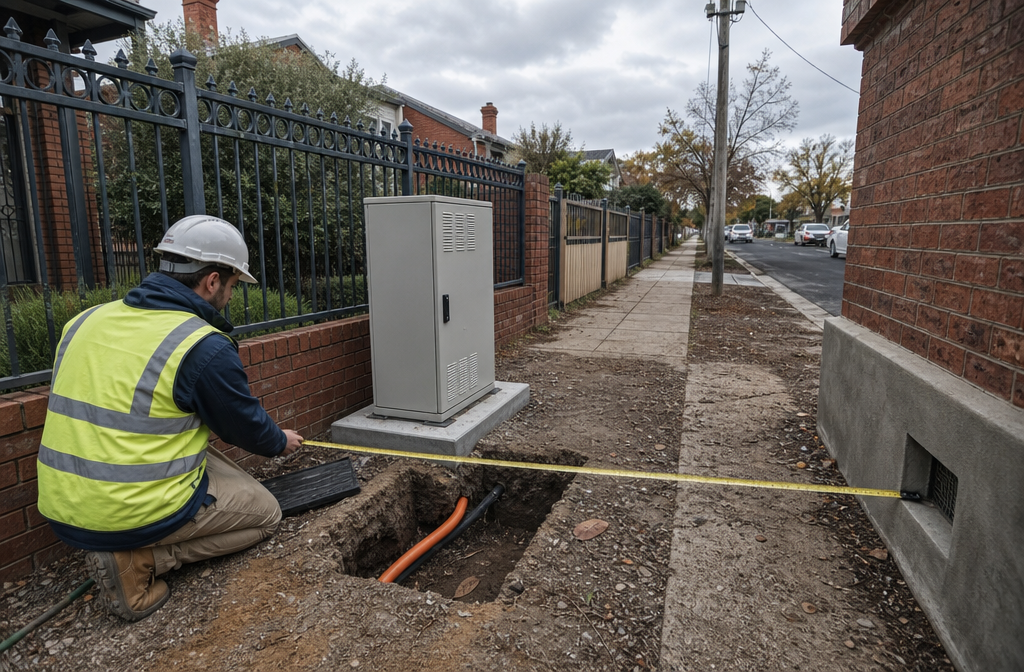
Section 6 is triggered where excavations are proposed within 3 metres of a neighbouring structure and to a depth lower than that structure's foundations, or within 6 metres where a 45-degree line drawn downward from the base of the neighbour's foundation would intersect the proposed excavation [2].
In 2026, telecoms operators are being advised to obtain foundation depth data for neighbouring buildings — through trial pits or structural records — before finalising cabinet locations. Party wall-triggering depth is now a common constraint in wayleave and design negotiations [2].
Horizontal fibre ducts laid near the boundary do not, by themselves, trigger the Act. However, the associated excavations for cabinets, joint boxes, or small-cell plinths very often do [2].
2026 Pre-Works Roof Survey Protocols: What Surveyors Now Require
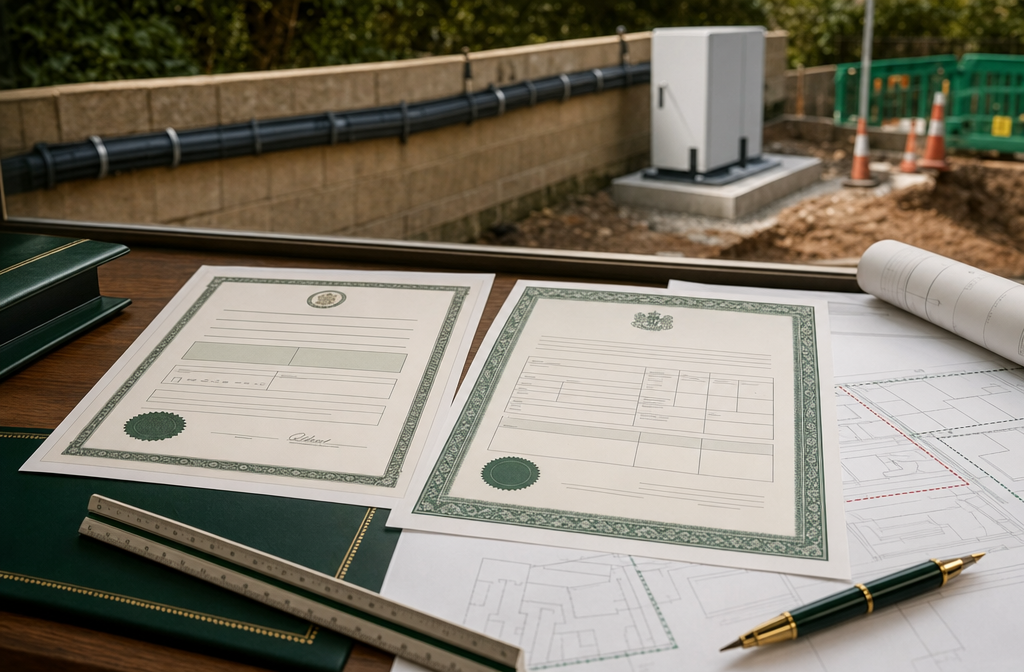
The enhanced pre-works survey requirements introduced in 2026 represent the most significant change in day-to-day practice for surveyors handling digital infrastructure projects. Where rooftop telecoms kit is proposed, surveyors now routinely require a comprehensive package of evidence before a party wall award can be agreed [9].
The Four-Part Roof Survey Package
1. Full Roof Condition Survey
A detailed inspection of the entire roof covering, including membrane condition, drainage outlets, upstands, and any existing penetrations. This establishes the baseline against which future claims for water ingress or membrane damage will be assessed.
2. Photographic Schedule of Condition
A systematic photographic record of membranes, flashings, upstands, and any existing defects. This is appended to the party wall award so that post-installation disputes over leaks and ponding can be traced back to pre-installation condition [9].
3. Wind-Load and Ballast Calculations
Structural calculations demonstrating that the proposed equipment will not accelerate membrane failure, overload the roof structure, or create shared drainage problems. These calculations must account for the specific wind exposure of the building and the weight distribution of the ballast frame.
4. Load-Path Mapping and Deck Core Sampling
The most technically demanding element of the 2026 protocol. Load-path mapping traces how the weight of the proposed installation will be transferred through the roof structure to the building's primary frame. Deck core sampling provides physical evidence of the roof build-up and its condition, supporting the structural calculations [2].
This four-part package is now commonly appended to the party wall award, creating a legally binding record of pre-installation condition [9]. For guidance on what a party wall award contains and how it protects both parties, the complete guide to party wall awards is essential reading.
Ponding Risk and Waterproofing Continuity
Flat roofs on older multi-occupancy blocks are particularly vulnerable to ponding — the accumulation of standing water caused by inadequate falls or blocked outlets. Installing heavy ballast frames can alter drainage patterns, creating new ponding risks or exacerbating existing ones.
2026 survey protocols require surveyors to assess ponding risk explicitly, including a review of existing drainage falls and an assessment of how the proposed installation might alter them. Where risk is identified, the award will typically include conditions requiring the operator to maintain drainage continuity and to remedy any ponding attributable to the installation.
Serving Notices Correctly: Practical Steps for Building Owners and Operators
The consequences of failing to serve correct notices are severe. Adjoining owners can obtain injunctions to halt works, and building owners who proceed without notices lose their statutory protection against damage claims. In 2026, the courts have shown little sympathy for operators who claim ignorance of the Act's application to digital installations.
The following steps represent best practice for any building owner or telecoms operator planning fibre or 5G works in 2026:
- Appoint a party wall surveyor early — ideally at the design stage, before cabinet locations and antenna positions are finalised.
- Commission a boundary survey to establish the precise position of all proposed works relative to the line of junction and neighbouring structures.
- Obtain foundation depth data for neighbouring buildings before finalising excavation locations.
- Identify all party structures that will be affected, including shared roofs, stair core walls, and riser shafts.
- Serve the correct notices for each category of work, observing the statutory notice periods.
- Commission the pre-works roof survey package before works commence, and ensure it is appended to the party wall award.
For building owners uncertain about whether a notice should have been served for works already underway, the guidance on no party wall notice served sets out the available remedies and risks.
Who Bears the Cost
In the majority of digital infrastructure projects, the telecoms operator or the building owner commissioning the installation will bear the cost of the party wall process. This includes the fees of both the building owner's surveyor and, where the adjoining owner dissents, the adjoining owner's surveyor as well [2].
For a clear breakdown of how surveyor costs are allocated between parties, the guide to party wall surveyor cost responsibilities provides practical guidance.
Multi-Occupancy Buildings: Special Considerations for 2026
The complexity of party wall compliance increases significantly in multi-occupancy buildings, where a single installation project may affect multiple adjoining owners simultaneously. In a typical urban apartment block, a rooftop 5G installation combined with a full-fibre retrofit could require notices to be served on every flat owner whose property adjoins the affected party structures.
2026 case studies in multi-occupancy blocks highlight several recurring challenges [2]:
- Multiple adjoining owners with different responses — some consenting, some dissenting, requiring separate awards for each dissenting owner
- Leasehold complications where both the freeholder and individual leaseholders may have party wall rights
- Staggered programme management where notice periods for different sections of work expire at different times
- Retrospective disputes where fibre riser works were carried out without notices and are only identified during a subsequent sale or refinancing
The guide to understanding party structure notices provides a detailed analysis of how notices apply in complex multi-ownership scenarios.
Drone Surveys as a Supplementary Tool
In 2026, drone surveys are increasingly being used as part of the pre-works roof condition assessment, particularly on large or complex roofs where access is difficult. Drone footage provides a comprehensive photographic record of roof condition from angles that are impractical to achieve on foot, and can be incorporated into the schedule of condition appended to the party wall award. For properties where traditional access is challenging, drone survey services offer a practical solution.
Boundary Works: Fibre Ducts, Small Cell Plinths, and the Section 6 Threshold
The boundary dimension of digital infrastructure projects is often underestimated. While the focus tends to fall on rooftop works, ground-level installations — particularly the cabinets, joint boxes, and small-cell plinths associated with fibre and 5G networks — can trigger party wall obligations that are just as demanding.
The key threshold under Section 6 is depth relative to the neighbour's foundation, not simply proximity to the boundary. A shallow excavation one metre from the boundary may not trigger the Act; a deeper excavation three metres away might. In 2026, surveyors are advising operators to treat this analysis as a mandatory design-stage step, not an afterthought [2].
Where Section 6 is triggered, the notice must be accompanied by plans and sections showing the proposed excavation and, where the adjoining owner requests it, an undertaking to underpin or otherwise safeguard the neighbour's foundations. In some cases, a geotechnical report will be required to demonstrate that the excavation will not affect the stability of neighbouring structures [2].
For a comprehensive overview of how boundary surveys inform party wall practice, the boundary surveys service provides relevant professional support.
Conclusion
The convergence of 5G rollout, full-fibre deployment, and the Party Wall etc. Act 1996 has created a compliance landscape that demands careful navigation in 2026. Party Wall Notices for Fibre Optic and 5G Antenna Installations: 2026 Survey Protocols for Roof and Boundary Works are no longer a niche concern — they are a mainstream obligation for any building owner or telecoms operator undertaking digital infrastructure works on or near shared structures.
The actionable steps are clear. Appoint a qualified party wall surveyor at the design stage. Commission a full boundary survey before finalising cabinet and antenna locations. Obtain foundation depth data for neighbouring buildings. Serve Section 1, Section 2, and Section 6 notices as required, observing statutory notice periods. Commission the full four-part pre-works roof survey package and ensure it is appended to the party wall award. Document everything.
The cost of getting this right at the outset is modest compared to the cost of injunctions, retrospective surveys, and structural damage claims. In a sector where programme delays translate directly into lost revenue, the party wall process is best treated as a design constraint to be managed proactively, not a legal formality to be addressed after works have started.
For expert guidance on any aspect of party wall compliance for digital infrastructure projects, consulting a RICS-qualified party wall surveyor with experience in telecoms installations is the most reliable first step.
References
[1] Speeding Fibre Optic And Mobile Network Expansion Federal Ministry Publishes Draft Bill 2026 Act Amending Telecommunications Act – https://www.gleisslutz.com/en/know-how/speeding-fibre-optic-and-mobile-network-expansion-federal-ministry-publishes-draft-bill-2026-act-amending-telecommunications-act
[2] Party Wall Notices For Digital Infrastructure Retrofits Surveying 5g And Fibre Compliance In 2026 Multi Occupancy Buildings – https://manchestersurveyors.com/party-wall-notices-for-digital-infrastructure-retrofits-surveying-5g-and-fibre-compliance-in-2026-multi-occupancy-buildings/
[9] Party Wall Surveys And Neighbour Disputes During 2026s Construction Uptick Rics Compliance Framework – https://nottinghillsurveyors.com/blog/party-wall-surveys-and-neighbour-disputes-during-2026s-construction-uptick-rics-compliance-framework
