
Nearly nine years after the Grenfell Tower fire claimed 72 lives, the UK's housing sector has poured enormous energy into identifying and removing dangerous cladding. Yet a quieter, more insidious problem persists: latent fire and safety defects in post‑Grenfell apartment blocks that have little to do with external cladding at all. Compartmentation breaches, failed fire doors, unprotected service penetrations, and dysfunctional smoke control systems are turning up in surveys across the country — and many are being missed, misreported, or reported in ways that cause unnecessary panic. This guide sets out exactly what building surveyors should still be checking, and how to communicate findings proportionately and professionally.
Key Takeaways 🔑
- Cladding is not the only risk. Internal fire safety defects — compartmentation failures, service penetrations, fire doors, and smoke control — remain widespread in post-Grenfell apartment blocks.
- Surveyors carry real responsibility. Identifying and reporting these defects accurately is now a core professional obligation, not an optional extra.
- Proportionate reporting matters. Over-alarming residents or buyers causes harm; under-reporting causes danger. The right balance is achievable.
- Legislation has raised the bar. The Building Safety Act 2022 and related regulations have significantly expanded surveyor duties in higher-risk buildings.
- Specialist input is often needed. Many latent defects require fire engineers or specialist consultants — knowing when to refer is as important as knowing what to look for.
Beyond Cladding: The Hidden Landscape of Fire Safety Defects
The public narrative around post-Grenfell remediation has been dominated by ACM panels and combustible insulation. That focus was justified — but it has inadvertently created a blind spot. Latent fire and safety defects in post‑Grenfell apartment blocks extend deep into a building's fabric, and many existed long before Grenfell made headlines.
What "Latent" Actually Means in This Context
A latent defect is one that is not immediately visible or obvious during a standard inspection. In fire safety terms, this typically means:
- Defects concealed within wall cavities, floor voids, or service risers
- Issues that only become apparent when a component is tested or disturbed
- Problems that have developed gradually — such as fire doors warped by moisture or intumescent strips that have degraded over time
The challenge for surveyors is that fire safety is largely invisible in a functioning building. Everything looks fine until it isn't.
Why These Defects Are Still Appearing in 2026
Several factors explain why hidden fire risks continue to surface:
| Factor | Explanation |
|---|---|
| Poor original construction | Many blocks built in the 1990s–2010s had inadequate fire stopping installed from day one |
| Uncontrolled refurbishment | Subsequent fit-outs by leaseholders or contractors created new penetrations without remediation |
| Regulatory gaps | Pre-2022 building regulations were less prescriptive about compartmentation in residential blocks |
| Inspection failures | Building control sign-off did not always include rigorous fire stopping verification |
| Maintenance neglect | Fire doors and smoke control systems degrade without regular servicing |
The Core Defect Categories Surveyors Must Investigate
Understanding the specific categories of latent fire risk is essential for any surveyor working on apartment blocks. A comprehensive building survey should address each of these systematically.
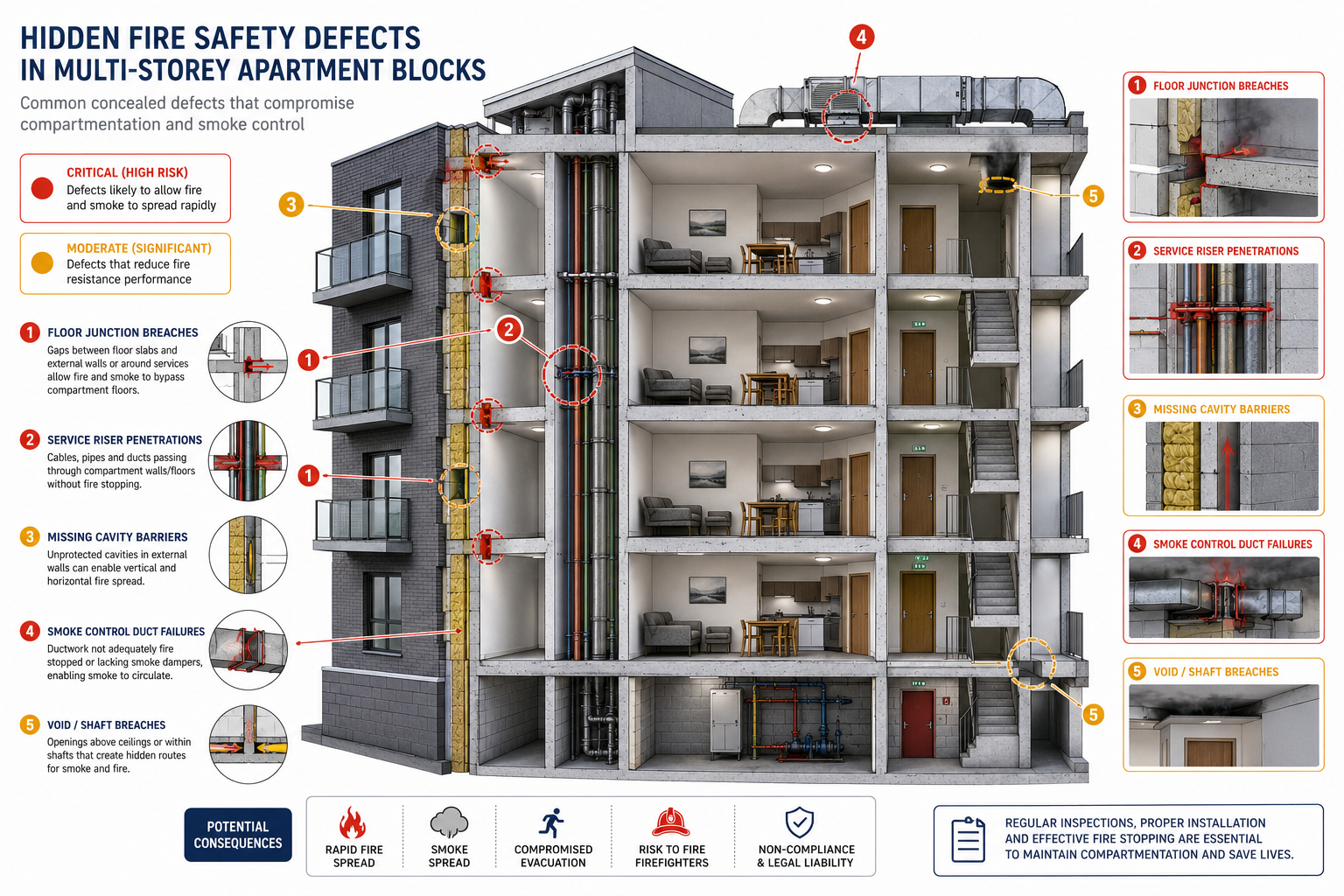
1. Compartmentation Failures 🔥
Compartmentation is the principle that a building is divided into fire-resistant cells, each designed to contain a fire for a defined period — typically 30 or 60 minutes. When compartmentation fails, fire and smoke spread rapidly.
Common compartmentation breaches include:
- Holes and gaps around pipes, cables, and ducts passing through walls and floors
- Missing or degraded fire stopping at junctions between elements
- Poorly installed cavity barriers in external wall systems (even non-cladding walls)
- Penetrations created by later fit-outs — kitchen extracts, bathroom fans, TV aerial cables
💬 "A single unprotected cable penetration through a compartment floor can render an entire fire strategy ineffective. These are not minor snags — they are fundamental failures."
Surveyors should check fire stopping at every visible service penetration, particularly in plant rooms, service risers, and at the interfaces between flats and common areas. Where access is limited, the report should clearly note what could not be inspected and why.
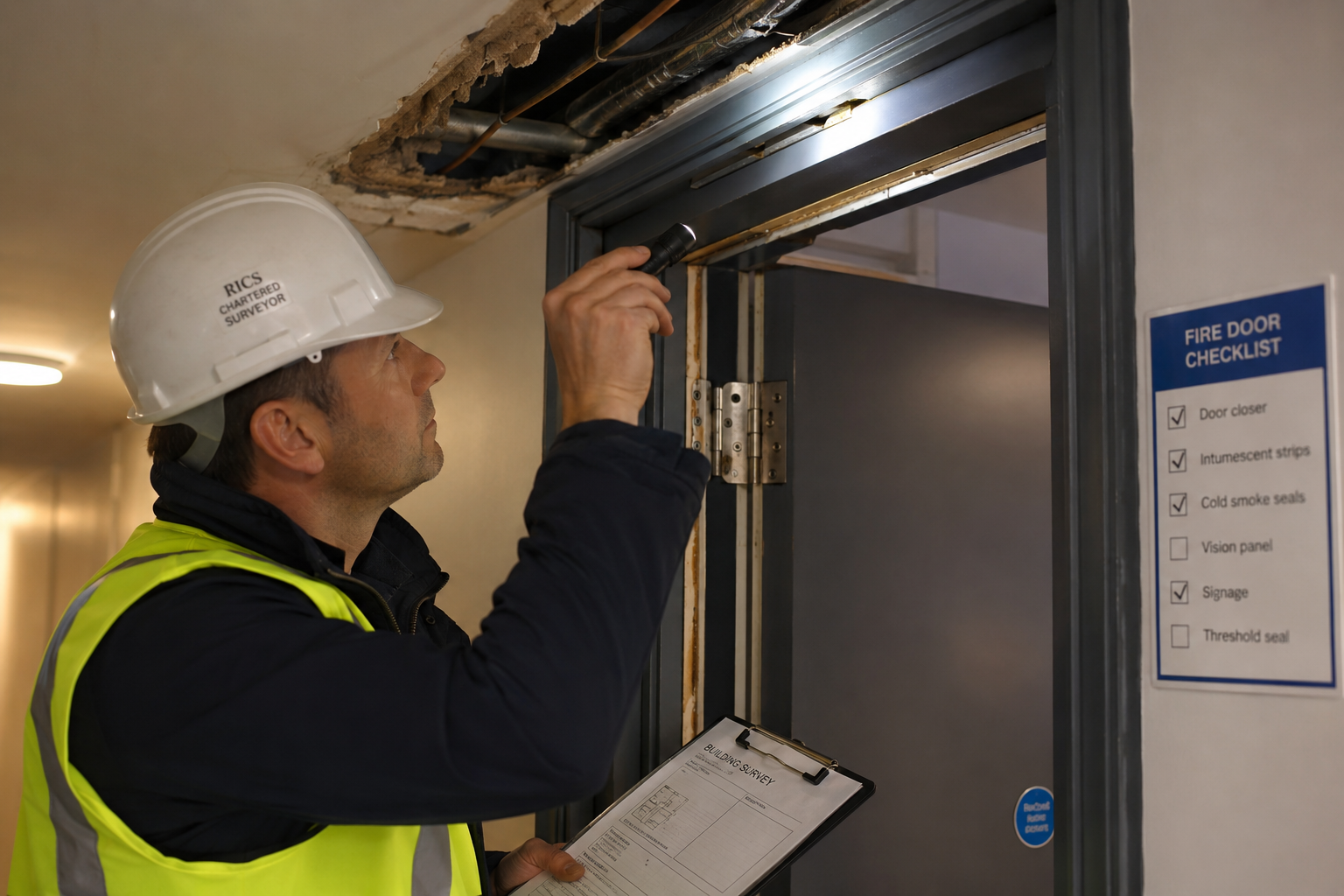
2. Fire Door Deficiencies 🚪
Fire doors are the most frequently encountered — and most frequently defective — fire safety component in residential apartment blocks. A fire door that fails to perform can allow smoke to spread within minutes.
Key checks for fire doors:
- Self-closing mechanism — must close fully from any open position without assistance
- Intumescent strips and cold smoke seals — must be continuous, undamaged, and correctly fitted
- Gap tolerances — gaps around the door leaf should not exceed 3mm at the sides and top, 8mm at the threshold
- Glazing integrity — any glazed panels must be fire-rated glass in a fire-rated frame
- Signage and hardware — "Fire Door Keep Shut" signage, correct hinges, and no unauthorised modifications
- Frame condition — frames must be structurally sound and correctly fixed to the surrounding structure
A Level 3 home survey will typically include a more detailed assessment of fire doors than a Level 2, but even a Level 2 surveyor should flag obvious deficiencies.
3. Service Penetrations and Risers ⚡
Service risers — the vertical shafts carrying pipes, cables, and ducts through a building — are among the most common locations for compartmentation breaches. They are also among the hardest to inspect fully.
What surveyors should look for:
- Evidence of fire stopping products (intumescent collars, pillows, boards) at each floor penetration
- Signs of recent works that may have disturbed existing fire stopping
- Unprotected openings in riser enclosures
- Combustible materials stored within risers (a surprisingly common finding)
Where risers cannot be accessed, surveyors must say so clearly — and recommend specialist investigation. This is not a weakness in the report; it is professional diligence.
4. Smoke Control System Failures 💨
Smoke is responsible for the majority of fire fatalities, not flame. Smoke control systems — including automatic opening vents (AOVs), pressurisation systems, and mechanical extract — are therefore critical life safety components.
Common smoke control defects:
- AOVs that are inoperative, disconnected, or set to incorrect trigger thresholds
- Pressurisation systems that have never been commissioned or tested
- Lobby and stairwell ventilation that has been blocked or modified
- Control panels with persistent faults that have been ignored
- Missing or illegible maintenance records
Surveyors are not expected to test smoke control systems themselves, but they should check for visible evidence of maintenance, review available service records, and recommend specialist testing where concerns arise.
Reporting Latent Fire Defects: Proportionality Without Complacency
One of the most difficult professional judgements a surveyor faces is how to report fire safety concerns without causing disproportionate alarm. The post-Grenfell environment has, understandably, made buyers, lenders, and residents highly sensitive to any fire-related finding. But not every defect is a crisis.
The Proportionality Framework
A useful approach is to categorise findings by urgency and impact:
| Category | Description | Reporting Approach |
|---|---|---|
| Critical | Immediate life safety risk (e.g., no fire stopping in a riser serving multiple floors) | Urgent recommendation; consider advising client to notify responsible person |
| Significant | Material defect affecting fire strategy (e.g., multiple defective fire doors) | Strong recommendation for specialist fire risk assessment |
| Notable | Defect present but limited in scope (e.g., single fire door with degraded seal) | Recommend remediation; note in context of overall building condition |
| Monitor | Minor issue or maintenance matter (e.g., door closer requires adjustment) | Note for attention; no immediate action required |
💬 "The surveyor's role is not to replicate a full fire risk assessment — it is to identify visible evidence of fire safety defects and direct the client to appropriate expertise."
Avoiding the Two Failure Modes
Surveyors can fail their clients in two opposite directions:
- Under-reporting — missing or minimising defects to avoid difficult conversations or protect a transaction. This is professionally and ethically indefensible.
- Over-alarming — using catastrophising language that causes buyers to withdraw from sound transactions or residents to experience unnecessary distress.
The solution is precise, evidence-based language. Describe what was observed, what it means in practical terms, and what action is recommended. Avoid speculation about worst-case scenarios unless the evidence genuinely supports it.
For surveyors working in London and the surrounding area, understanding the specific building stock — including the prevalence of 1990s and 2000s-era flatted developments — is essential context. Chartered surveyors in West London and Central London regularly encounter these issues in conversions and purpose-built blocks alike.
The Regulatory Framework Surveyors Must Know
The legal landscape for fire safety in residential buildings has changed substantially since 2017. Surveyors who are not across these changes risk giving advice that is out of date or legally inadequate.
Key Legislation and Guidance
- Building Safety Act 2022 — introduced the concept of "higher-risk buildings" (HRBs), defined as residential buildings over 18 metres or 7 storeys. HRBs are subject to a new regulatory regime including a mandatory Building Safety Regulator.
- Fire Safety Act 2021 — clarified that the Regulatory Reform (Fire Safety) Order 2005 applies to the structure, external walls, and flat entrance doors of multi-occupied residential buildings.
- PAS 9980:2022 — the publicly available specification for fire risk appraisals of external wall construction. Relevant where surveyors are considering external wall systems beyond cladding.
- RICS guidance — the RICS has published specific guidance on fire safety in residential buildings, including how surveyors should approach EWS1 forms and related assessments.
The Responsible Person Obligation
Under the Fire Safety Order, the "responsible person" for a building (typically the freeholder, management company, or their agent) has a legal duty to carry out and maintain a fire risk assessment. Surveyors should check whether a current fire risk assessment exists and whether its recommendations have been actioned. A fire risk assessment that is five years old and unreviewed is itself a red flag.
Practical Inspection Checklist for Apartment Block Surveys
The following checklist summarises the key areas surveyors should address. It is not exhaustive, and specialist input will be required for many items. For a broader understanding of what a surveyor checks during an inspection, the scope extends well beyond fire safety alone.
🔍 Fire Safety Inspection Checklist
Compartmentation:
- Check visible service penetrations in plant rooms and risers
- Inspect ceiling voids where accessible
- Look for evidence of recent works that may have disturbed fire stopping
- Check junction details at stairwell and corridor walls
Fire Doors:
- Test self-closing mechanism on all accessible fire doors
- Check gap tolerances around door leaf
- Inspect intumescent strips and cold smoke seals
- Check glazing integrity and hardware condition
- Note any unauthorised modifications
Smoke Control:
- Identify type of smoke control system (natural or mechanical)
- Check for visible AOVs and their apparent condition
- Request maintenance records
- Note any control panel fault lights
Documentation:
- Request current fire risk assessment
- Check EWS1 status if external walls are of concern
- Review any outstanding enforcement notices
- Check building's registration status under Building Safety Act (if HRB)

When to Refer to a Specialist
Knowing the limits of a surveyor's competence is not a weakness — it is a professional strength. The following situations should trigger a recommendation for specialist fire engineering or fire risk assessment input:
- Any higher-risk building (18m+ or 7+ storeys) where fire safety concerns are identified
- Evidence of significant compartmentation failure across multiple locations
- Smoke control systems that appear inoperative or untested
- Buildings with complex or non-standard construction — including those with non-standard construction types that may affect fire performance
- Absence of a current fire risk assessment
- Any building where the client is considering purchase and fire safety defects could materially affect value or mortgage eligibility
A RICS building survey provides the appropriate framework for this level of investigation, with clear escalation pathways built into the reporting structure.
The Leaseholder and Buyer Perspective
It is worth remembering that the people reading surveyor reports are often anxious, non-technical, and making the largest financial decision of their lives. Fire safety findings — even proportionate ones — can feel overwhelming.
Practical communication tips for surveyors:
- Lead with context. Explain briefly what the defect is and why it matters before describing what was found.
- Distinguish between risk and certainty. A missing intumescent strip does not mean the building will burn down — it means a specific component of the fire strategy is compromised.
- Be clear about next steps. Vague recommendations ("further investigation may be required") are less helpful than specific ones ("a fire risk assessment by a qualified fire engineer should be commissioned before exchange").
- Avoid jargon without explanation. Terms like "compartmentation," "AOV," and "intumescent" should be explained briefly on first use.
For buyers considering a purchase, understanding whether a survey is needed on a new build — or indeed any apartment — is a question surveyors are increasingly being asked in the context of fire safety concerns.
Conclusion: The Surveyor's Ongoing Role in Building Safety
The Grenfell Tower fire fundamentally changed what society expects from building professionals. For surveyors, that shift is permanent. Latent fire and safety defects in post‑Grenfell apartment blocks — from compartmentation breaches to failing fire doors and untested smoke control systems — represent a continuing challenge that demands both technical knowledge and professional judgement.
The good news is that the framework exists to do this well. Clear legislation, updated RICS guidance, and a growing body of specialist expertise mean that surveyors have the tools to identify, report, and escalate fire safety concerns proportionately and effectively.
Actionable Next Steps for Surveyors ✅
- Update your inspection protocols to include the full range of non-cladding fire safety defects covered in this guide.
- Review your report templates to ensure fire safety findings can be categorised by urgency and communicated clearly to non-technical clients.
- Build relationships with fire engineers and specialist consultants so referrals can be made quickly and confidently.
- Stay current with legislation — the Building Safety Act regime is still bedding in, and guidance continues to evolve.
- Consider specialist CPD in fire safety for residential buildings — it is now a core competency, not a niche skill.
For anyone buying, selling, or managing an apartment in a post-Grenfell landscape, commissioning a thorough building survey from a qualified chartered surveyor remains the single most important step toward understanding the true condition — and safety — of a property.
