
UK homes waste an estimated £3 billion worth of heat every year through poorly insulated walls, leaking roofs, and draughty windows — yet most buyers receive nothing more than a vague "poor insulation noted" comment in their survey report. That gap between what a surveyor observes and what a buyer actually needs to know is costing purchasers thousands at the negotiating table and beyond. Building Surveys for Energy‑Hungry Homes: Turning Thermal Performance Findings into Clear Costed Advice for UK Buyers addresses exactly that gap — showing how a well-executed Level 3 survey can move far beyond the Energy Performance Certificate (EPC) to quantify heat loss, recommend realistic retrofit measures, and arm buyers with the costed evidence they need to negotiate confidently.
Key Takeaways 📋
- An EPC gives a letter grade; a thorough building survey explains why a home is energy-hungry and what it will cost to fix it.
- Thermal performance defects — from cold bridging to failed cavity fill — can be identified and quantified during a Level 3 survey.
- Costed retrofit advice transforms vague survey findings into actionable negotiation tools.
- Buyers who understand the full remediation cost are better positioned to renegotiate the purchase price or budget accurately for post-completion works.
- Choosing the right survey level for an older or non-standard property is the critical first decision.
Why EPCs Fall Short for Energy‑Hungry Homes
An Energy Performance Certificate is a snapshot, not a diagnosis. It tells a buyer that a 1930s semi-detached in Ealing is rated "E" — but it does not explain whether that rating stems from uninsulated solid walls, a cold roof void, single-glazed bay windows, or a combination of all three. More critically, it attaches no cost to the problem.
"An EPC rating is the starting point of the conversation, not the end of it."
For buyers considering a property with high energy consumption, this matters enormously. Energy bills on an EPC band E or F home can run £2,000–£4,500 per year more than an equivalent band B property. Over a five-year ownership period, that differential can exceed £15,000 — a sum that dwarfs the cost of the survey itself.
What a Building Survey Adds
A Level 3 building survey goes substantially further. A competent surveyor will:
- Inspect the building fabric — walls, roof, floors, windows, and doors — for evidence of thermal deficiency.
- Identify specific defects that drive energy loss, such as failed cavity wall insulation, missing loft insulation, or cold bridges at structural junctions.
- Note the construction type, which determines which retrofit solutions are technically feasible.
- Recommend further specialist investigation where thermal imaging or airtightness testing would add diagnostic value.
The difference between a Level 2 homebuyer report and a Level 3 survey is significant for older or non-standard stock. For a detailed comparison, see this guide on the difference between Level 2 and Level 3 surveys.
Identifying and Quantifying Thermal Performance Defects
Building Surveys for Energy‑Hungry Homes: Turning Thermal Performance Findings into Clear Costed Advice for UK Buyers requires surveyors to think beyond the checklist. The following defect categories are the most common drivers of poor thermal performance in UK residential stock.
1. 🧱 Uninsulated Solid Walls
Pre-1920 properties — a large proportion of London and urban UK housing — are typically built with solid brick walls that have no cavity. These walls conduct heat freely. A 225mm solid brick wall has a U-value of approximately 2.1 W/m²K, compared to 0.18 W/m²K for a modern insulated wall. That is a twelve-fold difference in heat loss rate.
Survey finding example: "The solid brick external walls show no evidence of internal or external insulation treatment. Based on the floor area and wall area calculations, annual heat loss through the wall fabric is estimated to be significant. External wall insulation (EWI) or internal wall insulation (IWI) should be considered."
2. 🏠 Roof and Loft Insulation Deficiencies
Current Building Regulations recommend 270mm of mineral wool insulation in a cold loft. Many properties inspected in 2026 still have 50–100mm of compressed, aged insulation — or none at all. A roof survey can confirm whether the roof structure itself is contributing to the problem through damaged sarking felt or missing insulation at eaves.
3. 🪟 Glazing and Window Frames
Single glazing has a U-value of approximately 5.6 W/m²K. Even basic double glazing achieves 2.8 W/m²K, and modern triple glazing can reach 0.8 W/m²K. Failed sealed units (identified by internal condensation or misting) perform no better than single glazing and should be noted as defects requiring immediate attention.
4. ❄️ Cold Bridging
Cold bridges occur where the insulation layer is interrupted — typically at structural junctions, window reveals, lintels, and floor-to-wall connections. They cause localised surface temperature drops, condensation, and mould growth. While difficult to quantify precisely without thermal imaging, a skilled surveyor can identify high-risk locations and flag them for further investigation.
5. 💨 Air Infiltration and Draughts
Older properties with suspended timber floors, open fireplaces, and poorly fitting doors and windows can lose 30–40% of their heat through uncontrolled air infiltration. This is rarely captured by an EPC but can be referenced in a survey report with practical recommendations.
Thermal Performance Defect Summary Table
| Defect | Typical U-value (W/m²K) | Estimated Annual Heat Loss Impact | Retrofit Solution | Indicative Cost (2026) |
|---|---|---|---|---|
| Uninsulated solid walls | 2.1 | High | EWI or IWI | £8,000–£25,000 |
| Loft insulation <100mm | 0.6–1.0 | Medium–High | Top-up mineral wool | £300–£600 |
| Single glazing | 5.6 | High (windows) | Double/triple glazing | £5,000–£15,000 |
| Failed cavity fill | 0.8–1.2 | Medium | Re-injection | £1,500–£3,500 |
| Cold bridging | Variable | Low–Medium | Thermal break treatment | £500–£3,000 |
| Suspended floor (uninsulated) | 0.7 | Medium | Insulation boards | £2,000–£6,000 |
Costs are indicative ranges for a typical 3-bedroom UK property. Actual costs depend on property size, location, and contractor rates.
Turning Findings into Clear Costed Advice
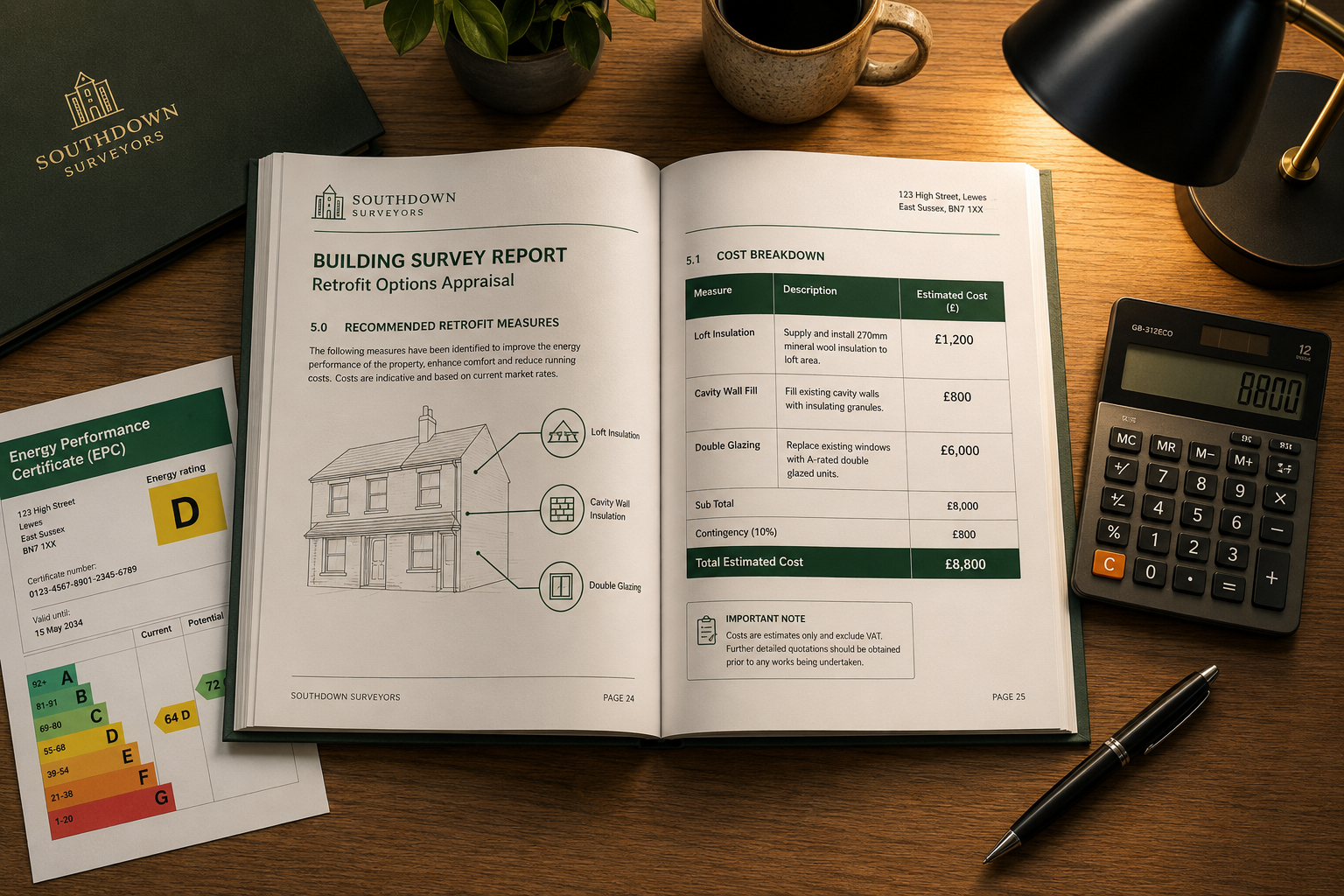
This is where most survey reports fall short — and where the real value lies. A finding that states "the loft insulation is inadequate" is technically accurate but practically useless to a buyer trying to decide whether to proceed, renegotiate, or walk away.
Effective costed advice has three components:
- The defect — clearly described in plain English.
- The consequence — what happens if it is not addressed (higher bills, condensation risk, structural damage).
- The remedy — a realistic cost range for the recommended work, referenced to current market rates.
Structuring the Retrofit Cost Schedule
A well-structured survey report for an energy-hungry home should include a Retrofit Cost Schedule — a standalone section that lists every thermal deficiency, the recommended remedy, and an indicative cost. This document serves multiple purposes:
- 🔑 Negotiation tool: Buyers can present the total remediation cost to the vendor and request a price reduction or credit.
- 📊 Budget planning: Buyers who proceed at the asking price know exactly what they are committing to post-completion.
- 🏦 Mortgage and finance: Some lenders and green mortgage products require evidence of planned energy improvements.
- 🛠️ Contractor briefing: The schedule provides a starting point for obtaining contractor quotes.
For buyers uncertain about which survey level provides this depth of analysis, the comprehensive guide to survey types is a useful starting point.
The Role of Thermal Imaging
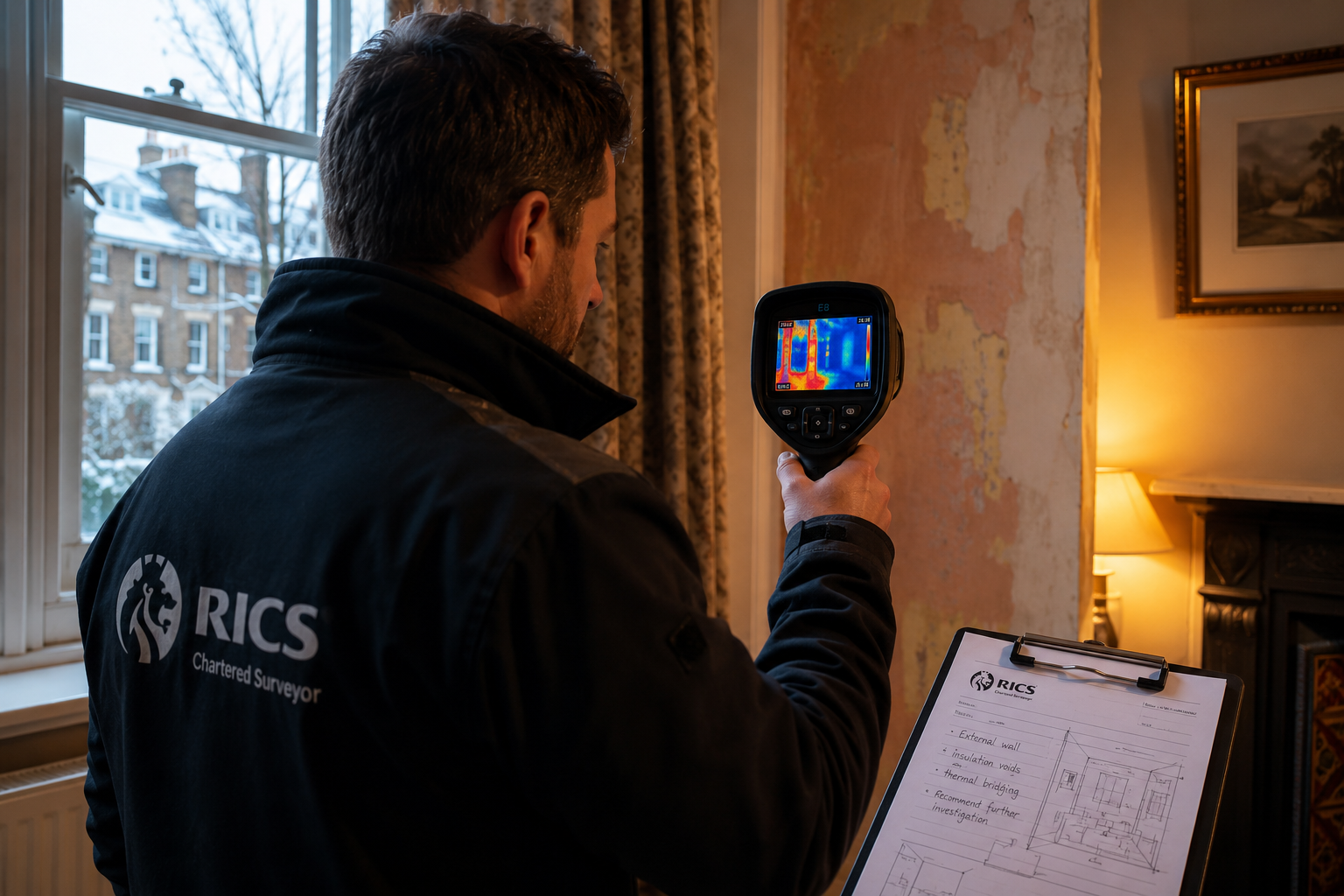
Thermal imaging cameras detect surface temperature variations invisible to the naked eye. When used during a building survey — ideally on a cold day with a temperature differential of at least 10°C between inside and outside — they can reveal:
- Areas of missing or degraded insulation
- Cold bridges at structural junctions
- Air infiltration pathways
- Moisture ingress behind finishes
Not every survey includes thermal imaging as standard, but for an energy-hungry home, it is worth requesting as an add-on. The additional cost (typically £200–£500) is trivial compared to the insight gained.
Valuation and Negotiation Implications for UK Buyers
Building Surveys for Energy‑Hungry Homes: Turning Thermal Performance Findings into Clear Costed Advice for UK Buyers is ultimately about financial empowerment. The thermal performance findings in a survey report have direct implications for the purchase price — and buyers who understand this are better negotiators.
How Thermal Defects Affect Value
Poor energy performance affects value in several ways:
- Running costs: Higher bills reduce the net disposable income of occupants, making the property less attractive and reducing what buyers will pay.
- Retrofit liability: The cost of bringing a property to a reasonable energy standard is a legitimate deduction from the market price.
- Future regulation: From 2028, proposed UK Government regulations may require rental properties to achieve EPC band C. Owner-occupiers face no immediate legal obligation, but resale value will increasingly reflect energy performance.
- Green mortgage eligibility: Properties below EPC band C may not qualify for preferential green mortgage rates, affecting the buyer's financing costs.
Structuring a Price Renegotiation
Armed with a costed retrofit schedule from a full structural survey, a buyer has a credible basis for renegotiation. The approach that works best is:
- Obtain three contractor quotes for the highest-cost items (e.g., external wall insulation, window replacement).
- Present the mid-range estimate to the vendor's agent, not the highest.
- Frame the request as a price adjustment, not a demand — "the survey has identified £18,000 of thermal remediation works; we would like to reflect this in the agreed price."
- Be prepared to accept a partial reduction — vendors rarely concede the full amount, but a 50–70% concession on documented costs is a realistic outcome.
"A costed survey finding is worth ten times more at the negotiating table than a vague comment about 'poor insulation'."
When to Walk Away
Not every energy-hungry home is a viable purchase. If the retrofit cost schedule reveals:
- Solid wall insulation costs exceeding £20,000 on a property where EWI is the only viable option
- Listed building status preventing insulation works
- Structural defects compounding the thermal issues
- A total remediation cost exceeding 10–15% of the purchase price
…then the buyer should consider whether the property represents genuine value, even after renegotiation.

Choosing the Right Survey for an Energy‑Hungry Home
Not all surveys are created equal. For properties suspected of poor thermal performance — particularly pre-1960 stock, non-standard construction, or homes with an EPC rating of D or below — the survey level matters enormously.
| Survey Type | Best For | Thermal Coverage |
|---|---|---|
| Level 2 Homebuyer Report | Modern, well-maintained properties | Basic observation only |
| Level 3 Building Survey | Older, non-standard, or problem properties | Detailed fabric inspection, defect identification |
| Specific Defect Report | Single known issue (e.g., wall insulation) | Focused thermal analysis |
For most energy-hungry homes, a Level 3 building survey is the appropriate choice. It provides the depth of inspection needed to identify thermal defects, assess their severity, and produce the costed advice that buyers need.
Buyers who are unsure whether their target property warrants a Level 3 survey should consider the key differences between Level 2 and Level 3 surveys before commissioning.
Questions to Ask Your Surveyor Before Commissioning
Before instructing a surveyor on an energy-hungry property, ask:
- ✅ Will the report include a dedicated section on thermal performance?
- ✅ Can you provide indicative costs for the remediation works identified?
- ✅ Do you use thermal imaging, and is it included or available as an add-on?
- ✅ Will you comment on the feasibility of retrofit measures given the construction type?
- ✅ Will the report reference current government grant schemes (e.g., the Great British Insulation Scheme)?
A surveyor who answers "yes" to most of these questions is likely to produce a report that genuinely serves the buyer's interests. For buyers who want to understand how a professional survey report is structured, a comprehensive condition survey report guide provides useful context.
Government Grants and Incentives: What the Survey Should Reference
A survey report that identifies thermal deficiencies should also point buyers toward available financial support. In 2026, the main UK schemes include:
- Great British Insulation Scheme (GBIS): Supports insulation upgrades for properties in EPC bands D–G.
- ECO4 (Energy Company Obligation): Targets low-income households and fuel-poor properties.
- Boiler Upgrade Scheme: Provides grants toward heat pump installation.
- Green Mortgages: Several major lenders offer preferential rates for properties at EPC band C or above, or for buyers committing to energy improvements.
A surveyor who references these schemes in the context of specific defects — "loft insulation top-up may qualify for GBIS funding, reducing the net cost to approximately £0–£200" — adds measurable value to the report.
Conclusion: From Observation to Action ✅
The most valuable building survey for an energy-hungry home is one that transforms thermal observations into a clear, costed action plan. Building Surveys for Energy‑Hungry Homes: Turning Thermal Performance Findings into Clear Costed Advice for UK Buyers is not just a professional standard to aspire to — it is the practical minimum that buyers of older UK property should demand.
Actionable Next Steps for Buyers
- Commission a Level 3 building survey for any property built before 1980 or rated EPC band D or below.
- Request thermal imaging as an add-on, particularly for solid-wall properties.
- Ask for a Retrofit Cost Schedule as a named section within the survey report.
- Use the costed findings to renegotiate the purchase price or plan post-completion works.
- Check grant eligibility before committing to remediation costs — government support can significantly reduce the net outlay.
- Revisit the EPC after major works are completed to capture the improved rating for resale or mortgage purposes.
Buyers who treat the survey as a negotiation and planning tool — rather than a box-ticking exercise — consistently make better-informed decisions and avoid the costly surprises that come with energy-hungry homes. The survey fee is not a cost; it is an investment with a measurable return.
