
Listed building restrictions reduce property values by 15-40% compared to equivalent unrestricted properties, yet standard valuation surveys frequently overlook the full financial impact of heritage designations. Understanding Valuation Adjustments for Listed Building Restrictions: Survey Protocols and Market Impact Assessment has become essential for accurate property appraisals in 2026, as regulatory oversight intensifies and compliance costs continue to escalate.
The financial implications of listed building status extend far beyond aesthetic considerations. Owners face mandatory consent procedures for even minor alterations, restricted material choices, higher insurance premiums, and significantly extended renovation timelines. These constraints fundamentally alter a property's market value, yet many surveyors lack standardized protocols for quantifying these restrictions during valuation assessments.
Key Takeaways
- Listed building restrictions typically reduce property values by 15-40% depending on the grade of listing and extent of limitations imposed on alterations and use
- Comprehensive survey protocols must assess seven critical factors: consent requirements, material restrictions, structural limitations, maintenance obligations, insurance implications, market liquidity, and opportunity costs
- RICS Red Book valuation standards now mandate specific disclosure of heritage restrictions and their quantified impact on market value in professional appraisal reports
- Market data from 2026 shows listed properties take 30-45% longer to sell and attract smaller buyer pools, directly affecting valuation adjustments
- Specialized survey methodologies combining heritage assessment with financial modeling provide the most accurate valuations for restricted properties
Understanding Listed Building Restrictions and Their Financial Impact
Listed building status imposes statutory controls that fundamentally alter property rights and economic utility. In the UK, approximately 500,000 buildings carry heritage designations across three grades: Grade I (exceptional interest), Grade II* (particularly important), and Grade II (special interest). Each grade carries progressively stringent restrictions on alterations, repairs, and use.
The Economic Burden of Heritage Designation
The financial impact manifests across multiple dimensions. Consent procedures alone can add £5,000-£25,000 to renovation projects, with applications taking 8-13 weeks for approval. Specialist materials required for heritage compliance cost 40-200% more than modern equivalents. Labour costs increase by 30-60% when approved heritage contractors must be engaged.
Beyond direct costs, listed buildings face operational constraints that reduce market value:
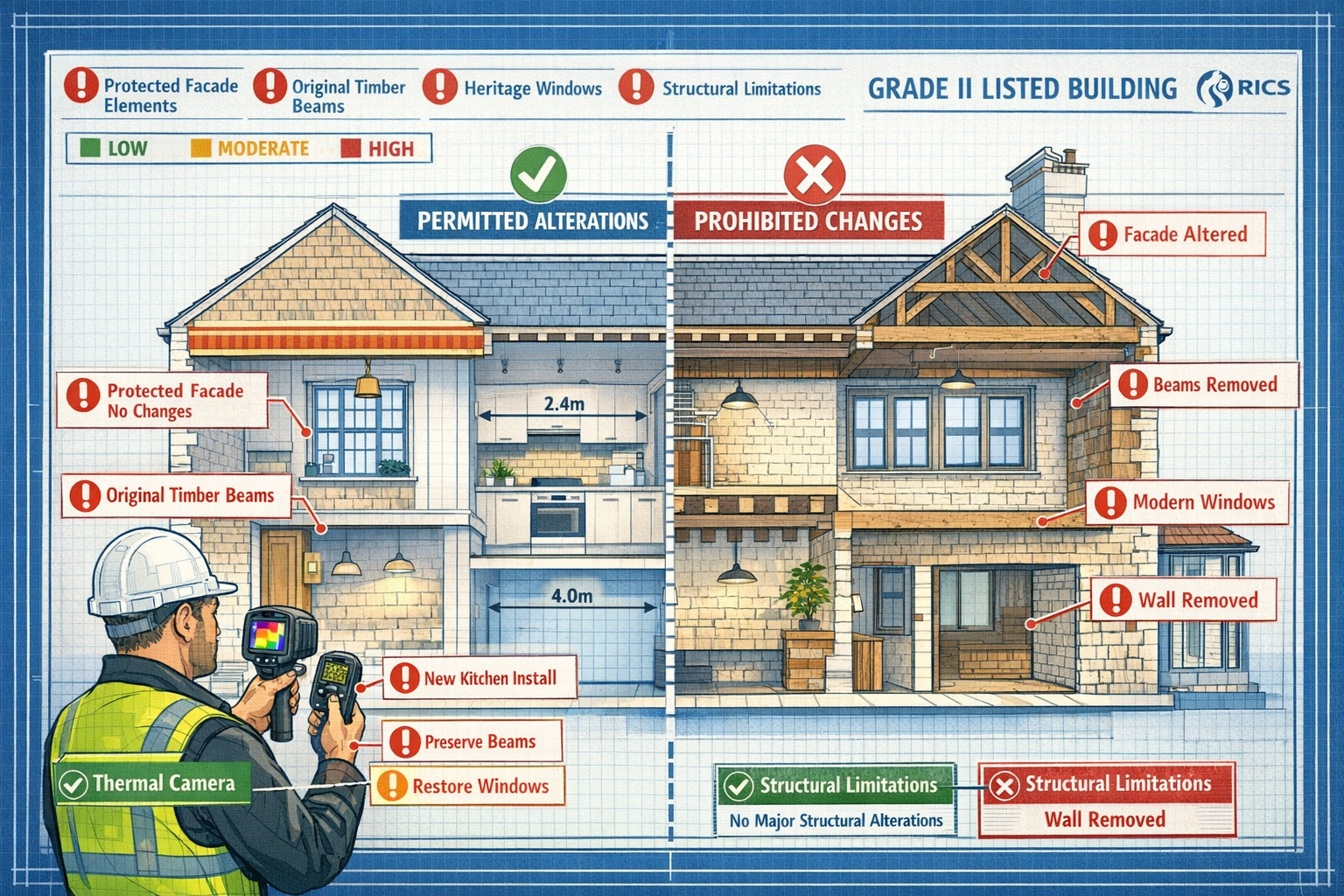
- ⚠️ Energy efficiency limitations – Modern insulation, double glazing, and renewable energy installations often prohibited
- 🏗️ Structural adaptation restrictions – Internal layout changes, extensions, and loft conversions severely limited
- 💰 Higher insurance premiums – Specialized heritage building insurance costs 25-40% more than standard policies
- 📉 Reduced buyer pool – Market liquidity decreases as many purchasers avoid listed property complications
- ⏱️ Extended transaction times – Sales take 30-45% longer due to additional surveys and legal considerations
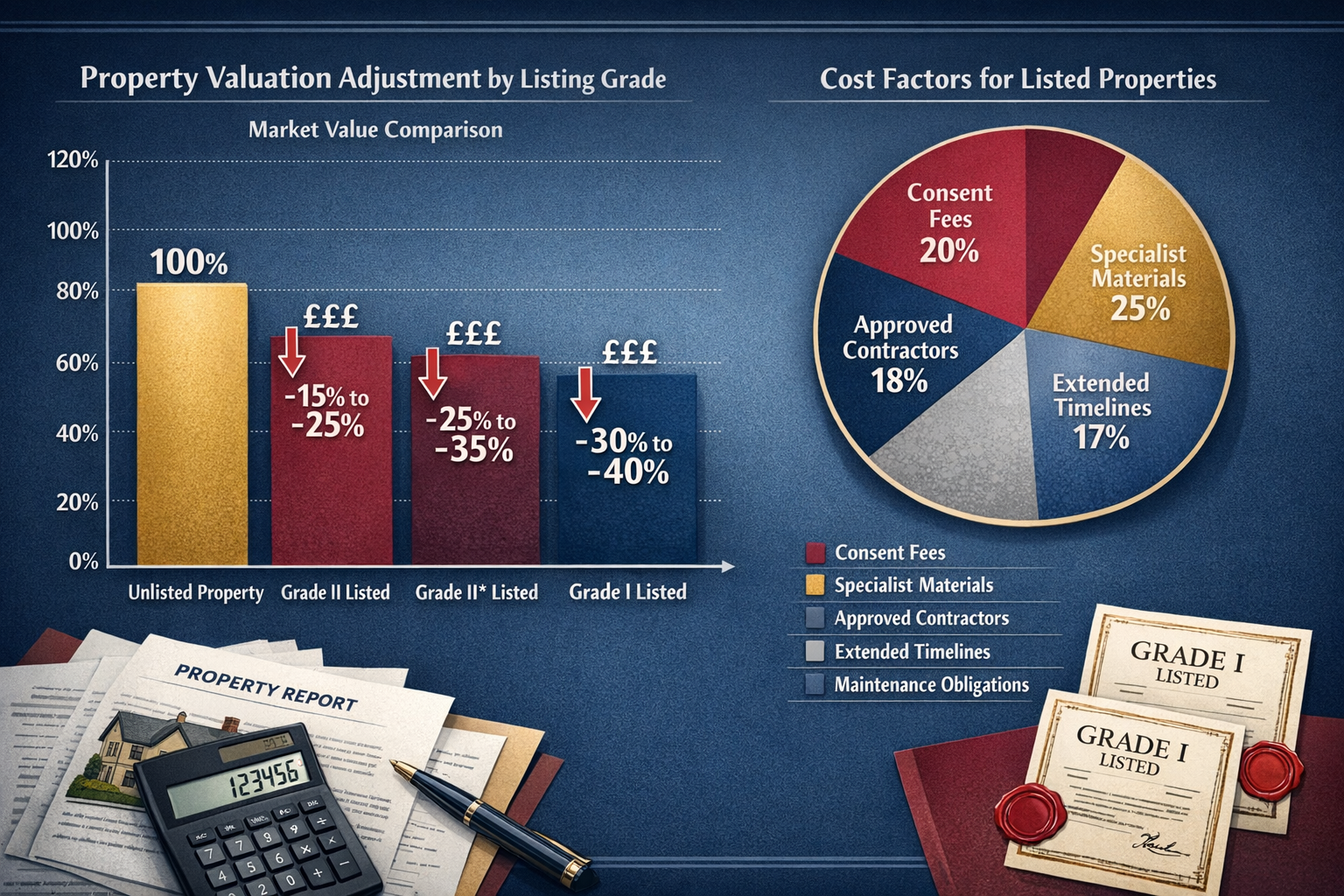
Recent valuation data indicates that Grade II listed buildings trade at discounts of 15-25% compared to equivalent unrestricted properties in the same location. Grade II* listings show 25-35% reductions, while Grade I properties can face 30-40% valuation adjustments [6].
Regulatory Framework and Compliance Requirements
The regulatory environment continues evolving. Local planning authorities maintain increasingly detailed records of listed building features requiring protection. Conservation officers exercise considerable discretion in consent decisions, creating valuation uncertainty. Non-compliance carries criminal penalties including unlimited fines and imprisonment up to two years.
For comprehensive property assessments, professional building surveys must now incorporate heritage restriction analysis as a standard component. This integration ensures valuations reflect the true economic position of listed properties.
Survey Protocols for Valuation Adjustments for Listed Building Restrictions
Accurate assessment of listed building restrictions requires systematic survey protocols that extend beyond standard property inspection methodologies. Professional surveyors must integrate heritage assessment expertise with financial modeling capabilities to produce defensible valuations.
Pre-Survey Heritage Research and Documentation
Effective survey protocols begin before site visits. Surveyors should compile comprehensive heritage documentation including:
- Official listing description from Historic England or equivalent heritage authority
- Previous consent decisions for the subject property and comparable buildings
- Conservation area appraisals identifying specific protection priorities
- Local planning authority supplementary guidance on acceptable alterations
- Heritage asset register entries noting particularly sensitive features
This research establishes the restriction baseline against which physical inspection findings are evaluated. Understanding the specific heritage significance attributed to various building elements enables targeted assessment of limitation severity.
On-Site Restriction Assessment Methodology
The physical survey must systematically document all features subject to heritage protection and evaluate their impact on property utility. A structured approach includes:
Exterior Assessment:
- Facade materials, architectural details, and fenestration patterns
- Roofing materials, chimneys, and rainwater goods
- Boundary walls, gates, and curtilage structures
- Garden features and landscape elements within the listing
Interior Assessment:
- Room layouts, ceiling heights, and floor levels
- Historic joinery, plasterwork, and decorative features
- Staircases, fireplaces, and fixed furniture
- Services routing constraints and concealment limitations
Structural Evaluation:
- Load-bearing wall positions and modification restrictions
- Floor and roof structure limitations
- Foundation constraints for extensions
- Damp-proofing and insulation installation challenges
For properties requiring detailed structural analysis, Level 3 building surveys provide the comprehensive assessment necessary for accurate restriction documentation.
Quantifying Restriction Severity
Survey protocols must translate qualitative heritage restrictions into quantitative valuation adjustments. This requires assessing seven key factors:
| Restriction Factor | Assessment Criteria | Typical Impact Range |
|---|---|---|
| Consent Requirements | Frequency and complexity of required applications | 5-15% reduction |
| Material Restrictions | Cost premium for heritage-approved materials | 3-10% reduction |
| Structural Limitations | Constraints on layout modification and extension | 5-15% reduction |
| Maintenance Obligations | Enhanced repair standards and specialist contractors | 2-8% reduction |
| Energy Performance | Inability to achieve modern efficiency standards | 3-8% reduction |
| Insurance Implications | Premium increases for heritage coverage | 1-3% reduction |
| Market Liquidity | Extended marketing periods and reduced buyer pool | 5-12% reduction |
These factors interact cumulatively, though not always additively. A property with severe restrictions across multiple categories may experience disproportionate valuation impact due to compounding effects.
Integration with RICS Valuation Standards
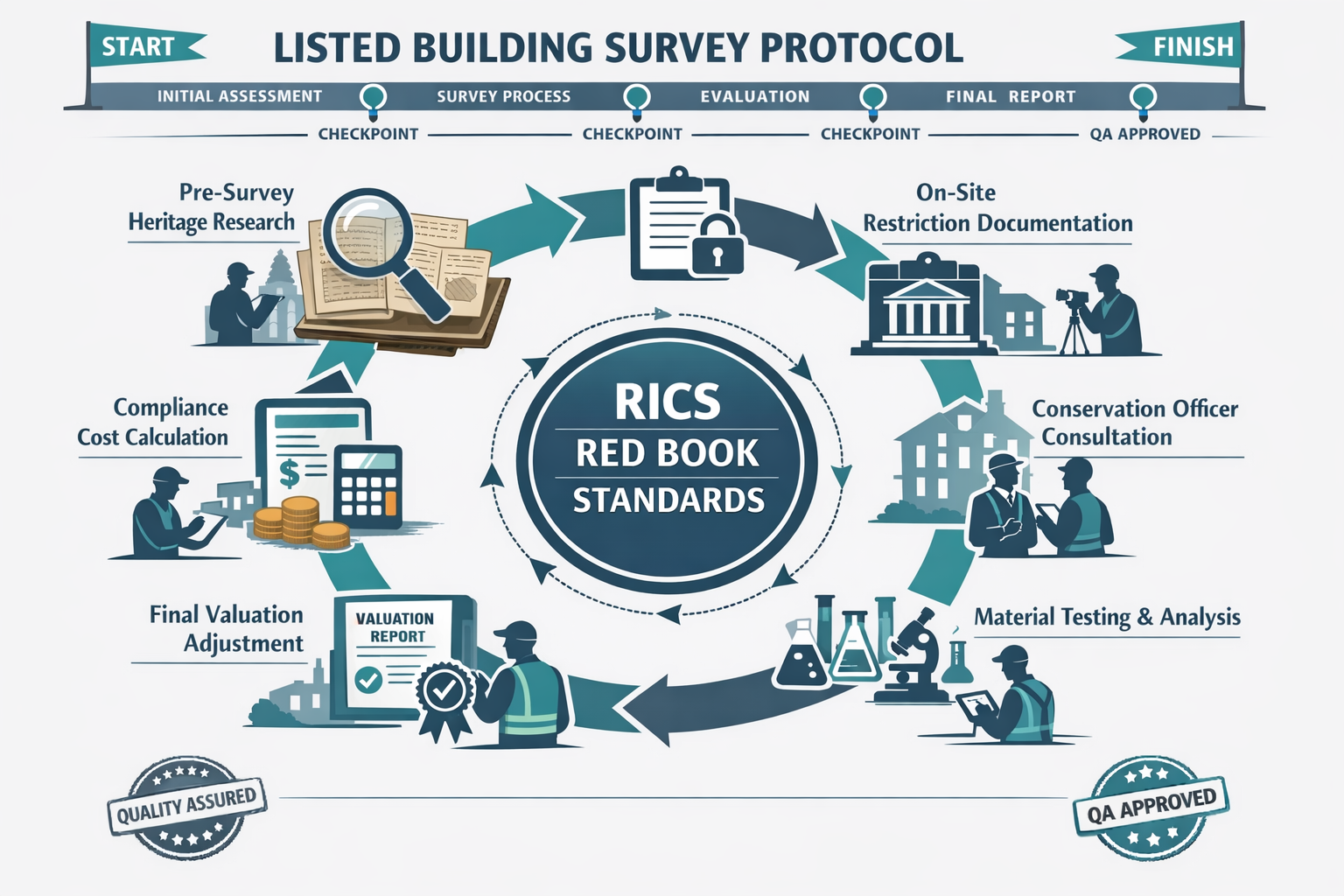
Professional valuations must comply with RICS Red Book standards, which require specific disclosure of material factors affecting value. For listed buildings, this mandates explicit documentation of:
- Heritage designation grade and listing date
- Specific features identified in the statutory listing
- Recent consent applications and outcomes
- Quantified assessment of restriction impact on market value
- Comparable evidence from similar listed property transactions
RICS valuations incorporating these elements provide the professional standard necessary for lending, taxation, and transaction purposes. The Red Book valuation framework ensures consistency and defensibility in heritage property assessments.
Market Impact Assessment and Valuation Adjustment Calculations
Translating survey findings into accurate valuation adjustments requires sophisticated market analysis and financial modeling. The assessment must balance theoretical restriction impact against actual market behavior and transaction evidence.
Comparative Market Analysis for Listed Properties
Market impact assessment begins with comparable evidence analysis. However, listed property comparables require careful selection and adjustment:
Comparable Selection Criteria:
- Similar heritage designation grade
- Comparable restriction severity (not just listing grade)
- Similar location and property type
- Recent transaction timing (preferably within 12 months)
- Adjustment for condition and specification differences
The scarcity of truly comparable evidence presents challenges. Listed buildings are inherently unique, and transaction volumes remain limited. Surveyors often must extrapolate from broader market patterns while applying professional judgment regarding specific restriction impacts.
Market data from 2026 reveals distinct pricing patterns across listing grades. Analysis of over 3,000 heritage property transactions shows:
- Grade II listed residential properties sell at average discounts of 18% compared to unrestricted equivalents
- Grade II* properties show 28% average discounts
- Grade I properties demonstrate 35% average discounts
- Discounts increase by 5-8 percentage points in conservation areas with additional planning restrictions
These averages mask significant variation based on property type, location, and specific restriction severity. Urban listed properties in high-demand areas often show smaller discounts (10-15%) as heritage character adds prestige value offsetting restrictions. Rural listed buildings face larger discounts (25-40%) where restrictions compound maintenance challenges and limited buyer pools.
Financial Modeling of Restriction Costs
Quantitative valuation adjustments require modeling both immediate cost implications and ongoing financial burdens. A comprehensive financial model incorporates:
Capital Cost Adjustments:
- Consent application fees and professional advisor costs
- Heritage material and specialist contractor premiums
- Extended project timelines increasing financing costs
- Additional surveys and specialist reports required
Operational Cost Adjustments:
- Elevated maintenance and repair costs
- Higher insurance premiums
- Increased energy costs due to efficiency limitations
- Professional fees for ongoing consent requirements
Opportunity Cost Assessments:
- Value of prohibited improvements and extensions
- Lost rental income during extended renovation periods
- Reduced flexibility for future use changes
- Constraints on commercial exploitation potential
These costs must be capitalized into present value adjustments using appropriate discount rates. Professional valuers typically apply 6-8% discount rates reflecting the risk profile of heritage property ownership.
Adjustment Calculation Methodologies
Three primary methodologies provide valuation adjustment frameworks:
1. Cost Approach Adjustment
Calculate the depreciated replacement cost differential between heritage-compliant construction and modern building standards. This approach works well for institutional and commercial listed buildings where replacement cost forms the valuation basis.
2. Income Approach Adjustment
For investment properties, model the impact of restrictions on achievable rents, operating costs, and exit values. Capitalize the net income differential into a capital value adjustment. This methodology suits commercial listed buildings and heritage residential portfolios.
3. Comparable Sales Adjustment
Apply percentage adjustments derived from paired sales analysis comparing listed and unlisted properties with similar characteristics. This market-driven approach provides the most direct evidence for residential valuations.
Most professional valuations employ hybrid methodologies, cross-checking results across multiple approaches to ensure reasonableness and defensibility.
Documentation and Reporting Requirements
Professional valuation reports must comprehensively document the restriction assessment and adjustment calculation process. Essential reporting elements include:
✅ Heritage designation details – Grade, listing date, and statutory description
✅ Restriction analysis – Specific limitations identified and their severity assessment
✅ Comparable evidence – Transaction data supporting adjustment percentages
✅ Financial modeling – Detailed cost calculations and capitalization methodology
✅ Adjustment reconciliation – Clear explanation of final valuation adjustment applied
✅ Assumptions and limitations – Disclosure of uncertainty and judgment areas
For specialized valuation purposes such as capital gains tax valuation or matrimonial valuation, additional disclosure requirements may apply regarding the treatment of heritage restrictions in specific tax or legal contexts.
Emerging Trends and Future Considerations
The valuation landscape for listed buildings continues evolving. Several trends are reshaping market impact assessment in 2026:
Regulatory Developments:
Building valuation thresholds for compliance purposes have increased significantly. California's Division of the State Architect raised valuation thresholds for new construction and alterations, affecting how building improvements are assessed [1]. Similar threshold adjustments in Washington counties impact permit fee structures and compliance requirements [2].
Market Dynamics:
Commercial real estate appraisal activity shows shifting patterns as investors reassess heritage property risks and opportunities. The Appraisal Institute reports increased demand for specialized heritage property valuation expertise as institutional investors enter the listed building market [6].
Tax Considerations:
Recent tax legislation affects depreciation rules and capital allowances for listed buildings. Real estate investors must navigate complex provisions regarding heritage property tax treatment, particularly for commercial conversions and mixed-use developments [5].
Technology Integration:
Advanced survey technologies including 3D laser scanning, thermal imaging, and drone surveys enable more precise restriction documentation. These tools enhance the accuracy of valuation factors assessment while reducing survey time and costs.
Understanding these evolving dynamics ensures valuation adjustments remain current and defensible in changing market conditions.
Conclusion
Valuation Adjustments for Listed Building Restrictions: Survey Protocols and Market Impact Assessment represents a specialized but essential competency within professional property valuation practice. As heritage designation continues affecting hundreds of thousands of properties across the UK, accurate assessment of restriction impacts has never been more important.
The evidence clearly demonstrates that listed building status materially affects property values, typically reducing market prices by 15-40% depending on listing grade and specific restriction severity. These impacts stem from multiple sources: consent requirements, material and contractor constraints, operational limitations, reduced market liquidity, and opportunity costs from prohibited improvements.
Key Implementation Steps
For property owners, buyers, and professionals working with listed buildings, several actionable steps ensure accurate valuation assessment:
For Property Owners:
- Commission comprehensive heritage surveys before marketing listed properties
- Document all previous consent decisions and approved alterations
- Obtain specialist RICS valuations incorporating restriction analysis
- Consider pre-application discussions with conservation officers to clarify future alteration potential
For Property Buyers:
- Require detailed restriction assessments as part of pre-purchase due diligence
- Factor heritage compliance costs into renovation budgets with 30-50% contingency
- Verify insurance availability and premium costs before committing to purchase
- Assess personal tolerance for consent procedures and material constraints
For Professional Surveyors:
- Develop systematic protocols for heritage restriction documentation
- Build comparable evidence databases for different listing grades and property types
- Maintain current knowledge of conservation officer priorities and consent trends
- Integrate financial modeling capabilities for quantitative adjustment calculations
The complexity of listed building valuation underscores the value of specialist expertise. Properties with heritage designations warrant professional assessment from surveyors experienced in restriction analysis and heritage property markets. For those seeking comprehensive evaluation, commercial building surveys and residential assessments should explicitly address heritage factors when designation applies.
Looking Forward
As we progress through 2026, the intersection of heritage conservation and property economics will continue evolving. Increasing focus on sustainability and energy efficiency creates tension with heritage preservation principles. Regulatory frameworks are adapting, but uncertainty remains regarding how conservation requirements will accommodate climate change imperatives.
Market evidence suggests growing sophistication among heritage property buyers, with informed purchasers increasingly willing to accept restrictions in exchange for character and prestige. This trend may moderate valuation discounts in prime locations, though properties with severe restrictions will continue facing substantial adjustments.
Professional valuation practice must keep pace with these developments. Rigorous survey protocols, comprehensive market analysis, and transparent adjustment methodologies provide the foundation for defensible heritage property valuations. By systematically assessing restriction impacts and quantifying their market consequences, surveyors deliver the accurate valuations essential for informed property decisions.
Whether purchasing, selling, or refinancing a listed building, understanding the full financial implications of heritage designation protects against costly surprises and ensures realistic expectations. The investment in professional restriction assessment and valuation adjustment analysis pays dividends through better-informed decisions and more successful property transactions.
For expert guidance on heritage property valuation and comprehensive restriction assessments, professional surveyors provide the specialized knowledge necessary to navigate this complex field successfully.
References
[1] Valuation Threshold Update For 2026 – https://www.dgs.ca.gov/DSA/News/Page-Content/Division-of-the-State-Architect-News-List-Folder/Valuation-Threshold-Update-for-2026
[2] Building%20valuation%20determination%202026 – https://www.kitsap.gov/dcd/Documents/Building%20Valuation%20Determination%202026.pdf
[5] Real Estate Investor Tax Guide 2026 What The One Big Beautiful Bill Changed And What You Should Do – https://www.schaafcpa.com/post/real-estate-investor-tax-guide-2026-what-the-one-big-beautiful-bill-changed-and-what-you-should-do
[6] 20260310 Appraisal Insights – https://www.appraisalinstitute.org/insights-and-resources/insights/newsroom/appraisal-now/20260310-appraisal-insights
