
The Building Safety Regulator processed over 1,200 Gateway applications in its first operational year, yet industry experts estimate that up to 40% of high-rise residential projects face significant delays due to compliance gaps identified during mandatory building surveys.[6] As the UK living sector confronts the most comprehensive regulatory overhaul since the Grenfell Tower tragedy, building surveys have transformed from routine property assessments into critical compliance instruments that determine project viability, investment risk, and tenant safety outcomes.
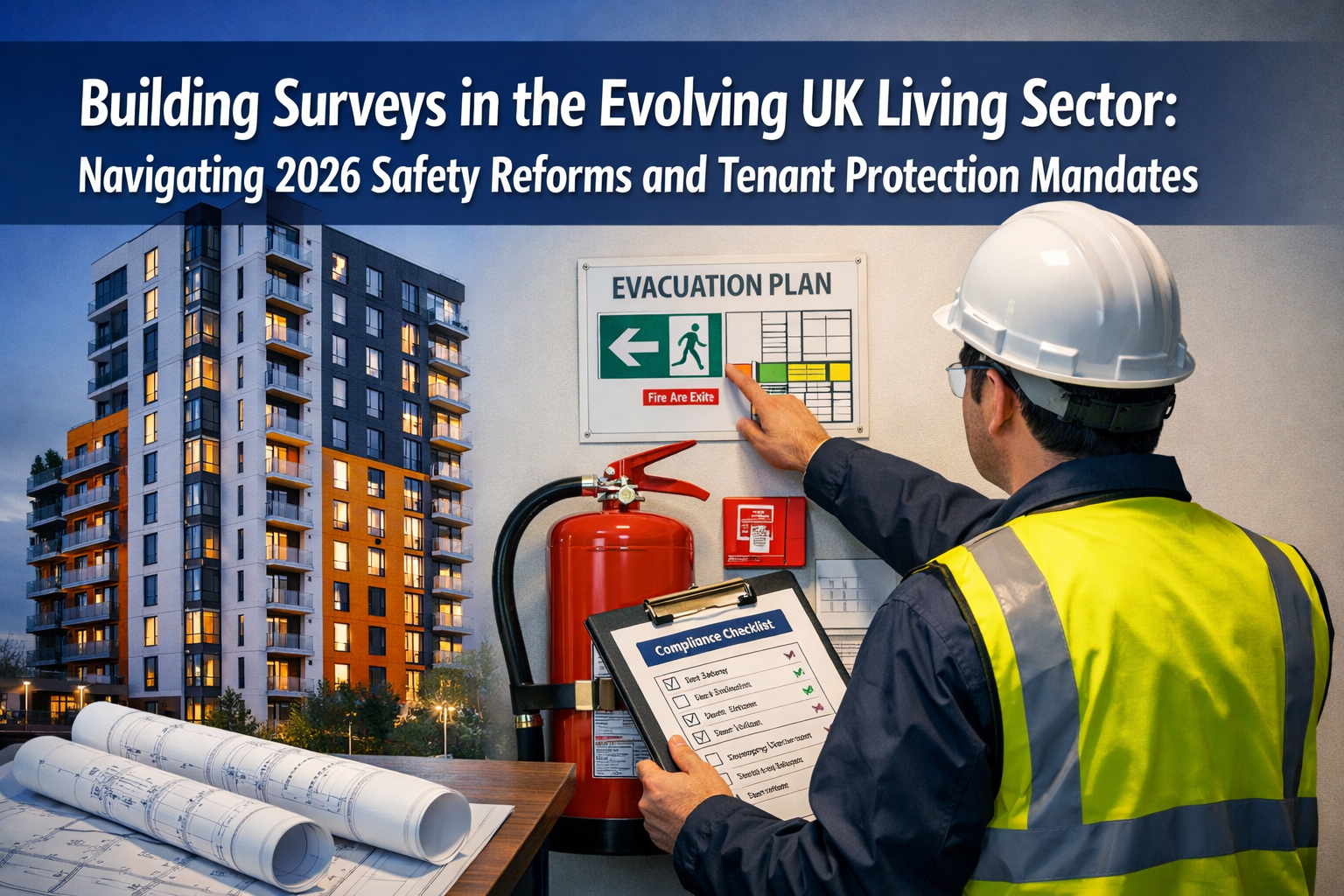
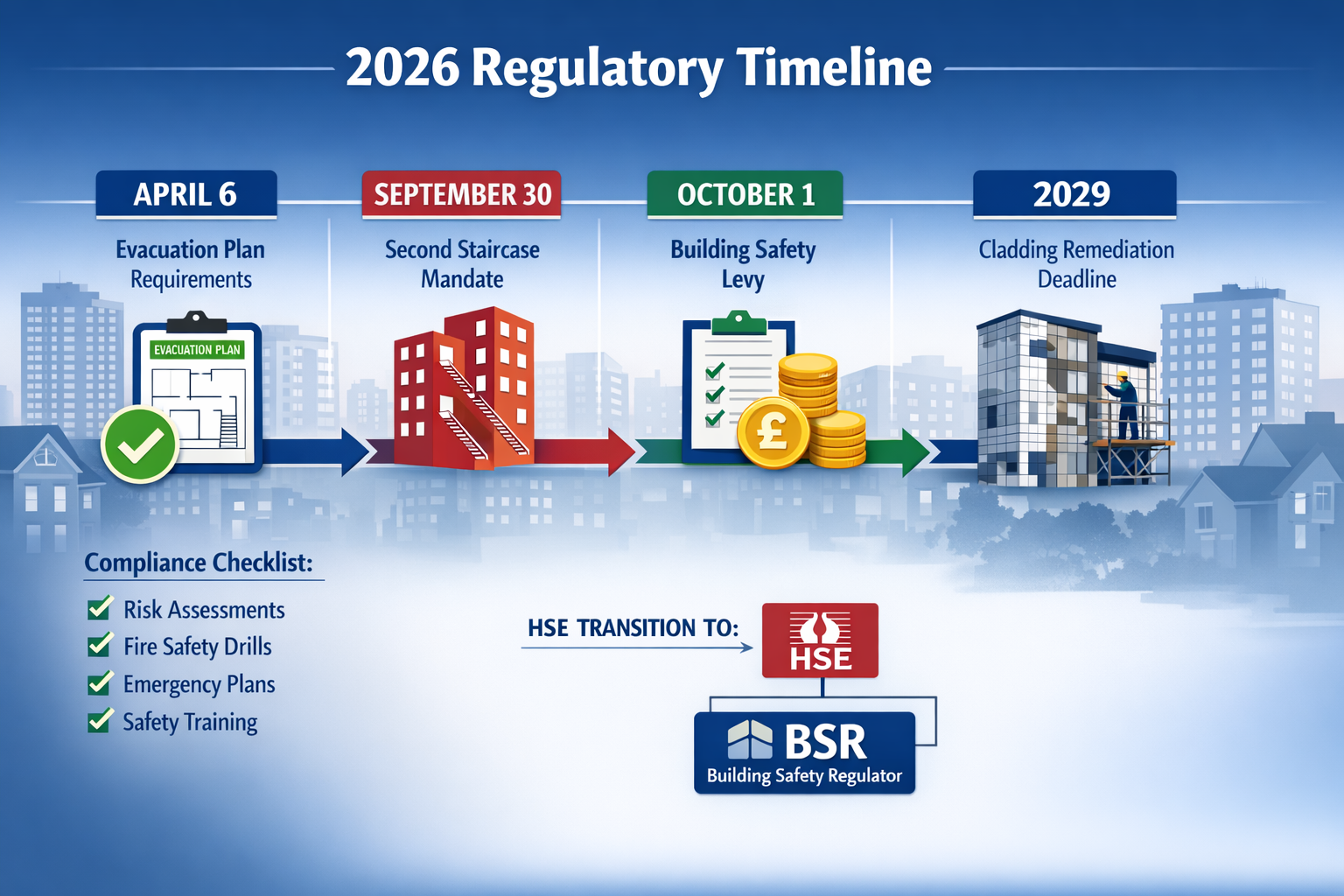
Building Surveys in the Evolving UK Living Sector: Navigating 2026 Safety Reforms and Tenant Protection Mandates represents a fundamental shift in how property professionals, developers, and investors approach due diligence in purpose-built student accommodation (PBSA), houses in multiple occupation (HMOs), and build-to-rent (BTR) developments. The convergence of fire safety regulations activated in April 2026, the Building Safety Levy implementation scheduled for October 2026, and mandatory second staircase requirements effective September 2026 has created an unprecedented compliance landscape that demands specialized surveying expertise.
Key Takeaways
- Fire safety evacuation plans became mandatory for high-rise residential buildings on April 6, 2026, requiring comprehensive building surveys to verify compliance with new resident assistance protocols[1]
- The Building Safety Levy launching October 1, 2026, will generate £3.4 billion over ten years, fundamentally altering development economics and requiring enhanced survey due diligence[2]
- Gateway 2 approval processes under the Building Safety Act 2022 have increased project timelines by 3-6 months, with specialized surveys essential for navigating heightened regulatory scrutiny[3]
- Second staircase requirements for buildings exceeding 18 metres (effective September 30, 2026) necessitate structural surveys assessing feasibility and retrofit costs for existing developments[3]
- PBSA and HMO sectors face unique compliance challenges requiring sector-specific survey protocols that address fire safety, tenant protection, and Renters' Rights regime alignment[1]
The Post-Grenfell Regulatory Landscape: How 2026 Reforms Are Reshaping Building Survey Requirements
The regulatory environment governing UK residential buildings underwent seismic transformation following the Grenfell Tower fire, with 2026 marking the year when multiple legislative streams converged into operational reality. Understanding this regulatory context is essential for appreciating why building surveys have evolved far beyond traditional structural assessments.
Fire Safety (Residential Evacuation Plans) Regulations 2025: Immediate Survey Implications
On April 6, 2026, the Fire Safety (Residential Evacuation Plans) (England) Regulations 2025 took full effect, imposing four critical obligations on "responsible persons" managing high-rise residential buildings:
- Preparation of building-wide evacuation plans tailored to specific building characteristics
- Arrangement of assistance for residents requiring evacuation support
- Information provision to local fire and rescue services
- Clear communication protocols with all residents regarding evacuation procedures[1]
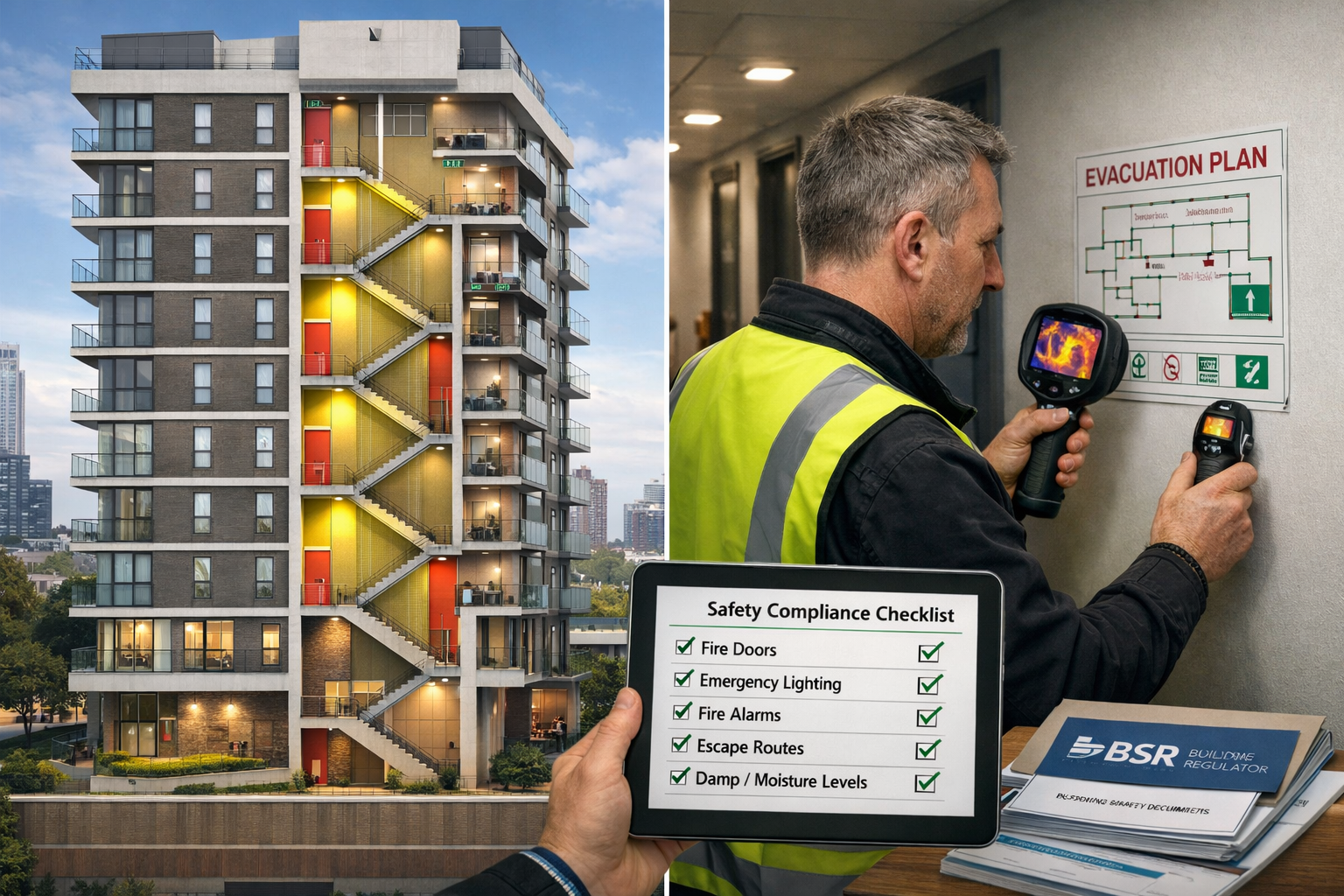
These requirements fundamentally changed the scope of building surveys for PBSA and HMO properties. Surveyors must now assess whether existing building configurations support compliant evacuation strategies, including:
- Evacuation route adequacy and signage compliance
- Accessibility features for residents with mobility limitations
- Communication system functionality for emergency notifications
- Documentation infrastructure supporting resident assistance registers
For purpose-built student accommodation operators, where resident populations change annually and demographic profiles vary significantly, these survey requirements present particular challenges. A Level 3 building survey conducted in 2026 for PBSA assets must now incorporate fire safety compliance verification as a core component, not an ancillary consideration.
Building Safety Regulator Transition: Institutional Changes Affecting Survey Protocols
January 27, 2026, marked the completion of the Building Safety Regulator's transition from the Health and Safety Executive to an independent arm's length body under the Ministry of Housing, Communities & Local Government.[4] This institutional reorganization created new reporting structures and compliance pathways that directly impact building survey requirements.
The BSR's strategic plan for 2026-2027 emphasizes:
- Enhanced enforcement capabilities through the new Remediation Enforcement Unit
- Standardized assessment protocols for Gateway submissions
- Competency requirements for building control professionals
- Digital submission systems requiring specific documentation formats[6]
Building surveys supporting Gateway 2 applications must now align with BSR-specific documentation standards, including detailed fire safety assessments, structural integrity certifications, and compliance declarations that meet the regulator's heightened scrutiny threshold.
"The BSR transition has fundamentally altered the due diligence landscape. Surveys that would have satisfied building control requirements 18 months ago are now routinely rejected for insufficient detail on fire safety systems integration." — Industry compliance expert[7]
The Building Safety Levy: Economic Impact on Development Viability
The Building Safety Levy, scheduled for implementation on October 1, 2026, applies to new residential buildings and purpose-built student accommodation in England with 10 or more dwellings. Expected to raise approximately £3.4 billion over ten years, the levy fundamentally alters development economics.[2]
For building surveyors conducting feasibility assessments and investment due diligence, the levy introduces critical considerations:
| Development Type | Levy Threshold | Survey Impact |
|---|---|---|
| Standard Residential | 10+ dwellings | Enhanced viability analysis required |
| PBSA | 10+ units | Sector-specific compliance assessment |
| BTR Developments | 10+ units | Long-term cost modeling essential |
| Mixed-Use | Residential component 10+ | Apportionment analysis required |
Building surveys supporting acquisition or development decisions must now incorporate levy cost projections, compliance verification confirming accurate unit counts, and risk assessments identifying potential levy escalation scenarios.[8]
Specialized Survey Protocols for PBSA, HMOs, and BTR Assets in the 2026 Compliance Environment
The living sector encompasses diverse property types, each with unique regulatory exposures and survey requirements. Building Surveys in the Evolving UK Living Sector: Navigating 2026 Safety Reforms and Tenant Protection Mandates must address sector-specific compliance challenges that generic residential surveys cannot adequately capture.
Purpose-Built Student Accommodation: Time-Sensitive Compliance Challenges
PBSA assets face particularly acute compliance pressures due to operational timelines that cannot accommodate extended regulatory delays. Gateway 2 due diligence requirements have caused substantial project delays, with time-sensitive projects like PBSA—where occupancy must align with academic schedules—experiencing the most severe impacts.[3]
Specialized PBSA survey protocols must address:
Fire Safety Compliance Verification
- Assessment of evacuation plan feasibility given high-density occupancy patterns
- Evaluation of fire door specifications and compartmentation integrity
- Review of alarm system adequacy for student demographic
- Analysis of communal space fire risk factors
Structural Adequacy for Safety Retrofits
- Feasibility assessment for second staircase installation in buildings exceeding 18 metres
- Load-bearing capacity analysis for fire safety equipment additions
- Evaluation of external wall system integrity and cladding safety
- Assessment of structural modifications required for compliance
Tenant Protection Mandate Compliance
- Review of accommodation standards against Renters' Rights regime requirements
- Assessment of maintenance protocols supporting tenant safety obligations
- Evaluation of accessibility features and disability accommodation provisions
- Analysis of building management systems supporting resident assistance registers[1]
The essential guide to commercial building surveys provides foundational principles, but PBSA assets require enhanced protocols addressing the unique intersection of commercial operation and residential safety standards.
Houses in Multiple Occupation: Heightened Fire Safety Scrutiny
HMO properties face intensified regulatory attention in 2026, with building surveys needing to address both existing licensing requirements and new fire safety mandates. The convergence of local authority HMO licensing regimes with national fire safety regulations creates complex compliance matrices.
Critical HMO survey components include:
✅ Fire Risk Assessment Integration – Coordination between building surveys and formal fire risk assessments to ensure consistent findings
✅ Compartmentation Verification – Detailed assessment of fire resistance between units and escape routes
✅ Means of Escape Analysis – Evaluation of escape route adequacy, travel distances, and alternative exit provisions
✅ Fire Detection System Compliance – Assessment of alarm system specifications, coverage, and interconnection
✅ Door Specification Verification – Confirmation that fire doors meet current standards with proper intumescent strips and self-closing mechanisms
For HMO investors and operators, Level 2 vs Level 3 survey comparisons become critical decision points, with Level 3 surveys increasingly necessary to capture the detailed fire safety assessments required for regulatory compliance.
Build-to-Rent Developments: Investment Due Diligence in the New Regulatory Context
BTR investments led living sector capital deployment in 2026, with clearer building safety processes and certainty on the Renters' Rights regime helping align buyer and seller valuations.[1] However, this investment activity demands enhanced survey due diligence addressing long-term compliance costs and regulatory risk exposure.
BTR-specific survey considerations include:
Long-Term Compliance Cost Modeling
- Projected costs for ongoing fire safety system maintenance and upgrades
- Assessment of building safety levy impact on operational economics
- Evaluation of potential remediation obligations for existing buildings
- Analysis of insurance implications related to fire safety compliance
Gateway Compliance Verification for New Developments
- Confirmation that Gateway 2 approvals align with actual construction specifications
- Assessment of building control documentation completeness
- Verification of competent person certifications for critical systems
- Review of digital building information model accuracy[3]
Tenant Protection Mandate Alignment
- Assessment of building management systems supporting Renters' Rights obligations
- Evaluation of maintenance protocols ensuring tenant safety standards
- Review of accessibility features and disability accommodation provisions
- Analysis of complaint handling and dispute resolution infrastructure
The complete guide to home surveying provides residential survey fundamentals, but BTR assets require institutional-grade assessments addressing portfolio-level risk management and regulatory compliance across multiple properties.
Gateway 2 Navigation: Building Survey Requirements for BSR Approval and Cladding Remediation Compliance
The Building Safety Act 2022 introduced a three-gateway approval process for higher-risk buildings, with Gateway 2 representing the planning permission stage where developers must demonstrate comprehensive safety compliance before construction commences. Building Surveys in the Evolving UK Living Sector: Navigating 2026 Safety Reforms and Tenant Protection Mandates must address Gateway 2 requirements that have substantially increased due diligence complexity and project timelines.
Understanding Gateway 2 Due Diligence Requirements
Gateway 2 applications require extensive documentation demonstrating that proposed designs meet building safety standards, including:
- Detailed fire safety strategies addressing evacuation, compartmentation, and suppression systems
- Structural integrity certifications confirming load-bearing adequacy and stability
- Material specifications with particular attention to external wall systems and cladding
- Competent person declarations certifying that design professionals meet BSR competency standards
- Digital building information in formats compatible with BSR submission systems[4]
Heightened due diligence requirements under Gateway 2 have increased costs and caused substantial project delays, with delays particularly acute for time-sensitive projects like PBSA where occupancy must align with academic schedules.[3] Building surveys supporting Gateway 2 applications must therefore provide documentation that anticipates BSR scrutiny and addresses common rejection factors.
Second Staircase Requirement: Structural Survey Implications
From September 30, 2026, all new residential buildings exceeding 18 metres in height must incorporate two separate staircases, enhancing evacuation routes and improving fire safety standards.[3] This requirement has profound implications for building surveys across multiple scenarios:
New Development Feasibility Assessments
- Evaluation of site constraints affecting dual staircase placement
- Assessment of structural design implications for load distribution
- Analysis of floor plan efficiency and unit layout optimization
- Review of cost implications for development viability
Existing Building Retrofit Evaluations
- Structural feasibility analysis for second staircase installation
- Assessment of space availability and unit reconfiguration requirements
- Evaluation of building services integration challenges
- Analysis of construction methodology and phasing for occupied buildings
Investment Due Diligence for Pre-2026 Developments
- Risk assessment of buildings approaching 18-metre threshold through extensions
- Evaluation of compliance status for buildings with planning permission predating the requirement
- Analysis of potential retrofit obligations under future regulatory changes
The second staircase mandate represents one of the most significant structural requirements introduced in 2026, making structural engineer reports an essential complement to comprehensive building surveys for high-rise residential projects.
Cladding Remediation Compliance: Survey Protocols for 2029 Deadline
By 2029, every 18m+ residential building in government-funded schemes will be remediated, and every 11m+ building with unsafe cladding will either have been remediated, have a completion date set, or their landlords will face penalties.[5] This remediation timeline creates immediate survey requirements for building owners, investors, and lenders.
Cladding-specific survey protocols include:
External Wall System Assessment
- Identification of cladding materials and construction methodology
- Evaluation of fire performance characteristics and test certifications
- Assessment of cavity barriers and fire stopping adequacy
- Review of attachment systems and structural integration
Remediation Scope Definition
- Determination of remediation extent and methodology
- Cost estimation for compliant replacement systems
- Assessment of building occupancy implications during works
- Evaluation of alternative compliance strategies
Regulatory Compliance Verification
- Confirmation of building registration with BSR
- Review of remediation funding eligibility and applications
- Assessment of developer liability and warranty claims
- Analysis of enforcement risk under Remediation Enforcement Unit powers[5]
The Remediation Enforcement Unit within the BSR has been established to help enforcement where 18m+ buildings with unsafe cladding are not progressing sufficiently, with local authorities and Homes England gaining additional powers to undertake remedial works directly.[5] Building surveys must therefore assess not only technical remediation requirements but also regulatory enforcement risk exposure.
Licensing Scheme Implications: Principal Contractor Competency
Following Grenfell Inquiry recommendations, the government is exploring introduction of a licensing scheme for principal contractors undertaking work on higher-risk buildings, with a broader review of the dutyholder regime due in Autumn 2026.[4] While not yet implemented, this potential licensing requirement has immediate survey implications:
- Contractor competency verification for existing projects and maintenance contracts
- Risk assessment of contractor licensing exposure for ongoing works
- Documentation review confirming contractor qualifications and certifications
- Contingency planning for potential contractor replacement if licensing requirements are introduced
Building surveys conducted in 2026 should anticipate this regulatory development by assessing whether current contractors and building management arrangements would satisfy likely licensing standards.
Investment Recovery Market: Survey Due Diligence Supporting Living Sector Transactions
Capital deployment into the living sector in 2026 is accelerating, led by PBSA and BTR investment growth, with clearer building safety processes and certainty on the Renters' Rights regime expected to help align buyer and seller valuations.[1] This investment recovery creates heightened demand for comprehensive building surveys that address both traditional structural concerns and the new regulatory compliance landscape.
Pricing and Valuation: Reflecting Finance Costs and Regulatory Requirements
Market pricing and due diligence in 2026 continue to reflect finance costs and regulatory requirements, with clearer building safety processes expected to help buyers and sellers reach agreement on valuation, particularly for PBSA assets operating under the Renters' Rights regime.[1]
Survey-supported valuation considerations include:
Regulatory Compliance Cost Quantification
- Building Safety Levy impact on development returns and exit values
- Remediation obligations affecting existing building valuations
- Ongoing compliance costs for fire safety and tenant protection mandates
- Potential enforcement penalties for non-compliant assets
Risk-Adjusted Return Modeling
- Regulatory delay risk for developments requiring Gateway approvals
- Enforcement action exposure for buildings with compliance gaps
- Insurance cost implications related to fire safety compliance status
- Tenant demand sensitivity to building safety certifications
Comparable Transaction Analysis
- Adjustment factors for buildings with confirmed BSR compliance
- Valuation premiums for assets with completed remediation
- Discount rates reflecting regulatory uncertainty for non-compliant properties
- Market evidence of compliance impact on rental values and occupancy rates
RICS valuations supporting living sector transactions must now integrate regulatory compliance status as a primary value driver, with building surveys providing the technical foundation for compliance verification.
Enhanced Due Diligence Protocols for Institutional Investors
Institutional investors deploying capital into UK living sector assets in 2026 demand enhanced due diligence protocols that address regulatory compliance alongside traditional investment criteria. Building surveys supporting institutional acquisitions must provide comprehensive assessments across multiple dimensions:
Technical Compliance Verification
- Confirmation of BSR registration status for qualifying buildings
- Review of Gateway approval documentation and conditions
- Assessment of fire safety system specifications and maintenance records
- Evaluation of structural adequacy for current and anticipated regulatory requirements
Operational Risk Assessment
- Analysis of building management competency and contractor qualifications
- Review of resident assistance protocols and accessibility provisions
- Evaluation of complaint handling and dispute resolution effectiveness
- Assessment of insurance coverage adequacy and claims history
Portfolio Integration Analysis
- Consistency evaluation across multiple assets regarding compliance standards
- Assessment of management systems scalability for portfolio growth
- Review of standardized documentation and reporting protocols
- Analysis of centralized compliance monitoring capabilities
The complete timeline guide for building surveys becomes particularly relevant for institutional investors managing acquisition pipelines, as enhanced due diligence requirements have extended survey timelines by 2-4 weeks compared to pre-2026 standards.
Lender Requirements: Building Surveys Supporting Development Finance
Development finance providers have substantially increased due diligence requirements for living sector projects in 2026, with building surveys playing a critical role in loan approval decisions. Lenders now require comprehensive assessments addressing:
Regulatory Approval Certainty
- Confirmation of Gateway 2 approval status and conditions
- Assessment of compliance risk factors that could trigger BSR enforcement
- Evaluation of planning permission alignment with building safety requirements
- Review of building control documentation completeness
Cost Certainty and Contingency Adequacy
- Verification of Building Safety Levy calculations and payment provisions
- Assessment of fire safety system specifications and cost estimates
- Evaluation of second staircase design and construction cost accuracy
- Analysis of contingency provisions for regulatory compliance risks
Exit Strategy Viability
- Assessment of market demand for compliant vs. non-compliant assets
- Evaluation of likely buyer due diligence requirements at exit
- Analysis of potential regulatory changes affecting future saleability
- Review of certification and documentation supporting marketability
Building surveys supporting development finance applications must therefore address not only current compliance status but also forward-looking regulatory risk assessment and exit strategy viability.
Practical Implementation: Selecting Qualified Surveyors and Navigating the 2026 Compliance Landscape
Building Surveys in the Evolving UK Living Sector: Navigating 2026 Safety Reforms and Tenant Protection Mandates requires specialized expertise that extends beyond traditional surveying competencies. Property owners, developers, and investors must carefully select survey professionals with demonstrated capability in the post-Grenfell regulatory environment.
Surveyor Qualification and Competency Verification
The BSR's emphasis on competency requirements for building control professionals extends to surveyors conducting assessments supporting Gateway applications and compliance verification.[6] When selecting surveyors for living sector projects, consider:
Professional Qualifications
- ✅ RICS membership and chartership status
- ✅ Specialist fire safety qualifications or certifications
- ✅ Building Safety Act 2022 training completion
- ✅ BSR submission process familiarity
Sector-Specific Experience
- ✅ Demonstrated PBSA or HMO assessment experience
- ✅ Gateway 2 application support track record
- ✅ Cladding remediation assessment experience
- ✅ BTR portfolio due diligence expertise
Technical Capabilities
- ✅ Fire safety system assessment competency
- ✅ Structural engineering coordination experience
- ✅ Digital building information model interpretation
- ✅ Regulatory compliance documentation proficiency
The question "is my surveyor qualified" has taken on heightened importance in 2026, with regulatory compliance depending on surveyor competency to identify and assess complex fire safety and structural issues.
Survey Scope Definition: Matching Assessment Level to Project Requirements
The choice between different survey levels significantly impacts the adequacy of regulatory compliance assessment. For living sector projects in 2026:
Level 2 Surveys (HomeBuyer Reports)
- Appropriate for: Standard residential properties below regulatory thresholds
- Limitations: May not provide sufficient fire safety detail for PBSA/HMO compliance
- Considerations: Is a homebuyers survey worth it for properties with minimal regulatory exposure
Level 3 Surveys (Building Surveys)
- Appropriate for: PBSA, HMO, BTR assets, and properties with known compliance issues
- Advantages: Comprehensive assessment supporting regulatory compliance verification
- Applications: Level 3 building survey comprehensive example demonstrates scope for complex properties
Specialist Surveys
- Asbestos surveys for pre-2000 buildings requiring remediation or refurbishment
- Drainage surveys for buildings with basement conversions or flood risk concerns
- Specific defect surveys targeting identified compliance issues
The comparison of different types of survey helps property professionals match assessment scope to regulatory requirements and investment due diligence needs.
Timeline Planning: Accommodating Extended Due Diligence Periods
Gateway 2 approval processes and enhanced regulatory scrutiny have extended project timelines by 3-6 months, with corresponding impacts on survey scheduling and due diligence periods.[3] Effective timeline planning requires:
Survey Scheduling Considerations
- Allow 2-4 weeks for comprehensive Level 3 surveys of complex properties
- Build in 1-2 week buffer for specialist assessments (fire safety, structural, cladding)
- Account for potential re-inspection requirements if initial findings reveal compliance concerns
- Coordinate survey timing with Gateway submission deadlines and planning permission conditions
Documentation Assembly Timeframes
- Allocate 1-2 weeks for surveyor report preparation and quality review
- Allow time for coordination between multiple specialist reports
- Build in review periods for client technical teams and legal advisors
- Account for potential supplementary information requests from BSR or building control
Contingency Planning
- Identify potential compliance issues early through preliminary assessments
- Establish relationships with specialist consultants for rapid deployment
- Maintain flexibility in transaction timelines to accommodate unexpected findings
- Develop clear communication protocols for managing stakeholder expectations
Understanding how long building surveys take in the 2026 regulatory environment helps developers, investors, and property owners plan realistic project timelines and avoid costly delays.
Cost-Benefit Analysis: Investment in Comprehensive Surveys
While enhanced survey requirements increase upfront due diligence costs, the investment provides substantial value through risk mitigation and regulatory compliance assurance:
| Survey Investment | Risk Mitigation Value | ROI Factors |
|---|---|---|
| £5,000-£10,000 Level 3 Survey | Identifies £50,000-£500,000 remediation needs | 10-50x cost avoidance |
| £15,000-£25,000 Gateway 2 Support | Prevents 3-6 month approval delays | Time-to-market value |
| £3,000-£8,000 Cladding Assessment | Clarifies £100,000-£2M remediation exposure | Investment decision certainty |
| £2,000-£5,000 Fire Safety Review | Avoids BSR enforcement action | Regulatory penalty avoidance |
The cost of comprehensive building surveys represents a fraction of potential compliance costs, remediation expenses, or regulatory penalties that could result from inadequate due diligence. For PBSA and BTR investors managing portfolio acquisitions, standardized survey protocols provide consistency and efficiency across multiple transactions while ensuring comprehensive regulatory compliance verification.
Conclusion
Building Surveys in the Evolving UK Living Sector: Navigating 2026 Safety Reforms and Tenant Protection Mandates represents far more than a technical compliance exercise—it defines the foundation for safe, viable, and investable residential assets in the post-Grenfell regulatory landscape. The convergence of fire safety regulations activated in April 2026, the Building Safety Levy launching in October 2026, mandatory second staircase requirements effective September 2026, and the 2029 cladding remediation deadline has fundamentally transformed building survey requirements for PBSA, HMO, and BTR properties.
The regulatory reforms implemented in 2026 demand specialized survey protocols that address fire safety compliance, structural adequacy for safety retrofits, tenant protection mandates, and Gateway 2 approval requirements. Generic residential surveys cannot adequately capture the complex compliance matrices facing living sector assets, making selection of qualified surveyors with sector-specific expertise essential for property owners, developers, and investors.
Actionable Next Steps
For property professionals navigating the 2026 compliance landscape:
- Conduct immediate compliance gap assessments for existing portfolio assets, focusing on fire safety, cladding status, and Building Safety Levy exposure
- Engage RICS-qualified surveyors with demonstrated Building Safety Act 2022 expertise and sector-specific experience in PBSA, HMO, or BTR properties
- Implement enhanced due diligence protocols for acquisitions and development projects, incorporating Gateway 2 requirements and regulatory timeline contingencies
- Establish relationships with specialist consultants covering fire safety, structural engineering, and cladding remediation to support comprehensive assessments
- Develop standardized survey specifications for portfolio properties ensuring consistency and efficiency across multiple transactions
- Monitor regulatory developments including the Autumn 2026 dutyholder regime review and potential principal contractor licensing requirements
- Integrate building survey findings into investment underwriting models, reflecting compliance costs, remediation obligations, and regulatory risk exposure
The living sector investment recovery accelerating through 2026 creates substantial opportunities for developers and investors who successfully navigate the new regulatory landscape. Comprehensive building surveys provide the technical foundation for regulatory compliance, risk mitigation, and investment certainty—transforming from routine property assessments into strategic instruments supporting safe, viable, and valuable residential assets in the post-Grenfell era.
References
[1] Uk Living Sector 2026 Regulatory Pressures New Trading Platforms And More Accessible Public Markets – https://www.charlesrussellspeechlys.com/en/insights/expert-insights/corporate/2026/uk-living-sector-2026-regulatory-pressures-new-trading-platforms-and-more-accessible-public-markets/
[2] January 2026 Welcome To Our New Building Safety Newsletter – https://assets.publishing.service.gov.uk/media/696f638c5b6060ca6736a085/January_2026_-_Welcome_to_our_new_Building_Safety_Newsletter.pdf
[3] The Uk Living Sector What Might We Expect In 2026 – https://www.gtlaw.com/en/insights/2025/12/the-uk-living-sector-what-might-we-expect-in-2026
[4] Building Safety Developments Expected In 2026 – https://www.shoosmiths.com/perspectives/stories/articles/building-safety-developments-expected-in-2026
[5] Biz Const Building Safety Act 2026 Key Developments And What To Expect – https://www.rwkgoodman.com/info-hub/biz-const-building-safety-act-2026-key-developments-and-what-to-expect/
[6] Building Safety Regulator Strategic Plan 2026 To 2027 – https://www.gov.uk/government/publications/building-safety-regulator-strategic-plan-2026-to-2027/building-safety-regulator-strategic-plan-2026-to-2027
[7] Regulatory Overhaul Continues Building Safety Reforms Deepen Across Sector – https://www.buildingengineer.org.uk/news/regulatory-overhaul-continues-building-safety-reforms-deepen-across-sector
[8] Uk Top 5 Most Significant Legislative Changes Regulatory Developments Or Trends Affecting – https://www.dlapiper.com/insights/publications/2026/03/uk-top-5-most-significant-legislative-changes-regulatory-developments-or-trends-affecting
