
The number of pet-friendly rental properties in the UK has dropped by 13% since the Renters' Rights Act was introduced, despite legislation designed to increase access for pet owners.[3] This counterintuitive trend reveals a critical gap: landlords need robust property assessment strategies to confidently navigate the Renters' Rights Act 2026: Building Survey Implications for Pet-Friendly Rentals and New Decent Homes Standards. With the Act taking effect on May 1, 2026, property surveyors now play a pivotal role in helping landlords evaluate habitability, assess pet-related wear potential, and ensure compliance with the new Decent Homes Standard—transforming lettings surveys from optional due diligence into essential risk management tools.
The Renters' Rights Act 2026: Building Survey Implications for Pet-Friendly Rentals and New Decent Homes Standards fundamentally changes how landlords approach property assessments. No longer can "no pets" clauses serve as blanket protections. Instead, landlords must actively evaluate each pet request against property-specific criteria, document their decision-making process, and maintain properties that meet enhanced habitability standards. This shift places building surveys at the center of compliance strategy.
Key Takeaways
✅ Mandatory pet consideration: Simple "no pets" clauses are invalid from May 1, 2026; landlords must formally assess each pet request using documented, property-specific criteria[1]
✅ Survey-driven decisions: Building surveys provide essential evidence for legitimate pet refusals based on property unsuitability, structural concerns, or superior lease restrictions[1]
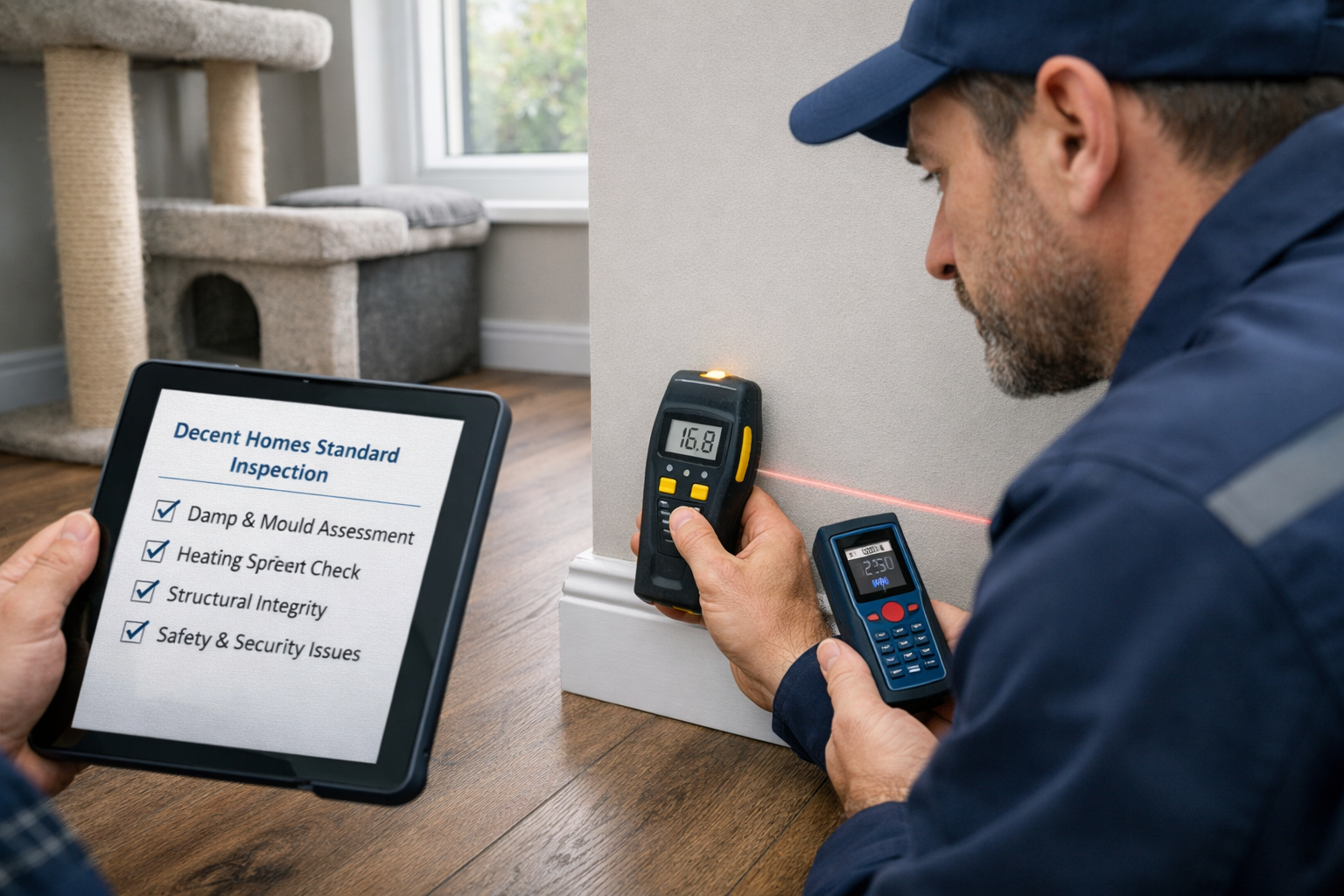
✅ Decent Homes Standard compliance: The Act introduces enhanced habitability requirements that surveyors must evaluate, including damp assessment, heating systems, and structural integrity[1]
✅ Revenue opportunity: Properties with structured pet-friendly policies backed by professional assessments experienced 30.7% revenue increases in 2026[5]
✅ Pre-tenancy preparation: Comprehensive building surveys conducted before tenancy commencement protect landlords from compliance failures and undocumented damage claims
Understanding the Renters' Rights Act 2026: Core Changes Affecting Property Assessments
The Renters' Rights Act 2025, taking effect May 1, 2026, represents the most significant overhaul of UK rental legislation in decades. For property surveyors and landlords, three key provisions directly impact how properties must be assessed before and during tenancies.
From Prohibition to Assessment: The Pet Permission Paradigm Shift
Under the new framework, landlords can no longer rely on blanket "no pets" clauses in tenancy agreements. Even where agreements contain pet prohibitions, tenants have the statutory right to submit written pet requests that landlords must formally evaluate on a case-by-case basis.[1]
This creates an immediate need for objective property assessment criteria. Landlords must determine whether their specific property is suitable for the requested animal based on:
🏠 Property size and layout relative to animal species and size
📋 Superior lease restrictions that may prohibit pets in leasehold properties
⚠️ Structural suitability including flooring type, ventilation, and outdoor access
👥 Neighbor impact potential in multi-unit buildings or shared spaces
The legislation requires landlords to provide documented reasoning for any pet request refusal.[1] This documentation requirement makes professional building surveys invaluable—they provide objective, third-party evidence supporting decision-making.
Valid Grounds for Pet Request Refusal
The Act doesn't mandate universal pet acceptance. Landlords retain the right to refuse requests based on legitimate, proportionate concerns including:[1]
- Property genuinely unsuitable for the animal's size or species
- Superior lease explicitly prohibiting pets
- Credible risk of property damage beyond normal wear
- Demonstrated nuisance risk to neighbors
- Adverse impact on other tenants in multi-occupancy buildings
The key word is "credible"—landlords must substantiate refusals with evidence, not assumptions. A Level 2 home survey or Level 3 building survey provides this evidence by documenting existing property condition, identifying vulnerable features, and assessing structural factors relevant to pet occupancy.
The Decent Homes Standard: Enhanced Habitability Requirements
Beyond pet provisions, the Renters' Rights Act 2026 introduces enhanced habitability standards that rental properties must meet. While specific criteria continue to evolve, the Decent Homes Standard framework requires properties to be:[1]
✔️ Free from serious hazards: Including damp, mold, structural instability, and inadequate heating
✔️ Reasonably modern: With facilities and services less than 30 years old
✔️ Thermally efficient: Meeting minimum energy performance standards
✔️ Well-maintained: With regular inspection and maintenance schedules
These requirements make pre-tenancy building surveys essential compliance tools. Surveyors can identify Decent Homes Standard failures before tenancies commence, allowing landlords to remediate issues proactively rather than facing enforcement action or tenant complaints.
Timeline and Preparation Requirements
Although the Act takes effect May 1, 2026, landlords should not wait until the final weeks to prepare. Key preparation steps include:[1]
- Review tenancy agreement templates to remove invalid pet prohibition clauses
- Check superior lease restrictions for leasehold properties
- Commission building surveys to establish baseline property condition
- Create documented pet request assessment procedures
- Implement deadline tracking systems for responding to tenant requests
- Strengthen property condition reporting at tenancy start and end
Professional surveyors play a critical role in steps 3, 5, and 6, providing the objective documentation that protects landlords while ensuring compliance.
Building Survey Implications for Pet-Friendly Rentals Under the Renters' Rights Act 2026
The Renters' Rights Act 2026: Building Survey Implications for Pet-Friendly Rentals and New Decent Homes Standards creates new assessment requirements that traditional lettings surveys may not address. Landlords need comprehensive property evaluations that specifically consider pet-related factors alongside standard habitability criteria.
Pre-Tenancy Survey Priorities for Pet Considerations
When conducting pre-tenancy surveys with potential pet occupancy in mind, surveyors should focus on several key areas that directly impact both pet suitability decisions and damage prevention:
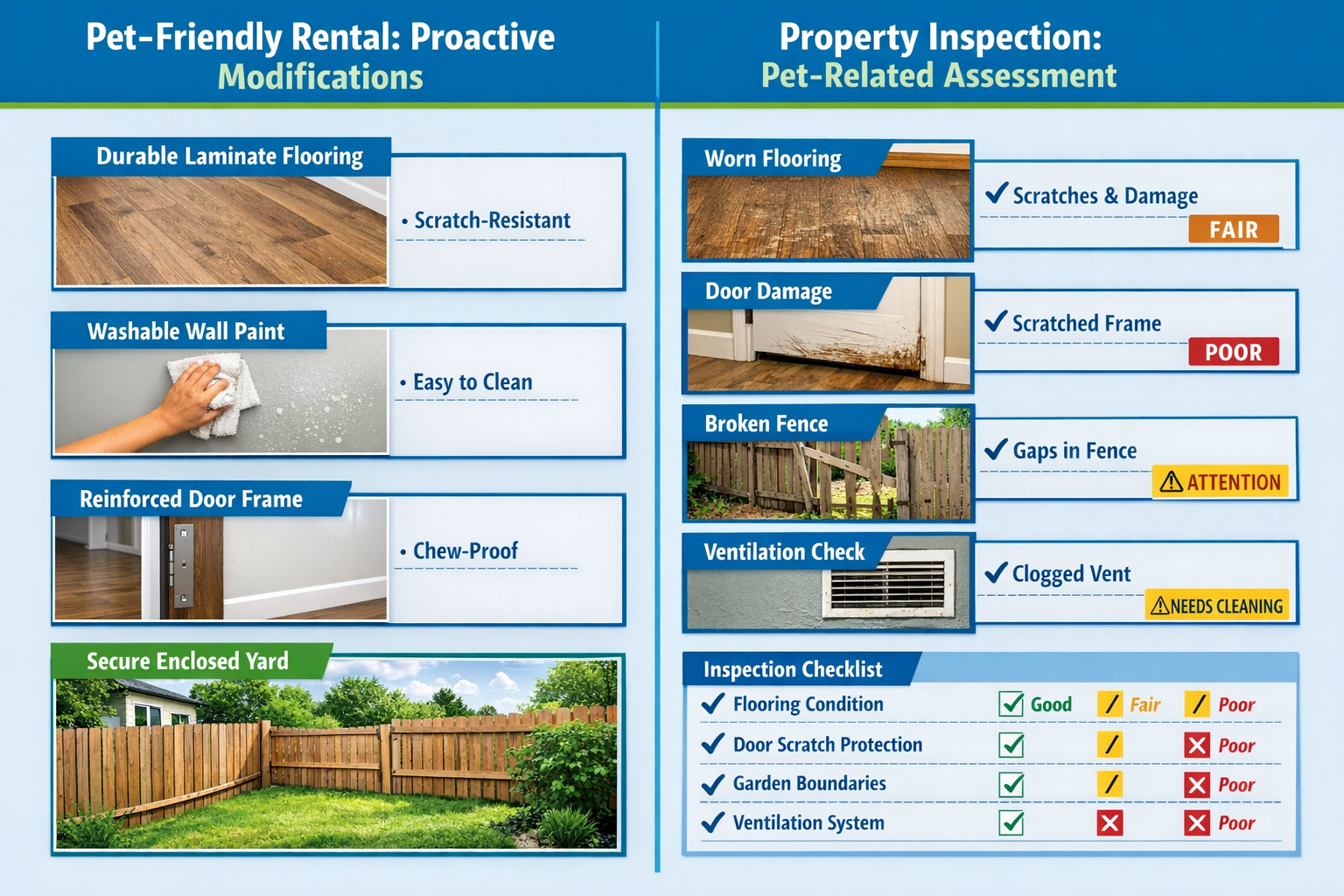
Flooring Assessment and Durability Analysis
Flooring type significantly affects pet suitability. Surveyors should document:
- Current flooring materials throughout the property
- Existing wear patterns, scratches, or damage
- Substrate condition beneath surface flooring
- Suitability for pet traffic based on material durability
- Replacement or protection costs for vulnerable flooring
Properties with scratch-resistant laminate, tile, or sealed concrete present lower risk profiles for pet occupancy than those with carpet, engineered wood, or vinyl that shows existing wear. A detailed Level 3 building survey provides this granular flooring analysis, including substrate evaluation that reveals whether floors can withstand increased wear.
Door and Trim Condition Documentation
Doors, frames, and skirting boards are primary pet damage zones. Survey documentation should include:
- Door surface condition and material composition
- Existing scratches, gouges, or bite marks
- Skirting board integrity and attachment quality
- Door frame condition and paint/finish durability
- Threshold and transition strip condition
Photographing these elements before tenancy commencement creates irrefutable baseline evidence. When disputes arise about pet-related damage, this documentation proves whether damage existed pre-tenancy or occurred during occupancy.
Garden and Outdoor Space Evaluation
For properties with gardens or outdoor areas, surveyors should assess:
🌳 Boundary security: Fence height, gate functionality, escape routes
🏡 Surface condition: Lawn quality, paving integrity, drainage effectiveness
🌱 Landscaping vulnerability: Established plants, flower beds, vulnerable features
💧 Drainage systems: Potential for pet waste impact on drainage
Properties with secure, well-drained outdoor spaces are objectively more suitable for pet occupancy. Conversely, properties with compromised fencing, poor drainage, or extensive landscaping may justify pet refusal based on documented unsuitability.
Ventilation and Odor Control Infrastructure
Adequate ventilation prevents pet-related odor accumulation. Surveyors should evaluate:
- Mechanical ventilation system functionality
- Natural ventilation adequacy (window placement, opening mechanisms)
- Air circulation patterns throughout property
- Existing odor issues or inadequate air exchange
- HVAC system condition and filter accessibility
Properties with poor ventilation present legitimate grounds for pet refusal, particularly for larger animals or multiple pets. Survey documentation of ventilation deficiencies provides objective evidence supporting such decisions.
Decent Homes Standard Compliance Assessment
The Renters' Rights Act 2026's Decent Homes Standard requirements overlap significantly with pet suitability factors. A comprehensive survey should evaluate:
Damp and Mold Assessment
Damp issues violate Decent Homes Standards and create unsuitable pet environments. Surveyors should:
- Conduct moisture meter readings in all rooms
- Identify condensation, penetrating damp, or rising damp
- Assess mold growth and underlying causes
- Evaluate ventilation adequacy in moisture-prone areas
- Document thermal bridging and cold spots
Properties failing damp standards require remediation before tenancies commence, regardless of pet considerations. However, pet occupancy can exacerbate existing moisture issues through increased humidity from animal respiration and wet coats, making pre-existing damp problems particularly problematic.
Heating System Evaluation
Adequate heating is a Decent Homes Standard requirement. Survey assessments should include:
- Heating system type, age, and functionality
- Radiator condition and heat distribution
- Thermostat functionality and programmability
- Energy efficiency ratings
- Compliance with minimum temperature standards
Properties with inadequate heating fail Decent Homes Standards independent of pet considerations. However, pets—particularly elderly or short-haired breeds—require consistent ambient temperatures, making heating adequacy a dual compliance concern.
Structural Integrity and Safety Hazards
Structural defects create both Decent Homes Standard failures and pet safety risks. Comprehensive surveys should identify:
- Cracks, subsidence, or settlement issues
- Roof condition and weather-tightness
- Window and door security and functionality
- Staircase safety and balustrade integrity
- Electrical system safety and capacity
A Level 3 building survey provides the detailed structural analysis necessary to identify these issues. Properties with significant structural defects require remediation before they're suitable for any tenancy, but particularly for pet occupancy where animals may interact with compromised features.
The Market Reality: Why Survey-Backed Pet Policies Increase Revenue
Despite the 13% decline in advertised pet-friendly properties post-Act announcement,[3] data shows that structured pet-friendly policies increase both applications and revenue:
📊 40.78% of rental operators report increased applications when allowing pets[2]
💰 30.7% revenue increase for landlords using formal pet screening platforms[5]
🏠 26.95% improved tenant retention from pet-friendly policies[2]
👥 59% of renters now have at least one pet, up from 46% in 2019[7]
The key difference between successful pet-friendly landlords and those withdrawing from the market is structured assessment and documentation. Professional building surveys provide the foundation for evidence-based pet policies that protect property value while accessing the majority renter demographic.
Superior Lease Restrictions: Survey Documentation Requirements
For leasehold properties, superior lease restrictions may prohibit pets regardless of landlord preference. Surveyors should:
- Request and review superior lease documents before survey commencement
- Document specific pet-related clauses in survey reports
- Identify freeholder consent requirements for pet permissions
- Note any existing pet-related breaches in the building
- Assess enforceability of superior lease restrictions
When superior leases prohibit pets, landlords have legitimate, documented grounds for refusal that satisfy Renters' Rights Act requirements.[1] Including this analysis in survey reports provides landlords with ready evidence for tenant communications.
Practical Implementation: Survey-Driven Compliance Strategies for Landlords
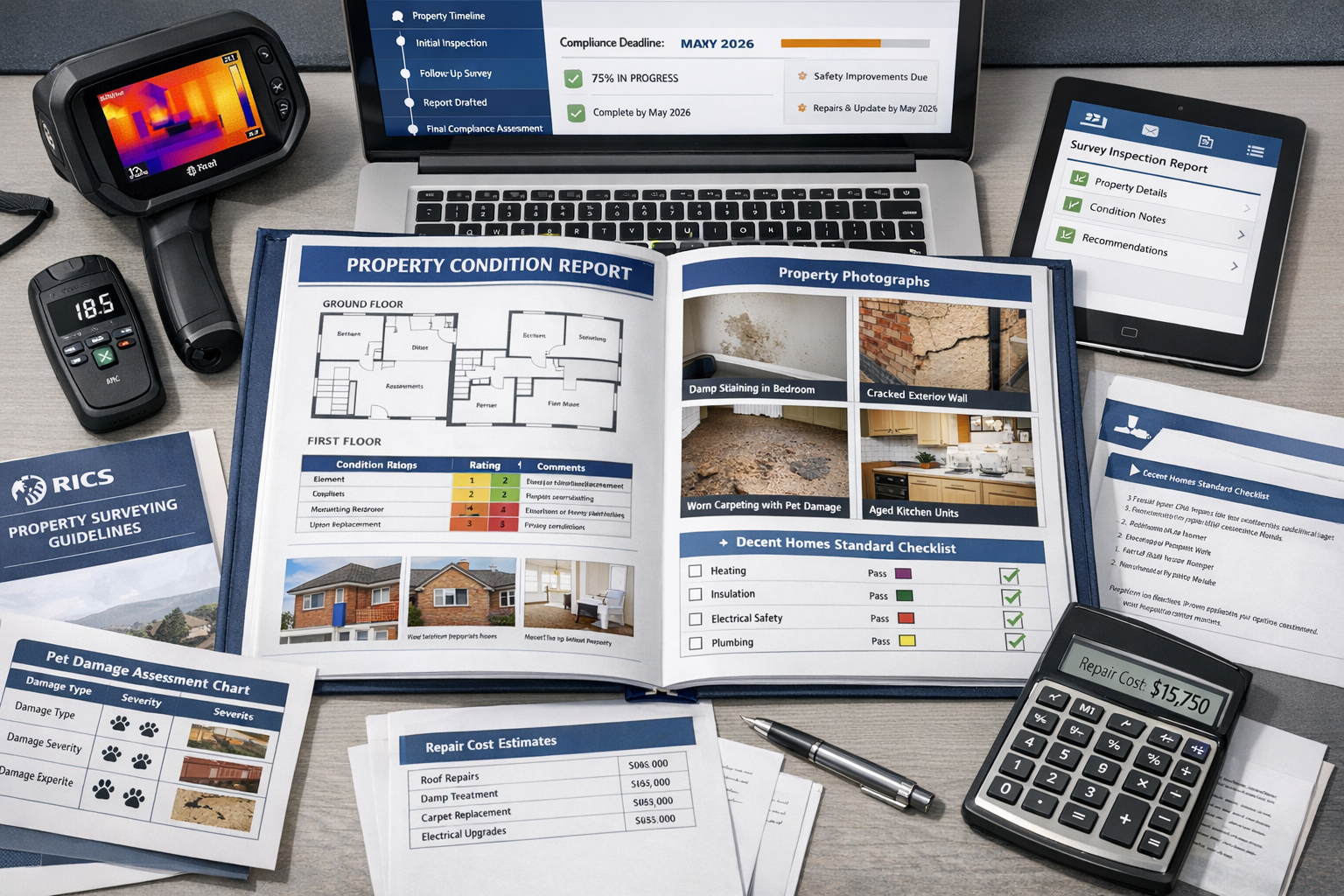
The Renters' Rights Act 2026: Building Survey Implications for Pet-Friendly Rentals and New Decent Homes Standards requires landlords to adopt proactive, evidence-based property management approaches. Here's how to implement survey-driven compliance strategies before the May 1, 2026 deadline.
Choosing the Right Survey Level for Rental Properties
Not all rental properties require the same survey depth. Understanding the differences between survey levels helps landlords allocate resources effectively:
When Level 2 Surveys Suffice
Level 2 Home Surveys (formerly HomeBuyer Reports) provide adequate assessment for:
- Modern properties (built post-1990) in good condition
- Properties with no visible defects or structural concerns
- Flats in well-maintained buildings with recent communal area maintenance
- Properties where landlords seek baseline condition documentation
A Level 2 survey typically takes 2-4 hours and provides traffic-light-rated condition assessments of major elements. For rental properties meeting Decent Homes Standards with no apparent issues, Level 2 surveys offer cost-effective baseline documentation.
When Level 3 Building Surveys Are Essential
Level 3 Building Surveys provide comprehensive analysis necessary for:
- Older properties (pre-1970) or those with period features
- Properties with visible defects, structural movement, or damp issues
- Buildings requiring Decent Homes Standard remediation assessment
- Properties where landlords need detailed pet suitability analysis
- High-value properties where comprehensive documentation justifies cost
Level 3 surveys include detailed investigation of construction methods, material condition, and defect causation. For landlords facing complex pet suitability decisions or Decent Homes Standard compliance questions, Level 3 surveys provide the detailed evidence necessary for defensible decisions.
Creating a Pet Request Assessment Framework
Using survey findings, landlords should develop documented assessment frameworks for evaluating pet requests. A robust framework includes:
Property Suitability Matrix
Create a scoring system based on survey findings:
| Assessment Factor | High Suitability (3 points) | Moderate Suitability (2 points) | Low Suitability (1 point) |
|---|---|---|---|
| Flooring durability | Tile/sealed concrete throughout | Laminate/engineered wood | Carpet/vinyl with existing wear |
| Outdoor space | Secure garden >50m² | Balcony/small yard | No outdoor access |
| Ventilation | Mechanical + excellent natural | Adequate natural ventilation | Poor ventilation/existing odor issues |
| Property size | >100m² for requested pet size | 60-100m² adequate space | <60m² cramped for pet |
| Structural condition | Excellent (no defects) | Good (minor issues only) | Fair/poor (requires remediation) |
Properties scoring 12+ points present strong suitability for pet occupancy. Scores below 8 points provide documented grounds for refusal based on property unsuitability.
Decision Documentation Template
For each pet request, maintain records including:
- Tenant request details: Pet species, breed, size, age, behavior history
- Property survey reference: Specific survey findings relevant to decision
- Suitability assessment score: Using the matrix above
- Superior lease review: Any restrictions or freeholder requirements
- Decision and reasoning: Approval or refusal with specific justification
- Communication timeline: Request receipt, decision date, tenant notification
This documentation satisfies the Act's requirement for transparent, evidenced decision-making.[1]
Pre-Tenancy Condition Reporting: Essential Protection
Comprehensive condition reports at tenancy commencement protect landlords from unfounded damage claims. Best practices include:
📸 Photographic documentation: High-resolution images of all rooms, focusing on floors, doors, trim, and fixtures
📋 Written descriptions: Detailed condition notes accompanying each photograph
🔍 Specific vulnerability identification: Highlighting areas susceptible to pet damage
📅 Date and metadata preservation: Ensuring images contain timestamp data
✍️ Tenant acknowledgment: Signed confirmation of condition report accuracy
When combined with pre-tenancy survey findings, these reports create an irrefutable baseline. If disputes arise about pet-related damage, landlords can demonstrate precisely what condition existed before pet occupancy commenced.
Ongoing Compliance: Mid-Tenancy Inspections
The Renters' Rights Act 2026 doesn't specify mid-tenancy inspection requirements, but regular property checks help landlords:
- Identify emerging Decent Homes Standard issues requiring remediation
- Document property condition changes during tenancy
- Detect pet-related wear requiring intervention
- Maintain positive landlord-tenant relationships through proactive communication
Quarterly inspections with photographic documentation provide appropriate oversight without excessive intrusion. When inspections reveal issues, landlords should:
- Document findings with photographs and written descriptions
- Communicate concerns to tenants promptly
- Agree remediation plans with clear timelines
- Follow up to verify completion
- Update property condition records
This proactive approach prevents minor issues from escalating into Decent Homes Standard violations or significant damage claims.
Cost-Benefit Analysis: Survey Investment vs. Risk Exposure
Many landlords question whether comprehensive surveys justify their cost. Consider the risk exposure without proper assessment:
Potential costs of inadequate assessment:
- Decent Homes Standard enforcement: Fines, mandatory remediation, potential rent repayment orders
- Unfounded pet refusal challenges: Tenant complaints, potential discrimination claims
- Undocumented damage disputes: Deposit scheme adjudication losses, legal costs
- Tenant turnover: Vacancy periods, re-letting costs, lost rental income
Survey costs vs. risk mitigation:
A comprehensive Level 3 building survey typically costs £800-1,500 for an average rental property. This investment provides:
✅ Decent Homes Standard compliance verification
✅ Objective pet suitability assessment evidence
✅ Baseline condition documentation preventing deposit disputes
✅ Maintenance planning preventing costly emergency repairs
✅ Enhanced tenant confidence increasing retention
Given that structured pet-friendly policies increase revenue by 30.7%[5] and improve retention by 26.95%,[2] survey costs represent minor investment relative to potential returns.
Working with Professional Surveyors: What to Request
To maximize survey value for Renters' Rights Act compliance, landlords should specifically request:
🎯 Pet suitability assessment: Explicit evaluation of property features relevant to pet occupancy
🎯 Decent Homes Standard review: Compliance assessment against habitability criteria
🎯 Photographic documentation: Comprehensive visual record of property condition
🎯 Maintenance prioritization: Ranking of identified issues by urgency and cost
🎯 Remediation cost estimates: Budget planning for required improvements
Chartered surveyors with lettings experience understand these requirements and can tailor survey reports accordingly. When commissioning surveys, clearly communicate your compliance objectives to ensure reports address your specific needs.
Timeline for Implementation Before May 1, 2026
Landlords should follow this implementation timeline:
January-February 2026:
- Commission building surveys for all rental properties
- Review superior lease restrictions for leasehold properties
- Update tenancy agreement templates removing invalid pet clauses
March 2026:
- Complete Decent Homes Standard remediation for properties with identified issues
- Develop pet request assessment frameworks based on survey findings
- Train property managers on new procedures
April 2026:
- Conduct final compliance reviews
- Prepare documentation systems for pet request tracking
- Communicate changes to existing tenants
May 1, 2026:
- New legislation takes effect
- Begin accepting and processing pet requests under new framework
This timeline provides adequate preparation without last-minute compliance scrambling.
Conclusion
The Renters' Rights Act 2026: Building Survey Implications for Pet-Friendly Rentals and New Decent Homes Standards represents a fundamental shift in UK rental property management. Simple "no pets" clauses become invalid on May 1, 2026, replaced by mandatory case-by-case assessment requirements that demand objective, documented evidence. Simultaneously, enhanced Decent Homes Standards require landlords to maintain properties meeting specific habitability criteria.
Professional building surveys emerge as essential compliance tools in this new regulatory environment. They provide the objective evidence necessary to make defensible pet suitability decisions, verify Decent Homes Standard compliance, and document baseline property condition protecting landlords from unfounded damage claims.
The market data is compelling: despite initial landlord hesitation reflected in the 13% decline in advertised pet-friendly properties, structured pet-friendly policies backed by professional assessment increase applications by 40.78%, improve retention by 26.95%, and boost revenue by 30.7%. With 59% of renters now owning pets, landlords who embrace evidence-based pet policies access the majority renter demographic while those maintaining blanket prohibitions increasingly struggle to compete.
Actionable Next Steps
For landlords preparing for May 1, 2026 compliance:
- Commission comprehensive building surveys for all rental properties, specifically requesting pet suitability and Decent Homes Standard assessments
- Review superior lease restrictions for leasehold properties to identify legitimate pet prohibition grounds
- Develop documented pet request assessment frameworks using survey findings to create objective evaluation criteria
- Implement robust condition reporting at tenancy commencement with photographic documentation of vulnerable features
- Create tracking systems for pet request deadlines and decision documentation
- Consider structured pet screening platforms that reduce administrative burden while maintaining compliance
For property surveyors adapting to new requirements:
- Expand survey templates to include explicit pet suitability assessments and Decent Homes Standard compliance reviews
- Develop landlord-specific reporting formats that provide ready-to-use evidence for pet request decisions
- Offer specialized lettings survey packages addressing Renters' Rights Act compliance needs
- Provide cost estimation services for Decent Homes Standard remediation work
- Market expertise in rental property assessment to landlords preparing for May 2026 deadline
The Renters' Rights Act 2026 doesn't mandate universal pet acceptance—it requires evidence-based decision-making. Landlords who invest in comprehensive property assessment, develop structured evaluation frameworks, and maintain thorough documentation will confidently navigate the new regulatory landscape while accessing revenue opportunities from the pet-owning renter majority. Those who delay preparation or attempt compliance without professional assessment face significant regulatory and financial risks.
With fewer than four months until implementation, the time for preparation is now. Professional building surveys provide the foundation for compliant, profitable rental property management in the post-Renters' Rights Act era.
References
[1] Pet Friendly Tenancies How The Renters Rights Act 2025 Changes The Rules For Landlords – https://www.hunters.com/guides/landlord/pet-friendly-tenancies-how-the-renters-rights-act-2025-changes-the-rules-for-landlords/
[2] Allowing Pets In Rental Properties Benefits Risks Market Data For Landlords – https://www.thornerealtync.com/blog/allowing-pets-in-rental-properties-benefits-risks–market-data-for-landlords
[3] Watch – https://www.youtube.com/watch?v=rVat8TD4IBE
[5] Trends And Data Illustrate 2026 State Of Pets In Rentals – https://rentalhousingjournal.com/trends-and-data-illustrate-2026-state-of-pets-in-rentals/
[7] multifamilydive – https://www.multifamilydive.com/news/dogs-and-cats-are-priority-no-1-for-potential-renters/715772/
