
{"cover":"Professional landscape format (1536×1024) hero image featuring bold text overlay 'RICS AI Standards in Building Surveys 2026: Implementing Responsible Use While Maintaining Professional Judgment' in extra large 72pt white sans-serif font with dark shadow and semi-transparent navy overlay box, positioned center-upper third. Background shows split composition: left side displays modern building surveyor using tablet with AI interface overlay showing thermal imaging and structural analysis, right side shows traditional clipboard inspection notes and measuring tools. Color scheme: deep navy blue, white, electric blue accents, professional grey tones. High contrast, magazine cover quality, editorial style with architectural blueprint subtle pattern in background, conveying balance between technology and traditional expertise","content":["Detailed landscape format (1536×1024) image showing four interconnected pillars or columns labeled 'Governance & Risk', 'Professional Judgment', 'Transparency', and 'Responsible Development' arranged in architectural style with digital network connections between them. Each pillar features relevant icons: shield for governance, brain for judgment, speech bubble for transparency, gear for development. Background shows faded building survey checklist and AI neural network pattern overlay. Color palette: professional navy, white, light blue gradient. Clean infographic style with text annotations showing key requirements under each pillar, modern business aesthetic with architectural elements","Detailed landscape format (1536×1024) image depicting building surveyor in hard hat examining property defects on physical structure (left side of frame) while simultaneously reviewing AI-generated thermal imaging analysis on large tablet screen (right side). Split-screen composition showing contrast between human inspection (visible cracks, damp patches, structural issues) and AI visualization (heat maps, moisture detection overlays, predictive analytics). Foreground shows checklist with both manual tick boxes and digital verification stamps. Professional construction site lighting, realistic property inspection setting, emphasis on complementary relationship between human expertise and AI tools, warm natural lighting mixed with cool digital screen glow","Detailed landscape format (1536×1024) image showing professional meeting scene with surveyor presenting to clients across modern conference table. Large wall-mounted screen displays AI disclosure document with clear sections: 'AI Tools Used', 'Human Oversight', 'Quality Assurance'. Foreground shows signed transparency agreement and RICS compliance checklist. Background features subtle architectural drawings and digital interface elements. Professional business environment with natural window lighting, diverse group of professionals engaged in discussion, documents showing material impact assessment criteria, color scheme of navy, white, and corporate grey, emphasis on trust and professional communication"]
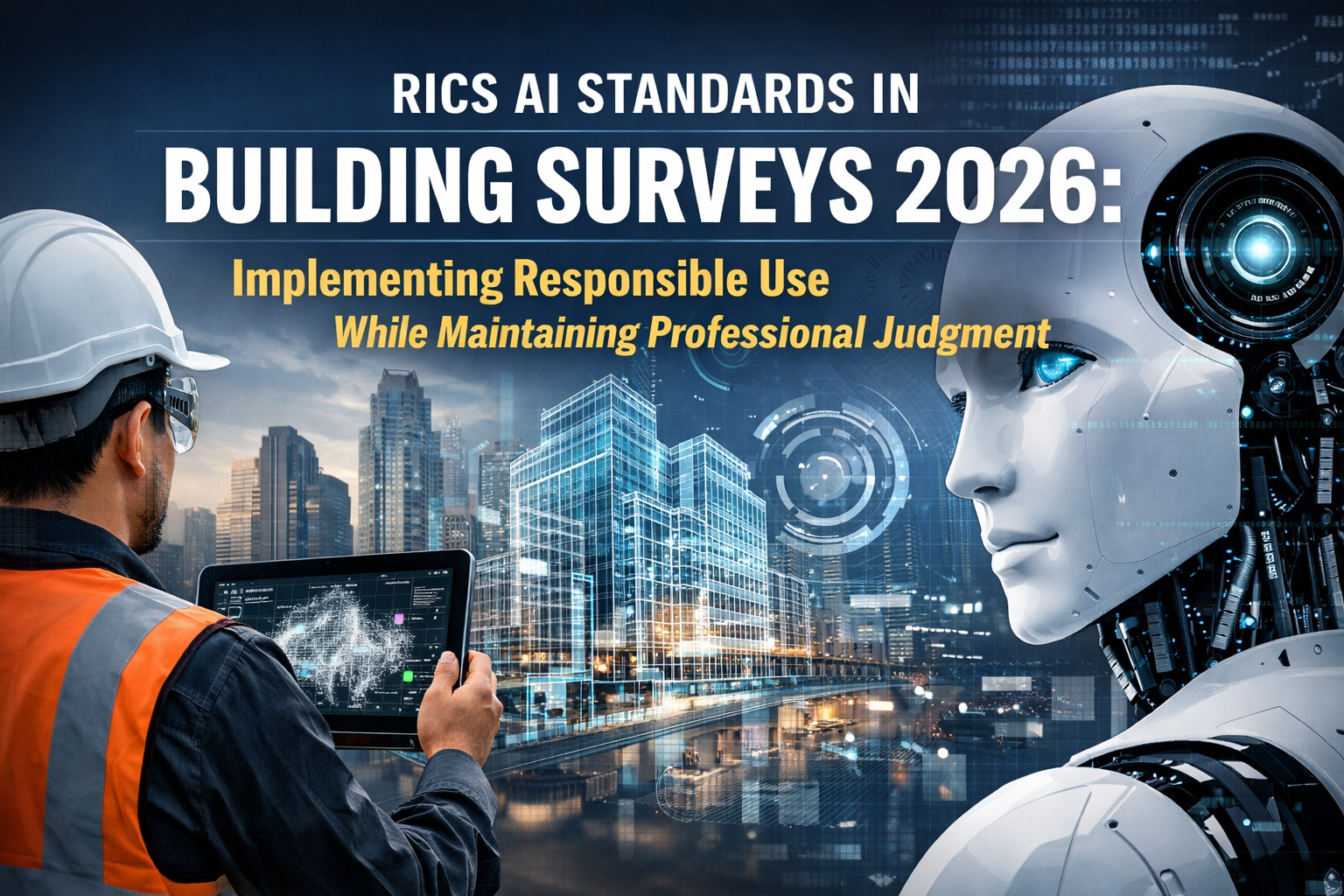
The Royal Institution of Chartered Surveyors (RICS) has just made history: as of 2026, every chartered surveyor worldwide must now comply with the first-ever mandatory global standard on responsible artificial intelligence use. This isn't optional guidance—it's a binding professional requirement that fundamentally reshapes how building surveyors integrate technology into their practice. The RICS AI Standards in Building Surveys 2026: Implementing Responsible Use While Maintaining Professional Judgment represents a watershed moment for the profession, establishing clear boundaries between AI assistance and human accountability.[3]
For building surveyors conducting RICS building surveys, this standard creates both opportunity and obligation. The promise of AI lies in enhanced defect detection, faster data analysis, and more comprehensive property assessments. Yet the standard makes one principle crystal clear: artificial intelligence supports professional judgment—it never replaces it.
Key Takeaways
✅ Global mandatory compliance: The RICS AI standard applies to all members and regulated firms worldwide across all surveying disciplines, not just valuations, with enforcement beginning in 2026.[1]
✅ Material impact threshold: The standard only applies to AI systems with material impact on service delivery, requiring surveyors to exercise professional judgment in determining when compliance measures are necessary.[2]
✅ Four core requirement areas: Firms must establish governance and risk management, maintain professional judgment and oversight, ensure transparency with clients, and follow responsible development practices.[3]
✅ Mandatory client disclosure: Surveyors must inform clients in writing when AI supports service delivery, explaining the technology's role and limitations in their professional work.[1]
✅ Professional accountability remains absolute: Regardless of AI tools used, surveyors retain full responsibility for every piece of professional advice and all survey conclusions.[3]
Understanding the RICS AI Standards in Building Surveys 2026: Implementing Responsible Use While Maintaining Professional Judgment
The RICS Professional Standard for Responsible Use of AI in Surveying Practice establishes a comprehensive framework that extends far beyond simple technology adoption guidelines. This standard recognizes that artificial intelligence has already permeated surveying practice—from automated valuation models to thermal imaging analysis software—and provides the professional guardrails necessary to protect both practitioners and clients.[2]
Global Scope and Applicability
The standard applies universally to all RICS members and regulated firms regardless of geographic location. This includes surveyors working in:
- Valuation services (residential, commercial, and specialized)
- Construction monitoring and project management
- Infrastructure assessment and planning
- Land services and boundary determination
- Building surveys and condition assessments[1]
Importantly, even firms not currently using AI cannot claim exemption. The standard requires awareness and readiness since future software updates and industry tools will increasingly incorporate AI capabilities—often without explicit labeling as "artificial intelligence."[1]
The Material Impact Threshold Principle
One of the most significant aspects of the RICS AI Standards in Building Surveys 2026: Implementing Responsible Use While Maintaining Professional Judgment is the material impact threshold. The standard deliberately focuses on high-risk use cases where AI could meaningfully affect professional outcomes.[2]
Material impact occurs when AI systems:
🔍 Influence key professional judgments or recommendations
🔍 Process sensitive client or property data
🔍 Generate outputs that clients rely upon for significant decisions
🔍 Automate processes previously requiring professional expertise
For building surveyors conducting Level 3 building surveys, this means AI tools that identify structural defects or assess repair costs likely meet the material impact threshold, while basic scheduling software probably does not.
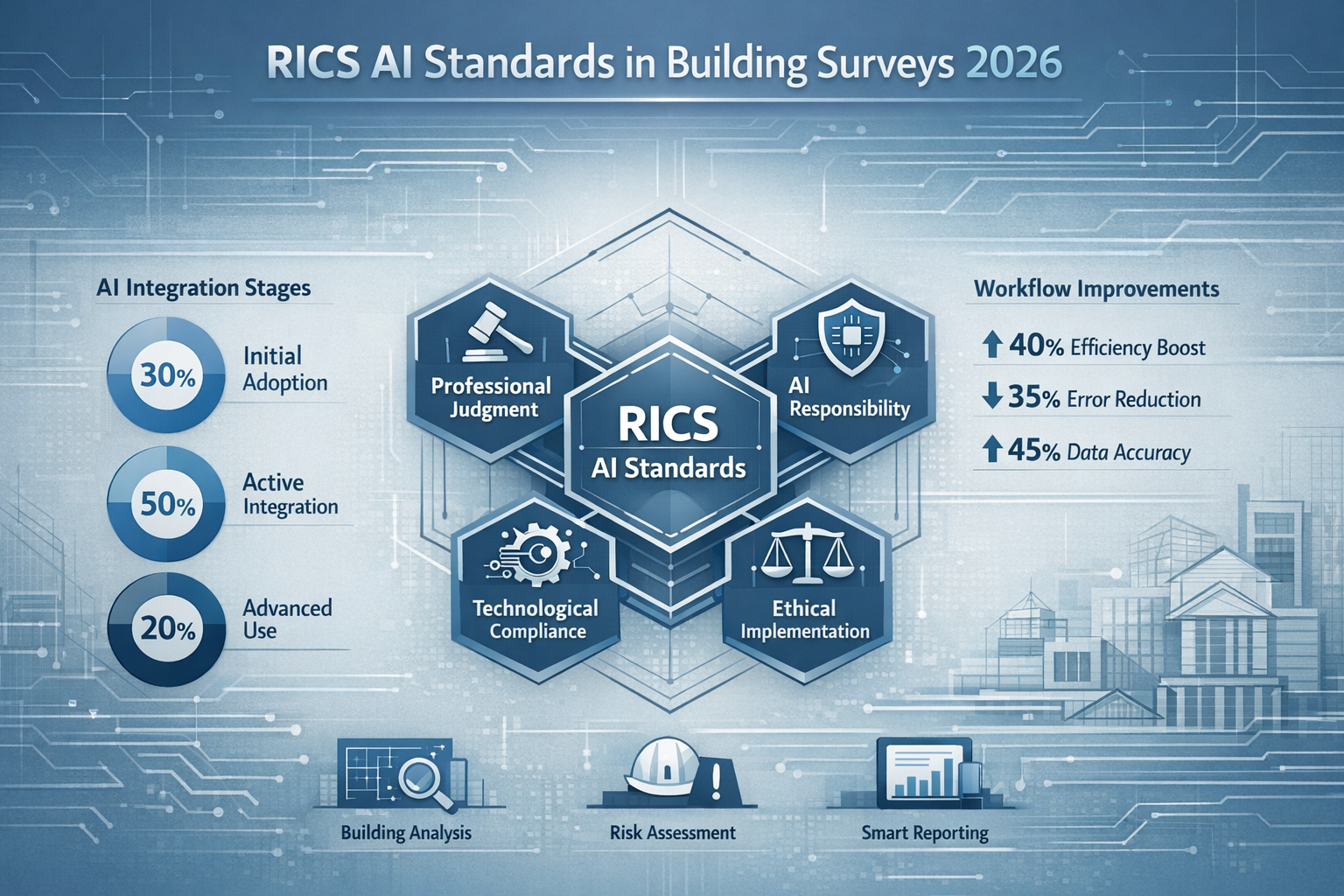
Four Core Requirements of RICS AI Standards in Building Surveys 2026: Implementing Responsible Use While Maintaining Professional Judgment
The standard establishes four interconnected requirement areas that create a comprehensive compliance framework for responsible AI integration in surveying practice.
1. Governance and Risk Management
Firms must establish robust governance structures that address AI-specific risks before deploying these technologies in professional practice.[2]
Key governance requirements include:
| Requirement | Description | Implementation Example |
|---|---|---|
| Data Governance | Policies for data collection, storage, and usage | Encrypted databases with access controls for property data used in AI training |
| System Governance | Oversight of AI system selection and deployment | Approval process requiring senior surveyor sign-off before new AI tools go live |
| Risk Assessment | Regular evaluation of AI-related professional risks | Quarterly reviews of AI tool accuracy against manual survey results |
| Accountability Framework | Clear assignment of responsibility for AI outputs | Named senior professional responsible for validating all AI-assisted reports |
Building surveyors must document these governance structures and demonstrate active oversight. This isn't bureaucratic box-ticking—it's fundamental risk management that protects both professional standing and client interests.[4]
2. Professional Judgment and Oversight
The standard embeds a non-negotiable principle: AI assists professional practice; it does not replace it. Surveyors remain fully accountable for every piece of professional advice regardless of the tools employed.[3]
This requirement directly addresses automation bias—the dangerous tendency to assume computer-generated outputs must be correct. Industry practitioners have identified this as perhaps the greatest risk in AI-assisted surveying.[3]
Practical implementation for building surveys:
- Never accept AI outputs without verification: When AI identifies potential subsidence, the surveyor must physically inspect the property and apply professional judgment to confirm or refute the finding
- Document professional reasoning: Survey reports must explain why conclusions were reached, not simply present AI-generated findings
- Maintain technical competence: Surveyors must understand both traditional survey methodology and the AI tools they employ
- Apply professional skepticism: Question AI outputs that seem inconsistent with property characteristics or local knowledge
For those conducting comprehensive Level 3 surveys, this means AI might flag potential issues for investigation, but the surveyor's expert analysis determines what appears in the final report.
3. Transparency and Client Communication
Mandatory client transparency represents one of the most visible changes under the RICS AI Standards in Building Surveys 2026: Implementing Responsible Use While Maintaining Professional Judgment. Firms must inform clients in writing when AI supports service delivery.[1]
Effective transparency communication includes:
✉️ Clear disclosure: Identify which AI tools support the service and their specific functions
✉️ Role explanation: Describe how AI contributes to the overall professional service
✉️ Limitation acknowledgment: Explain what AI can and cannot do in the context of the specific survey
✉️ Human oversight assurance: Confirm that qualified professionals review and validate all AI outputs
✉️ Data usage notice: Inform clients how their property data will be processed by AI systems
This transparency requirement extends beyond initial engagement. When conducting homebuyer surveys, surveyors should explain in the report itself which elements benefited from AI assistance and how professional judgment shaped the final conclusions.
4. Responsible Development for Firms Creating AI Solutions
While most surveying firms purchase third-party AI tools, some larger practices develop proprietary solutions. For these organizations, the standard imposes additional requirements around responsible AI development.[2]
Development requirements include:
- Ethical design principles: AI systems must be designed to augment rather than replace professional judgment
- Testing and validation: Rigorous testing against known outcomes before deployment
- Bias detection and mitigation: Active measures to identify and address algorithmic bias
- Ongoing monitoring: Continuous assessment of AI system performance and accuracy
- Documentation: Comprehensive records of design decisions, testing results, and performance metrics
Even firms using third-party tools should conduct due diligence to ensure vendors follow these responsible development practices.[2]
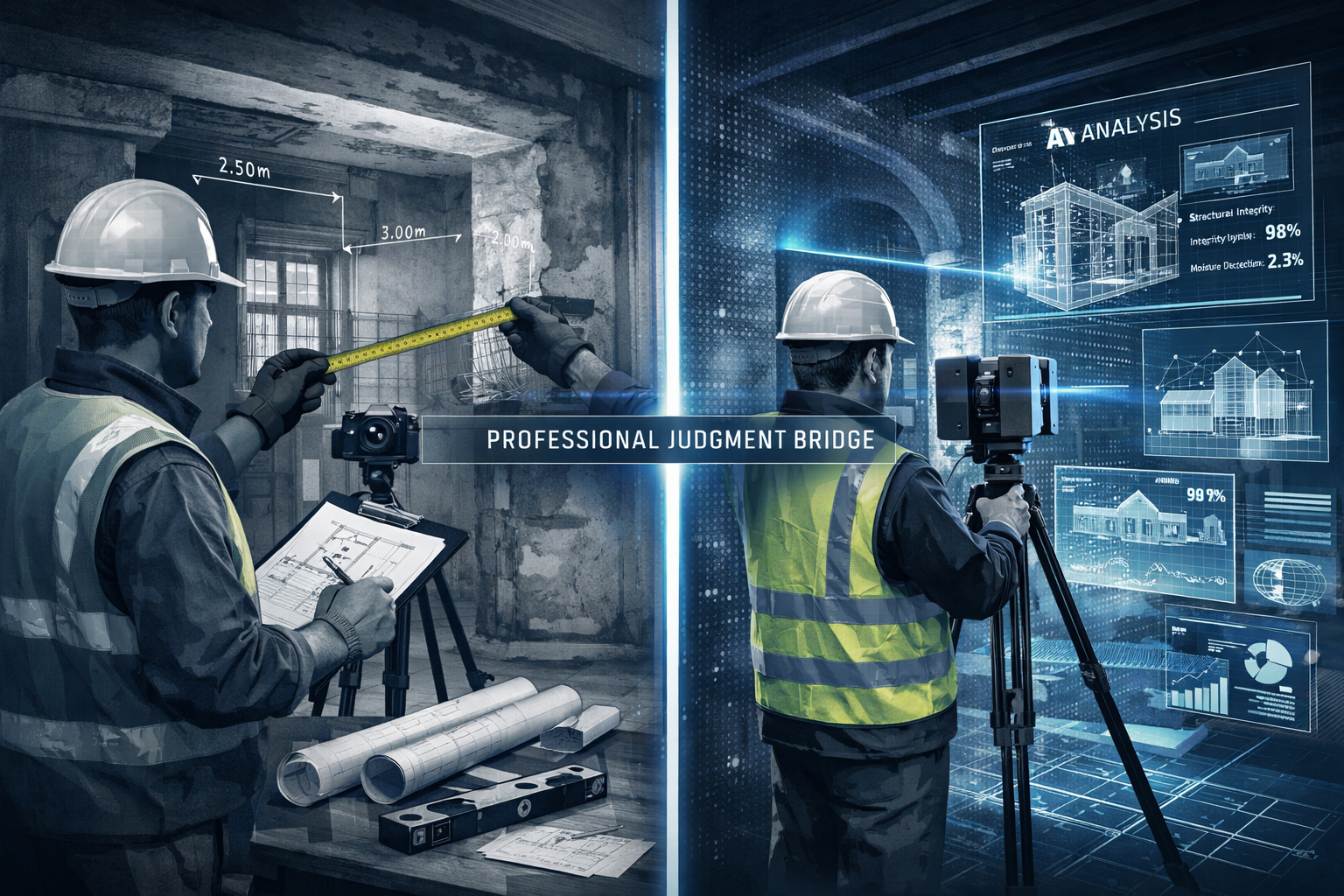
Implementing RICS AI Standards in Building Surveys 2026: Practical Steps for Compliance
Moving from understanding the standard to actual compliance requires systematic implementation across multiple operational areas.
Knowledge and Competence Requirements
The standard explicitly addresses knowledge requirements for using AI in surveying practice.[2] This creates a professional development imperative for all chartered surveyors.
Essential knowledge areas:
📚 AI fundamentals: Understanding what AI is, how machine learning works, and the difference between various AI technologies
📚 Tool-specific training: Competence in operating the specific AI systems your firm employs
📚 Limitation awareness: Recognition of what AI cannot do and where human judgment remains essential
📚 Risk identification: Ability to spot potential AI errors or inappropriate outputs
📚 Ethical considerations: Understanding of bias, fairness, and responsible AI use
Firms should implement structured training programs rather than assuming surveyors will self-educate. This is particularly important for experienced professionals who may have decades of traditional survey experience but limited technology exposure.
AI Procurement and Due Diligence
Before adopting any AI tool that meets the material impact threshold, firms must conduct thorough due diligence.[2]
Procurement checklist:
✔️ Vendor credentials: Verify the provider's expertise and track record in surveying applications
✔️ Training data quality: Understand what data trained the AI and whether it's relevant to your market
✔️ Accuracy metrics: Demand evidence of system accuracy, including false positive and false negative rates
✔️ Explainability: Ensure the system can explain how it reaches conclusions, not just provide outputs
✔️ Data security: Confirm robust data protection and client confidentiality measures
✔️ Update protocols: Understand how the system evolves and improves over time
✔️ Support and maintenance: Verify ongoing vendor support and system maintenance commitments
✔️ Regulatory compliance: Confirm the tool complies with relevant data protection and professional standards
When selecting AI tools for building condition assessments, this due diligence protects both professional standards and client interests.
Output Reliability and Assurance Protocols
The standard requires firms to establish protocols for validating AI outputs before incorporating them into professional advice.[2]
Validation framework:
- Initial output review: Immediate sanity check—does the AI output make basic sense?
- Cross-reference verification: Compare AI findings against other data sources or traditional analysis methods
- Professional interpretation: Apply expert knowledge to contextualize AI outputs within broader property assessment
- Consistency checking: Ensure AI outputs align with other survey findings and local market knowledge
- Documentation: Record the validation process and professional reasoning in working papers
- Client communication: Explain in reports how AI contributed to conclusions while emphasizing professional oversight
For surveyors conducting structural surveys, this might mean AI thermal imaging identifies potential moisture issues, but the surveyor physically inspects the area, considers building age and construction type, and determines whether intervention is necessary.
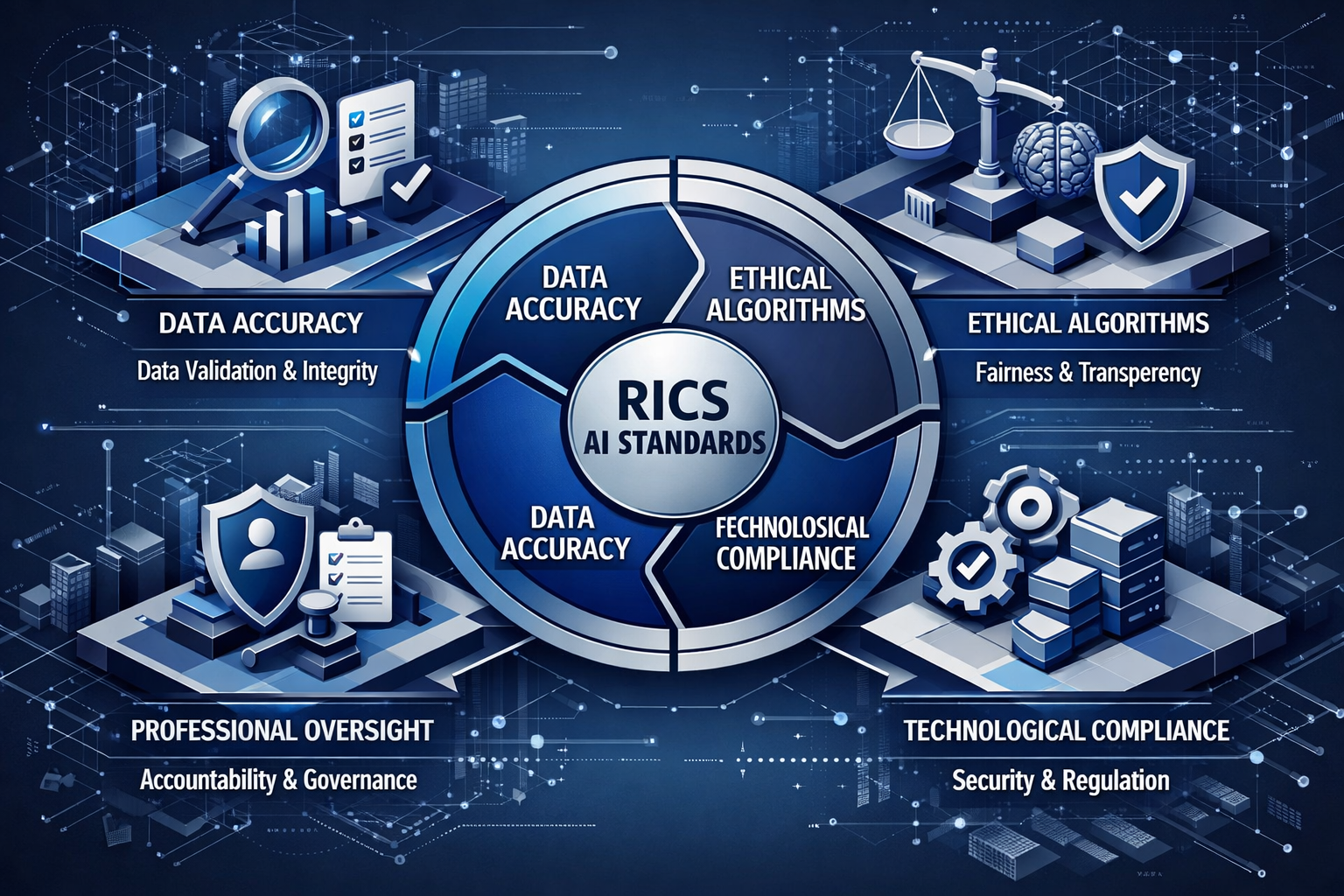
Business Model Implications of RICS AI Standards in Building Surveys 2026: Implementing Responsible Use While Maintaining Professional Judgment
Beyond technical compliance, the AI standard has profound implications for surveying business models and client relationships.
The End of Time-Based Billing?
Industry experts suggest the shift toward AI-assisted practice may fundamentally disrupt traditional time-based billing models.[3] When AI enables surveyors to complete certain analyses in minutes rather than hours, hourly rates and traditional fixed fees become problematic.
Potential business model adaptations:
💼 Value-based pricing: Charge based on insight quality and professional expertise rather than time invested
💼 Tiered service offerings: Different service levels with varying degrees of AI assistance and human involvement
💼 Subscription models: Ongoing professional relationships rather than one-off survey transactions
💼 Outcome-based fees: Pricing tied to the value delivered to clients rather than effort expended
This transformation may prove as significant as the historical abolition of mandatory fee scales—a fundamental restructuring of how surveying services are priced and delivered.[3]
Articulating Value in an AI-Assisted World
As AI handles more routine analysis, surveyors must better articulate the unique value of professional judgment. This becomes critical when explaining fees to clients who may wonder why they're paying for human expertise when "the computer did the work."
Value communication strategies:
🎯 Emphasize judgment and interpretation: AI identifies patterns; professionals determine significance
🎯 Highlight local knowledge: Technology lacks understanding of local market conditions, building practices, and regulatory nuances
🎯 Stress accountability: Clients hire a professional who takes responsibility, not a software program
🎯 Demonstrate quality assurance: Explain the validation and oversight processes that ensure reliable conclusions
🎯 Showcase experience: Years of practical experience enable professionals to spot issues AI might miss
When conducting Level 2 surveys, surveyors should proactively explain how AI enhanced the service while emphasizing that professional expertise drove all conclusions and recommendations.
Competitive Advantage Through Compliance
Rather than viewing the RICS AI Standards in Building Surveys 2026: Implementing Responsible Use While Maintaining Professional Judgment as a compliance burden, forward-thinking firms recognize the competitive advantages it creates.[1]
Client Confidence and Trust
Clients increasingly seek reassurance about AI use in professional services. Demonstrating compliance with RICS standards provides tangible evidence of responsible practice.
Marketing compliance effectively:
- Transparency as differentiator: Proactively explain AI use rather than waiting for clients to ask
- Governance credentials: Highlight robust oversight and validation processes
- Professional accountability: Emphasize that qualified surveyors review all AI outputs
- Quality assurance: Demonstrate systematic approaches to ensuring reliable conclusions
Professional Risk Management
Compliance significantly reduces professional liability risks associated with AI adoption.[1]
Risk mitigation benefits:
🛡️ Reduced error rates: Systematic validation catches AI mistakes before they reach clients
🛡️ Documentation trail: Comprehensive records support professional decisions if disputes arise
🛡️ Insurance positioning: Demonstrable compliance may improve professional indemnity insurance terms
🛡️ Regulatory standing: Proactive compliance prevents disciplinary issues and regulatory scrutiny
Future-Proofing the Practice
Firms that embrace the standard position themselves for long-term success as AI becomes increasingly prevalent in surveying practice.[1]
Strategic advantages:
- Technology readiness: Infrastructure and processes prepared for emerging AI capabilities
- Staff competence: Team trained and comfortable with AI-assisted workflows
- Client relationships: Trust established through transparent, responsible AI use
- Market positioning: Recognition as a forward-thinking, professionally rigorous firm
Non-Compliance Consequences
The mandatory nature of the standard means non-compliance carries real consequences that extend beyond theoretical regulatory risk.[1]
Disciplinary Action
RICS can pursue disciplinary proceedings against members and firms failing to comply with the standard. This may result in:
- Formal warnings recorded on professional files
- Mandatory training requirements and supervised practice periods
- Financial penalties for serious or persistent non-compliance
- Suspension or expulsion from RICS membership in extreme cases
Professional Standing Impact
Non-compliance affects reputation and market position:
- Client complaints arising from inadequate AI governance or transparency
- Referral source concerns from solicitors, estate agents, and other professionals
- Market reputation damage in an increasingly quality-conscious industry
Regulatory and Insurance Implications
Insurers and regulators increasingly scrutinize AI use in professional services:
- Insurance coverage questions: Insurers may question coverage for claims involving non-compliant AI use
- Premium implications: Demonstrable compliance may become a factor in professional indemnity insurance pricing
- Regulatory reporting: Firms may need to explain AI governance to financial services regulators
For practices offering various survey types, compliance isn't optional—it's fundamental to sustainable professional practice.
Practical AI Applications in Building Surveys Under the 2026 Standards
Understanding compliance requirements is essential, but surveyors also need practical examples of how AI can enhance building surveys while maintaining professional standards.
Defect Detection and Analysis
AI-powered image recognition can identify potential defects in property photographs, thermal images, and drone footage.
Compliant implementation:
- AI role: Analyze images to flag potential issues for professional investigation
- Human oversight: Surveyor physically inspects all flagged areas and applies professional judgment
- Transparency: Report explains AI assisted in initial analysis but surveyor confirmed all findings
- Validation: Compare AI findings against traditional inspection methods for accuracy verification
Moisture and Thermal Analysis
Advanced AI systems can analyze thermal imaging data to identify moisture ingress, insulation deficiencies, and thermal bridging.
Compliant implementation:
- AI role: Process thermal imaging data to identify temperature anomalies
- Human oversight: Surveyor investigates anomalies, considers building construction and context
- Transparency: Disclose thermal imaging technology and AI analysis in survey terms
- Validation: Use moisture meters and physical inspection to confirm AI-identified issues
Historical Data Analysis
AI can analyze historical survey data, planning records, and property information to provide context for current assessments.
Compliant implementation:
- AI role: Aggregate and summarize historical information relevant to the property
- Human oversight: Surveyor evaluates relevance and reliability of historical data
- Transparency: Explain data sources and AI processing in methodology section
- Validation: Cross-reference AI summaries against original documents when making critical judgments
Predictive Maintenance Recommendations
Machine learning models can predict when building components may require replacement based on age, condition, and usage patterns.
Compliant implementation:
- AI role: Provide statistical predictions based on component lifecycle data
- Human oversight: Surveyor adjusts recommendations based on actual condition and client circumstances
- Transparency: Clarify predictions are AI-assisted estimates, not guarantees
- Validation: Ground predictions in physical inspection findings and professional experience
For those considering whether they need a survey on a new build, AI tools can help identify construction defects even in recently completed properties, but professional judgment remains essential for determining significance and remediation requirements.
Preparing Your Firm for RICS AI Standards Compliance
Systematic preparation ensures smooth transition to compliant AI-assisted practice.
Step 1: AI Audit and Inventory
Identify all AI systems currently used or planned for use in your practice:
- Survey software with automated analysis features
- Valuation tools using algorithmic models
- Image analysis systems for defect detection
- Data processing platforms with machine learning capabilities
- Report generation tools with AI-assisted content
Assess which systems meet the material impact threshold requiring full compliance measures.
Step 2: Governance Framework Development
Establish documented governance structures addressing:
- Roles and responsibilities for AI oversight and validation
- Risk assessment protocols for evaluating new AI tools
- Data governance policies covering client information used by AI systems
- System approval processes before deploying new AI capabilities
- Monitoring and review schedules for ongoing compliance verification
Step 3: Staff Training and Competence
Implement structured training covering:
- RICS standard requirements and compliance obligations
- AI fundamentals relevant to surveying practice
- Tool-specific training for systems your firm employs
- Validation protocols for checking AI outputs
- Client communication about AI use in surveys
Step 4: Client Communication Templates
Develop standardized materials for transparency compliance:
- Engagement letter clauses explaining AI use
- Report methodology sections describing AI assistance
- Client FAQs addressing common AI questions
- Marketing materials positioning responsible AI use as a quality advantage
Step 5: Documentation and Record-Keeping
Establish systems for documenting:
- AI tool selection decisions and due diligence
- Validation processes for AI outputs
- Professional judgment reasoning in survey reports
- Training records demonstrating staff competence
- Governance reviews and compliance monitoring
For firms conducting dilapidations surveys, these documentation practices create an audit trail supporting professional decisions if disputes arise.
The Future of AI in Building Surveys Beyond 2026
The 2026 standard represents a starting point rather than a destination. As AI technology evolves, professional standards will adapt accordingly.
Emerging AI Capabilities
Technologies on the horizon include:
- Autonomous inspection drones with real-time AI analysis
- Augmented reality overlays showing historical property data during inspections
- Natural language report generation from structured survey data
- Predictive building performance modeling based on construction characteristics
- Automated regulatory compliance checking against building standards
Each advancement will require careful evaluation against professional standards and client interests.
Evolving Professional Skills
The surveyor's role continues evolving toward higher-value activities:
- AI system evaluation and selection becomes a core competency
- Complex problem-solving where AI provides data but humans determine solutions
- Client advisory services interpreting AI insights for decision-making
- Quality assurance validating technology outputs against professional standards
- Ethical oversight ensuring responsible AI use in practice
Regulatory Evolution
Expect ongoing development of AI-related professional standards:
- Sector-specific guidance for different surveying specializations
- Enhanced transparency requirements as AI becomes more sophisticated
- International harmonization of AI standards across jurisdictions
- Integration with data protection regulations and privacy frameworks
Staying informed about these developments ensures continued compliance and competitive positioning.
Conclusion
The RICS AI Standards in Building Surveys 2026: Implementing Responsible Use While Maintaining Professional Judgment marks a defining moment for the surveying profession. This mandatory global standard establishes clear expectations: AI can enhance professional practice, but it must never replace professional judgment, accountability, or ethical responsibility.
For building surveyors, compliance requires systematic attention to governance, professional oversight, client transparency, and responsible development practices. The material impact threshold focuses requirements on high-risk applications while avoiding unnecessary bureaucracy for low-impact tools.
Rather than viewing these standards as constraints, forward-thinking firms recognize the competitive advantages they create. Demonstrable compliance builds client confidence, reduces professional risk, and positions practices for long-term success in an increasingly technology-enabled industry.
The standard's four core requirements—governance and risk management, professional judgment and oversight, transparency and client communication, and responsible development—create a comprehensive framework that protects both practitioners and clients. When conducting RICS building surveys, whether Level 2 or Level 3, surveyors can now leverage AI capabilities with confidence, knowing clear professional boundaries guide their practice.
Actionable Next Steps
For immediate implementation:
- Conduct an AI audit of all technology currently used in your practice
- Assess material impact for each system to determine compliance requirements
- Develop governance documentation establishing oversight and accountability
- Create client communication templates ensuring transparency compliance
- Implement staff training on RICS AI standards and tool-specific competencies
- Establish validation protocols for checking AI outputs before incorporating into professional advice
- Review professional indemnity insurance to ensure coverage addresses AI-assisted practice
The integration of artificial intelligence into building surveys represents progress, not threat—provided it's implemented responsibly under professional oversight. The RICS standards provide the roadmap for this transformation, ensuring technology serves clients and the profession rather than undermining professional values.
As 2026 unfolds, surveyors who embrace these standards while maintaining the professional judgment that defines chartered practice will find themselves well-positioned for success in an evolving industry. The future of building surveys lies not in choosing between human expertise and artificial intelligence, but in combining both under rigorous professional standards that protect client interests and maintain public trust.
References
[1] Rics Ai Standards For Surveyors – https://goreport.com/rics-ai-standards-for-surveyors/
[2] Responsible Use Of Ai – https://www.rics.org/profession-standards/rics-standards-and-guidance/conduct-competence/responsible-use-of-ai
[3] Rics First Ever Standard On Responsible Ai Use Now In Effect – https://www.rics.org/news-insights/rics-first-ever-standard-on-responsible-ai-use-now-in-effect
[4] Rics Introduces Mandatory Ai Standard For Surveyors What Insurers And Their Clients Need To Know – https://cms.law/en/gbr/legal-updates/rics-introduces-mandatory-ai-standard-for-surveyors-what-insurers-and-their-clients-need-to-know
