
A six-bedroom Regency house overlooking Regent's Park just sold for £11.5 million. The owner paid £20.7 million for it in 2013. That is a loss of roughly 44% on the purchase price, and it is not an isolated story. Across the capital, prime London discounts are forcing Notting Hill sellers in October 2026 to confront a market that no longer rewards wishful pricing. For owners of period houses and lateral flats in W11, the lesson from this single transaction is bigger than one address on Hanover Terrace.
Key Takeaways
- A Hanover Terrace house sold in October 2026 for £11.5 million, roughly 44% below its 2013 purchase price, after being listed in 2021 at nearly triple that figure.
- JLL data shows prime central London prices down 7.2% over 12 months and about a quarter below their 2014 peak; Savills does not expect recovery until 2028.
- Knight Frank reports average prime central London prices are 22% below their 2015 peak, though transactions above £10 million held steady year on year.
- Sellers are becoming more "realistic" on price, according to Knight Frank's Liza-Jane Kelly, and demand returns quickly once negative headlines fade.
- An independent RICS Red Book valuation, not asking-price history, is the most reliable guide for Notting Hill sellers and buyers negotiating in this climate.
The Hanover Terrace Sale That Shook Prime London
The numbers behind the Hanover Terrace sale tell their own story. Addison Lee founder John Griffin bought the 1822 John Nash terrace house in 2013 for £20.7 million. He listed it in 2021 at £32 million, pulled it from the market after repeated price cuts, then relisted in 2026 at £13.5 million. It eventually changed hands for about £11.5 million, according to Bloomberg figures reported by The National on 14 October 2026.
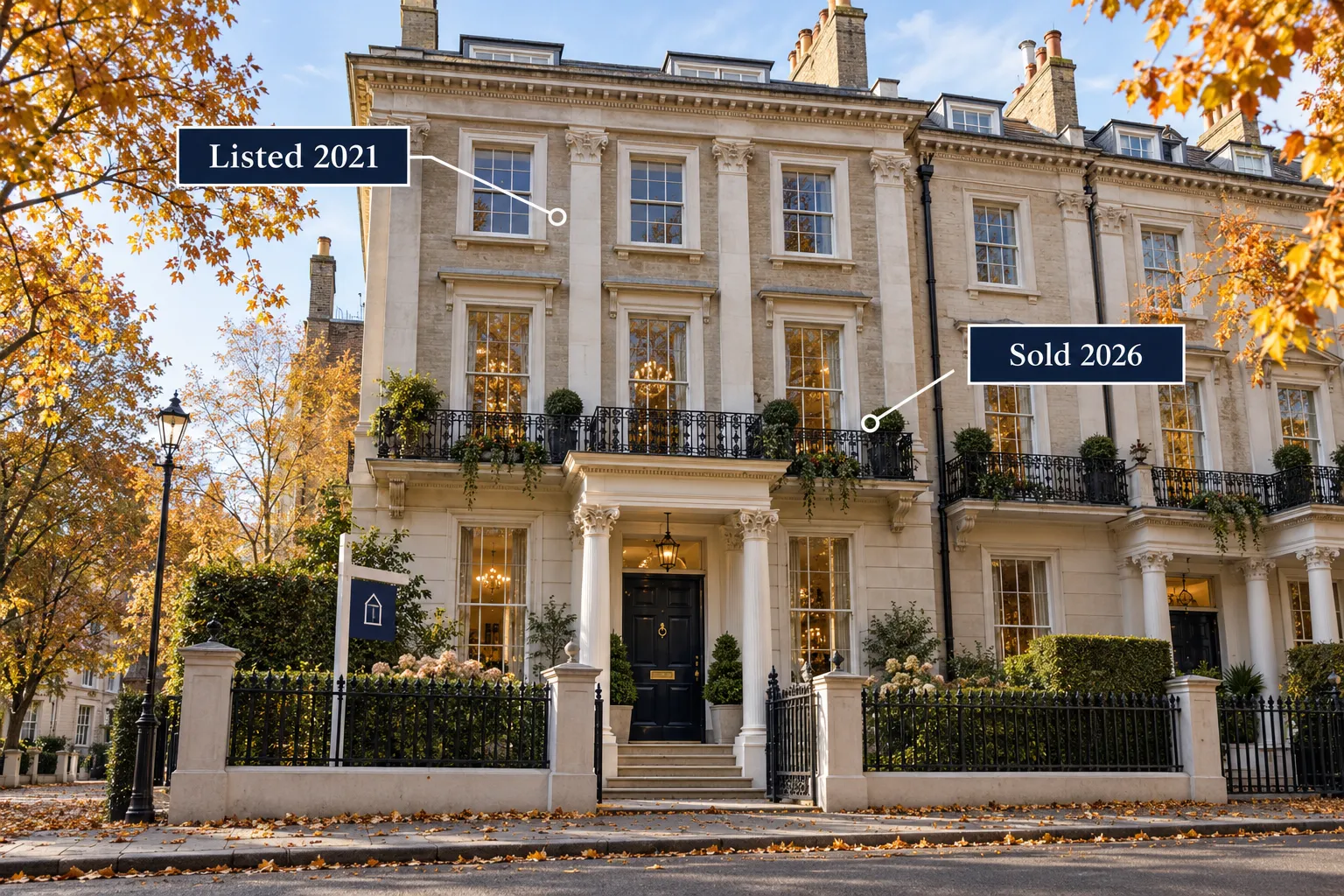
That is not a story about one eccentric seller. It reflects a wider repricing across the top of the London market. JLL data cited in the same report shows 457 homes worth over £5 million sold across central London between July and September 2026, down 11% on the previous quarter. Prime prices fell 7.2% over the year and now sit about a quarter below their 2014 peak. Savills does not expect nominal price growth at this level of the market to return until 2028.
Prime London Discounts Notting Hill Sellers Are Seeing Across the Market
Notting Hill sits firmly inside the prime London catchment tracked by agents and analysts, which means the citywide figures matter directly to local sellers. LonRes data shows average prime London sale prices in July 2026 were 7.9% lower than a year earlier. Transactions above £5 million fell 20%, and new listings across the prime market dropped 30.3%. Nick Gregori of LonRes summed up the mood as a "subdued prime London market."
Knight Frank's own analysis, reported by Estate Agent Today on 5 October 2026, found average prime central London prices now sit 22% below their August 2015 peak. Exchanges across prime central and prime outer London fell 2.5% year on year in the 12 months to September 2026, a much smaller decline than the 14% drop recorded back in March.
| Metric | Figure | Source |
|---|---|---|
| Prime central London prices vs 2015 peak | Down 22% | Knight Frank |
| Prime price change, 12 months | Down 7.2% | JLL |
| Average prime London sale prices, year on year | Down 7.9% | LonRes |
| Sales above £5 million, quarter on quarter | Down 11% | JLL |
| New listings across prime London | Down 30.3% | LonRes |
Super-Prime Transactions Are Stabilising, Not Collapsing
Not every signal points downward. Transactions above £10 million totalled 121 in the year to September 2026, level with the previous year, while spending above that threshold rose 14% to £2.4 billion, according to Knight Frank. Super-prime activity had bottomed out in November 2025 at 106 transactions over a rolling 12 months, down from 155 a year earlier, but has since held steady rather than falling further. Knight Frank's own conclusion is that the super-prime market "hasn't rebounded to 2024 levels, it has stabilised."
Liza-Jane Kelly, Knight Frank's head of London sales, puts the shift in behaviour plainly: "We are starting to see sellers become more realistic with their price." She adds that "what this year has clearly shown is that underlying demand strengthens quickly when the negative news fades."
Why Asking-Price History Is a Trap for Notting Hill Sellers
The Hanover Terrace example is instructive precisely because the asking price told a misleading story for years. A £32 million ask in 2021, followed by repeated cuts, created an anchor that buyers simply ignored. PrimeResi's analysis of LonRes data, published 14 October 2026, found agreed sales across prime London in the first nine months of 2026 were 22% below the five-year average and 36% below 2021 levels, the slowest opening three quarters in at least six years.
Asking-price history reflects a seller's hopes at the time of listing. It does not reflect current market evidence, and buyers in 2026 are pricing accordingly.
For Notting Hill owners, this means a house that was "worth" a certain figure in 2021 or even 2023 may simply not command that number today. Clinging to an outdated valuation anchor, rather than current comparable evidence, is the single biggest reason trophy homes sit unsold for years before a painful correction.
What Buyers Can Negotiate in Notting Hill and Holland Park
Buyers active in W11 and W8 postcodes in late 2026 have more room to negotiate than at almost any point since 2014. With transaction volumes down and new listings scarce, serious buyers are in a stronger position to ask for evidence-based pricing, extended completion timelines, and condition-related adjustments on period stucco houses that often need significant modernisation.
Several factors are shaping these negotiations locally:
- Council-tax surcharge pressure: homes above £2 million have faced a surcharge since the November 2025 Budget, a cost buyers increasingly factor into offers.
- Fading tax speculation: Knight Frank's Tom Bill, writing on PrimeResi on 16 October 2026, notes that speculation around property taxes has been fading ahead of the 28 October Budget, a marked change from the previous year's uncertainty.
- Strong rental fundamentals: ONS data from 16 September 2026 shows Kensington and Chelsea has the UK's highest average rent at £3,690 a month, with London rents up 3.5% year on year, underpinning investor appetite even as sale prices adjust.
These crosscurrents mean buyers and sellers are not necessarily on opposite sides of a collapsing market. They are negotiating around a smaller, more carefully priced pool of stock.
The Role of an Independent RICS Red Book Valuation
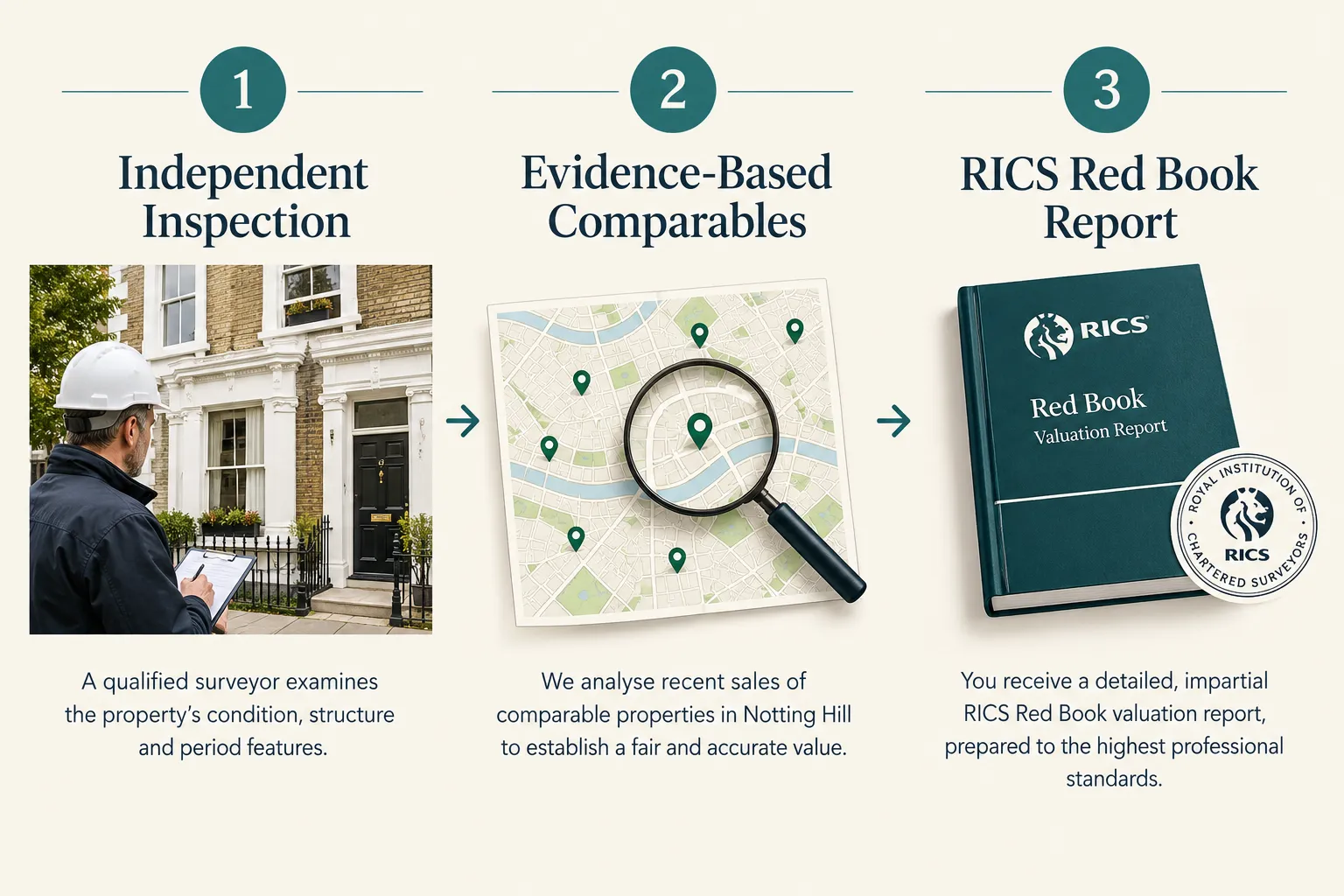
Given how unreliable asking-price history has become, an independent RICS Red Book valuation is the most useful tool available to Notting Hill sellers and buyers alike. A chartered surveyor's valuation is based on verified comparable evidence, property condition, and current market activity rather than a figure set years earlier in a different climate.
For sellers, a Red Book valuation provides a defensible starting point for pricing a period house or lateral apartment, reducing the risk of the repeated cuts seen on Hanover Terrace. For buyers, it offers leverage in negotiation, backed by professional evidence rather than guesswork. In a market where prime prices sit a quarter below their 2014 peak, that evidence matters more than sentiment.
What This Means for Prime London Discounts Notting Hill Sellers Must Plan Around in October 2026
The direction of travel is becoming clearer. Prime London discounts are not a temporary blip; Savills expects nominal growth at this level to remain subdued until 2028. Yet the super-prime segment shows signs of stabilising rather than deteriorating further, and transaction values above £10 million are rising even as volumes stay flat. For Notting Hill, the practical takeaway is that realistic, evidence-led pricing, not optimistic asking prices, is what moves a sale from listed to sold.
Frequently Asked Questions
Is the Notting Hill market falling as sharply as the Hanover Terrace sale suggests?
No Notting Hill-specific transaction data mirrors that single Regent's Park sale. However, the broader prime London price falls it reflects, average prices down 7.2% to 7.9% over 12 months, apply across prime postcodes including Notting Hill.
Does this mean every Notting Hill seller should expect a 44% loss?
Not necessarily. The Hanover Terrace discount reflects a specific listing history with a 2021 asking price far above current market reality. Properties priced from the outset using current evidence are less exposed to such corrections.
Are super-prime buyers still active in late 2026?
Yes. Transactions above £10 million held level year on year to September 2026, and spending in that bracket rose 14%, suggesting demand persists for well-priced trophy assets.
Why has prime London buyer demand slowed since 2021?
Non-dom status abolition in April 2025, a council-tax surcharge on homes above £2 million, and broader tax speculation have all weighed on sentiment, though Knight Frank notes that tax speculation has been fading ahead of the October 2026 Budget.
What is the single most useful step a Notting Hill seller can take right now?
Commission an independent RICS Red Book valuation before setting an asking price. It replaces outdated expectations with current comparable evidence.
Conclusion
The Hanover Terrace sale is a warning and a lesson in equal measure. Prime London discounts Notting Hill sellers face in October 2026 are real, measurable, and unlikely to reverse quickly, yet they are not evenly distributed and do not spell collapse across every price band. Sellers who anchor to historic asking prices risk years of costly cuts; those who commission an independent RICS Red Book valuation and price to current evidence stand the best chance of a clean sale. Buyers, meanwhile, have genuine room to negotiate on price, condition, and terms. The next step for any Notting Hill owner considering a sale is simple: get an evidence-based valuation before fixing a figure.
References
- The National, citing Bloomberg, "Trophy London home sells at near-50% discount" (14 October 2026)
- Estate Agent Today, citing Knight Frank (5 October 2026)
- PrimeResi, analysis of LonRes data (14 October 2026)
- PrimeResi, Tom Bill, Knight Frank (16 October 2026)
- Office for National Statistics (16 September 2026)