
A single decimal point just changed the conversation in Notting Hill. Prime central London prices rose 0.3% in the quarter to October 2026, according to Knight Frank, the first quarterly gain in four years. It is a small number with a large message: after years of falling values, stretched negotiations and non-dom uncertainty, the market may finally be finding its floor.
For anyone selling a period property in W11, that single statistic matters more than it looks. It does not mean values are booming again. It means the long slide has paused, and buyers who have waited on the sidelines since 2022 are starting to move. Understanding what the prime central London prices October 2026 Notting Hill data actually shows, and what it does not, is the first step toward pricing a home correctly in this market.
Key Takeaways
- Knight Frank data shows prime central London prices rose 0.3% in the latest quarter, the first quarterly increase in four years, though values remain roughly 22% below the August 2015 peak.
- PCL and prime outer London exchanges fell 2.5% in the year to September 2026, a sharp improvement on the 14% annual drop recorded in March 2026.
- Super-prime demand (over £10m) has stabilised rather than rebounded, with transactions flat year-on-year at 121 but total spend up 14% to £2.4 billion.
- LonRes figures show London agreed sales are still 22% below the five-year average, underlining that recovery is patchy, not broad-based.
- Realistic pricing, backed by an independent RICS valuation, is now the single biggest factor separating sales that complete from those that stall.
The Knight Frank October 2026 Data: A Four-Year Turning Point
Knight Frank's figures, reported by PrimeResi on 2 October 2026 and Estate Agent Today on 5 October 2026, mark a genuine inflection point. The 0.3% quarterly rise ends a run of declines that stretched back to 2022, when rising interest rates and weakening sentiment began eroding values across prime central London.
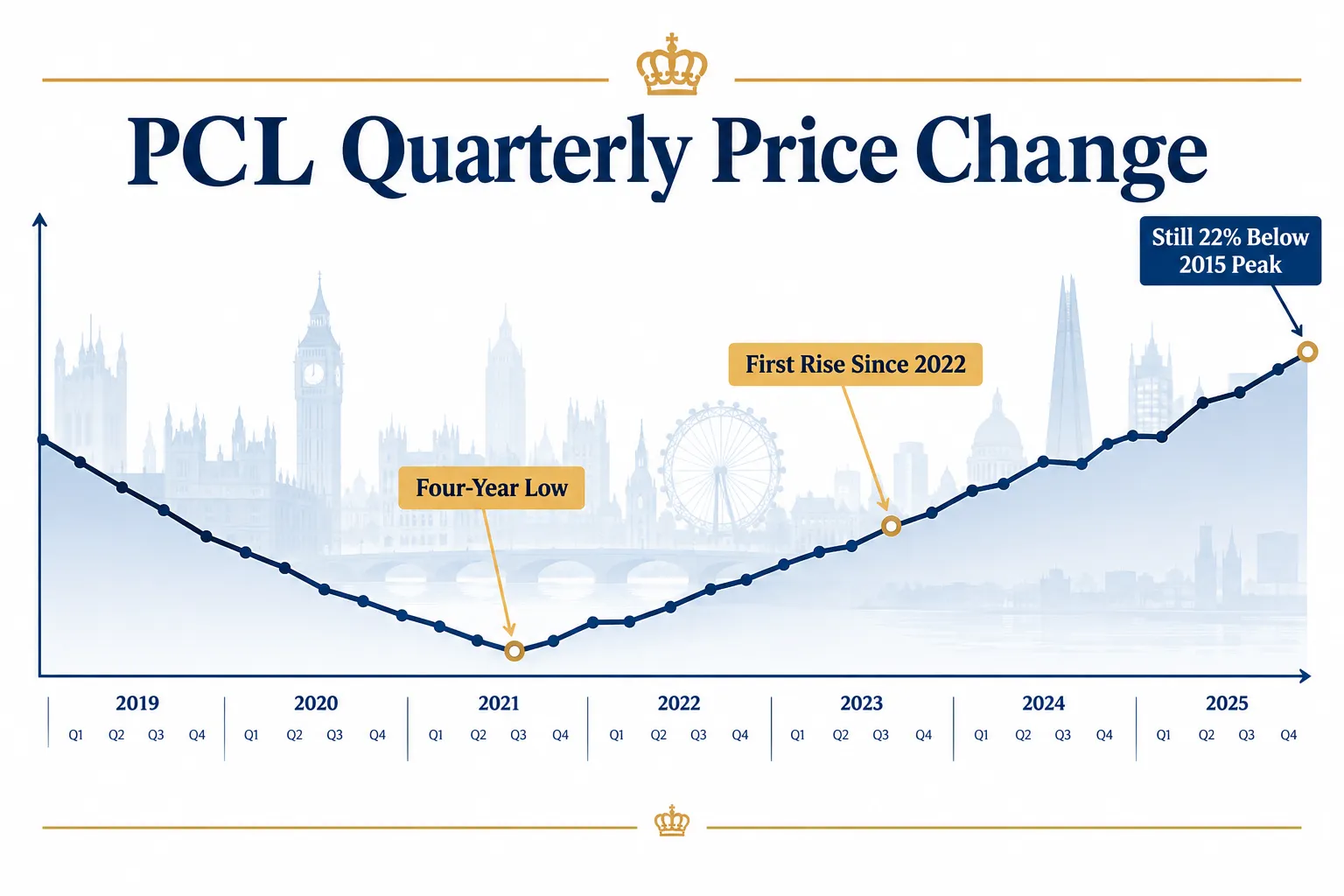
Context matters here. Average PCL prices remain about 22% below their August 2015 peak, so this is a pause in the correction, not a recovery. Annual figures tell a similar story of improvement rather than reversal: PCL and prime outer London exchanges in the year to September 2026 were down 2.5% on the previous 12 months, a marked easing compared with the 14% annual fall recorded as recently as March 2026.
Liza-Jane Kelly, head of London sales at Knight Frank, put it plainly: "We are starting to see sellers become more realistic with their price." She added that "underlying demand strengthens quickly when the negative news fades", a comment that speaks directly to how sentiment, not just affordability, has been driving the market.
What's Driving the Shift: Super-Prime, Transactions, and the Non-Dom Effect
The headline number hides a two-speed market. At the very top, super-prime transactions above £10m bottomed out in November 2025 at 106 sales over the preceding 12 months, down sharply from 155 in the year to November 2024. Knight Frank links much of that pressure to the scrapping of non-dom tax status in April 2025, which removed a key incentive for the wealthiest international buyers.
Yet the picture is not uniformly negative. Transactions above £10m in the year to September 2026 held level with the previous year at 121, while total spend in that bracket actually rose 14%, to £2.4 billion. Knight Frank's own assessment is careful: the super-prime market "hasn't rebounded to 2024 levels, it has stabilised." That is an important distinction for sellers of large family houses in Notting Hill, demand has firmed, but it has not returned to its pre-2025 peak.
Meanwhile, LonRes data shows London agreed sales in the first nine months of 2026 were 22% below the five-year average and 36% below 2021 levels. The market is recovering from a low base, not accelerating from a strong one.
Prime Central London Prices October 2026 Notting Hill: Reading the Local Signals
Notting Hill sits squarely within the prime central London boundary that Knight Frank tracks, so the quarterly rise is relevant to anyone weighing a sale in W11. But no Notting Hill-specific price figures have been published alongside this data, and sellers should be cautious about assuming the 0.3% uplift applies evenly street by street.
Wider London context reinforces the need for caution. Lloyds' House Price Index for September 2026 put the Greater London average at £531,548, down 2.2% annually, a reminder that outside prime postcodes, the broader capital is still softening. Notting Hill's period houses, garden squares and communal gardens continue to command a premium, but that premium is now being tested by buyers who have far more choice and far more negotiating leverage than they did three years ago.
The practical takeaway: treat the Knight Frank figures as a market-wide signal of improving sentiment, not a green light to push asking prices higher. Sellers who ignore this distinction risk a longer time on market, which in a recovering-but-fragile sector can be more damaging than a slightly lower initial asking price.
Realistic Pricing: Why an Independent RICS Valuation Matters Now
Kelly's comment about sellers "becoming more realistic" is the clearest practical guidance in the entire dataset. In a market moving from four years of decline to a tentative plateau, pricing a property correctly from day one is critical.
An independent RICS valuation gives sellers an evidence-based figure, free from the natural optimism that can creep into an estate agent's marketing appraisal. It also gives buyers and their lenders confidence that a price is defensible, important when mortgage valuations are under closer scrutiny following several years of price volatility.
| Approach | Basis | Main risk |
|---|---|---|
| Agent marketing appraisal | Comparable sales, competitive instinct | Can overstate value to win instruction |
| Independent RICS valuation | Surveyed evidence, market data, condition | None if used to set a realistic guide price |
| Online automated estimate | Algorithmic, postcode-level | Cannot account for period features or condition |
For a Notting Hill seller, a RICS valuation also provides a documented baseline that can support price negotiations later in the process, particularly if a buyer's survey raises condition issues, which, in this market, is increasingly common.
Period Property Pitfalls: Stucco, Basements, and Leasehold Risks in Notting Hill
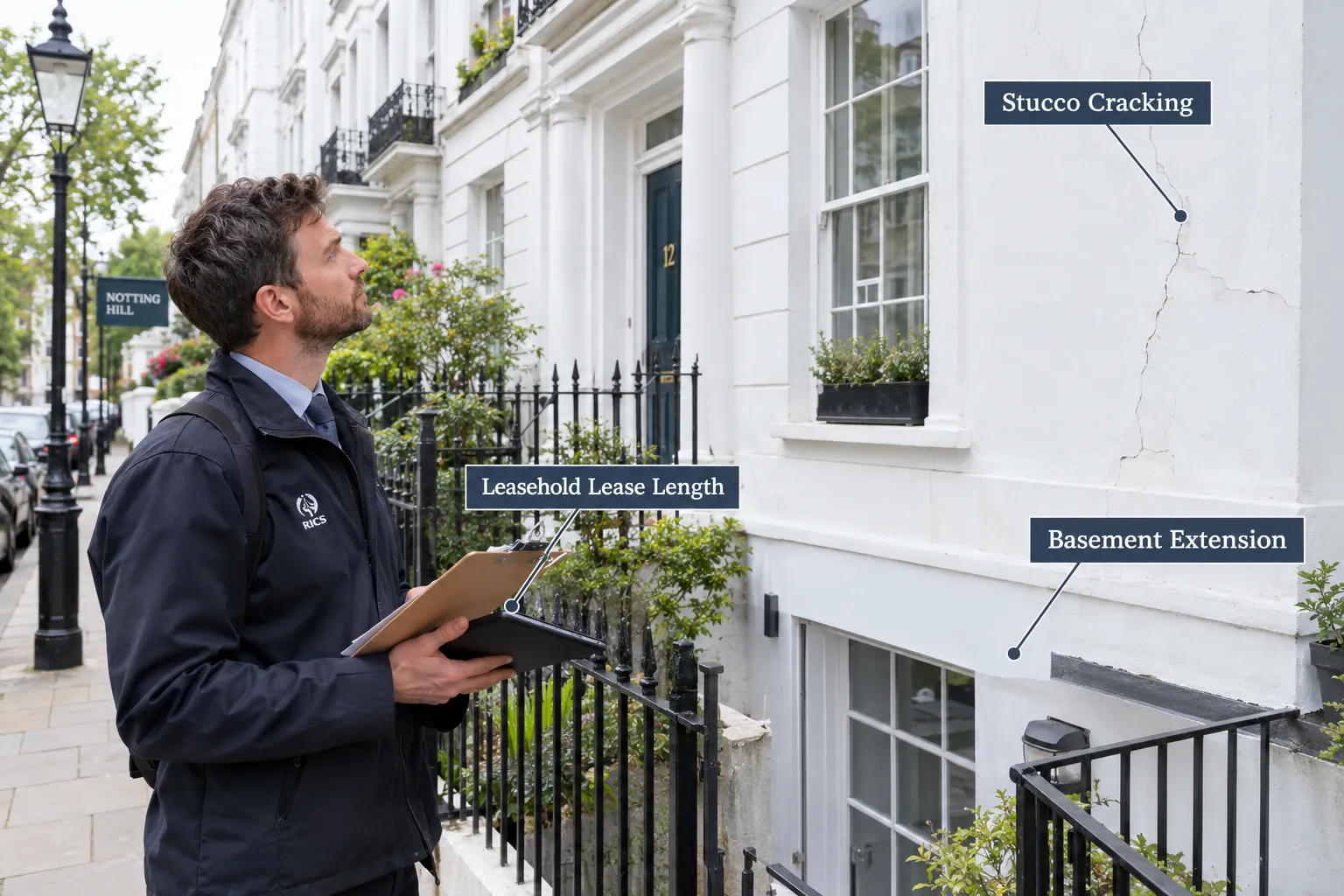
Notting Hill's stucco-fronted terraces and garden squares are architecturally distinctive, but they bring survey risks that buyers' surveyors scrutinise closely in a cautious market.
Common issues include:
- Stucco render: cracking, water ingress behind render, and costly redecoration cycles that buyers now factor into offers.
- Basement conversions: structural waterproofing, party wall compliance and historic underpinning records, all of which a lender's surveyor will want evidence of.
- Leasehold terms: short remaining lease lengths, escalating ground rent clauses, and service charge history, each capable of reducing a mortgage valuation significantly.
- Listed building constraints: many Notting Hill properties sit within conservation areas, limiting alteration options and affecting renovation costs.
An independent survey conducted before marketing, rather than waiting for a buyer's survey to surface problems, allows sellers to address issues, adjust pricing expectations, or prepare documentation in advance. In a market where buyers have leverage, surprises during a transaction are now far more likely to cause price chips or withdrawn offers than they were during the boom years.
The Autumn Budget and What Sellers Should Watch Next
The Autumn Budget on 28 October 2026 adds further context for sellers weighing timing. A council tax surcharge on homes above £2 million is already scheduled for April 2028 in England, giving high-value Notting Hill owners a multi-year runway to plan around it. The additional 5% stamp duty surcharge on second homes is expected to remain in place, continuing to dampen demand from investors and second-home buyers in favour of owner-occupiers.
Neither measure is new information, but both reinforce Knight Frank's broader message: the market is stabilising on the back of improved sentiment, not loosened taxation. Sellers should expect continued buyer caution around high-value thresholds and plan pricing strategy accordingly, rather than assuming policy will shift in their favour.
FAQ: Prime Central London Prices October 2026 Notting Hill
Does the 0.3% rise mean Notting Hill prices are increasing too?
It means sentiment across prime central London, which includes Notting Hill, has improved. No Notting Hill-specific figures have been published, so individual streets may perform differently.
Are prices still below their peak?
Yes. Average PCL prices remain about 22% below their August 2015 peak, despite the latest quarterly rise.
Why did super-prime sales slow so sharply?
Knight Frank links the drop in £10m-plus activity largely to the removal of non-dom tax status in April 2025, which reduced incentives for some international buyers.
Should sellers price higher now that the market has turned?
No. Knight Frank's own data describes stabilisation, not recovery. Realistic, evidence-based pricing remains the key factor in achieving a sale.
How does a RICS valuation help a Notting Hill sale?
It provides an independent, defensible price based on condition and comparable evidence, reducing the risk of later price negotiations or mortgage valuation shortfalls.
What survey issues are most common in Notting Hill period homes?
Stucco render defects, basement conversion compliance, leasehold terms, and conservation area restrictions are the most frequent issues raised by buyers' surveyors.
Conclusion
The Knight Frank data for October 2026 marks a genuine, if modest, turning point for prime central London. A 0.3% quarterly rise after four years of decline, combined with a narrowing annual fall and stabilising super-prime demand, suggests confidence is slowly returning. But values remain well below their 2015 peak, and London-wide sales activity is still running far below historic averages.
For Notting Hill sellers, the sensible response is not optimism about higher prices, but discipline about realistic ones. Commissioning an independent RICS valuation before marketing, addressing period property risks such as stucco condition, basement compliance and leasehold terms in advance, and pricing in line with current evidence rather than pre-2022 memories will give any sale the best chance of completing smoothly in this still-cautious market.
.cg-tool{font-family:Arial,Helvetica,sans-serif;max-width:680px;margin:0 auto;border:1px solid #ddd;border-radius:10px;padding:18px;background:#fafafa;color:#222}
.cg-tool h2{font-size:18px;margin:0 0 10px;color:#1a2a4a}
.cg-tool label{display:block;margin:10px 0 4px;font-size:14px;font-weight:bold}
.cg-tool select{width:100%;padding:8px;border-radius:6px;border:1px solid #ccc;font-size:14px}
.cg-tool button{margin-top:14px;background:#1a2a4a;color:#fff;border:none;padding:10px 16px;border-radius:6px;cursor:pointer;font-size:14px}
.cg-result{margin-top:14px;padding:12px;border-radius:8px;background:#eef2f8;font-size:14px;line-height:1.5;display:none}
.cg-result.show{display:block}
.cg-result strong{color:#1a2a4a}
@media(max-width:480px){.cg-tool{padding:12px}}
Notting Hill Period Property Survey Risk Checker
Stucco render / facade
Basement conversion
Leasehold term
Conservation area / listed status
function cgCheck(){
var f=document.getElementById(‘cg-feature’).value;
var r=document.getElementById(‘cg-result’);
var data={
stucco:”Stucco render: Ask for evidence of redecoration cycles and check for cracking or water ingress behind render. Costly if left unaddressed, and often flagged by lenders’ surveyors.”,
basement:”Basement conversion: Request party wall agreements, waterproofing certificates, and structural sign-off. Undocumented underpinning can delay mortgage approval.”,
leasehold:”Leasehold term: Check remaining lease length and ground rent escalation clauses. Short leases can significantly reduce valuation and buyer appetite.”,
conservation:”Conservation area status: Confirm what alterations are permitted. Unauthorised past works can create legal and valuation complications.”
};
r.innerHTML=data[f];
r.className=”cg-result show”;
}