
Half of Savills' agents now name one piece of legislation as their single biggest worry about the prime lettings market, ahead of tax, ahead of mortgage costs. That legislation is the Renters' Rights Act, and its fingerprints are now visible in the hardest data set available: Savills' prime rental index for Q3 2026. The story it tells is simple but important for anyone who owns or rents a flat in Notting Hill, Holland Park or Bayswater: prime London rents under the Renters' Rights Act 2026 framework are rising faster, supply is shrinking, and landlords are behaving more cautiously than at any point in recent memory.
This matters well beyond the City finance pages. For Notting Hill landlords weighing a sale against a re-let, and for tenants bracing for a rent review, the numbers released in October 2026 offer the clearest early signal yet of how the new rental rules are reshaping prime west London.
Key Takeaways
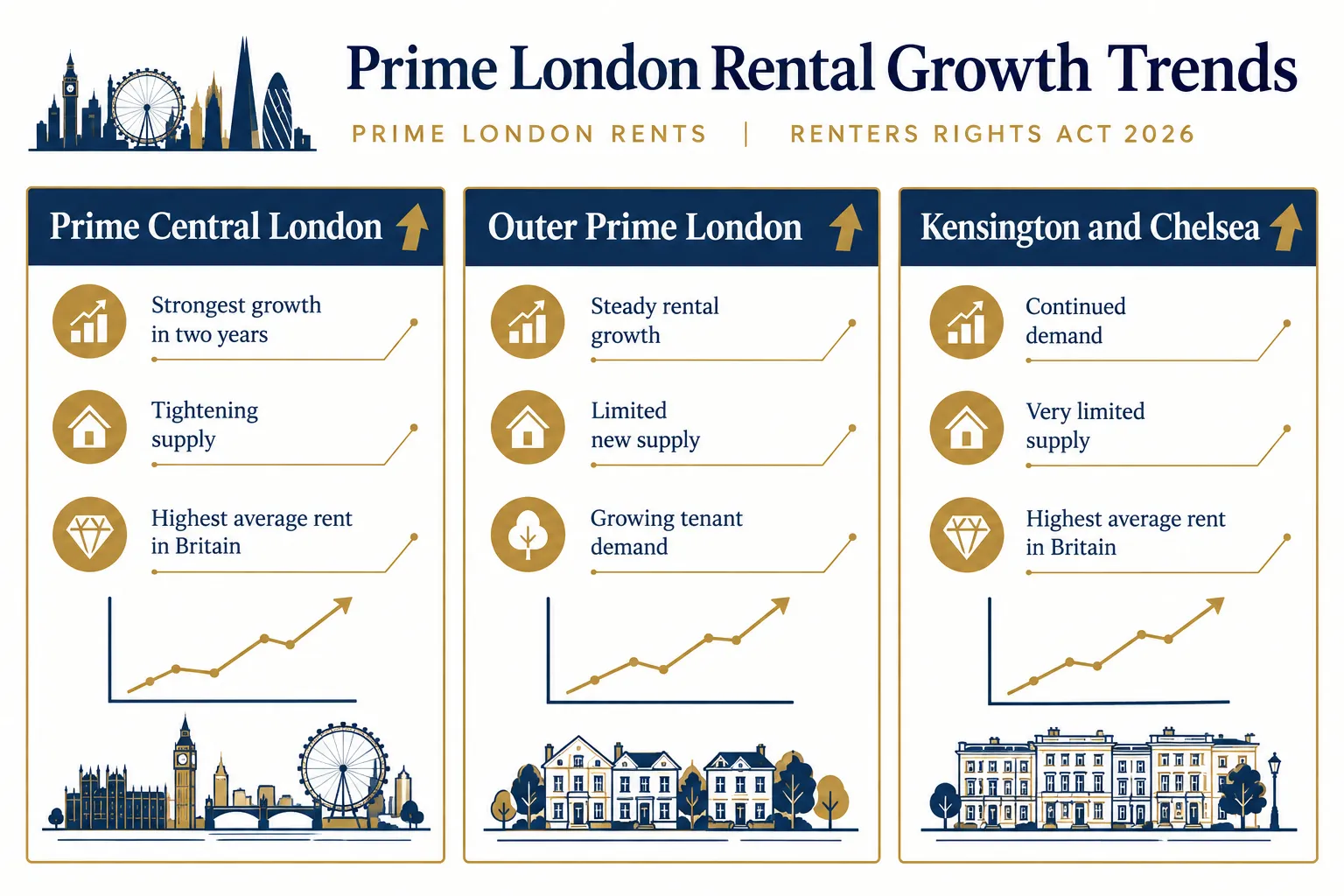
- Prime central London rents rose 1.9% year on year in Q3 2026, the strongest quarterly growth in two years, according to Savills.
- Outer prime London, which includes Notting Hill, climbed 2.9% annually, faster growth, driven by tightening supply.
- Almost half of Savills' agents cite the Renters' Rights Act as their top landlord concern, above tax and mortgage costs.
- Kensington and Chelsea now has the highest average private rent in Britain, at £3,690 (ONS, August 2026).
- London-wide rental listings are down 9% year on year while renter demand is up 6%, according to Rightmove.
Prime London Rents Renters Rights Act 2026: The Savills Numbers Explained
Savills' October 2026 release, covered by Landlord Today on 16 October, confirms that prime central London rents increased 1.9% over the year to Q3 2026, with the quarter itself delivering the strongest rental growth seen in two years. Outer prime London, the broader ring that takes in Notting Hill, Holland Park and similar postcodes, outperformed the centre, rising 2.9% annually.
Crucially, the growth was not evenly spread. Savills found the strongest gains concentrated in homes let below the Renters' Rights Act's £100,000-a-year rent threshold, the band where fewer properties are available. That squeeze on supply at the lower end of the prime market is pushing rents up precisely where competition among tenants is fiercest.
Yields have also moved. Prime central London yields are now at their strongest level since 2009, a sign that rental income growth is outpacing capital values in parts of the market, a dynamic landlords weighing sale versus re-let should not ignore.
Jessica Tomlinson, research analyst at Savills, summed up the mood: "Landlord caution is continuing to constrain rental supply." She added a note of caution of her own: "It remains too early to judge the full legacy of the Renters' Rights Act." Tomlinson also pointed out that "affordability constraints continue to limit the pace of increases," meaning rents are rising but not accelerating without limit, tenants' wallets are still a check on the market.
Why Landlord Caution Is Driving Prime London Rents Under the Renters' Rights Act 2026
The Renters' Rights Act overhauls how tenancies are structured, how notice periods work, and how landlords can recover possession of a property. For many owners of prime London flats, particularly smaller portfolio landlords common in Notting Hill's period conversions, the practical effect has been hesitation. Rather than pour fresh listings onto the market, many are holding back, reducing choice for tenants and pushing rents higher on what remains.

This caution shows up clearly in Rightmove's Q3 2026 tracker, published 15 October. London's average advertised rent hit a record £2,825, up 3.2% year on year. Inner London rents reached £3,349, up 1.5% on the quarter and 4.0% annually, while Outer London rents reached £2,442, up 2.5%. At the same time, available rental listings across London fell 9% year on year and new listings dropped 7%, even as renter demand rose 6%. Fewer homes, more buyers for them: that is the textbook recipe for rising rents.
Kesha Foss-Smith, Head of Lettings at John D Wood & Co, offers a second explanation layered on top of landlord caution: higher mortgage costs are keeping would-be buyers renting for longer than they planned. That extra demand from frustrated buyers adds further pressure to an already tight prime rental pool.
Locally, the Office for National Statistics confirmed on 16 September 2026 that Kensington and Chelsea has the highest average private rent in Britain, at £3,690 as of August 2026, a figure that underlines just how acute the supply-demand imbalance has become in the boroughs surrounding Notting Hill.
"Securing a suitable tenant is often preferable to facing a costly void period.", Jessica Tomlinson, Savills
That quote carries particular weight for landlords near Portobello Road and Holland Park, where void periods on a well-presented flat used to be rare but are now a real cost landlords are actively trying to avoid.
What This Means for Notting Hill Landlords and Tenants
For landlords in W11 and the wider Royal Borough, three practical implications stand out.
First, pricing a re-let correctly matters more than ever. With rents rising fastest below the £100,000-a-year threshold where supply is tightest, many Notting Hill flats sit exactly in the band benefiting most from the squeeze. Getting the asking rent right, neither underpricing and leaving money on the table, nor overpricing and risking a void, depends on an up-to-date, evidence-based rental valuation rather than a rough guess based on last year's figures.
Second, the shift toward yields at their strongest since 2009 raises a genuine strategic question: hold and let, or sell into a market where Knight Frank reported prime central London prices rose 0.3% in Q3 2026, the first quarterly price growth in four years? That is a meaningful inflection point after years of flat or falling values, and it means the sell-versus-let calculation has changed for many owners.
Third, the Renters' Rights Act's new possession and notice rules make documentation non-negotiable. Before any rent review or new tenancy, landlords need:
- A current, defensible market rent valuation
- A thorough, dated condition report and inventory
- Clear records supporting any rent increase under the new review cycle
These steps protect landlords if a tenancy dispute arises, and they give tenants confidence that increases are fair and evidenced rather than arbitrary.
For tenants, the picture is more mixed. Rising rents under prime London rents Renters Rights Act 2026 conditions mean budgeting for above-inflation increases is sensible, particularly at renewal. But the Act also strengthens tenants' procedural protections, understanding notice periods and review rights is now part of basic tenancy literacy in this market.
A Quick Comparison
| Metric | Figure | Source |
|---|---|---|
| Prime central London rents (annual) | +1.9% | Savills Q3 2026 |
| Outer prime London rents (annual) | +2.9% | Savills Q3 2026 |
| London average advertised rent | £2,825 | Rightmove Q3 2026 |
| Kensington and Chelsea average rent | £3,690 | ONS, Aug 2026 |
| London rental listings (annual) | -9% | Rightmove Q3 2026 |
Frequently Asked Questions
What is the £100,000-a-year rent threshold under the Renters' Rights Act?
It is the rent level above which certain tenancy protections under the Act do not apply in the same way. Savills found rental growth strongest below this threshold, where competition for fewer available homes is most intense.
Are Notting Hill rents rising faster than the rest of prime London?
Outer prime London, which includes Notting Hill, saw annual rental growth of 2.9% in Q3 2026, ahead of prime central London's 1.9%, according to Savills.
Should a Notting Hill landlord sell or keep letting right now?
It depends on individual circumstances, but prime central London yields are at their strongest since 2009 and prices rose for the first time in four years in Q3 2026, according to Knight Frank. A professional valuation comparing likely sale proceeds against rental income is the sensible starting point.
Why are rental listings falling while demand rises?
Landlord caution linked to the Renters' Rights Act is widely cited as the main driver, alongside buyers delaying purchases due to higher mortgage costs and staying in rented homes for longer.
Does a landlord need a new valuation before increasing rent?
Yes, in practical terms. A documented, evidence-based rental valuation supports fair and defensible rent reviews, which is increasingly important given the Act's revised notice and review procedures.
Conclusion
The direction of travel is now unmistakable. Savills' October 2026 figures show prime London rents Renters Rights Act 2026 pressures working exactly as landlord caution would predict: supply down, demand up, rents climbing fastest where choice is scarcest. Notting Hill sits squarely inside that squeeze, reinforced by ONS data confirming Kensington and Chelsea's status as Britain's most expensive rental borough.
For landlords, the sensible next step is a professional rental valuation before any rent review, paired with a thorough condition report and inventory that will stand up if a tenancy dispute arises under the new rules. For tenants, understanding the local rent trajectory and the Act's protections helps set realistic expectations ahead of renewal. Either way, acting on current evidence, not last year's assumptions, is the safest course through a market still settling into its new legal shape.