
Nearly one in five UK property transactions involves a price renegotiation after a survey is returned, according to industry estimates [6]. Yet many buyers receive a detailed building survey report, feel overwhelmed by the technical language, and fail to act on findings that could save them thousands of pounds. The journey from building survey to negotiation tool is not automatic — it requires a structured approach, the right evidence, and a clear understanding of how to present that evidence to sellers and agents.
This guide explains exactly how UK buyers can use survey findings to renegotiate price or arrange repairs, and how surveyors can structure their reports and post-survey advice to make that process realistic and effective.
Key Takeaways
- A building survey report is only as useful as the action taken on it — buyers must translate findings into costed, written evidence before approaching sellers.
- Obtaining two to three written contractor quotes per significant defect is the single most persuasive step in any post-survey negotiation.
- Condition 3 (urgent) items carry the most weight in renegotiation; Condition 2 items can still support a price adjustment when costs are evidenced.
- Written communication through the estate agent, not verbal discussion, creates a clear negotiating record and protects both parties.
- Surveyors who present defects with prioritised risk ratings and indicative cost ranges give buyers a far stronger platform from which to negotiate.
Understanding What a Building Survey Actually Tells You
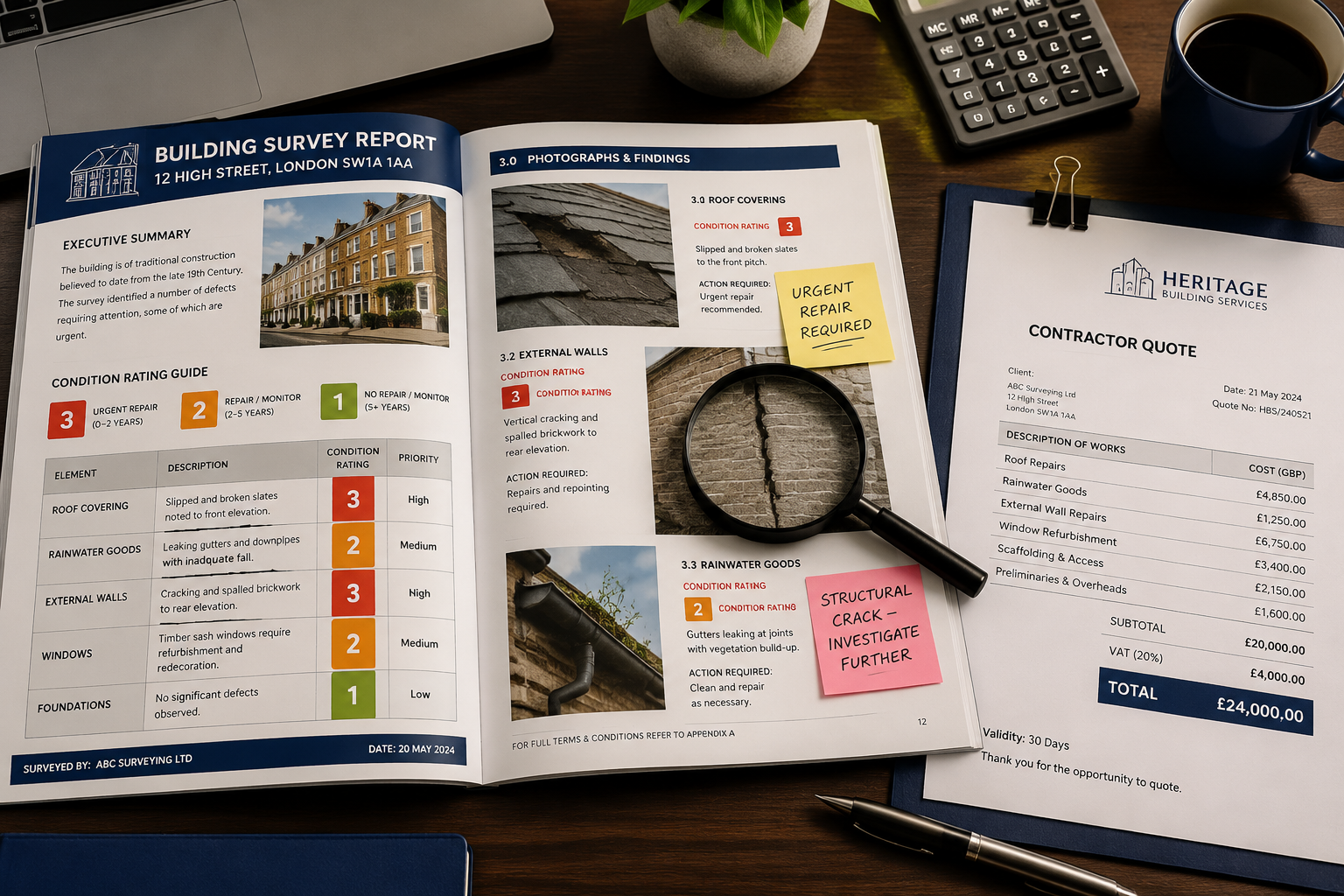
Before moving from building survey to negotiation tool, buyers need to understand what the report is communicating. A Level 3 Building Survey is the most comprehensive inspection available for residential property in the UK. It uses a traffic-light condition rating system defined by RICS:
| Condition Rating | Meaning | Negotiation Weight |
|---|---|---|
| Condition 1 (Green) | No repair currently needed | Low |
| Condition 2 (Amber) | Defects that need attention but are not urgent | Medium |
| Condition 3 (Red) | Serious defects requiring urgent repair | High |
Condition 3 items are the foundation of any renegotiation. These are the findings that most directly justify a revised offer or a request for the seller to complete repairs before exchange. Condition 2 items, while less urgent, can still support a cumulative case for price reduction when repair costs are evidenced and totalled [1].
Buyers should read the full report carefully, noting the section reference and page number for every Condition 2 and Condition 3 item. This creates a working document that forms the backbone of the negotiation strategy.
What Surveyors Should Include to Support Negotiation
Surveyors play a critical role in making the transition from building survey to negotiation tool achievable. Reports that include the following elements give buyers a significantly stronger platform:
- Prioritised defect lists that separate urgent structural concerns from routine maintenance items
- Indicative cost ranges for remediation, even if approximate, so buyers have a starting reference point
- Specific specialist referrals — for example, recommending a structural engineer for movement cracks or a damp specialist for penetrating damp
- Clear language that avoids excessive hedging while remaining accurate
A report that flags "possible damp" without any context about likely cause, severity, or cost range leaves buyers with little to negotiate with. A report that states "active rising damp to the front elevation, likely requiring a chemical damp-proof course injection and replastering at an estimated cost of £1,500–£3,500, subject to specialist assessment" gives the buyer a concrete basis for action. For a detailed understanding of what inspections cover, see what a surveyor checks during an inspection.
The Step-by-Step Process: From Building Survey to Negotiation Tool
Turning a survey report into an effective negotiation tool requires a methodical process. Rushing to call the estate agent the moment a concerning report lands is one of the most common — and costly — mistakes buyers make [2].
Step 1: Read the Report in Full Before Reacting
It is tempting to scan for red flags and call the agent immediately. Instead, read the entire report. Some findings that appear alarming in isolation are common for the property type or age and carry modest repair costs. Conversely, a cluster of Condition 2 items may collectively represent a significant financial liability that justifies renegotiation even if no single item is rated Condition 3 [1].
Make a list of every Condition 2 and Condition 3 item. Note:
- The defect type and location
- The condition rating assigned
- Any specialist referral recommended
- Any indicative cost range provided
Step 2: Obtain Written Contractor Quotes
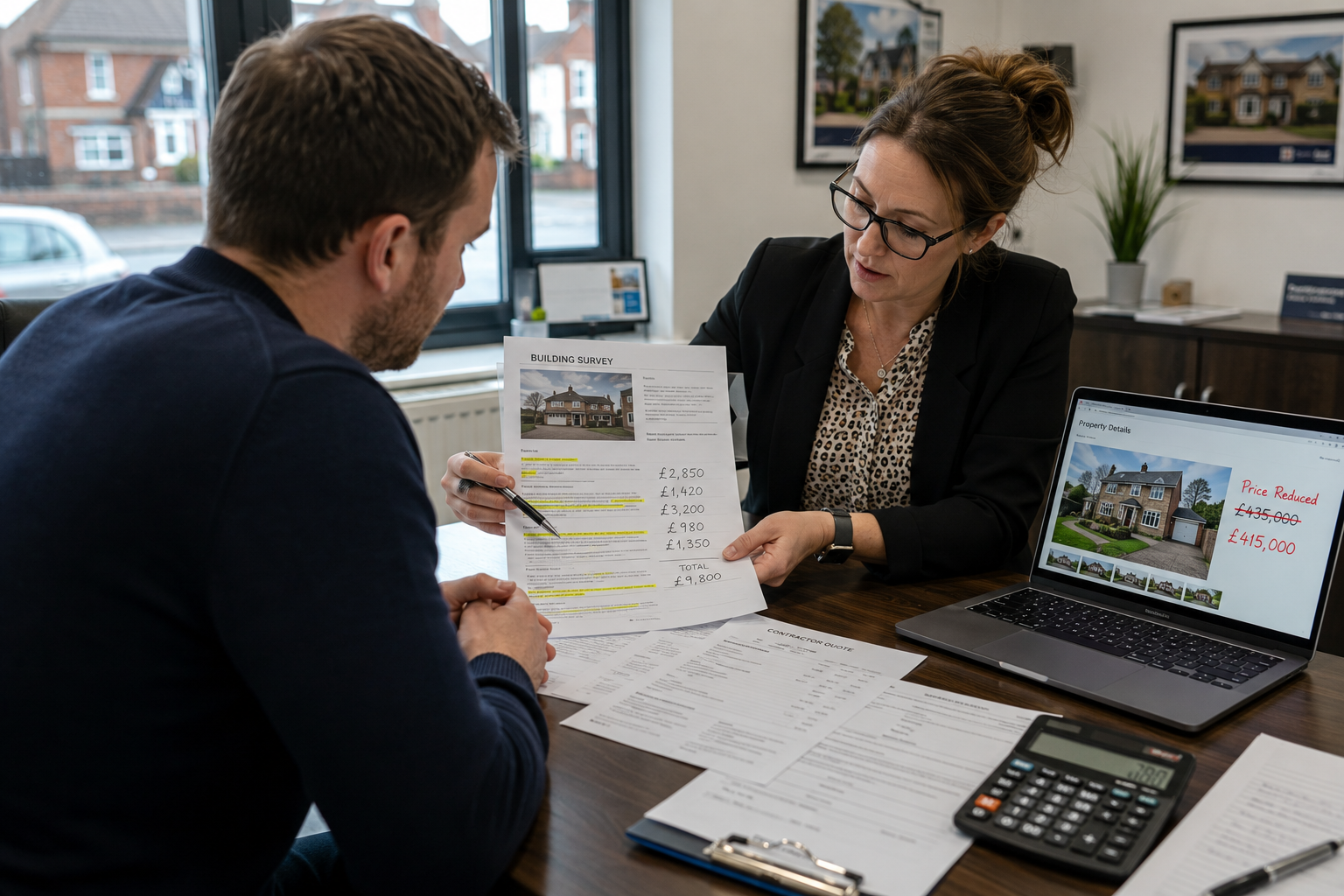
This is the single most important step in the entire process. Written quotes from two to three relevant contractors for each significant defect transform a survey report from a list of concerns into a costed evidence file [1][2][7].
Verbal estimates carry no weight in negotiation. A written quote on a contractor's letterhead, dated and itemised, is a document the seller and their agent cannot easily dismiss. It demonstrates that the buyer has done due diligence and is presenting a factual case rather than a speculative one.
For specialist issues such as subsidence or structural movement, a formal subsidence survey or structural engineer's report may be required before any contractor can quote accurately. Similarly, suspected damp issues may benefit from a dedicated damp survey to establish the cause and extent before costs can be confirmed.
"The most persuasive evidence a buyer can bring to a post-survey negotiation is not the survey report itself — it is a set of written contractor quotes that translate defects into pounds and pence." [7]
Step 3: Calculate the Total Evidenced Repair Cost
Once quotes are assembled, total the costs. This figure becomes the central number in the negotiation. Buyers should decide at this stage whether to:
- Request a price reduction equal to the full repair cost, or a negotiated portion of it
- Request that the seller completes specific repairs before exchange of contracts
- Use a combination — seller completes urgent works, buyer accepts a reduced price for remaining items
In practice, sellers are often more willing to accept a price reduction than to manage repairs themselves, particularly if they are in a chain or have already vacated the property [4][10].
Step 4: Write to the Estate Agent — Not Call
Communication should be in writing. A written summary sent to the estate agent creates a clear record of the buyer's position, the evidence supporting it, and the specific reduction or repair request being made [2].
The written communication should include:
- A brief reference to the survey date and surveyor's firm
- A concise list of the key defects identified (Condition 3 first, then Condition 2)
- The total repair cost evidenced by contractor quotes
- The specific revised offer or repair request, stated in clear monetary terms
- A reasonable deadline for the seller's response
Avoid emotional language or ultimatums. The tone should be factual, professional, and solution-focused. Sellers are more likely to engage constructively when the buyer presents evidence rather than demands [4].
Step 5: Be Prepared to Negotiate, Not Just Demand
Renegotiation is a two-way process. Sellers may counter with a partial reduction, an offer to complete specific repairs, or a rejection. Buyers should enter the process knowing their walk-away point — the minimum acceptable outcome given the survey findings and their own financial position [10].
It is also worth noting that sellers are not obligated to reduce the price or complete repairs. However, a well-evidenced case significantly increases the likelihood of a positive outcome. Research suggests that buyers who present written contractor quotes achieve better outcomes than those who rely on the survey report alone [1][7].
Common Defects and Their Negotiating Weight
Not every defect carries the same negotiating power. Understanding which findings are most likely to move a seller helps buyers prioritise their approach.
High-Impact Defects
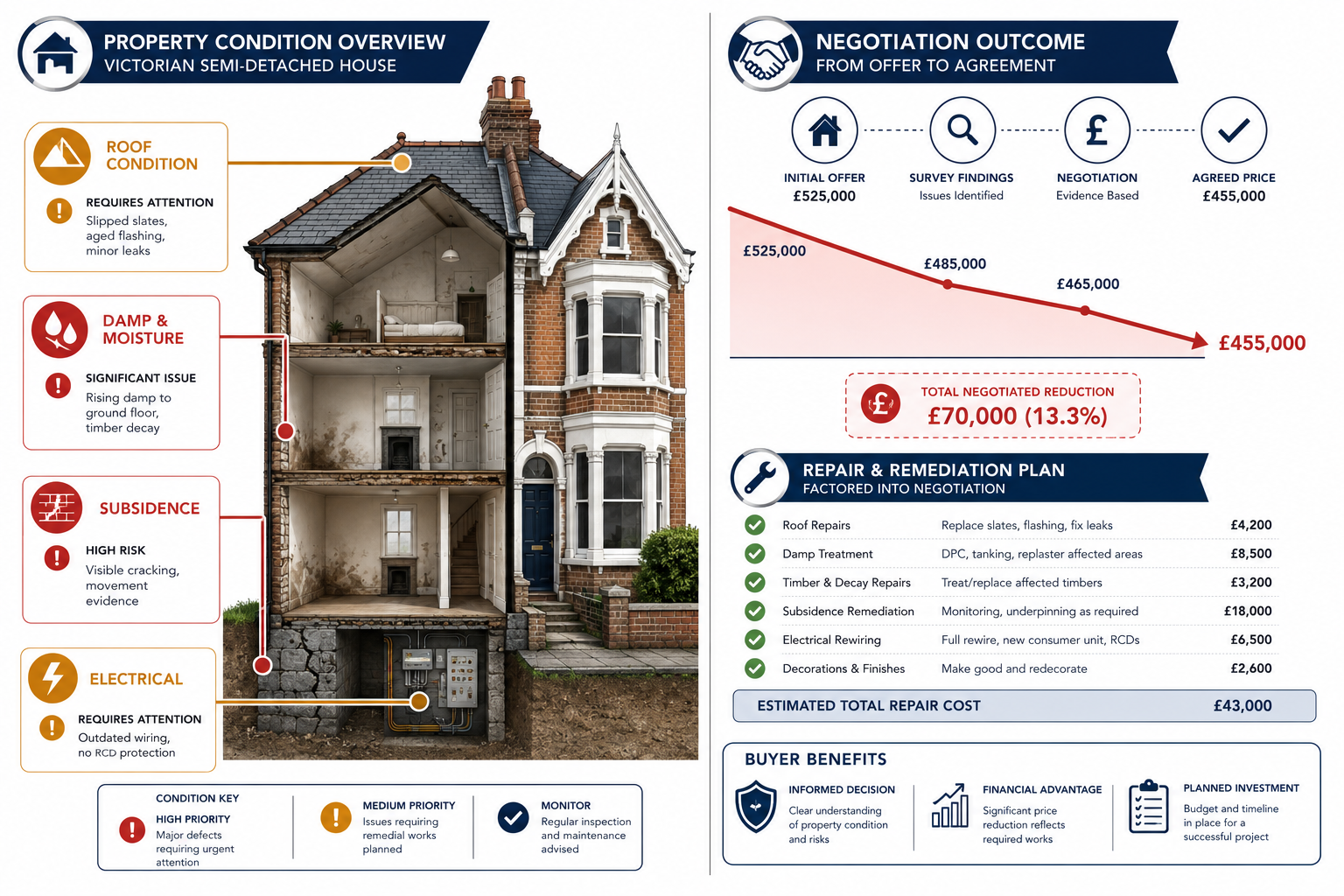
These are the findings most likely to support a significant price reduction or seller-funded repair:
- Structural movement or subsidence — often requires specialist investigation and can involve substantial remediation costs. A structural survey finding in this area carries considerable weight.
- Roof failure — complete or partial re-roofing is a major cost item with clear contractor quotes available.
- Damp penetration or rising damp — particularly where it has caused secondary damage to plasterwork, joinery, or floor structures.
- Electrical installations requiring full rewiring — a safety issue that lenders may also flag.
- Drainage defects — collapsed or blocked drains identified through CCTV survey can be expensive to remedy.
Medium-Impact Defects
These findings support a cumulative case for reduction when totalled:
- Chimney stack repointing or rebuilding
- Window replacement (single glazing, failed double glazing units)
- Flat roof renewal
- Timber decay in floor joists or lintels
- Boiler replacement or heating system upgrade
Lower-Impact Findings
These are unlikely to support significant renegotiation on their own but contribute to the overall picture:
- General redecoration
- Minor pointing or render repairs
- Garden maintenance issues
- Minor plumbing repairs
What Surveyors Should Avoid Overstating
A critical aspect of the surveyor's role is calibrating the language and condition ratings accurately. Overstating defects as deal-breakers when they are routine maintenance items damages the buyer's credibility in negotiation and can cause transactions to collapse unnecessarily.
For example, some degree of settlement cracking in a Victorian terrace is entirely normal and does not indicate active structural movement. Labelling such cracks as Condition 3 without qualification, or without distinguishing them from genuinely concerning movement, can lead buyers to either abandon viable purchases or to demand reductions that sellers rightly reject.
Accurate, well-calibrated reports serve buyers better than alarming ones. The goal is to give buyers a realistic, evidenced case — not to generate anxiety. For further context on what different survey levels cover, the comparison of Level 2 and Level 3 surveys provides useful background.
How Much Can Buyers Realistically Expect to Renegotiate?
There is no fixed formula, but industry data provides useful context. Average price reductions following survey negotiations in the UK typically range from 1% to 5% of the agreed purchase price, with larger reductions possible where major structural or roofing defects are identified [6].
On a £400,000 property, a 2% reduction represents £8,000 — often more than enough to cover the cost of the survey and the repairs identified. The key variable is the quality of the evidence presented [6][7].
Buyers should be realistic about the market context. In a competitive seller's market, sellers have less incentive to negotiate. In a slower market, or where a property has been on the market for some time, buyers have greater leverage [8].
It is also worth considering the survey cost itself in context. The homebuyers survey: pros, cons, and key considerations resource outlines why the upfront investment in a thorough survey almost always pays for itself — either through renegotiated savings or through the informed decision to walk away from a problematic property.
When Requesting Repairs Is Better Than a Price Reduction
In some circumstances, asking the seller to complete repairs before exchange is preferable to a price reduction. This is particularly true when:
- The defect is a safety issue (gas, electrics, structural instability) that the buyer's lender may also require to be resolved
- The buyer lacks the cash reserves to fund repairs after completion
- The repair requires specialist contractors who the seller may already have relationships with
- The defect could worsen between exchange and completion if left unaddressed
When requesting repairs, buyers should specify the standard of work required and, where possible, agree that a re-inspection or sign-off by a qualified professional will take place before exchange [2][4].
Protecting the Process: Practical Considerations
Several practical points help buyers navigate the post-survey negotiation without jeopardising the transaction:
- Act promptly. Delays in responding to a survey can signal lack of commitment to the seller. Most agents expect a response within one to two weeks of the survey being received [1].
- Keep communication professional. Emotional or aggressive communication rarely achieves better outcomes and can cause sellers to disengage entirely.
- Involve your solicitor. Where repairs are agreed, they should be documented in the contract. A solicitor can ensure that any seller undertakings are legally binding.
- Know when to walk away. If the survey reveals defects that exceed the buyer's budget or risk tolerance, and the seller refuses to negotiate, walking away before exchange is the right outcome. The survey has done its job.
For buyers who want to understand the full scope of what a Level 3 survey covers before commissioning one, the comprehensive guide to Level 3 building surveys provides detailed context.
Conclusion
The transition from building survey to negotiation tool is one of the most valuable — and most underused — steps in the UK home-buying process. A well-structured survey report, combined with a methodical approach to obtaining contractor quotes and presenting a written, evidenced case to the seller, gives buyers a realistic and professional basis for renegotiation.
Actionable next steps for buyers in 2026:
- Read the full survey report and list every Condition 2 and Condition 3 item with page references.
- Instruct two to three contractors to provide written quotes for each significant defect before approaching the seller.
- Commission any specialist surveys recommended (structural, damp, drainage) to strengthen the evidence base.
- Prepare a concise written summary for the estate agent that states the total evidenced repair cost and the specific revised offer or repair request.
- Set a realistic walk-away point before entering negotiations, and stick to it.
For surveyors, the professional obligation extends beyond producing a technically accurate report. Presenting defects with clear prioritisation, indicative cost ranges, and appropriate specialist referrals gives buyers the tools they need to act — and supports a transaction outcome that reflects the property's true condition.
References
[1] Negotiating After Survey – https://www.getkeywise.com/negotiating-after-survey
[2] Can I Renegotiate The Price After A Bad Survey – https://mortgagenotes.co.uk/questions/can-i-renegotiate-the-price-after-a-bad-survey
[3] Survey Costs What Sellers Should Know – https://getpine.co.uk/guides/survey-costs-what-sellers-should-know
[4] Renegotiating A House Offer After Your Survey – https://www.reallymoving.com/surveyors/guides/renegotiating-a-house-offer-after-your-survey
[5] Home Buying And Selling Reform Roadmap – https://www.gov.uk/government/consultations/home-buying-and-selling-reform/outcome/home-buying-and-selling-reform-roadmap
[6] Average Price Reduction After Survey Negotiating The Purchase Price With A Building Survey – https://wimbledonsurveyors.com/average-price-reduction-after-survey-negotiating-the-purchase-price-with-a-building-survey/
[7] How To Negotiate A House Price Reduction After A Survey – https://www.homebuilding.co.uk/advice/how-to-negotiate-a-house-price-reduction-after-a-survey
[8] UK Residential Market Survey – https://www.rics.org/news-insights/market-surveys/uk-residential-market-survey
[9] Making An Offer On A House – https://www.surveymerchant.com/blog/making-an-offer-on-a-house
[10] Negotiating House Price After Survey – https://www.ybs.co.uk/mortgages/guides/negotiating-house-price-after-survey
