
Nearly one in five UK property buyers who skip a professional building survey later discover defects that cost them more than £12,000 to repair, yet the survey itself rarely costs more than a fraction of that. The best routes to a reliable building survey: how to find a truly professional surveyor near you in the UK come down to knowing exactly where to search, what credentials to verify, and which red flags to avoid before you sign anything.
This guide walks through every practical step, from the official RICS directories to the five questions that separate a genuinely qualified surveyor from someone who merely claims to be one.
Key Takeaways
- The RICS "Find a Surveyor" directory lists over 40,000 regulated surveying firms and is the safest starting point for any search [2][5][7].
- Always cross-check an individual surveyor's credentials using the RICS "Find a Member" database before instructing anyone [1].
- Request a fixed-fee quote with scope, deliverables, and turnaround agreed in writing before committing.
- Current cost benchmarks for 2026 range from roughly £400 to £1,500 depending on property type and region, use these figures to spot underpricing or overpricing.
- Firms that explicitly reference RICS Home Survey Standards in their proposals are a forward-looking sign of reliability.
Why the Route to Your Surveyor Matters as Much as the Survey Itself
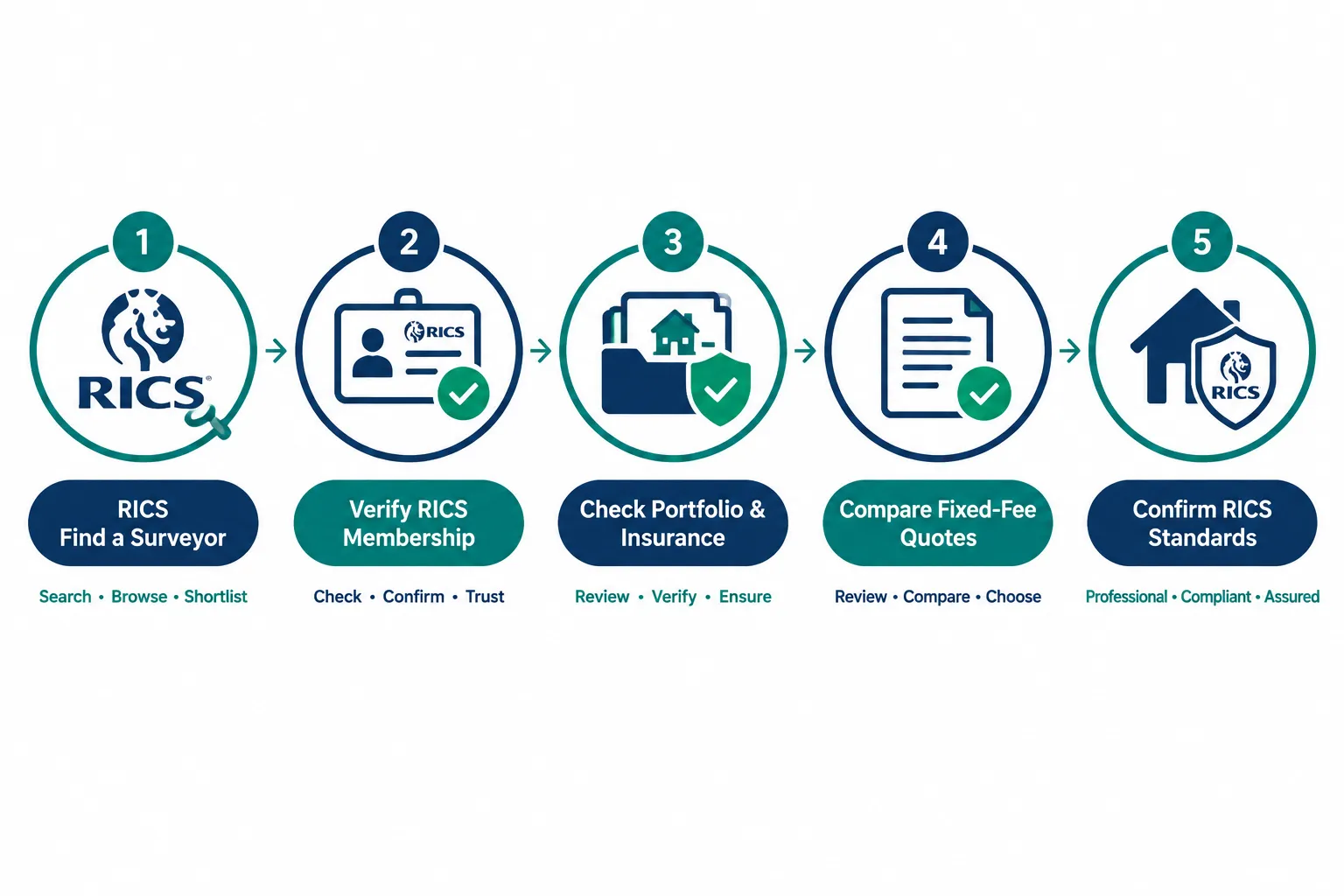
A building survey is only as reliable as the professional conducting it. The UK surveying market is largely unregulated at the individual level, meaning that, in theory, anyone can call themselves a "surveyor." What separates a truly professional surveyor from an unqualified one is membership of the Royal Institution of Chartered Surveyors (RICS), which imposes mandatory competency standards, continuing professional development, and a formal complaints procedure.
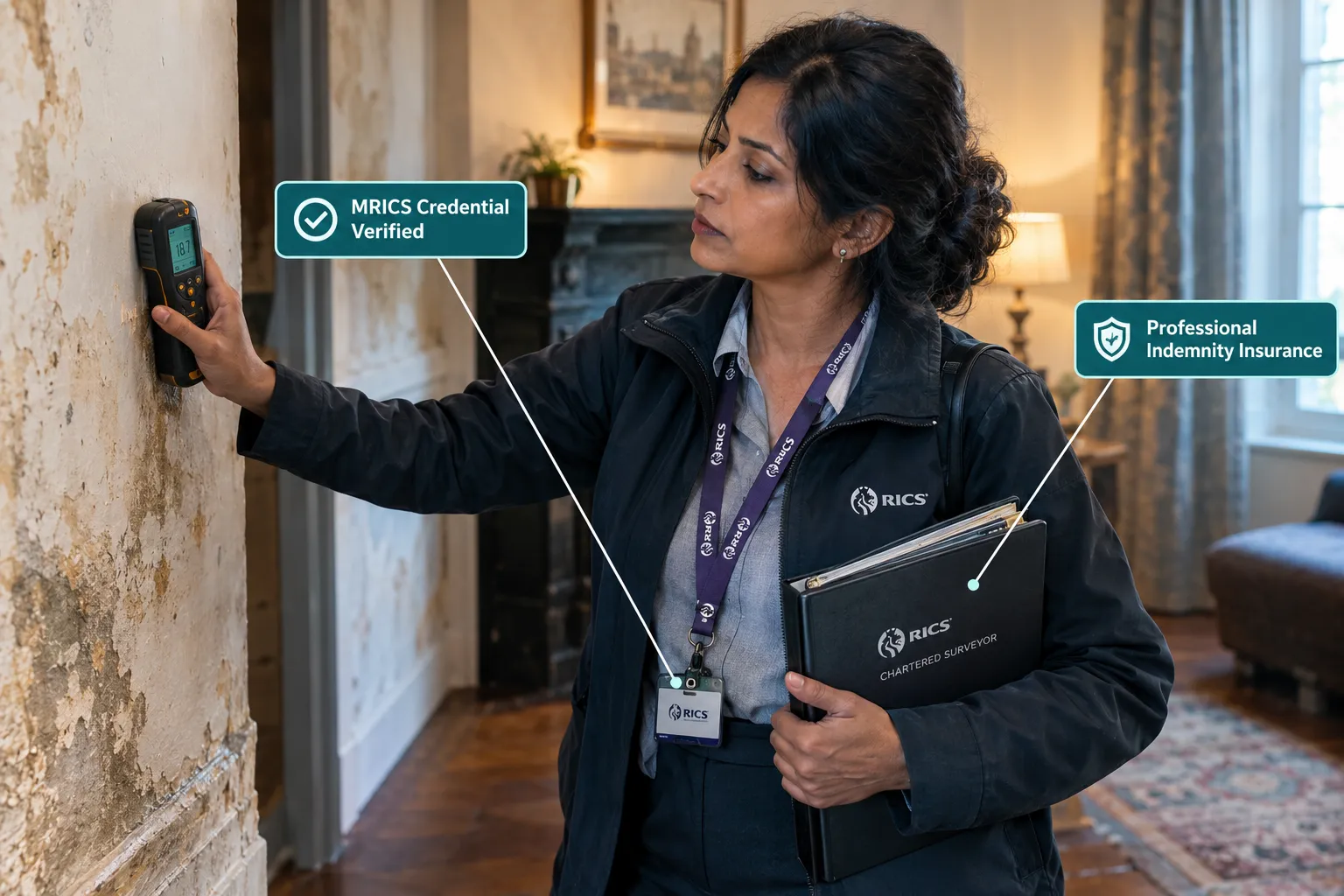
Understanding what a chartered surveyor does and their roles and responsibilities is a useful first step before you begin your search. Chartered surveyors hold either MRICS (Member) or FRICS (Fellow) status, both designations require demonstrated competence, ethical compliance, and professional indemnity insurance. These are not honorary titles; they are actively maintained and can be revoked.
The stakes are particularly high for buyers of older or period properties, where structural defects, damp, and roof problems are common but not always visible to the untrained eye. Instructing an underqualified surveyor on such a property is a false economy that can cost tens of thousands of pounds in missed defects.
The core principle: the route you take to find your surveyor directly affects the quality of the survey you receive.
The Official Starting Point: RICS Directories and How to Use Them
The single most authoritative route to a professional building surveyor in the UK is the RICS "Find a Surveyor" directory at ricsfirms.com. This official online search tool lists over 40,000 surveying firms, each of which must employ at least one qualified Chartered Surveyor or Associate RICS member [5][2][7]. The directory is actively maintained and covers all UK regions, including London, regional cities, and smaller towns [3][8].
How to Search Effectively
The RICS firm directory allows you to filter results by:
- Location, enter a postcode or town to find firms near you [2][3]
- Service type, select residential building surveys, home surveys, or specialist services
- Firm size, useful if you prefer an independent local practice or a larger national firm
Once you have a shortlist of three to five firms, the next step is to verify the individual surveyor, not just the firm, who will actually carry out your inspection. Use the separate RICS "Find a Member" database at rics.org to confirm their name, membership number, and current status as MRICS or FRICS [1][5]. This step is critical: a firm may be RICS-regulated, but the surveyor assigned to your job may be a junior employee without full chartered status.
"A firm may be RICS-regulated, but the surveyor assigned to your job may be a junior employee without full chartered status. Always verify the individual, not just the company."
Consumer Platforms: Useful but Verify
By mid-2026, consumer-facing platforms such as Find My Surveyor [6] have made it easier to generate a shortlist of accredited surveyors quickly. These tools are a reasonable supplementary route, particularly for buyers in areas with fewer local firms. However, expert guidance consistently recommends cross-checking any surveyor found via such platforms against the RICS membership directories and the credential checklist outlined below [1][2]. Speed of shortlisting is not a substitute for credential verification.
Choosing the Right Type of Survey for Your Property
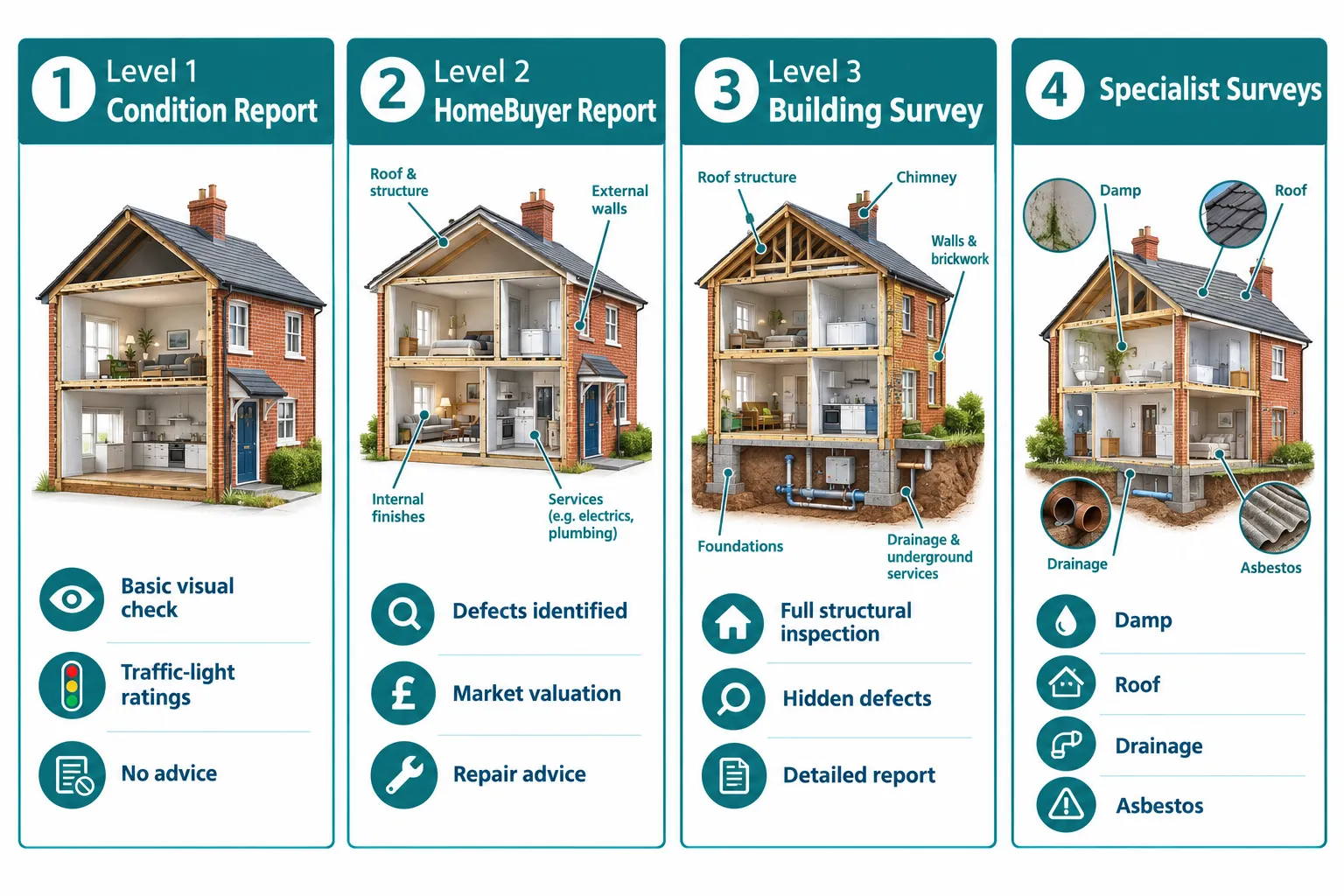
Before shortlisting surveyors, it is important to know which type of survey your property actually needs. Instructing the wrong level of survey is a common and costly mistake.
The Three Main RICS Survey Levels
| Survey Level | Best For | What It Covers |
|---|---|---|
| Level 1, Condition Report | New builds, modern homes in good condition | Basic visual inspection, traffic-light ratings |
| Level 2, HomeBuyer Report | Conventional properties in reasonable condition | Defects, market valuation, repair advice |
| Level 3, Building Survey | Older, larger, or unusual properties | Full structural inspection, hidden defects, detailed report |
For buyers of new-build properties, the question of whether a survey is needed at all is a common one, see this complete guide to whether you need a survey on a new build for a detailed answer. For most period or pre-1960s properties, a Level 3 RICS building survey is the appropriate choice.
If you are still weighing up the differences between survey types, a clear breakdown of Level 2 vs Level 3 survey key differences will help you make an informed decision before approaching surveyors.
Specialist Surveys
Some properties require additional specialist inspections alongside or instead of a standard building survey. These include:
- Damp surveys for properties with suspected moisture ingress
- Roof surveys for properties with aging or visibly damaged roofing
- Drainage surveys for properties with older drainage systems
- Asbestos surveys for properties built before 2000
Knowing which type of survey you need before contacting firms allows you to ask more precise questions and compare quotes on a like-for-like basis.
The Five-Question Checklist: Best Routes to a Reliable Building Survey When Shortlisting Surveyors
Once you have a shortlist of three to five local firms, apply the following checklist to each surveyor before instructing them. This five-question framework, drawn from 2026 industry guidance on professional surveying standards, directly reduces the risk of receiving an unreliable or incomplete survey.
1. Are They MRICS or FRICS With Relevant Experience?
Confirm RICS membership via the "Find a Member" database [1]. MRICS and FRICS are the two full chartered designations. An Associate RICS (AssocRICS) member has a lower qualification threshold and may be appropriate for straightforward surveys, but for complex or high-value properties, full chartered status is preferable.
Ask specifically: "Will the surveyor conducting the inspection hold MRICS or FRICS status?" If the answer is vague, treat it as a red flag.
2. Can They Show a Portfolio of Similar Projects in the Last 12 Months?
A professional surveyor should be able to demonstrate recent experience with properties similar to yours in type, age, and location. Ask for anonymised examples of comparable survey reports completed in the past year. Reluctance to provide these is a warning sign.
3. Does Every Deliverable Include an Explicit Accuracy Statement?
A professional survey report should clearly state its scope, the methodology used, and any limitations on the findings. Reports that hedge every conclusion without explanation, or that omit scope statements entirely, are of limited practical value.
4. Is Professional Indemnity Insurance Appropriate for the Project Value?
All RICS-regulated firms are required to hold professional indemnity (PI) insurance, but the level of cover varies. For high-value properties, ask the firm to confirm the level of PI cover in writing. This protects you if the surveyor misses a significant defect that later leads to financial loss.
5. Is the Quote Fixed-Fee With Scope, Deliverables, and Turnaround Agreed in Writing?
A professional surveyor will provide a fixed-fee quote that specifies exactly what is included: the type of survey, the areas to be inspected, the format of the report, and the expected turnaround time. Open-ended or hourly-rate quotes for standard building surveys are unusual and should prompt further questions.
Understanding 2026 Cost Benchmarks to Spot Red Flags
Knowing what a professional building survey should cost in 2026 is one of the most practical tools for identifying underqualified surveyors who compete on price rather than quality.
Current cost benchmarks for measured building surveys across UK regions (as of mid-2026) are as follows:
| Property Type | Regional UK | London |
|---|---|---|
| 2-3 bed house | £400, £600 | £600, £1,200 |
| 4+ bed house | £500, £800 | £600, £1,200 |
| Period property | £500, £900 | Higher end of range |
| Commercial property | £800, £1,500 | Higher end of range |
Underpricing, a quote significantly below these ranges, often signals that the surveyor will conduct a cursory inspection, produce a template report, or lack the insurance and qualifications of a properly regulated professional.
Overpricing without a clear justification (specialist equipment, unusual access requirements, complex property type) can also be a signal of opportunism rather than expertise.
For a broader overview of surveying services, costs, and how to choose the right firm, the complete guide to building surveyors in London provides a detailed reference point, particularly useful for buyers in the capital.
Red Flags to Watch for When Instructing a Surveyor
The best routes to a reliable building survey: how to find a truly professional surveyor near you in the UK also involve knowing what to avoid. The following are concrete warning signs that a surveyor may not meet professional standards:
- No verifiable RICS membership, they cannot be found on the RICS "Find a Member" database [1]
- Reluctance to provide a written, fixed-fee quote before the survey is booked
- No professional indemnity insurance or unwillingness to confirm the level of cover
- Generic or template-style report samples with no property-specific observations
- Pressure to book immediately without time to compare quotes or verify credentials
- No mention of RICS Home Survey Standards in their proposal or engagement letter, firms that reference these standards are more likely to deliver consistent, regulated outputs [12]
- Unusually fast turnaround promises (e.g., same-day reports for complex properties)
- No complaints procedure, RICS-regulated firms are required to have one [4]
A useful additional check is to review whether the surveyor is genuinely qualified using the guidance in this article on how to verify a surveyor's credentials in the UK.
Finding a Local Surveyor: Location-Specific Considerations
The RICS firm directory covers all UK regions [3][8], but local knowledge matters. A surveyor with direct experience of properties in your specific area will be better placed to identify region-specific issues, for example, subsidence risks in certain London clay zones, flooding history in low-lying areas, or common defect patterns in local Victorian or Edwardian stock.
When searching for a local firm, consider whether the surveyor:
- Has conducted surveys in your specific postcode or neighbourhood recently
- Understands the local property market well enough to contextualise their findings
- Is physically based close enough to conduct a thorough inspection without time pressure
For buyers in specific areas, location-specific chartered surveyor services are available across a wide range of UK locations, including chartered surveyors in Twickenham, chartered surveyors in Richmond, chartered surveyors in Epsom, and chartered surveyors in Sussex, among many others.
The Regulatory Backdrop: Why 2026 Is a Pivotal Year for Survey Standards
RICS is currently running linked public consultations on updates to the Home Survey Standard and a potential regulatory scheme for home surveys [12][13]. These consultations, active through late 2025 and into 2026, signal that future home surveys will be more tightly standardised. Surveyors who already align closely with current RICS Home Survey Standards are better positioned to deliver compliant, high-quality outputs regardless of how the regulatory landscape evolves.
Additionally, sector commentary for 2025-2026 highlights the impact of consumer protection legislation, including the Digital Markets, Competition and Consumers Act, on how surveying services are marketed and delivered [9]. This regulatory pressure is pushing professional firms toward clearer service descriptions, more transparent terms, and stronger complaint handling. When reviewing a surveyor's proposal or engagement letter, these qualities are meaningful signals of a well-run, professionally managed practice.
Conclusion: A Practical Action Plan for 2026
The best routes to a reliable building survey: how to find a truly professional surveyor near you in the UK can be summarised in a clear sequence of steps that any property buyer can follow in 2026.
Actionable next steps:
- Start with the RICS "Find a Surveyor" directory at ricsfirms.com to identify three to five local firms offering the type of building survey you need [2][7].
- Verify each individual surveyor, not just the firm, using the RICS "Find a Member" database to confirm MRICS or FRICS status [1][5].
- Apply the five-question checklist: credentials, portfolio, accuracy statements, PI insurance, and a fixed-fee written quote.
- Compare quotes against 2026 cost benchmarks to identify underpricing or overpricing that may signal quality concerns.
- Favour firms that reference RICS Home Survey Standards and recent RICS frameworks in their materials.
- Watch for red flags, no verifiable membership, no written quote, no complaints procedure, or pressure to book immediately.
- Choose a surveyor with genuine local knowledge of your property type and area.
Taking these steps before instructing a surveyor takes less than a day but can save thousands of pounds and months of legal complications. A truly professional surveyor is not hard to find, but they do require a structured approach to identify.
References
[1] Find A Member – https://www.rics.org/find-a-member
[2] Surveyors – https://www.ricsfirms.com/surveyors/
[3] ricsfirms – https://www.ricsfirms.com/search/GB/
[4] Contact Us – https://www.rics.org/footer/contact-us
[5] About Us – https://www.ricsfirms.com/about-us/
[6] findmysurveyor – https://findmysurveyor.com/
[7] ricsfirms – https://www.ricsfirms.com/
[8] Search – https://www.ricsfirms.com/search/
[9] pbctoday.co.uk – https://www.pbctoday.co.uk/news/planning-construction-news/five-hot-topics-surveyors-autumn-2025/155201/