
A single unpatched GNSS field controller connected to a cloud survey platform can expose an entire project's cadastral dataset to a ransomware attack — and from 27 April 2026, that oversight is also an automatic Cyber Essentials compliance failure. For surveying practices across the UK, the convergence of tightening regulation, an evolving threat landscape, and the mass migration of geospatial workflows to the cloud has made cybersecurity a front-line professional concern rather than a back-office IT afterthought. Understanding the Cybersecurity Essentials for Surveyors: Protecting Geospatial Data in the Cloud Era is no longer optional — it is a condition of winning public sector contracts, protecting client data, and maintaining professional credibility.
Key Takeaways
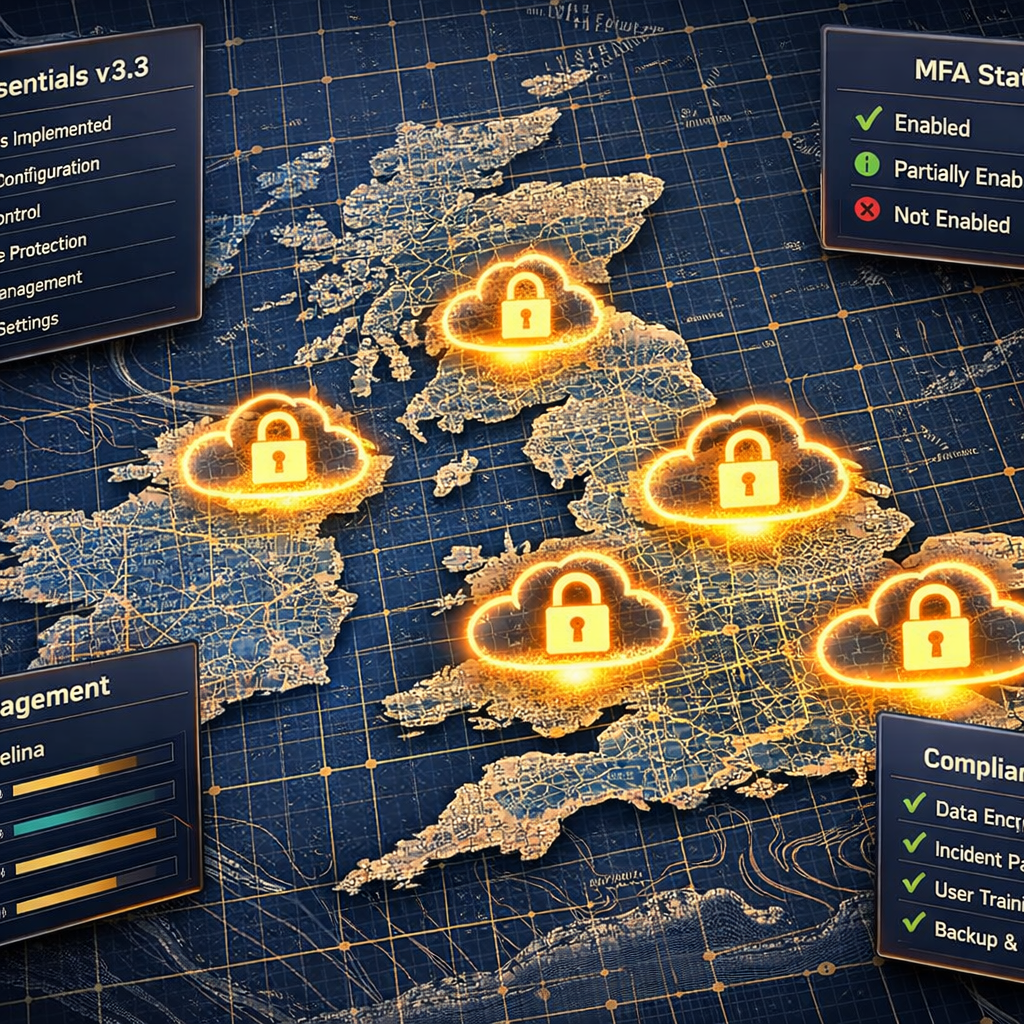
- From 27 April 2026, all cloud services storing or processing organisational data are explicitly in scope under the updated UK Cyber Essentials framework (Requirements for IT Infrastructure v3.3).
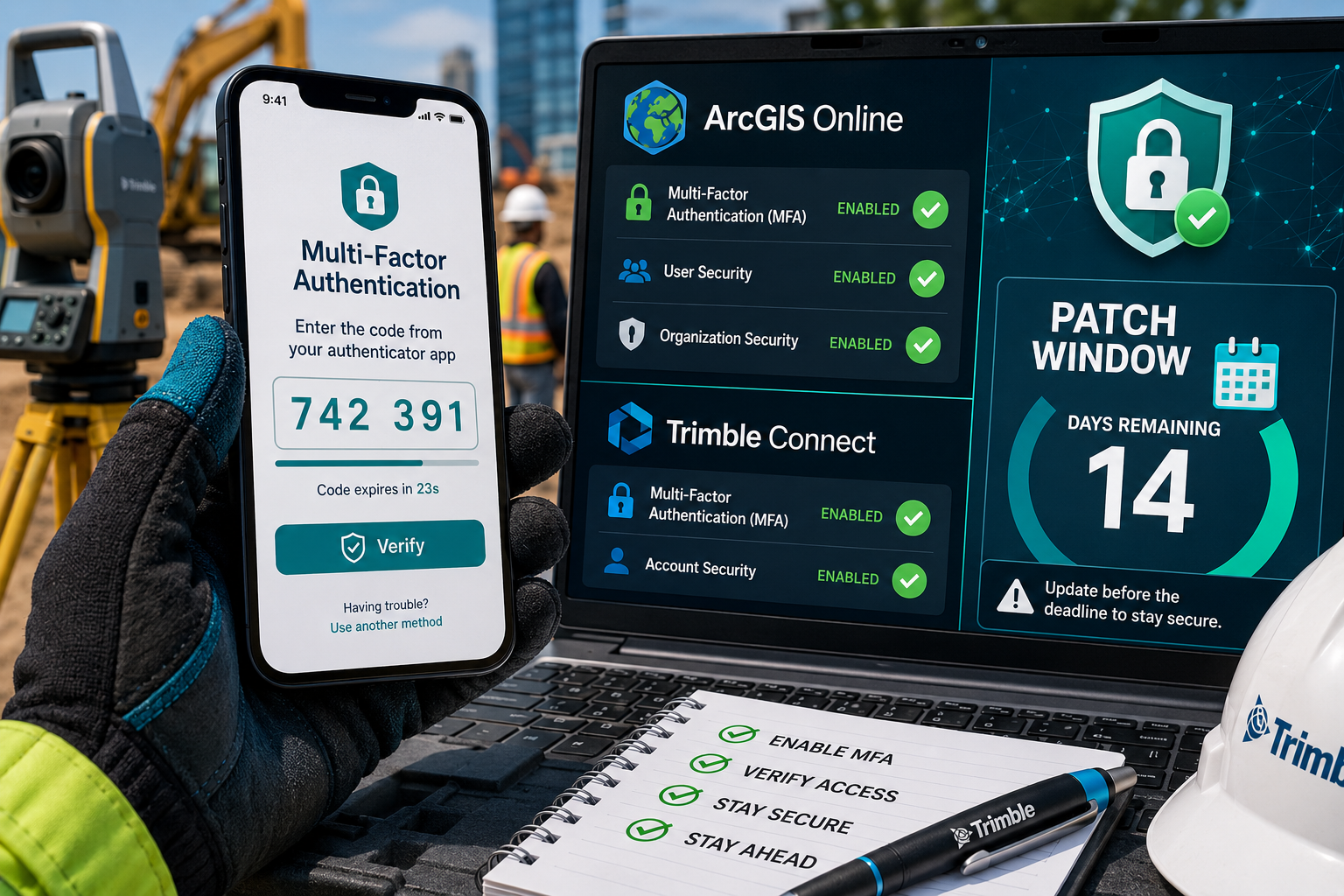
- Multi-factor authentication (MFA) is now mandatory on every cloud account — including standard field staff accounts — and failure to enable it is an automatic assessment fail.
- Critical security patches must be applied within 14 days of release, covering field controllers, GNSS receivers, rugged tablets, and cloud-synchronised survey software.
- Geospatial data — including topographic, cadastral, and infrastructure datasets — is a high-value target; breaches carry legal, financial, and reputational consequences for survey firms.
- Survey practices working with UK public sector clients must treat Cyber Essentials compliance as a de-facto tender requirement in 2026 and beyond.

The 2026 Threat Landscape: Why Geospatial Data Is a Target
Geospatial data has quietly become one of the most commercially sensitive categories of information that a professional services firm can hold. Topographic surveys of critical national infrastructure, cadastral records tied to high-value property transactions, underground utility mapping, and real-time monitoring data from construction sites all represent assets that threat actors — ranging from opportunistic ransomware gangs to state-affiliated groups — are actively seeking.
The UK's National Cyber Security Centre (NCSC) has consistently highlighted professional services firms, including those in the built environment sector, as targets of phishing campaigns, supply chain attacks, and credential stuffing. For surveyors, the attack surface has expanded dramatically as workflows have shifted to cloud platforms. Tools such as ArcGIS Online, Trimble Connect, Leica Geosystems cloud services, and Microsoft 365 SharePoint are now central to daily operations — and each represents a potential entry point if not properly secured.
The financial consequences of a breach are significant. Beyond immediate remediation costs, firms face potential liability under the UK GDPR if personal data (including property owner information embedded in survey records) is compromised, regulatory sanctions, and the reputational damage of losing a client's sensitive project data. For practices that rely on public sector contracts — where geospatial data sensitivity is highest — a breach can be career-defining in the worst possible way.
Understanding what a chartered surveyor is responsible for professionally helps frame why data stewardship sits at the heart of modern practice. The professional obligations that govern survey work extend naturally to the digital environments in which that work is conducted.
Understanding the April 2026 Cyber Essentials Changes
The UK government's Cyber Essentials scheme, administered through IASME, underwent its most significant revision in years when Requirements for IT Infrastructure v3.3 came into force on 27 April 2026. For surveying practices, the changes are directly relevant and demanding [1][9].
Cloud Services Are Now Fully in Scope
The most consequential change for survey firms is the explicit inclusion of all cloud services within the Cyber Essentials assessment scope. Previously, there was ambiguity about whether SaaS platforms, cloud storage, and hosted databases needed to be assessed. That ambiguity is gone [9].
Under v3.3, any cloud service that stores or processes organisational data — including geospatial project files, client records, drone survey outputs, and point cloud datasets — must be brought into scope and assessed against the five Cyber Essentials controls: firewalls, secure configuration, user access control, malware protection, and patch management [1][5].
This means that a survey firm using Dropbox for project file sharing, OneDrive for report storage, and a cloud-hosted GIS platform for data delivery must now demonstrate that all three environments meet the required controls. The days of treating cloud platforms as someone else's security problem are over [8].
"All cloud services that store or process organisational data are now presumed in scope — there is no opt-out unless the service is formally and technically segregated from the rest of the organisation's infrastructure." [9]
Internet-Connected Field Devices Are Also in Scope
Any device or service that accepts inbound or outbound internet connections — or routes internet-connected data — is now considered in scope unless it is formally and technically segregated [5][1]. For surveyors, this directly affects:
- GNSS base stations connected via IP networks
- Cloud-connected data collectors and field controllers
- Mobile field laptops and rugged tablets used on site
- Drone ground control systems with cloud sync capabilities
- IoT monitoring sensors transmitting to cloud dashboards
This is a significant expansion. A GNSS receiver that uploads raw observation data to a cloud processing service, or a total station controller that syncs project data over a mobile network, is now subject to the same scrutiny as an office workstation [5][10].
For practices offering specialist services such as drone surveys or monitoring surveys, the number of in-scope devices can be substantial, requiring a thorough asset inventory before any assessment.
MFA Is Now Mandatory — No Exceptions
Perhaps the most operationally impactful change is the mandatory requirement for multi-factor authentication across all cloud accounts [9][7]. Under the April 2026 update:
- MFA must be enabled wherever a cloud service offers it
- This applies to all named users, not just administrators
- Failure to enable MFA for any account — including field staff and contractors — is an automatic assessment fail [7][9]
This directly affects the day-to-day workflows of survey teams. A field operative accessing ArcGIS Online from a site tablet, a junior surveyor logging into Trimble Connect from a personal laptop, or a contractor uploading deliverables to a shared SharePoint folder — all of these scenarios now require MFA to be active [5][7].
Expert commentary on the 2026 changes has been unambiguous: organisations that continue to allow contractors and field staff to access cloud data with passwords alone will fail their Cyber Essentials assessment, and many are expected to do so if they have not already addressed this gap [7].
Practical Cybersecurity Controls for Survey Practices
Meeting the Cybersecurity Essentials for Surveyors: Protecting Geospatial Data in the Cloud Era challenge requires translating regulatory requirements into practical, day-to-day operational changes. The following controls address the most critical risk areas.
Patch Management: The 14-Day Rule
The 2026 Cyber Essentials revision formalises that critical security patches must be applied within 14 days of release [1][10]. Organisations must be able to prove compliance through scans and documented patch reports. For survey firms, this creates a specific challenge because field equipment — GNSS receivers, rugged tablets, field controllers — often lags significantly behind office systems in firmware and application updates [5][3].
Recommended approach:
| Device Category | Patch Management Action |
|---|---|
| Office workstations and laptops | Automated patch management via Windows Update or endpoint management tool |
| Field rugged tablets and controllers | Monthly firmware check schedule; document update dates |
| GNSS receivers with IP connectivity | Subscribe to manufacturer security bulletins; apply firmware within 14 days |
| Cloud-connected survey software | Enable auto-update where available; log version changes |
| Mobile devices (iOS/Android) | Enforce OS updates via mobile device management (MDM) policy |
Unpatched field devices will be treated identically to unpatched office laptops in Cyber Essentials audits [5][3]. Practices that have historically managed field equipment informally must now formalise this process.
Secure Configuration of Cloud Platforms
Default settings on cloud platforms are rarely secure. Survey practices must actively configure their cloud environments rather than accepting out-of-the-box defaults [1][8].
Key configuration actions include:
- Disable unused features and services on cloud platforms (e.g., anonymous sharing links in SharePoint or Dropbox)
- Apply the principle of least privilege — field staff should only access the project data relevant to their current assignment
- Review and remove stale accounts — former employees and contractors whose credentials remain active are a common attack vector
- Enable audit logging on all cloud platforms to create an evidence trail for assessments and incident investigation
For practices conducting building surveys or commercial building surveys, where client data sensitivity is high and project lifecycles can span years, stale account management is particularly important.
Protecting Data in Transit and at Rest
Geospatial data moving between field devices and cloud platforms, or between a survey firm and its clients, must be encrypted in transit. All reputable cloud platforms use TLS encryption for data in transit as standard, but practices must verify this is active and not disabled by misconfiguration.
For data at rest — stored project files, point clouds, orthomosaics, and survey reports — cloud storage encryption should be confirmed and documented. Where particularly sensitive data is involved (critical infrastructure surveys, for example), additional encryption at the file level may be appropriate before upload.
Staff Training and Phishing Awareness
Technical controls alone are insufficient. Phishing remains the most common initial access vector for cyberattacks against professional services firms. Survey staff — particularly those working in the field who may be accessing email on mobile devices in distracting environments — are vulnerable to credential-harvesting attacks.
Annual security awareness training should be mandatory for all staff, including field operatives. Specific training should cover:
- Recognising phishing emails and SMS messages
- Safe use of public Wi-Fi networks when accessing cloud platforms on site
- Reporting suspected incidents promptly
- Secure handling of USB drives and external storage (a common malware vector on construction sites)
Incident Response Planning
Every survey practice, regardless of size, should have a documented incident response plan that covers the scenario of a cloud data breach. The plan should identify:
- Who is responsible for declaring an incident
- How to isolate affected systems (including revoking cloud access tokens)
- Notification obligations under UK GDPR (the Information Commissioner's Office must be notified within 72 hours if personal data is involved)
- How to communicate with affected clients
- Recovery procedures for restoring data from backups
Building a Cyber Essentials Compliance Programme for Surveyors
For practices seeking formal Cyber Essentials certification — which is increasingly required for UK public sector contracts involving sensitive geospatial data — a structured compliance programme is needed [3][8].
Step 1: Asset Inventory
Compile a complete inventory of all in-scope devices and cloud services. For a typical survey practice, this will include office IT, field equipment, and all cloud platforms used for data storage, processing, and delivery. Do not overlook:
- Personal devices used by staff to access work cloud platforms (BYOD)
- Third-party contractor devices that connect to the firm's cloud environment
- Cloud platforms used by subconsultants with access to project data
Step 2: Gap Analysis Against v3.3 Controls
Map current security controls against the five Cyber Essentials technical controls under v3.3. Pay particular attention to MFA status across all cloud accounts and patch currency across all in-scope devices [9][1].
Step 3: Remediation
Address identified gaps systematically. MFA enablement and patch management are typically the highest-priority remediation actions given their status as automatic fail criteria under the 2026 framework [7][10].
Step 4: Evidence Collection
Gather documentary evidence of compliance: screenshots of MFA settings, patch reports, configuration records, and asset inventory documentation. Cyber Essentials Plus assessments involve technical verification through scanning, so evidence must be robust [4].
Step 5: Maintain and Review
Cyber Essentials certification is annual. Build ongoing processes — automated patch reporting, quarterly access reviews, regular security awareness training — to maintain compliance between assessments [8].
For practices offering dilapidations surveys or schedule of condition reports, where detailed photographic and written records of property condition are held in cloud systems, maintaining continuous compliance protects both the firm and its clients.
Cybersecurity Essentials for Surveyors: Protecting Geospatial Data in the Cloud Era — Sector-Specific Risks
Certain survey specialisms carry elevated cybersecurity risk profiles that warrant additional attention beyond baseline Cyber Essentials compliance.
Critical Infrastructure Surveys
Surveys of utilities, transport networks, and energy infrastructure produce data that is classified as sensitive under the UK's National Security and Investment Act and related frameworks. Loss or unauthorised disclosure of this data can have consequences beyond the commercial — it can represent a national security risk. Practices in this space should consider Cyber Essentials Plus (the independently verified tier) as a minimum, and should review whether additional controls such as network segmentation and enhanced access controls are warranted.
Real-Time Monitoring Data
Monitoring surveys that transmit real-time structural or ground movement data to cloud dashboards create a continuous data stream that must be secured end-to-end. Compromised monitoring data could lead to false alerts — or, more dangerously, suppressed alerts — with serious safety implications. The integrity of the data pipeline, not just its confidentiality, is a critical security objective.
Property Transaction Surveys
Surveys conducted as part of property transactions — including Level 2 home surveys and Level 3 building surveys — contain personal data about property owners and buyers. This data is subject to UK GDPR, and cloud storage of survey reports must comply with data protection principles including storage limitation and security of processing.
Supply Chain Risk
Survey practices frequently work within larger project teams — alongside architects, engineers, contractors, and project managers — sharing data through common cloud platforms. A security weakness in any part of that supply chain can expose the survey firm's data. Practices should assess the security posture of key supply chain partners and include cybersecurity requirements in subconsultant agreements.
Conclusion
The Cybersecurity Essentials for Surveyors: Protecting Geospatial Data in the Cloud Era is not a theoretical concern for the future — it is a pressing operational and compliance reality in 2026. The April 2026 Cyber Essentials update has fundamentally changed the rules: cloud services are in scope, MFA is mandatory for every user, and 14-day critical patching is now a verifiable requirement rather than a best-practice aspiration.
Actionable next steps for survey practices:
- Conduct an immediate asset inventory covering all cloud platforms, field devices, and mobile endpoints that connect to organisational data.
- Enable MFA on every cloud account — ArcGIS Online, Trimble Connect, Microsoft 365, Google Workspace, and any cloud storage platform — for all users including field staff and contractors.
- Establish a formal patch management process with documented evidence of update dates for all in-scope devices, including GNSS receivers and field controllers.
- Review cloud platform configurations to remove default settings, disable unnecessary sharing features, and apply least-privilege access controls.
- Develop or update an incident response plan that specifically addresses cloud data breach scenarios and UK GDPR notification obligations.
- Pursue Cyber Essentials certification — or Cyber Essentials Plus for higher-risk specialisms — to demonstrate compliance to public sector clients and protect the practice against the most common cyber threats.
The geospatial data that surveyors generate and steward is valuable, sensitive, and increasingly targeted. Treating cybersecurity as a core professional competency — alongside measurement accuracy and legal compliance — is the standard that 2026 demands.
References
[1] Cyber Essentials 2026 Updates What You Need To Know – https://www.cybersecurityspecialists.co.uk/cyber-essentials-2026-updates-what-you-need-to-know/
[3] Cyber Essentials Is Changing In 2026. Heres What Organisations Need To Know – https://insights.integrity360.com/cyber-essentials-is-changing-in-2026.-heres-what-organisations-need-to-know
[4] Cyber Essentials Plus 2026 Compliance – https://blog.qualys.com/product-tech/2026/03/02/cyber-essentials-plus-2026-compliance
[5] Cyber Essentials Certification 2026 – https://www.minervauk.com/cyber-essentials-certification-2026/
[7] Cyber Essentials 2026 Two Changes Catching Enterprises Out – https://www.claranet.com/uk/blog/cyber-essentials-2026-two-changes-catching-enterprises-out/
[8] The Cyber Essentials Schemes 2026 Update And What It Means For Your Organisation – https://grcsolutions.io/the-cyber-essentials-schemes-2026-update-and-what-it-means-for-your-organisation/
[9] Upcoming Changes To The Cyber Essentials Scheme April 2026 Update – https://iasme.co.uk/articles/upcoming-changes-to-the-cyber-essentials-scheme-april-2026-update/
[10] Cyber Essentials 2026 Changes – https://www.advantex.uk.com/cyber-essentials-2026-changes/
