
Property tax disputes in the UK rose sharply following the 2024 Autumn Budget, with assessors routinely relying on historical data that no longer reflects current market realities — a gap that expert witnesses are uniquely positioned to close [1]. As buyer enquiries tracked by RICS began their measured recovery into 2025 and 2026, the need for rigorous, defensible valuations in legal and tax proceedings has never been more pressing. Understanding expert witness roles in post-budget property valuations: adapting to tax changes and market stabilisation is now a core competency for solicitors, property owners, and surveyors alike.

Key Takeaways
- Post-Autumn Budget tax changes have directly increased the volume of property valuation disputes requiring expert witness input.
- Expert witnesses must demonstrate independence, RICS-compliant methodology, and an ability to justify comparable evidence in stabilising markets.
- Proactive reassessment of property values — rather than waiting for assessors to act — is a critical strategy for managing tax liability [1].
- Market stabilisation creates specific evidential challenges: thin transaction volumes and diverging comparable sales require expert interpretation.
- Qualified expert witnesses provide services spanning tax appeals, divorce proceedings, estate disputes, and mortgage valuation challenges [8].
How the Post-Autumn Budget Landscape Reshaped Property Valuation Disputes
The 2024 Autumn Budget introduced a series of tax adjustments that reverberated across the UK property market. Stamp Duty Land Tax thresholds were revised, Capital Gains Tax rates on residential property were restructured, and changes to Inheritance Tax treatment of agricultural and business property sparked immediate uncertainty. These shifts did not simply alter transaction costs — they fundamentally changed how properties are valued for tax purposes, and how those valuations are challenged.
RICS data tracking buyer enquiries showed a notable uptick in activity through late 2025 and into 2026, as purchasers and vendors recalibrated their positions in response to the new fiscal environment. This renewed market engagement, however, came against a backdrop of price stabilisation rather than outright growth. Prices in many segments were neither falling sharply nor rising convincingly. That ambiguity is precisely where disputes arise.
Why stabilising markets create more disputes, not fewer:
- Comparable sales evidence becomes thinner and harder to interpret
- Assessors may rely on peak-market figures that overstate current values [1]
- Buyers and sellers disagree on whether a property sits above or below the stabilised mean
- Tax authorities may apply valuations that do not account for post-Budget sentiment shifts
Deloitte has highlighted that property tax assessors frequently use historical data that lags behind actual market conditions, creating a persistent mismatch between assessed and true market value [1]. For property owners facing inflated tax bills, or for those contesting a valuation in legal proceedings, an expert witness who can bridge that gap is invaluable.
Understanding the full scope of valuation factors that influence property assessments is essential context for any expert witness preparing to give evidence in these circumstances.
What Expert Witness Roles in Post-Budget Property Valuations Involve
Expert witness roles in post-budget property valuations: adapting to tax changes and market stabilisation encompass a far broader set of responsibilities than simply attending court and giving an opinion. The role begins long before any hearing and demands a combination of technical expertise, procedural discipline, and communicative clarity.
The Core Responsibilities
An expert witness in property valuation matters is typically instructed to:
- Prepare a written expert report setting out their opinion of value, the methodology used, and the evidence relied upon
- Review and respond to opposing expert evidence, identifying areas of agreement and disagreement
- Attend joint meetings with the opposing expert to narrow the issues in dispute
- Give oral evidence at tribunal, court, or arbitration hearings
- Advise legal teams on the technical merits of a valuation case during pre-trial preparation [4]
The Knowles Group, which brings over 30 years of experience in state and federal venues, demonstrates how financial expert witness testimony and damage calculations in real estate disputes require both technical depth and courtroom credibility [7]. In the UK context, the same principles apply: an expert who cannot explain their methodology clearly under cross-examination will see their evidence discounted.
Qualification Standards
Qualification requirements for expert witnesses in property matters are stringent. In the UK, RICS membership — ideally at Fellow or Member level — is the accepted standard. The expert must be able to demonstrate:
- Active professional practice in the relevant property sector
- Familiarity with the RICS Valuation — Global Standards (Red Book)
- No conflict of interest with either party
- Compliance with Civil Procedure Rules (CPR) Part 35 obligations
In the US context, the IRS sets out under IRC Section 170(f)(11)(E) that a qualified appraiser must hold a recognised designation, meet education and experience benchmarks, and have no disqualifying relationship to the transaction [2]. While UK rules differ in their legal framing, the underlying principle — independence, competence, and accountability — is identical.
For those seeking a detailed understanding of what a professional expert witness report should contain, the standards are demanding and non-negotiable.
Adapting Expert Witness Evidence to Tax Changes and Market Stabilisation
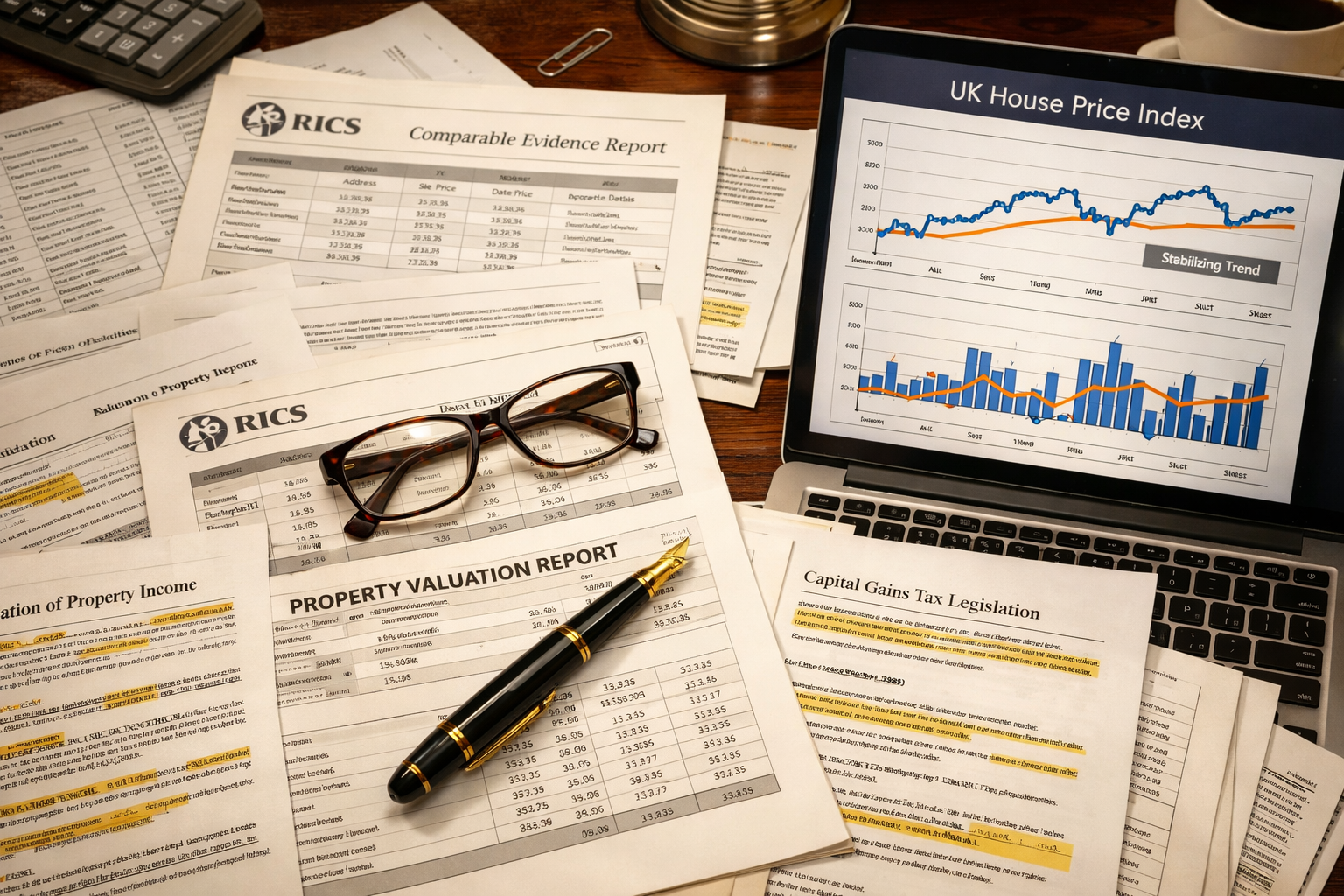
The specific challenge of expert witness roles in post-budget property valuations: adapting to tax changes and market stabilisation lies in the word "adapting." Static methodologies do not survive contact with a market in transition.
Selecting and Justifying Comparable Evidence
Canterbury Surveyors have noted that presenting valuation evidence during market stabilisation requires expert witnesses to justify their comparable sales selections with particular care [9]. In a rising market, a wide spread of comparables may still support a coherent opinion. In a stabilising market, the selection of comparables becomes contested territory.
Key principles for comparable evidence in stabilising conditions:
| Factor | Best Practice |
|---|---|
| Date of transaction | Prioritise sales closest to the valuation date |
| Market conditions adjustment | Apply and explain time adjustments explicitly |
| Property characteristics | Match closely on size, condition, and location |
| Volume of evidence | Use multiple comparables to reduce reliance on any single sale |
| Outliers | Identify and explain rather than silently exclude |
An expert who cannot account for why they selected certain comparables and rejected others will face sustained challenge in cross-examination.
Proactive Reassessment as a Dispute Avoidance Strategy
One of the most important lessons from post-Budget practice is that waiting for a tax assessor to revise a valuation is rarely the optimal strategy. Deloitte's analysis strongly advocates for proactive engagement with assessors, seeking reassessment before a formal dispute crystallises [1]. In practice, this means:
- Commissioning an independent valuation as soon as a Budget change affects the relevant tax base
- Engaging with the assessing authority early, supported by expert evidence
- Documenting market conditions at the relevant valuation date with contemporaneous data
KPMG's property tax practice similarly emphasises the importance of staying current with evolving valuations and regulations to identify savings opportunities before disputes become entrenched [6]. For property owners and their advisers, this is a proactive risk management posture, not merely a reactive one.
The Range of Dispute Types Requiring Expert Witnesses
Post-Budget changes have expanded the range of proceedings in which expert valuation evidence is required. McKissock Learning identifies twelve distinct types of expert witness assignments for appraisers, including divorce litigation, estate disputes, and tax appeal hearings [8]. In the UK post-Budget context, the most active areas include:
- Capital Gains Tax disputes: Where the acquisition or disposal value is contested
- Inheritance Tax appeals: Particularly following changes to agricultural property relief
- Stamp Duty Land Tax assessments: Where the apportioned value of mixed-use properties is disputed
- Mortgage valuation challenges: Where lenders and borrowers disagree on the security value in a stabilising market
- Dilapidations and lease-related disputes: Where market conditions affect reinstatement or diminution in value calculations
For properties with complex valuation profiles, a reinstatement cost valuation may form a critical component of the expert's overall evidence package.
Building a Defensible Expert Witness Opinion in 2026
"A defensible valuation is not simply one that reaches the right number — it is one that can withstand rigorous scrutiny at every methodological step."
In 2026, the standard expected of expert witnesses in property valuation disputes has continued to rise. Tribunals and courts are increasingly sophisticated in their understanding of valuation methodology, and opposing experts are better equipped to identify weaknesses in evidence.
The Structure of a Strong Expert Report
A well-constructed expert witness report in a property valuation dispute should follow a clear structure:
- Instructions and scope: What was the expert asked to do, and what did they do?
- Valuation date: Clearly stated and justified
- Methodology: Red Book-compliant, with alternatives considered and rejected
- Market commentary: Conditions at the valuation date, including post-Budget impacts
- Comparable evidence: Selected, adjusted, and explained
- Opinion of value: Stated as a single figure or a justified range
- Statement of truth: CPR Part 35 compliant
National Appraisal Partners emphasises that defensible appraisals require not just technical accuracy but also consulting insights that help legal teams understand the strength and limitations of the evidence [5]. An expert who can explain uncertainty honestly — rather than overstating confidence — is more credible, not less.
Litigation Support Beyond the Report
Expert witnesses increasingly provide value beyond the written report. Firms such as evcValuation offer pre-trial consulting, trial preparation, and appellate guidance as part of their litigation support services [4]. In the UK, this translates to:
- Advising solicitors on the technical strengths and weaknesses of the opposing expert's report
- Assisting with the preparation of questions for cross-examination
- Providing updated evidence if market conditions change between instruction and hearing
Elysian Insights similarly demonstrates how expert services in property disputes extend to damage analysis and financial loss quantification, not just headline valuation opinions [3].
For chartered surveyors considering this area of practice, understanding what a chartered surveyor does across different roles and responsibilities provides important context for how expert witness work fits within the broader profession.
Practical Guidance for Property Owners and Legal Teams
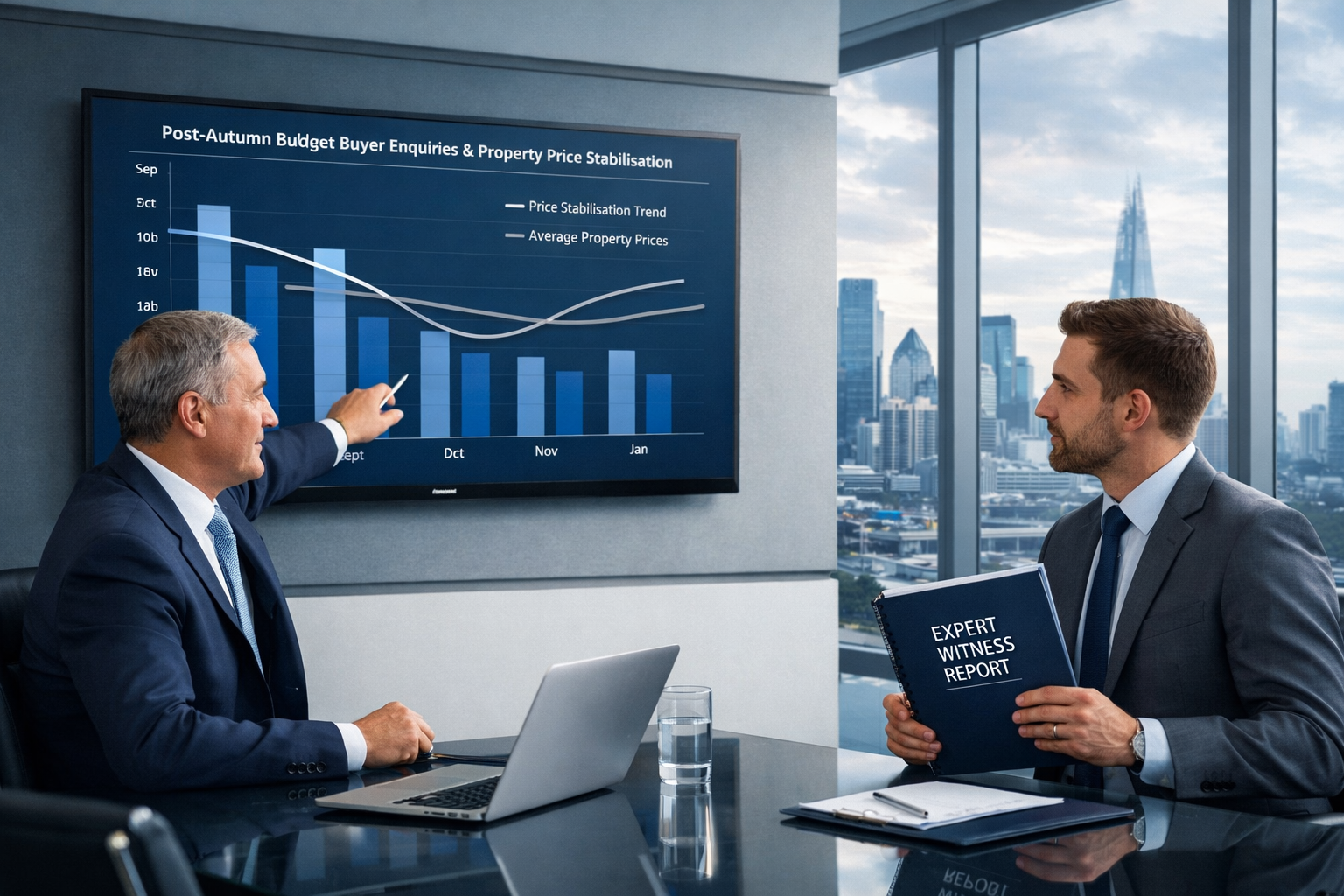
Navigating expert witness roles in post-budget property valuations requires clear thinking from both property owners and their legal advisers. The following practical steps apply in 2026:
For property owners facing a disputed valuation:
- Instruct an independent RICS-qualified surveyor at the earliest opportunity
- Preserve all documentation relating to the property's condition and market context at the relevant date
- Do not accept an assessor's valuation as final without independent review [1]
- Understand that market stabilisation may work in your favour if peak-market figures have been applied
For solicitors and legal teams:
- Identify the expert witness before proceedings are issued where possible
- Ensure the expert's instructions comply with CPR Part 35 and are clearly scoped
- Request a preliminary view before committing to a formal report
- Allow sufficient time for joint expert meetings — these frequently narrow disputes significantly
For surveyors acting as expert witnesses:
- Maintain a clear audit trail of all data sources and adjustments
- Be prepared to explain market stabilisation dynamics to a non-specialist tribunal
- Engage constructively in joint meetings — intransigence damages credibility
- Keep abreast of post-Budget legislative changes that affect the valuation basis
Understanding how property surveyors operate and what their role requires is foundational knowledge for anyone entering this field.
For disputes involving freehold interests, a specialist freehold valuation prepared to expert witness standards may be required to resolve disagreements over enfranchisement or lease extension premiums — areas where post-Budget changes have added further complexity.
Conclusion
The intersection of post-Budget tax reform and a stabilising property market has created fertile ground for valuation disputes — and placed expert witnesses at the centre of their resolution. Expert witness roles in post-budget property valuations: adapting to tax changes and market stabilisation demand technical rigour, procedural discipline, and the ability to communicate complex evidence clearly to non-specialist decision-makers.
Actionable next steps for 2026:
- Commission an independent valuation review if any post-Budget tax change has affected your property's assessed value
- Engage a RICS-qualified expert witness at the earliest stage of any dispute — before positions become entrenched
- Ensure expert reports are structured to CPR Part 35 standards and include explicit market commentary on stabilisation conditions
- Use proactive reassessment as a tax management tool, not just a dispute resolution mechanism [1]
- Brief legal teams thoroughly on the technical limitations of comparable evidence in thin markets [9]
The property market of 2026 rewards those who act on expert advice early. Whether the dispute involves Capital Gains Tax, Inheritance Tax, or a mortgage valuation challenge, a well-prepared expert witness opinion remains the most powerful tool available to property owners and their advisers.
References
[1] Property Tax Valuations Assessments – https://www.deloitte.com/us/en/services/tax/articles/property-tax-valuations-assessments.html?icid=mosaic-grid_property-tax-in-focus&utm_source=openai
[2] Irs Qualified Appraiser Requirements Rules And Penalties – https://legalclarity.org/irs-qualified-appraiser-requirements-rules-and-penalties/?utm_source=openai
[3] elysian-insights – https://www.elysian-insights.com/?utm_source=openai
[4] Litigation Support Expert Testimony – https://evcvaluation.com/valuation-services/litigation-support-expert-testimony/?utm_source=openai
[5] Valuation Consulting Taxes Ad Valorem Estate – https://www.napllp.com/valuation-consulting-taxes-ad-valorem-estate/?utm_source=openai
[6] Property Tax Practice – https://kpmg.com/us/en/capabilities-services/tax-services/indirect-tax/property-tax-practice.html?utm_source=openai
[7] Real Estate – https://www.theknowlesgroup.org/areas-of-practice/real-estate/?utm_source=openai
[8] 12 Types Of Expert Witness Assignments For Appraisers – https://www.mckissock.com/blog/appraisal/12-types-of-expert-witness-assignments-for-appraisers/?utm_source=openai
[9] Mortgage Valuation Disputes In Early Recovery Expert Witness Evidence Standards Amid Stabilizing House Prices – https://www.canterburysurveyors.com/blog/mortgage-valuation-disputes-in-early-recovery-expert-witness-evidence-standards-amid-stabilizing-house-prices/?utm_source=openai
