
A 7% drop in lettings revenue sounds like bad news. But buried inside that number is a £2.7m hit from tenants ending tenancies early, and Foxtons says that pressure eased through October. For anyone watching Foxtons Q3 2026 Notting Hill property activity, the detail matters more than the headline.
On 5 November 2026, Foxtons Group published its third-quarter trading update. Group revenue came in at £45.9m, down 6% year on year. For owners, landlords and buyers in Notting Hill, Kensington and the wider West London market, this update is one of the clearest windows available into how a turbulent year is actually playing out on the ground.
Key Takeaways
- Group revenue fell 6% to £45.9m in Q3 2026; lettings revenue dropped 7% to £31.1m.
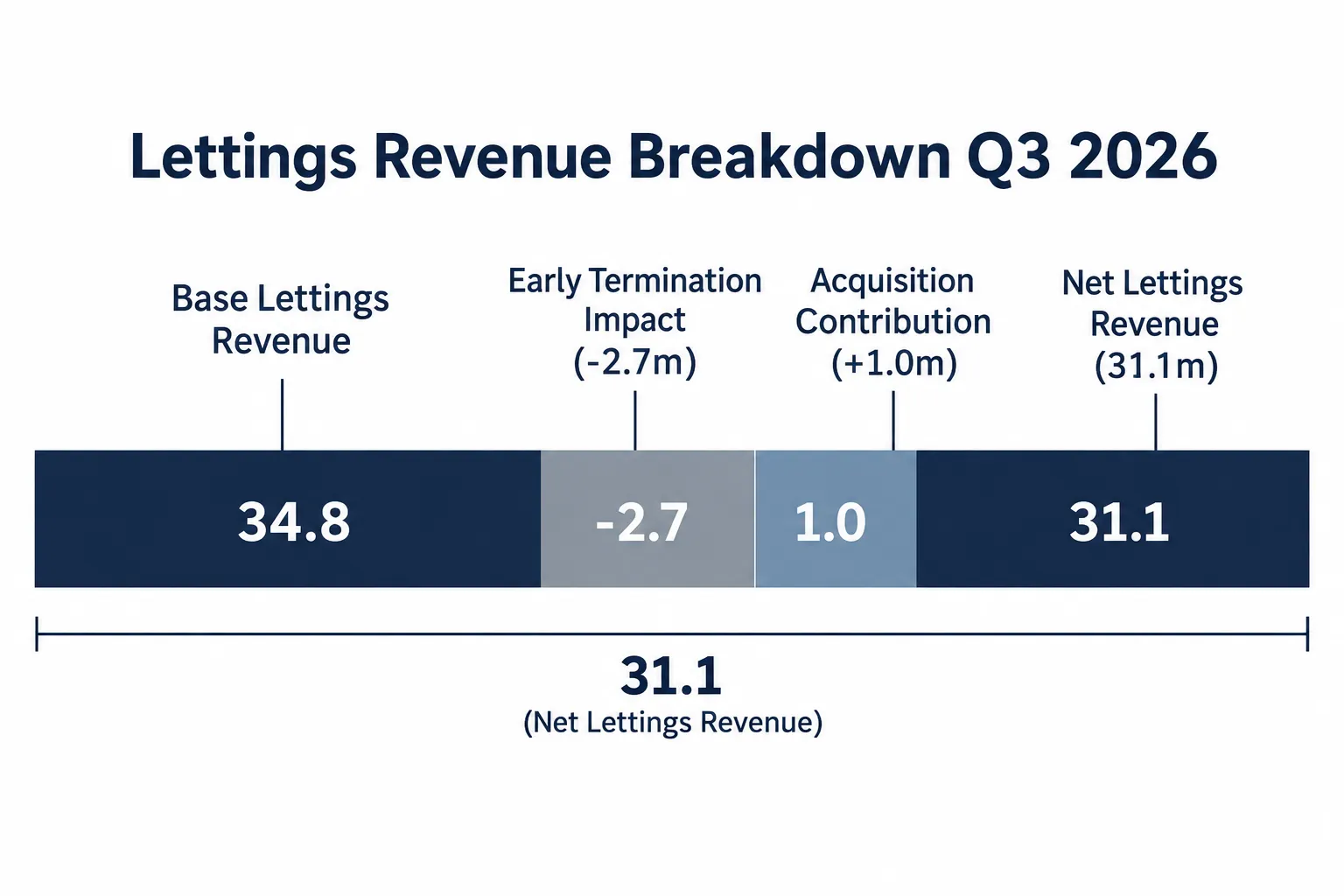
- £2.7m of the lettings fall came from tenant-led early terminations tied to the Renters' Rights Act, which started 1 May 2026.
- Excluding that effect, lettings revenue was marginally ahead year on year, helped by £1.0m from acquisitions.
- Sales revenue fell 5% to £12.0m; transaction volumes held broadly steady, but average revenue per deal dropped 8%, reflecting weaker activity at higher price points.
- Foxtons kept its full-year adjusted operating profit guidance of £17m to £19m unchanged.
Foxtons Q3 2026 Notting Hill Property Trends in Lettings
Lettings is where the Renters' Rights Act has left the clearest fingerprint. Foxtons reported lettings revenue of £31.1m for the quarter, a £2.3m fall. Of that, £2.7m was directly linked to tenants ending agreements earlier than expected once the new rules took effect in May 2026. Strip that single factor out, and lettings revenue was actually slightly higher than a year earlier, partly thanks to £1.0m of extra revenue brought in through recent acquisitions.
Chief Executive Guy Gittins described the quarter as "a resilient performance… despite a challenging market backdrop," adding that Foxtons continues "to see longer-term benefits from the RRA, notwithstanding some short-term volatility." Crucially, the company said early terminations eased during Q3 and into October, a sign this looks more like a transition bump than a structural shift.
For Notting Hill landlords, the practical takeaway is simple: tenancy turnover is higher right now. More tenants are moving on sooner than a landlord might have planned for under the old tenancy framework. That means more check-ins and check-outs happening within a shorter window, often with less notice to prepare.
This is exactly where accurate paperwork earns its keep. A thorough inventory and schedule of condition, carried out by an independent professional at the start and end of a tenancy, protects landlords against disputed deposit deductions and gives both parties a clear, evidenced record. With turnover rising, the margin for error on informal or rushed inventories has shrunk.
Why This Matters for Local Landlords
From a surveyor's practical standpoint, rather than as Foxtons-reported data, the current environment calls for tighter documentation habits. With tenancies ending sooner and more frequently, landlords face more changeover points where disputes can arise, and the evidential value of an independent inventory or schedule of condition becomes greater, not less. Landlords who previously treated inventories as a one-off exercise at the start of a tenancy should now budget for them at every turnover, since the cost of a professional check-in and check-out report is modest compared with the risk of a contested deposit claim.
Sales Fees Under Pressure at Higher Price Points
Sales told a different story but pointed to the same underlying theme: affordability stress concentrated near the top of the market. Sales revenue fell 5% to £12.0m in the quarter, and is now down 10% year to date at £35.5m. The interesting part is that transaction volumes on a like-for-like basis stayed broadly stable. What fell was average revenue per transaction, down 8%.
Foxtons attributed this to a mix shift, more deals happening at lower price points, fewer at the top, compounded by higher mortgage rates squeezing affordability further up the ladder. Moneyfacts currently puts the average new mortgage rate at a three-year high of 5.89%, which helps explain why buyers are either trading down their ambitions or staying on the sidelines at higher values.
Gittins also addressed the Budget's Your First Home scheme, arguing that "first-time buyers deserve real choice" while insisting that "stamp duty remains the biggest barrier at every price point."
"We delivered a resilient performance in Q3 despite a challenging market backdrop.", Guy Gittins, CEO, Foxtons
This pattern of steady volumes but weaker revenue per transaction lines up with wider forecasts. Savills, in research published 4 November 2026, expects London mainstream house prices to fall 3.5% in 2027, with the capital remaining the weakest-performing region in its five-year outlook through 2031 (an 8.1% rise over that period). None of this is Notting Hill-specific data, and a single agent's trading update is not a market index. But taken together, it points to buyers becoming more cautious and more price-sensitive at the upper end, particularly for larger period properties common across West London.
For owners considering a sale, this environment rewards precision. When buyer budgets are tighter and mortgage approval depends on accurate affordability calculations, an evidence-based valuation and a thorough building survey carry more weight than ever. Sellers who can present a well-documented, professionally assessed property are better placed to hold their asking price and avoid renegotiation after a buyer's own survey turns up issues.
What Four September Acquisitions Signal
Foxtons completed four acquisitions in September, in Birmingham, Watford and Reading. Separately, acquisitions contributed £1.0m of incremental lettings revenue in the quarter. This is a reminder that Foxtons is growing its footprint beyond central and West London, which also means its group-level numbers increasingly blend different regional markets. When reading headline Foxtons figures, it is worth remembering they are not a pure West London barometer, though the London-heavy core of the business still makes it one of the more useful proxies available for local trends.

Financial Services and the Full-Year Outlook
Financial services revenue came in at £2.9m, down 7%, consistent with a broader slowdown in mortgage-related activity as higher rates dampen demand. Despite the mixed picture across divisions, Foxtons maintained its full-year adjusted operating profit guidance of £17m to £19m, first set out in July. That consistency suggests management does not see anything in the Q3 numbers that changes the bigger annual picture.
What This Means for Notting Hill Owners and Buyers
Three practical conclusions stand out from this update:
- Landlords should expect more frequent tenancy changeovers in the near term and should budget for professional inventories and schedules of condition at each turnover, not just at the start of a tenancy.
- Sellers at higher price points face a more selective buyer pool. A credible, independent valuation and survey help justify asking prices when mortgage affordability is tighter.
- Buyers negotiating on period property should lean on a full building survey to identify issues that could affect financing or future costs, especially given mortgage rates near three-year highs.
Frequently Asked Questions
Did Foxtons change its profit guidance?
No. The trading update reports revenue rather than quarterly profit, and Foxtons reiterated its full-year adjusted operating profit guidance of £17m to £19m, in line with the range it gave in July.
Is the Renters' Rights Act the main reason lettings revenue fell?
It was the biggest single factor. The £2.7m impact from tenant-led early terminations was larger than the overall £2.3m fall in lettings revenue, so without it lettings revenue would have been marginally ahead year on year.
Are Notting Hill property values definitely falling?
This update does not contain Notting Hill-specific price data. It reflects company-wide trends and broader London forecasts from Savills, not a confirmed local price fall.
Why did sales revenue drop if transaction volumes held steady?
Average revenue per transaction fell 8%, driven by a shift toward lower-value sales and reduced activity at higher price points amid elevated mortgage rates.
Should landlords change how they manage tenancy turnovers?
Given more tenant-led early terminations, landlords should prioritise accurate inventories and schedules of condition to protect against disputes and reduce void periods.
Conclusion
The Foxtons Q3 2026 Notting Hill property update is a useful, if imperfect, signal of a market in transition. Lettings is adjusting to new tenancy rules, with early signs the disruption is settling down. Sales activity is holding up in volume but losing value at the top end, squeezed by mortgage costs and buyer caution. For owners and landlords in Notting Hill and West London, the sensible response is the same whichever way the market moves: get independent, evidence-based valuations, commission thorough building surveys before buying or selling, and keep tenancy documentation airtight. Speak to a qualified chartered surveyor before your next transaction to make sure decisions are grounded in facts, not headlines.