
Two days from now, the legal machinery behind one of the biggest shifts in leasehold law in a generation quietly starts turning. Not with a bang, but with a commencement regulation whose only job is to let future rules be written. For owners of the thousands of period conversion and mansion-block flats across Notting Hill, Kensington, Holland Park and Bayswater, that technical first step on 6 November 2026 marks the start of a multi-year countdown that will change how service charges, insurance costs and legal fees are handled.
The leasehold reform timetable story is not a single event, it is a phased rollout running to November 2028. Here is what has been confirmed, and what it means for anyone buying, selling or already owning a leasehold flat in west London.
Key Takeaways
- 6 November 2026 brings Part 4 of the Leasehold and Freehold Reform Act 2024 partially into force, but only to allow secondary legislation to be drafted.
- Real protections for leaseholders, fixed service charge rules, advance notice of demands, litigation-cost limits, start on 1 April 2027.
- Standardised demand forms, annual reports and insurance cost restrictions follow on 1 November 2027 (social landlords: 1 November 2028).
- A High Value Council Tax Surcharge on homes worth £2 million-plus starts April 2028, relevant to many Notting Hill properties.
- Buyers should treat lease and service charge due diligence as more important than ever during this transition period.
What Happens on 6 November 2026
The Leasehold and Freehold Reform Act 2024 (Commencement No. 4 and Saving Provision) (England) Regulations 2026 bring Part 4 of the 2024 Act into force in England, in stages. Part 4 covers service charges, buildings insurance, administration charges and litigation costs.
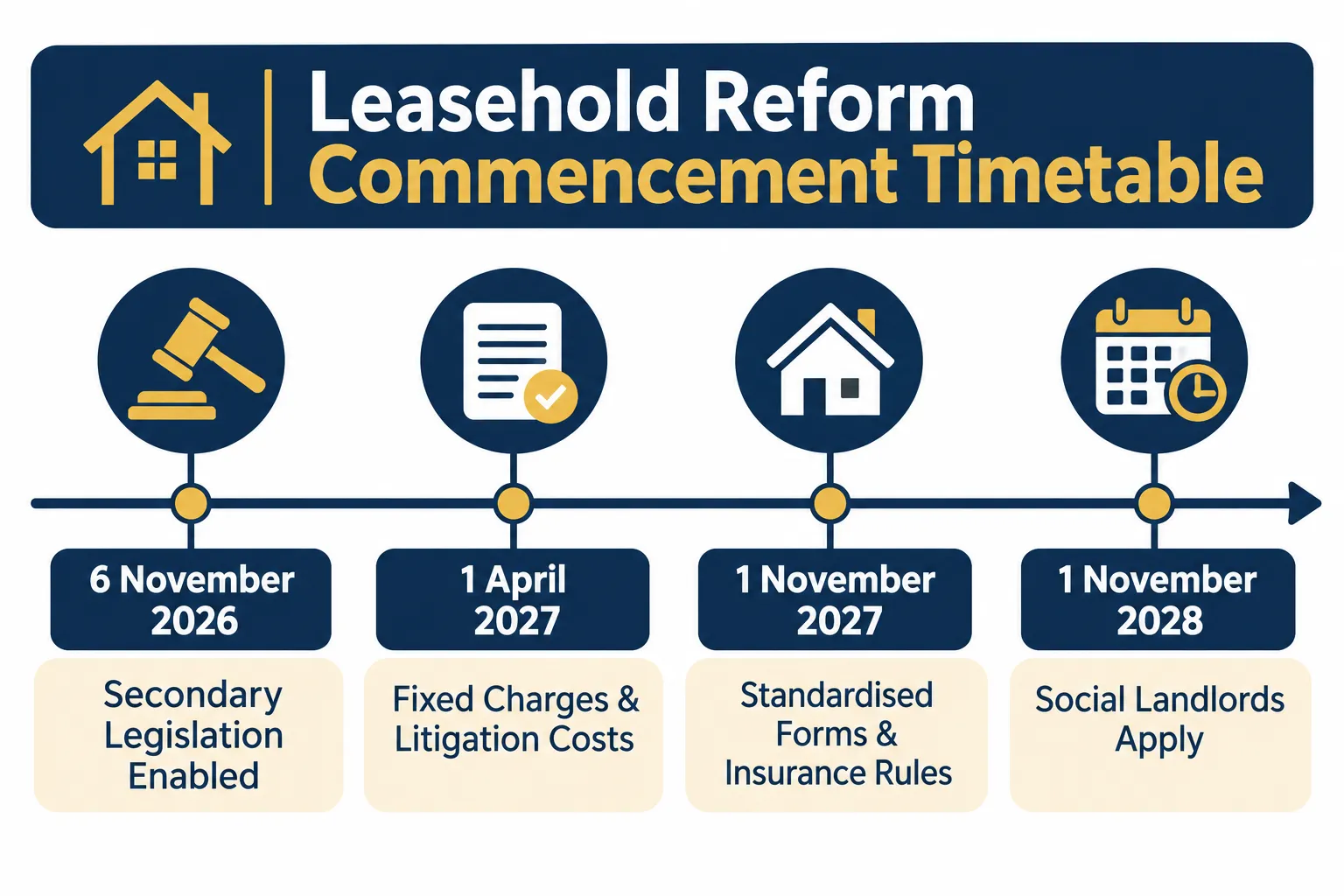
On 6 November 2026 itself, the provisions commence solely so that government can make the secondary legislation needed to operate the new system, covering service charge demands, accounts and annual reports, information rights, administration charge schedules, insurance information and litigation costs. No new leaseholder right takes effect on that date. It is, in effect, the legal starting gun for drafting the detailed rules that follow.
This follows the government consultation, "Strengthening leaseholder protections over charges and services," and a Written Ministerial Statement in July 2026 in which housing minister Matthew Pennycook confirmed Part 4 would be implemented through at least five statutory instruments: standardised demand forms, annual reporting, information rights, litigation costs, and building insurance.
Commencement Timetable at a Glance
| Date | What Comes Into Force |
|---|---|
| 6 November 2026 | Part 4 commences solely to enable secondary legislation (demands, accounts, information rights, admin charges, insurance, litigation costs) |
| 1 April 2027 | Sections 53, 54, 57, 58 (part), 62, 63, fixed service charge protections, advance notice of demands, broader information rights, stronger enforcement, litigation-cost regime |
| 1 November 2027 | Sections 55, 56, 58 (non-social landlords), 59, 60, 61, standardised demand forms, accounts/annual reports, insurance cost restrictions, admin charge schedules |
| 1 November 2028 | Sections 55, 56, 58 for social landlords |
Why This Matters for Notting Hill's Period Conversions and Mansion Blocks
Notting Hill's housing stock is dominated by Victorian and Edwardian terraces converted into flats, plus large mansion blocks with lifts, porters and communal gardens. These buildings carry complex, often expensive, service charge structures, exactly the kind of arrangements Part 4 targets.
From 1 April 2027, leaseholders gain a broader right to request service charge information, and landlords must give advance notice of future demands. The litigation-cost provisions are particularly significant: landlords will face limits on recovering legal costs through service or administration charges, while leaseholders gain greater scope to recover their own costs in some circumstances. For blocks where disputes over major works or arrears have previously been funded from the service charge pot, this changes the financial calculus materially.
From 1 November 2027, standardised demand forms and annual reports should make it easier to compare accounts year on year, valuable in mansion blocks where multiple flats share lifts, roofs and communal heating systems with substantial ongoing costs.
What a Buyer's Surveyor Checks in the Lease and Accounts
Ahead of these changes taking full effect, lease and financial due diligence is more important, not less. A RICS surveyor reviewing a Notting Hill flat purchase, alongside solicitors, typically focuses on:
- Service charge accounts, recent years' accounts, year-on-year trends, and whether charges are fixed or variable.
- Reserve/sinking funds, balance held against future major works, and whether it is adequate for the building's age.
- Major-works liabilities, upcoming or planned external redecoration, roof repairs, and lift overhauls, which are common cost drivers in period conversions and mansion blocks.
- Section 20 consultations, whether any statutory consultation notices have been served, signalling significant works and cost-sharing ahead.
- Building insurance, who arranges it, how costs are apportioned, and whether commission or fees are disclosed.
- Administration charges, fees for consents, approvals, or late payments, and how these interact with the lease terms.
This sits alongside broader valuation considerations explored in our guide to valuing freehold and leasehold properties under the 2026 reforms.
How a Level 2 or Level 3 Survey Covers the Whole Picture
A physical survey complements the paperwork review. For a flat, a Level 2 survey (Homebuyer Report) or a Level 3 (Building Survey) will inspect visible common parts, hallways, stairwells, lift shafts, communal gardens, and assess the building envelope: roof coverings, parapets, rainwater goods, render and brickwork, and window condition. Understanding the difference between Level 2 and Level 3 surveys helps buyers choose the right depth of inspection for an older conversion versus a well-maintained mansion block.

Surveyors flag defects likely to trigger future section 20 works, cracked render, failing pointing, ageing lift mechanisms, so buyers can cross-reference physical condition against the reserve fund and service charge history before exchanging contracts.
The Autumn Budget and the High Value Council Tax Surcharge
Separately from leasehold reform, the Autumn Budget on 28 October 2026 confirmed a High Value Council Tax Surcharge in England from April 2028, applying to homes valued at £2 million or more at April 2026 values. Annual charges will range from £2,500 to £7,500, with the legal owner liable. Given Notting Hill's property values, many flat and house owners in the area should factor this future liability into ownership costs, alongside the phased service charge reforms.
For those considering lease extensions as part of their ownership planning, our lease extension valuation service and FAQ on lease extensions provide further context, as does our breakdown of the cost of a lease extension.
Why Leasehold Due Diligence Matters More as Reforms Phase In
During a multi-year transition, different buildings will be subject to different rules depending on landlord type and timing. A flat bought in early 2027 may fall under different protections than one bought in late 2027. This creates a genuine risk of confusion for buyers, lenders and even existing owners trying to understand their rights. Independent professional advice, from solicitors on legal rights and from chartered surveyors on building condition and service charge adequacy, is the best protection against costly surprises. Our chartered surveyors covering Notting Hill regularly support buyers navigating exactly this kind of transitional uncertainty, and our Notting Hill valuation reports incorporate lease and service charge risk into the overall assessment.
FAQ
Does anything change for leaseholders on 6 November 2026 itself?
No. The regulations commence Part 4 only to the extent needed to allow secondary legislation to be drafted. Substantive leaseholder protections begin 1 April 2027.
When do the biggest practical changes take effect?
1 April 2027 brings fixed service charge protections, advance notice requirements, broader information rights and the litigation-cost regime.
Will standardised service charge demand forms apply immediately?
No. These, along with annual reports and insurance cost restrictions, apply from 1 November 2027 for most landlords, and 1 November 2028 for social landlords.
How does the litigation-cost regime affect leaseholders?
From 1 April 2027, landlords face limits on recovering legal costs through service or administration charges, and leaseholders gain greater ability to recover their own costs in some circumstances.
Is the £2 million council tax surcharge connected to leasehold reform?
No, it is a separate Autumn Budget measure confirmed on 28 October 2026, taking effect from April 2028 for homes valued at £2 million or more.
Should buyers delay purchases because of the reforms?
Not necessarily, but thorough lease, service charge and building condition checks are essential given the shifting rules.
Conclusion
The confirmed leasehold reform timetable confirms a careful, staged approach by government, running from this week's technical commencement through to full implementation in November 2028. For owners and buyers of Notting Hill's period conversions and mansion blocks, the practical message is clear: scrutinise leases, service charge accounts, reserve funds and major-works plans now, because the rules governing them are about to change significantly.
Contact Notting Hill Surveyors to arrange a Level 2 or Level 3 survey, or a valuation review, ahead of your next leasehold purchase or sale.