
Roughly 165,000 households across England will open a letter they have never seen before: a council tax bill with a new line on it, separate from the tax itself, payable straight to the Treasury. That is the Office for Budget Responsibility's own estimate for the new high value council tax surcharge, confirmed alongside the 28 October 2026 Autumn Budget. For owners in Notting Hill and Kensington, where a two-bedroom conversion can easily clear £2 million, this is no longer speculation. It is policy, with a start date, a VOA process, and a clock now running.
This article sets out, in plain English, what the mansion tax high value council tax surcharge Budget 2026 means for W11 and W8 postcodes, and what owners, landlords and buyers should be doing in November 2026, eighteen months before the first bills land in March 2028.
Key Takeaways
- The surcharge applies in England to homes worth £2 million or more at April 2026 values, charged from April 2028, first bills March 2028.
- Annual charges range from £2,500 (£2m,£2.5m) to £7,500 (£5m+), rising with CPI from 2029-30.
- Owners, not tenants, are liable; a 100% premium applies to homes left substantially unfurnished and unoccupied for 12+ months.
- The Valuation Office Agency is expected to publish draft bands in autumn 2027, owners can challenge these and appeal to the Valuation Tribunal for England.
- An independent RICS Red Book valuation evidencing April 2026 value is the single most useful document an owner can commission now.
What the Mansion Tax High Value Council Tax Surcharge Budget 2026 Actually Says
The surcharge, widely nicknamed the "mansion tax," was first announced in the November 2025 Budget and its details were restated at the 28 October 2026 Autumn Budget, according to Propertymark and the HomeOwners Alliance. It is a genuinely new charge, collected alongside council tax but paid to the Treasury rather than the local authority.
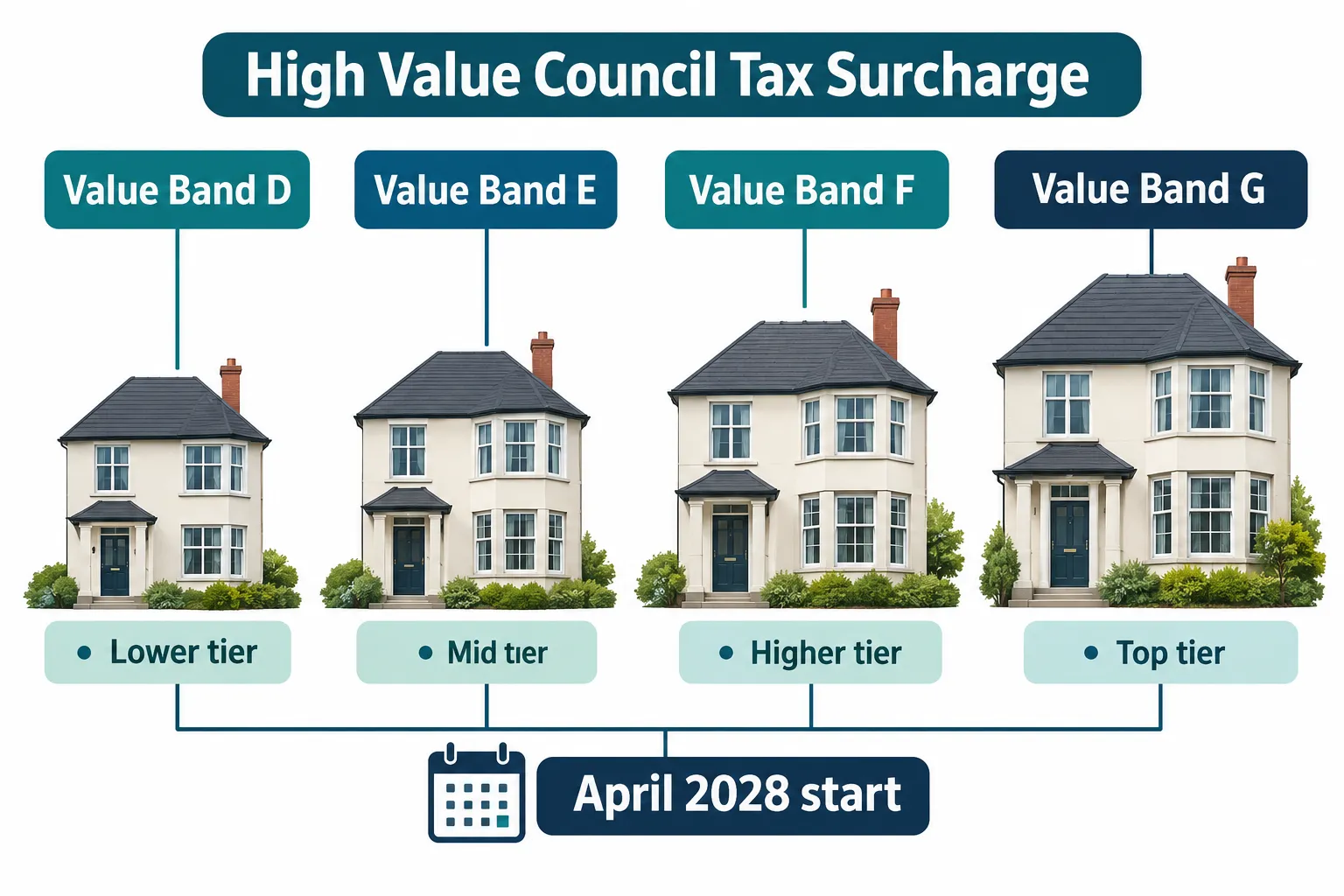
The structure is a simple ladder:
| Property value (April 2026) | Annual surcharge |
|---|---|
| £2m, £2.5m | £2,500 |
| £2.5m, £3.5m | £3,500 |
| £3.5m, £5m | £5,000 |
| £5m+ | £7,500 |
Social housing is exempt. Charges rise with CPI from 2029-30. The OBR expects the measure to raise about £0.4 billion in 2029-30, a modest sum nationally, but concentrated heavily in prime London boroughs like Kensington and Chelsea, where property values near these thresholds are common rather than exceptional.
Notably, the Chancellor has reportedly ruled out lowering the threshold to £1.5 million, which will reassure owners of slightly smaller flats and houses, though nothing in politics is permanent, and a consultation on the detail closed on 14 July 2026.
Why Notting Hill and Kensington Sit Directly in the Firing Line
W11 and the surrounding Kensington streets are unusual in the national context. A large share of stock, Victorian terraces, garden flats, mews houses, lateral conversions, sits precisely in the £2m-£3.5m band where the surcharge bites hardest in relative terms. Zoopla reported on 27 October 2026 that London prices are down 1% year-on-year with homes taking 56 days to sell on average, a softer market than the capital has seen in some time.
Against that backdrop, an annual charge of £2,500 to £7,500 is not trivial. For owners near a threshold, a few hundred thousand pounds of valuation movement either way could mean the difference between paying £2,500 or £3,500 a year, or avoiding the surcharge altogether.
Second Homes and the Empty-Property Premium
The 100% premium for properties left substantially unfurnished and unoccupied for 12 months or more is especially relevant locally. Notting Hill and Kensington have a meaningful proportion of pied-à-terres and investment flats held by owners who spend limited time in London. Anyone in this position should start reviewing occupancy patterns now, well before the April 2028 start date.
How the Valuation and Appeal Process Will Work
The Valuation Office Agency (VOA) is expected to publish draft bands and a list of affected properties in autumn 2027. That gives owners roughly a year from now to prepare evidence before the draft list appears, and a further window to challenge it before bills start in March 2028.
Owners who believe their property has been wrongly banded can challenge the VOA's decision and, if unresolved, appeal to the Valuation Tribunal for England. The practical lesson from council tax banding disputes over the decades is consistent: appeals succeed when backed by independent, dated, professionally reasoned evidence, not simply an owner's opinion that the figure feels too high.
Why an Independent RICS Red Book Valuation Matters Now
This is where preparation now pays off later. Because the surcharge is based on an April 2026 value, and the VOA will not publish its own assessment until autumn 2027, there is a real risk of owners being banded on assumptions that do not reflect their property's actual condition, layout, or local comparable evidence at the relevant date.
A RICS Red Book valuation, commissioned by a chartered surveyor and dated to April 2026, gives owners:
- A formally reasoned, defensible figure anchored to the correct valuation date
- Evidence that can be used immediately if a challenge or Valuation Tribunal appeal becomes necessary
- Clarity on exactly which side of a £2m, £2.5m, £3.5m or £5m threshold a property genuinely sits
- A record that reflects specific property condition, layout and any works carried out around that date
For properties sitting close to a boundary, say, a home that might be worth £2.45 million or £2.55 million depending on assumptions, this evidence can be the difference between two very different annual bills.
Market and Negotiation Implications for Buyers and Sellers
Prime west London has already absorbed a run of tax and cost pressures; this surcharge adds another variable to pricing conversations. Expect:
- Sellers near thresholds to face buyer questions about future liability during negotiations.
- Buyers factoring the annual charge into offers, much as they already weigh stamp duty and service charges.
- Landlords of higher-value lets reassessing yields, since owners, not tenants, are liable for the surcharge.
- Developers of large refurbishments or extensions near £2m reconsidering specification where it tips a property into a higher band.
A soft market with 56-day average sale times, per Zoopla, means negotiating leverage is already shifting toward buyers. A credible, independent valuation strengthens an owner's position whichever side of the transaction they are on.
What Notting Hill Surveyors Recommends Doing Now
- Commission a RICS Red Book valuation dated to April 2026 if your property is anywhere near £2m, £2.5m, £3.5m or £5m.
- Review second-home and investment-flat occupancy records ahead of the 12-month empty-property premium test.
- Keep evidence of property condition, works and comparable sales as at spring 2026, ready for when the VOA publishes draft bands in autumn 2027.
- Watch for the VOA's draft list and be ready to challenge promptly if a banding looks wrong.
- Speak to a qualified tax adviser or solicitor about personal liability, this article is not tax or legal advice.
FAQ
Who has to pay the mansion tax high value council tax surcharge Budget 2026?
The property owner, not the occupier or tenant, is liable for the charge from April 2028.
When do the first bills arrive?
First bills are expected in March 2028, with charges applying from April 2028, based on April 2026 property values.
Will the threshold be lowered to £1.5 million?
The Chancellor has reportedly ruled this out, with £2 million remaining the entry threshold as confirmed at the October 2026 Budget.
What happens if my second home sits empty?
A 100% premium applies where a property has been substantially unfurnished and unoccupied for 12 months or more.
Can I challenge the VOA's valuation band?
Yes. Owners can challenge the VOA's draft banding decision, expected autumn 2027, and escalate to the Valuation Tribunal for England if unresolved.
Is this the same as stamp duty or existing council tax?
No. It is a separate annual surcharge collected alongside council tax but paid to the Treasury, on top of existing bills.
Conclusion
The mansion tax high value council tax surcharge Budget 2026 is now a confirmed feature of the property landscape for owners in Notting Hill, Kensington and across prime west London. With draft VOA bands expected in autumn 2027 and bills landing in March 2028, the eighteen months ahead are the window for preparation, not panic. Owners near the key thresholds should commission an independent RICS Red Book valuation evidencing April 2026 value, review occupancy records on second homes, and take professional tax advice before decisions are made under time pressure. Notting Hill Surveyors can provide RICS-regulated valuations to support owners through this process.
mansion tax, high value council tax surcharge, Budget 2026, Notting Hill property, Kensington homes, RICS valuation, Red Book valuation, property tax UK, VOA banding, Valuation Tribunal, prime London property, second homes tax