
{"cover":"Professional landscape format (1536×1024) hero image with bold text overlay: 'Building Survey Certainty in 2026 Transactions' in extra large 72pt white bold sans-serif font with dark semi-transparent background panel, centered upper-third composition. Background shows a chartered surveyor in hard hat and hi-vis vest inspecting a Victorian brick building facade with clipboard and tablet, golden hour lighting, urban London streetscape. Color scheme: deep navy blue, white text, amber accent lines. Magazine cover aesthetic, editorial quality, high contrast, photorealistic.","content":["Landscape format (1536×1024) editorial image showing a close-up overhead view of a professional building survey checklist spread across a wooden desk alongside a structural floor plan, magnifying glass, and pen. Sticky notes highlight fabric defect categories: damp, subsidence, roof structure. Warm office lighting, shallow depth of field on checklist detail. Color palette: cream, charcoal, deep green accents. Clean, professional, documentary photography style. No people visible, focus entirely on survey documentation tools.","Landscape format (1536×1024) split-composition image: left half shows a cracked external brick wall with visible damp staining and mortar erosion, right half shows a digital tablet displaying a costed risk matrix table with red, amber, green RAG status columns and remediation cost figures. A surveyor's hand points to the amber row. Dramatic contrast between physical defect and digital risk data. Color scheme: terracotta, slate grey, white. Photorealistic, editorial quality, wide angle.","Landscape format (1536×1024) wide-angle image of a modern property transaction meeting room: two professionals reviewing a bound Level 3 building survey report across a glass table, laptops open showing property data dashboards, London skyline visible through floor-to-ceiling windows in background. Documents include structural engineer reports and risk mitigation protocols. Soft natural light, corporate atmosphere. Color palette: cool grey, white, navy blue accent. Photorealistic, editorial quality, documentary style."]

Fewer than one in three UK property buyers who skip a full structural survey report satisfaction with their purchase within two years of completion — yet in recovering markets, where competitive pressure tempts buyers to cut corners, survey uptake remains inconsistently applied. Achieving building survey certainty in 2026 transactions: protocols for risk mitigation in recovery markets is no longer a procedural nicety; it is a financial imperative backed by evolving technical standards and a sharper understanding of how hidden defects translate into measurable monetary loss.
Recovery markets carry a particular kind of risk. Renewed buyer confidence compresses decision timelines, while sellers — aware of rising demand — resist price renegotiation. In that environment, a poorly scoped survey, or no survey at all, leaves buyers exposed to fabric defects, latent structural problems, and remediation costs that can dwarf the fee saved. At the same time, geopolitical uncertainty and supply-chain disruption continue to push repair costs upward, making early defect identification more valuable than at any point in the past decade [7].
This article equips surveyors, buyers, and portfolio managers with enhanced checklists, protocol frameworks, and risk-mitigation thinking designed to deliver genuine transaction confidence in 2026.
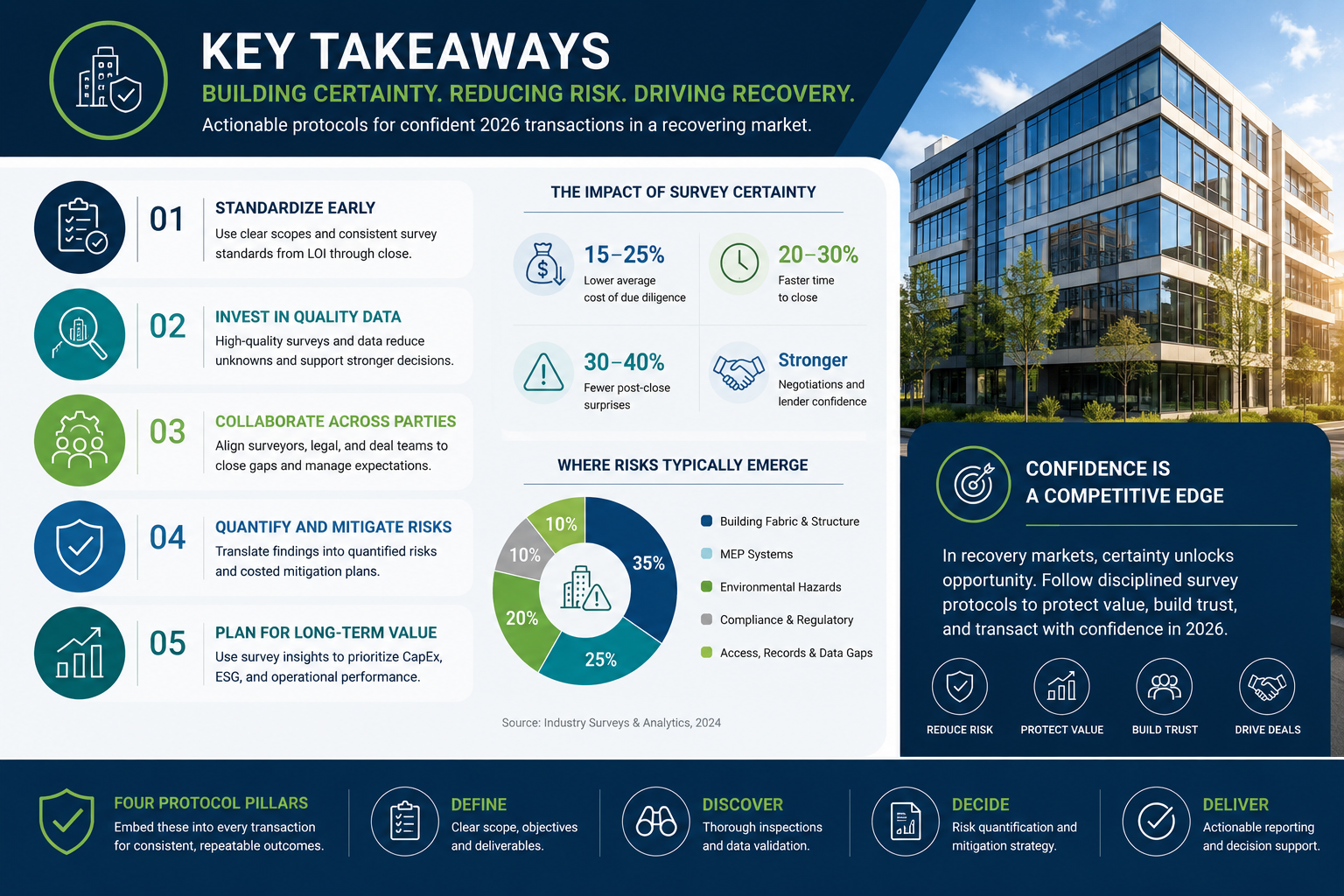
Key Takeaways
- Level 3 building surveys are now formally positioned as risk-management instruments, not just condition reports, in 2026 recovery markets.
- Costed defect schedules within survey reports give buyers and investors a quantified basis for negotiation and due diligence.
- Hidden structural risks — including subsidence, concealed damp, and roof structure failure — remain the most financially damaging categories of defect.
- Verifying surveyor credentials and survey scope before instruction is as important as the survey itself.
- Integrated checklists covering fabric, services, drainage, and environmental factors produce the most defensible transaction outcomes.
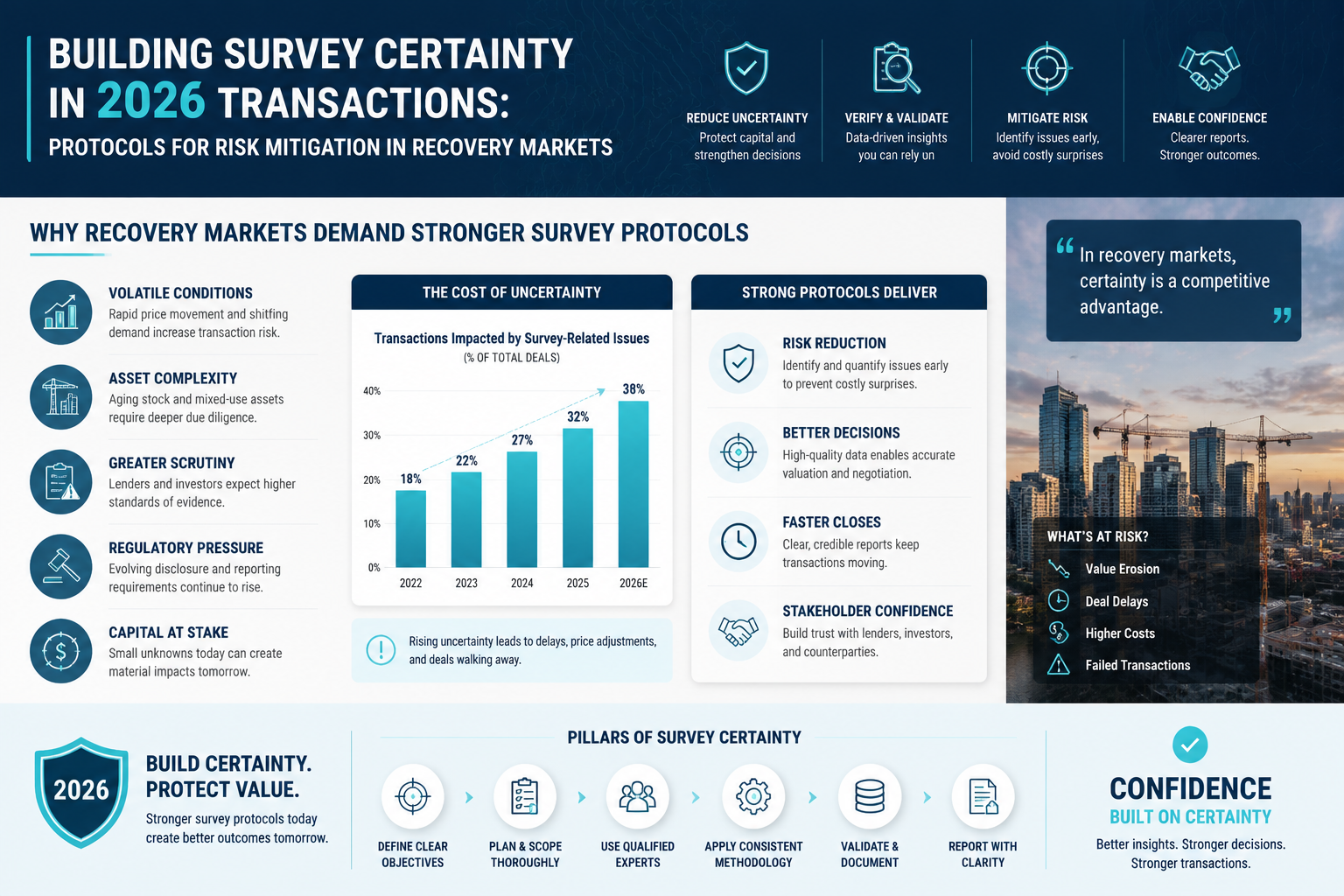
Why Recovery Markets Demand Stronger Survey Protocols
Property markets that emerge from slowdowns share a common trait: buyers return before stock quality improves. Vendors who deferred maintenance during the downturn bring properties to market with accumulated defects, while buyers, energised by stabilising prices, move quickly. The result is a structural mismatch between perceived and actual asset condition [1].
Research into surveying's role during market slowdowns confirms that the volume of significant defects identified per survey rises during periods of deferred maintenance — precisely the conditions that characterise a recovery market [1]. This dynamic makes the survey protocol, rather than just the survey itself, the critical variable.
Three forces are reshaping survey expectations in 2026:
- Geopolitical and supply-chain pressure — Material and labour costs remain elevated, meaning a defect that cost £8,000 to repair in 2021 may cost £14,000 or more today. Accurate costing within a survey report directly affects negotiation leverage.
- Regulatory evolution — Updated RICS guidance in early 2026 places greater emphasis on identifying hidden structural risks before portfolio expansion, raising the standard of care expected from chartered surveyors.
- Corporate and institutional demand — Portfolio buyers now routinely require surveys that quantify costed risks and remediation timeframes, treating building surveys as formal due-diligence instruments rather than advisory documents [2].
"Strategic building surveys have evolved from condition snapshots into investment-decision tools that quantify risk in financial terms." — Cambridge Network, 2024 [2]
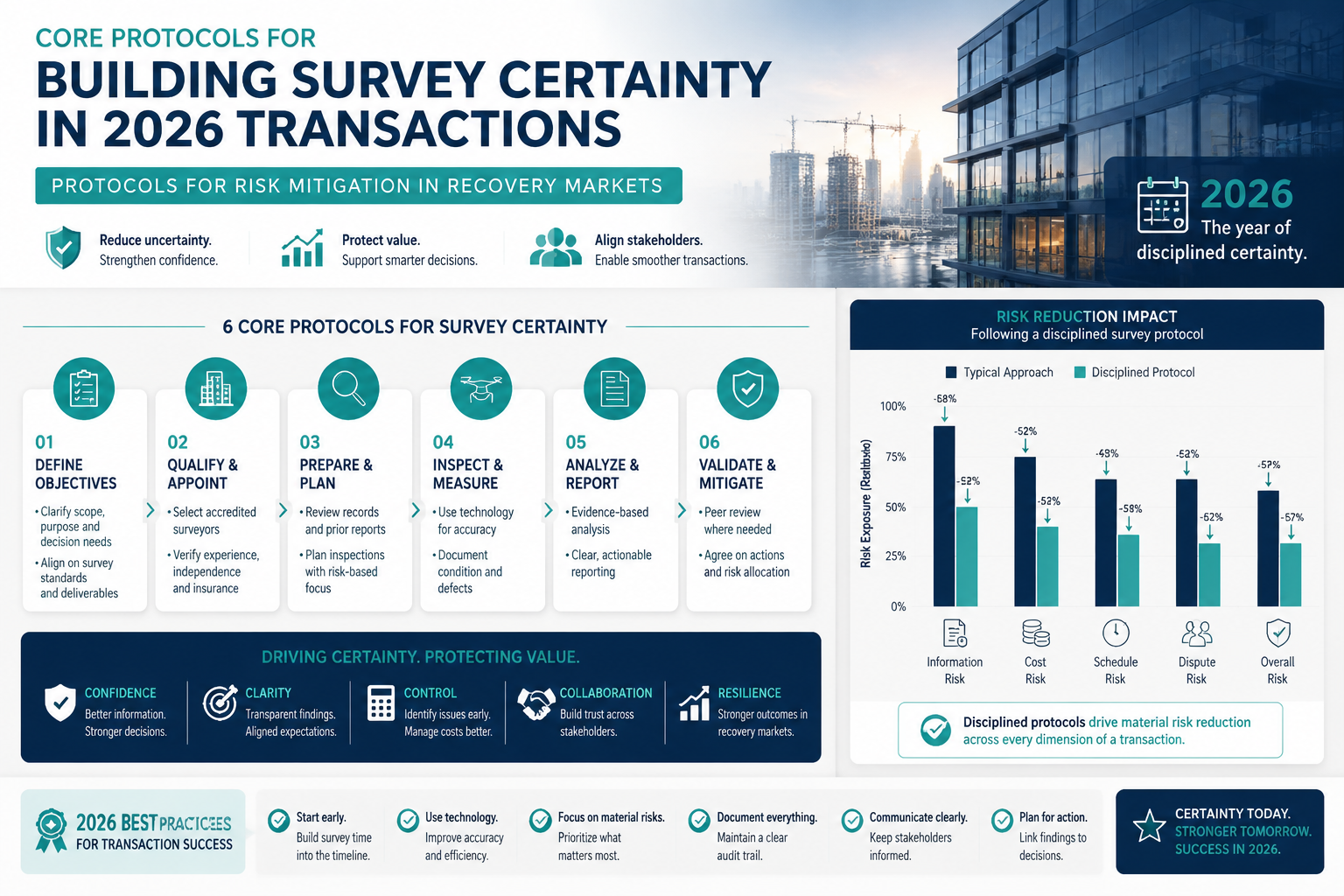
Core Protocols for Building Survey Certainty in 2026 Transactions: Protocols for Risk Mitigation in Recovery Markets
Achieving survey certainty requires a structured approach that begins before the surveyor sets foot on site. The following protocol framework addresses the full transaction lifecycle.
Pre-Instruction: Scoping the Survey Correctly
The most common failure point in property transactions is instructing the wrong survey type. A Level 2 HomeBuyer Report is appropriate for modern, conventionally constructed properties in reasonable condition. For older, extended, or non-standard properties — which account for a significant proportion of UK housing stock — a Level 3 building survey is the appropriate instrument.
The Level 2 vs Level 3 survey comparison is not merely academic. A Level 3 survey involves inspection of roof spaces, subfloor voids, chimney stacks, and structural elements that a Level 2 report either omits or treats superficially. In recovery markets, where deferred maintenance is common, this depth of inspection is essential.
Pre-instruction checklist:
| Factor | Question to Answer |
|---|---|
| Property age | Pre-1919, interwar, or post-war construction? |
| Construction type | Solid wall, cavity, timber frame, non-standard? |
| Visible alterations | Extensions, loft conversions, structural openings? |
| Known issues | Damp, cracks, roof repairs noted in listing? |
| Tenure | Freehold, leasehold, or shared ownership? |
| Commercial use | Any mixed-use or commercial elements? |
If any of the above flags apply, a full Level 3 survey is the appropriate minimum. For commercial assets, a RICS commercial building survey provides the additional technical depth required for non-residential transactions.
Credential Verification: Knowing Who Is Inspecting
Survey certainty is only as reliable as the professional delivering it. Before instruction, buyers should verify that their surveyor holds current RICS membership and that the firm carries adequate professional indemnity insurance. A practical guide to verifying surveyor credentials in the UK outlines the specific checks that protect buyers from underqualified practitioners.
In 2026, the RICS register remains the definitive verification tool. Buyers should also confirm that the surveyor has direct experience with the specific property type and locality — a surveyor familiar with London Victorian terraces may not have equivalent expertise in rural timber-frame construction.
The Enhanced Defect Checklist: Fabric and Structure
The heart of any protocol for risk mitigation in recovery markets is a comprehensive defect checklist. The categories below represent the highest-risk areas identified in current technical guidance and should be treated as mandatory inspection points in any Level 3 survey.
Fabric defects — enhanced checklist:
- Roofing: Condition of covering material (slate, tile, flat felt, or GRP); integrity of flashings, valleys, and parapet junctions; evidence of ponding or deflection in flat roof sections
- External walls: Pointing condition; evidence of sulfate attack in pre-1945 brickwork; render adhesion; cavity wall tie corrosion indicators; movement cracks (pattern, width, recency)
- Damp: Rising damp at DPC level; penetrating damp at window reveals, chimney breasts, and parapet walls; interstitial condensation in cold-bridge zones
- Foundations and substructure: Evidence of differential settlement; heave in clay-rich soils; proximity to trees (particularly oak, poplar, and willow within 10 metres)
- Structural timbers: Roof structure deflection; evidence of woodworm, wet rot, or dry rot in floor joists and wall plates; adequacy of lateral restraint
- Windows and doors: Frame condition, draught sealing, glazing unit failure (misting)
- Chimney stacks: Pointing, flaunching, pot condition, and evidence of lateral movement
For properties where subsidence is suspected — particularly in areas with shrinkable clay soils or a history of mining — specialist investigation beyond the standard survey scope should be recommended as a protocol requirement.
Services and Environmental Risk
Fabric defects are the most visible category, but services and environmental factors frequently generate the largest remediation costs. The enhanced protocol for 2026 transactions should include:
- Drainage: CCTV drainage survey for properties over 25 years old, or where extensions have been added. Drainage surveys identify root ingress, collapsed sections, and illegal connections that are invisible to visual inspection.
- Electrical installation: Age and condition of consumer unit; presence of outdated wiring types (aluminium, rubber-insulated); earthing arrangements.
- Heating and hot water: Boiler age and servicing history; evidence of system leaks; adequacy of insulation.
- Environmental: Proximity to flood zones (Environment Agency Flood Map); radon potential (Public Health England radon map); Japanese knotweed or other invasive species.
Costed Risk Schedules: Translating Defects into Transaction Intelligence
The shift that defines building survey certainty in 2026 transactions: protocols for risk mitigation in recovery markets at the institutional level is the move from descriptive defect reporting to costed risk schedules. Strategic building surveys for corporate and portfolio buyers now routinely include estimated remediation costs alongside defect descriptions, enabling buyers to model financial exposure before exchange [2].
This approach is directly aligned with broader risk-management trends. Across financial services and construction sectors, quantified risk assessment has become the expected standard — organisations that rely on qualitative risk descriptions alone are increasingly seen as under-prepared [7][8].
What a Costed Risk Schedule Contains
A well-structured costed risk schedule within a Level 3 survey report should include:
| Defect Category | Severity (RAG) | Estimated Cost Range | Recommended Action | Timeframe |
|---|---|---|---|---|
| Roof covering replacement | Red | £12,000 – £18,000 | Immediate | 0-6 months |
| Repointing (rear elevation) | Amber | £3,500 – £5,500 | Within 12 months | 6-18 months |
| Damp-proof course treatment | Amber | £2,000 – £4,000 | Within 12 months | 6-18 months |
| Window frame replacement | Green | £6,000 – £9,000 | Planned maintenance | 2-5 years |
| Electrical rewire | Red | £8,000 – £14,000 | Immediate | 0-12 months |
The RAG (Red, Amber, Green) status system provides an at-a-glance risk summary that non-technical buyers and their solicitors can use directly in negotiation. Red items represent immediate safety or structural risks; Amber items require action within 18 months; Green items are maintenance items for longer-term planning.
For a practical example of how this reporting structure works in practice, the Level 3 building survey comprehensive example and guide illustrates the format and depth expected from a high-quality report.
Using Survey Findings in Negotiation
Once a costed risk schedule is in hand, buyers have three options:
- Price reduction — Request a reduction equivalent to the cost of Red and Amber items.
- Pre-completion remediation — Require the vendor to carry out specified works before exchange.
- Retention — Agree a sum held in escrow pending completion of agreed works.
In recovery markets, where vendors hold more leverage, option three is increasingly common. Having a surveyor's costed schedule — rather than a vague reference to "significant damp" — gives buyers a defensible, evidence-based position that is harder for vendors and their agents to dismiss.
Portfolio and Commercial Applications: Scaling Survey Protocols
For institutional buyers, property companies, and portfolio investors, building survey certainty in 2026 transactions requires protocols that scale across multiple assets without sacrificing analytical depth.
Batch Survey Protocols
When acquiring multiple properties simultaneously — whether a residential portfolio or a commercial estate — a tiered survey approach manages cost while maintaining risk coverage:
- Tier 1 (Desktop review): Title, planning history, environmental data, and EPC review for all assets.
- Tier 2 (Drive-by and external inspection): Rapid external condition assessment to triage assets by apparent risk.
- Tier 3 (Full Level 3 or commercial survey): Applied to all Tier 2 red-flag assets and a random 20% sample of the remainder.
This protocol ensures that the highest-risk assets receive full scrutiny while managing the cost of surveying large portfolios. For commercial assets, commercial property surveying services provide the specialist expertise required for mixed-use, industrial, and retail properties.
Drone and Technology-Assisted Inspection
One of the most significant developments in survey practice entering 2026 is the mainstream adoption of drone-assisted inspection for roofs, high-level facades, and large commercial structures. Drone surveys provide photographic evidence of defects that would otherwise require expensive scaffold access, reducing both cost and programme time for complex assets.
Technology integration in risk management more broadly is accelerating — the 2026 Prosight CRO Outlook Survey identifies technology adoption as both a primary risk-management opportunity and a source of new operational risk [3]. For building surveys, this means that drone and thermal imaging data must be interpreted by qualified professionals; technology augments but does not replace chartered surveyor judgment.
Selecting the Right Survey for Your 2026 Transaction
Not every transaction requires the same survey instrument. The following decision framework helps buyers and advisors match survey type to property and transaction characteristics.
Survey selection guide:
| Property Type | Recommended Survey | Key Risk Focus |
|---|---|---|
| Modern flat (post-1985) | Level 2 HomeBuyer | Services, leasehold terms |
| Victorian/Edwardian terrace | Level 3 Building Survey | Fabric, damp, structure |
| Interwar semi-detached | Level 3 Building Survey | Cavity ties, roof, services |
| Non-standard construction | Level 3 + Structural Engineer | Foundation, frame integrity |
| Commercial premises | RICS Commercial Survey | Services, compliance, tenure |
| Large portfolio acquisition | Tiered batch protocol | Risk-weighted prioritisation |
For buyers uncertain about which survey is appropriate, the survey selection guide provides a structured decision tool based on property type, age, and transaction complexity.
Where structural concerns are identified within a survey, a structural engineer report provides the specialist analysis needed to quantify the engineering risk and specify remediation in technical detail.
Regional Considerations in 2026 Recovery Markets
Recovery is not uniform across UK regions. Demand concentration in commuter belts, university towns, and coastal areas creates localised risk profiles that surveyors must account for in their protocols.
Key regional risk factors in 2026 include:
- London and South East: High proportion of Victorian and Edwardian stock; leasehold complexity; party wall obligations in terraced and semi-detached properties. Buyers in areas such as North West London and Surrey should ensure surveyors have specific local knowledge of common defect patterns.
- South West and coastal areas: Elevated exposure to wind-driven rain penetration; higher incidence of solid wall construction without cavity insulation.
- Midlands and North: Greater proportion of non-standard construction types including prefabricated post-war housing; higher subsidence risk in former mining areas.
- Rural and agricultural areas: Septic tank and private drainage systems; agricultural building conversion compliance; listed building constraints.
Conclusion: Actionable Steps for Transaction Confidence in 2026
Building survey certainty in 2026 transactions is achieved through deliberate protocol, not chance. The recovery market environment — characterised by renewed demand, elevated repair costs, and accumulated deferred maintenance — makes structured risk mitigation more valuable than at any point in recent memory.
Actionable next steps for buyers and advisors:
- Instruct the correct survey type from the outset. For any property built before 1985, altered, or showing visible defects, commission a Level 3 building survey as the minimum standard.
- Verify surveyor credentials before instruction. Confirm current RICS membership, relevant experience, and adequate professional indemnity cover.
- Request a costed risk schedule as a standard deliverable. Insist that the survey report includes estimated remediation costs and a RAG-rated defect summary, not just narrative descriptions.
- Commission specialist investigations where flagged. Drainage surveys, subsidence assessments, and structural engineer reports should be treated as protocol requirements, not optional extras, when the primary survey identifies relevant risk indicators.
- Use survey findings actively in negotiation. A costed schedule is a negotiation instrument. Apply it as such, with professional support from the surveyor where vendor challenges arise.
- For portfolio acquisitions, implement a tiered batch protocol. Ensure all assets receive appropriate scrutiny proportionate to their risk profile, using technology-assisted inspection where access or scale demands it.
The property transaction that proceeds without adequate survey due diligence in 2026 is not a transaction completed efficiently — it is a risk transferred invisibly from vendor to buyer. Structured survey protocols eliminate that transfer and replace uncertainty with defensible, evidence-based decision-making.
References
[1] The Surveys Role In A Slowing Market – https://constructionmaguk.co.uk/the-surveys-role-in-a-slowing-market/
[2] How Strategic Building Surveys Inform Smart Business Investment Decisions – https://www.cambridgenetwork.co.uk/news/how-strategic-building-surveys-inform-smart-business-investment-decisions
[3] The 2026 Prosight Cro Outlook Survey Technologys Promise And Peril – https://www.prosightfa.org/insights/the-2026-prosight-cro-outlook-survey-technologys-promise-and-peril/
[7] Building Amid Uncertainty How Risk Management Became Everyones Job – https://fmicorp.com/insights/thought-leadership/building-amid-uncertainty-how-risk-management-became-everyones-job
[8] 2026 Risk Outlook Managing Uncertainty Across A Shifting Risk Landscape – https://asurityadvisors.com/2026-risk-outlook-managing-uncertainty-across-a-shifting-risk-landscape/
