
More than half of homes assessed in recent Scottish housing statistics failed basic quality standards — a striking figure that should concern every buyer considering a new-build purchase in 2026 [6]. Against a backdrop of falling completions, record-low social housing starts, and a Scottish Government consultation on accelerating delivery, the case for rigorous pre-completion inspection has never been stronger. This guide covers the protocols behind Building Surveys for New Build Defects in Scotland's Stable 2026 Market: RICS Checklists, explaining what RICS Level 3 surveys examine, which defects appear most often in Scottish new-builds, and what lessons cross the border to benefit English buyers too.
Key Takeaways
- Scotland's new-build completions fell 13% in 2025, yet demand remains firm, making defect identification at purchase critical.
- More than half of recently assessed homes showed housing quality failures, underlining the value of a professional survey before legal completion.
- RICS Level 3 building surveys provide the most thorough defect assessment available and are recommended for new-builds where construction quality cannot be assumed.
- A structured RICS checklist covers structure, roofing, drainage, insulation, airtightness, and services — all areas where Scottish new-builds commonly fail.
- Drone technology and thermal imaging are now standard tools that enhance defect detection in hard-to-reach areas.
Scotland's New-Build Market in 2026: Stable Demand, Falling Supply
Scotland's housing market in 2026 is defined by a tension between persistent buyer demand and a shrinking pipeline of new homes. In 2025, just 17,336 new homes were completed across all sectors — a 13% decline, representing 2,509 fewer homes than the previous year [1]. Housing starts fell further, with only 14,999 recorded in 2025, down 6% year-on-year [1]. Social housing starts hit their lowest level since records began in 1997, and completions in that sector reached a low not seen since 2014 [2].
The Affordable Housing Supply Programme delivered 6,289 affordable homes in 2025, a 25% drop from 2024 [3]. By December 2025, only 32,479 homes had been delivered against the Scottish Government's target of 110,000 affordable homes by 2032 — a shortfall that Shelter Scotland has described as putting the government on course to break its social housing promise [3]. The National House Building Council reported 2,138 new home registrations in Scotland during Q1 2026, a further 5% decline from Q1 2025 [4], while major housing development applications in the first two quarters of 2025/26 dropped by 38.6% compared to the same period in 2024/25 [5].
CIH Scotland's national director Gillian McLees has called for increased action to address the housing emergency [9]. In February 2026, the Scottish Government launched a consultation on incentives and penalties to accelerate housing delivery, acknowledging the scale of the problem [10].
What this means for buyers: When supply is constrained and demand is stable, developers face pressure to complete homes quickly. Speed and quality do not always align. Buyers in this market are purchasing assets that may carry hidden defects, making independent professional inspection essential before legal completion.
"Stable demand in a low-supply market does not guarantee build quality. It guarantees competition — and competition rarely slows a developer's programme."
For buyers uncertain whether a survey is necessary, the complete guide to whether you need a home survey when buying sets out the core arguments clearly.
Understanding RICS Level 3 Surveys for New-Build Defects
What Is a RICS Level 3 Building Survey?
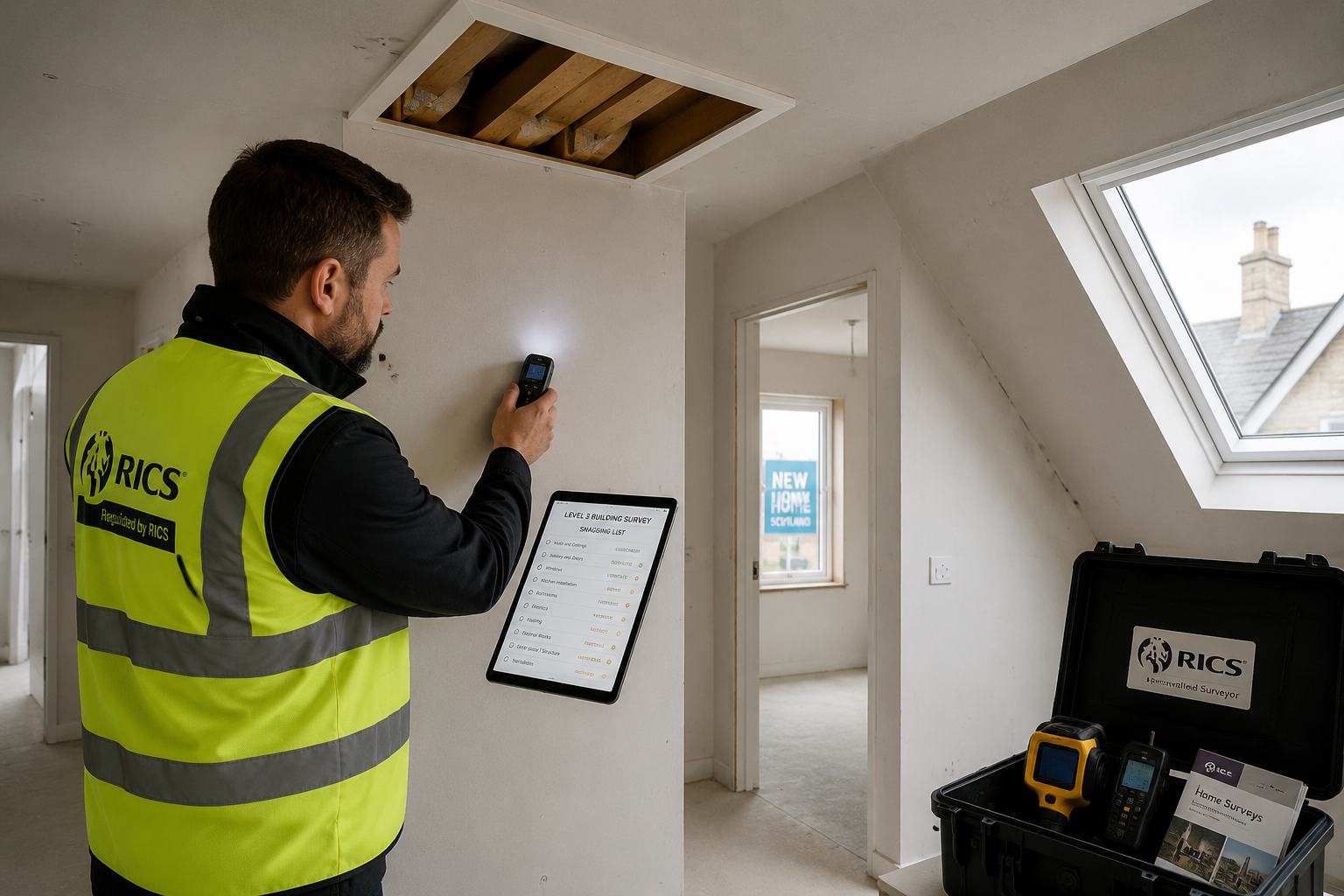
A RICS Level 3 Home Survey — formerly known as a Full Structural Survey — is the most comprehensive inspection product available to residential buyers. Unlike a Level 2 HomeBuyer Report, which suits standard properties in reasonable condition, a Level 3 survey involves a detailed, methodical examination of every accessible element of a building, from foundations to ridge tiles.
For new-builds, the Level 3 format is particularly valuable because it does not assume that a recently constructed property is defect-free. On the contrary, it applies the same rigorous scrutiny to a six-month-old home as it would to a Victorian terrace, examining construction quality against current Building Regulations and relevant British Standards.
The comprehensive guide to Level 3 building surveys explains the full scope of what these inspections cover and why they differ fundamentally from a developer's own snagging inspection.
The Difference Between a Snagging Survey and a Level 3 Survey
Many new-build buyers rely on a snagging list — a basic checklist of cosmetic and minor functional defects compiled just before handover. Snagging surveys are useful but limited. They typically identify:
- Scratched glass or paintwork
- Poorly fitted doors and windows
- Incomplete decoration
- Minor plumbing leaks
A RICS Level 3 survey goes considerably further. It assesses structural integrity, thermal performance, drainage, roof construction, airtightness, and the condition of all building services. It identifies latent defects — problems that are present but not yet visible — and provides a prioritised schedule of remedial work with cost guidance.
For a detailed example of what a Level 3 report contains, the Level 3 building survey example and guide offers a practical walkthrough of a real-world report structure.
Building Surveys for New Build Defects in Scotland's Stable 2026 Market: RICS Checklists in Practice
The Core RICS Inspection Framework
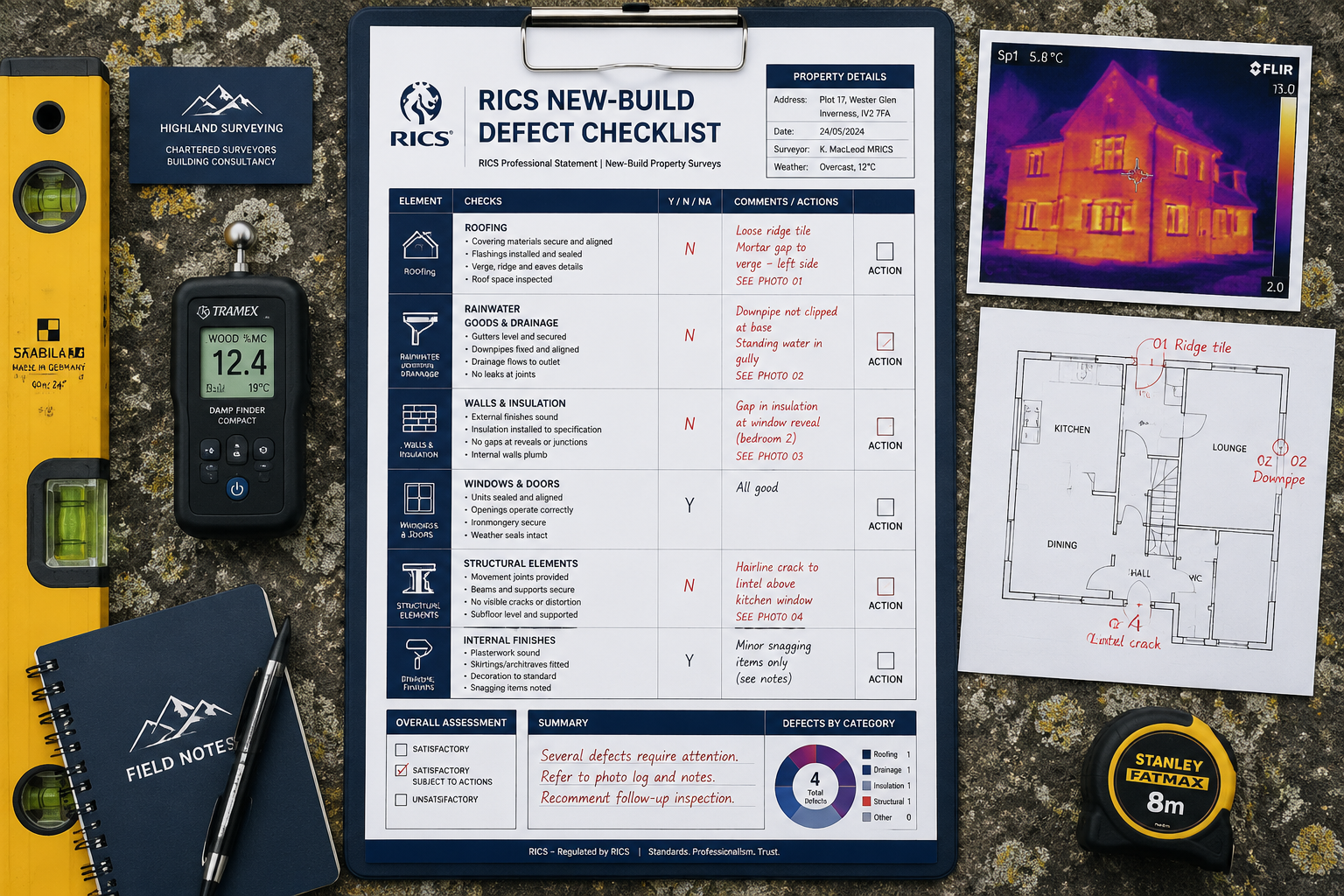
RICS-accredited surveyors working in Scotland follow a structured inspection methodology that covers all main elements of a property. The checklist below represents the standard categories examined during a Level 3 survey of a new-build home.
| Inspection Category | Key Items Assessed |
|---|---|
| Roof structure | Timber quality, truss spacing, bracing, insulation depth |
| Roof coverings | Tile/slate fixing, ridge and hip details, flashing |
| External walls | Cavity fill, render adhesion, brick/mortar quality |
| Windows and doors | Frame seals, draught-proofing, glazing unit integrity |
| Internal walls | Plasterboard fixing, cracking, moisture ingress |
| Floors | Screed quality, underfloor heating pipe pressure, deflection |
| Drainage | Fall gradients, connection quality, manhole integrity |
| Services | Electrical installation condition, boiler commissioning |
| Insulation and airtightness | Continuity, cold bridges, air barrier integrity |
| Ventilation | MVHR commissioning, extract fan performance |
Most Common New-Build Defects Found in Scotland
Scottish new-builds present a specific set of recurring defects, shaped by the local climate, predominant construction methods (predominantly timber frame), and the pace of current delivery programmes.
1. Thermal bridging and insulation gaps
Timber-frame construction, which dominates Scottish new-build output, is highly susceptible to insulation discontinuity at junctions. Cold bridges at wall-floor and wall-roof interfaces allow heat loss and condensation, which can lead to mould growth within months of occupation.
2. Airtightness failures
Scotland's building regulations require new homes to meet specific air permeability targets. Surveyors frequently identify poorly sealed service penetrations, gaps around window frames, and incomplete air barrier installation — all of which increase energy costs and risk interstitial condensation.
3. Roof drainage deficiencies
Inadequate fall on gutters, poorly seated downpipe connections, and missing or misaligned flashings are among the most commonly recorded defects. In Scotland's high-rainfall climate, these failures accelerate and cause damage quickly.
4. Drainage system defects
Foul and surface water drainage connections are a consistent problem area. Poorly graded pipework, root ingress from landscaping installed too close to drainage runs, and inadequate manhole seating are all regularly identified. A professional drainage survey can confirm whether underground drainage meets required standards before completion.
5. Structural movement in ground floors
Screed cracking, excessive deflection in timber cassette floors, and inadequate compaction of sub-base material beneath ground-bearing slabs are frequently noted in Level 3 reports on Scottish new-builds.
6. Incomplete or defective services commissioning
Boilers, underfloor heating systems, and mechanical ventilation units are often found without commissioning certificates or with settings that do not match design specifications.
Drone Technology and Thermal Imaging
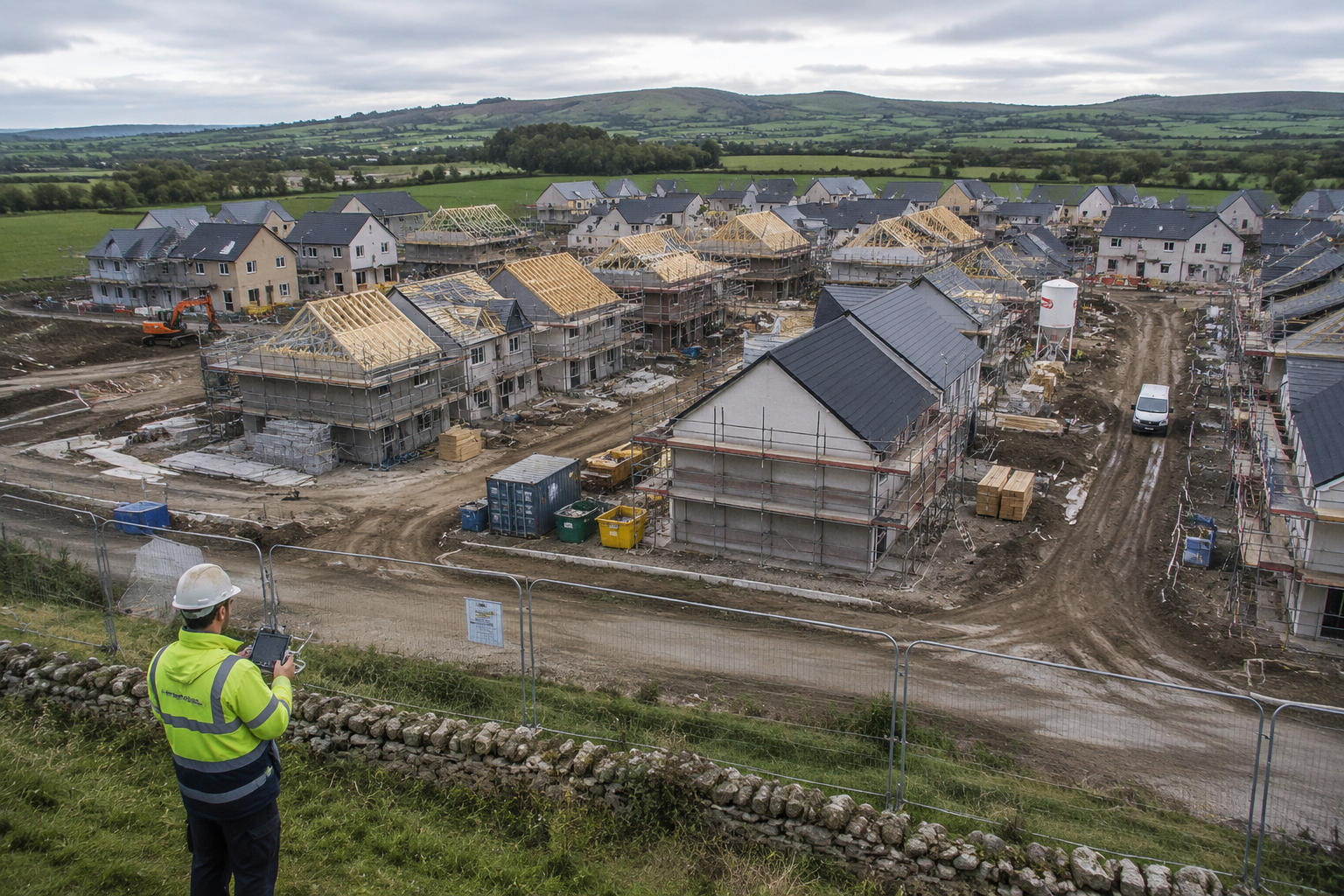
Modern surveying practice in Scotland increasingly incorporates drone technology for roof and upper-level inspections, enabling safe assessment of areas that would otherwise require scaffolding [8]. Thermal imaging cameras are used to identify cold bridges, moisture ingress, and insulation gaps that are invisible to the naked eye. These tools materially improve the quality of defect identification in new-builds, where problems may be hidden behind freshly decorated surfaces.
For buyers who want to understand the full range of survey options available, the comparison of different survey types provides a clear breakdown of what each level of inspection covers and when each is appropriate.
Cross-Border Lessons: What England Can Learn from Scotland's Experience
Scotland's Regulatory Context
Scotland operates under a distinct planning and building standards framework from England. Building standards are administered by local authorities under the Building (Scotland) Act 2003, and the technical standards (Scottish Technical Handbooks) differ in several respects from England's Approved Documents. Energy performance requirements, in particular, have historically been more demanding in Scotland, which means that when Scottish new-builds fail airtightness or insulation standards, the gap between specification and delivery is proportionally more significant.
Applying RICS Checklists Across Borders
The RICS inspection methodology is consistent across the UK. The same Level 3 framework that applies to a new-build in Edinburgh applies to one in Bristol. However, surveyors working in England on new-builds can draw specific lessons from Scotland's experience:
- Timber-frame defects are equally prevalent in England, where timber-frame construction has grown significantly. The insulation and airtightness failures documented in Scottish surveys are directly transferable.
- Drainage inspection is consistently under-prioritised in England's new-build sector. Scotland's experience demonstrates that underground drainage defects are among the most costly to rectify post-completion.
- Commissioning documentation — the formal sign-off of mechanical and electrical services — should be requested and verified by the buyer's surveyor in every case, regardless of location.
For English buyers weighing up whether a detailed survey represents good value, the analysis in is a HomeBuyers survey worth it addresses the cost-benefit question directly.
The Stable Market Premium
In a market where prices are holding firm and competition for available stock is active, buyers may feel pressure to proceed quickly and skip independent inspection. This is precisely the environment in which defects go undetected. A stable market does not correct for poor construction quality — it simply means buyers pay full price for it.
The ultimate house survey checklist provides a practical reference for buyers preparing for any type of property inspection, including new-builds.
Commissioning a Building Survey: Practical Steps for Scottish New-Build Buyers
When to Commission the Survey
The optimal time to commission a RICS Level 3 survey on a new-build is before legal completion — ideally after the property has reached practical completion but before the buyer takes the keys. This window allows the surveyor to inspect the property in its finished state while the buyer still has leverage to require remedial work from the developer.
What to Provide to the Surveyor
- Full address and postcode
- Developer's specification documents and floor plans
- Any correspondence about known defects or snagging items
- Confirmation of the construction method (timber frame, masonry, SIPS)
- Access arrangements with the developer's site manager
Questions to Ask Before Appointing a Surveyor
- Are you RICS-accredited and experienced with new-build inspections in Scotland?
- Does your inspection include thermal imaging and, where relevant, drone survey of the roof?
- Will the report include a prioritised defect schedule with indicative costs?
- Will you attend a post-report call to explain findings?
- Are you independent of the developer and any associated estate agents?
For buyers who want to understand the full scope of professional building survey services before making an appointment, the building surveys service page provides a clear overview of what a qualified surveyor delivers.
Conclusion
Building Surveys for New Build Defects in Scotland's Stable 2026 Market: RICS Checklists represent the most reliable tool available to buyers navigating a market defined by constrained supply, firm pricing, and documented quality failures. With more than half of recently assessed homes failing basic quality standards [6], and new-build completions declining sharply across Scotland [1], the risk of purchasing a defective property has increased — not decreased — in 2026.
A RICS Level 3 survey, conducted by an accredited and independent surveyor before legal completion, provides a structured, evidence-based assessment of every material element of a new-build home. The checklist covers structure, roofing, drainage, insulation, airtightness, services, and ventilation — precisely the categories where Scottish new-builds most frequently fail.
Actionable next steps for buyers:
- Commission a RICS Level 3 survey before legal completion, not after.
- Request thermal imaging and drone inspection as standard components of the survey.
- Obtain and review commissioning certificates for all mechanical and electrical services.
- Use the surveyor's defect schedule as a negotiating document with the developer before handover.
- Do not rely solely on the developer's own snagging process as a substitute for independent inspection.
The investment in a professional survey is modest relative to the cost of remediating hidden defects after the keys have changed hands. In Scotland's stable but supply-constrained 2026 market, independent inspection is not a precaution — it is a necessity.
References
[1] Quarterly Housing Statistics March 2026 – https://www.gov.scot/publications/quarterly-housing-statistics-march-2026/?utm_source=openai
[2] Scotlands Social Housing Build Starts At Lowest Since Records Began – https://projectscot.com/2026/03/scotlands-social-housing-build-starts-at-lowest-since-records-began/?utm_source=openai
[3] Government On Course To Break Social Housing Promise As Building Falls Behind – https://scotland.shelter.org.uk/media/press_releases/government_on_course_to_break_social_housing_promise_as_building_falls_behind?utm_source=openai
[4] New Home Registrations Down As Builders Face Perfect Storm Nhbc Reports – https://www.scottishconstructionnow.com/articles/new-home-registrations-down-as-builders-face-perfect-storm-nhbc-reports?utm_source=openai
[5] New Figures Show Fall In Major Housing Applications In Scotland – https://projectscot.com/2026/05/new-figures-show-fall-in-major-housing-applications-in-scotland/?utm_source=openai
[6] New Statistics Reveal Falling Supply Rising Need And Widespread Housing Quality Failures – https://www.scottishconstructionnow.com/articles/new-statistics-reveal-falling-supply-rising-need-and-widespread-housing-quality-failures?utm_source=openai
[7] Rics Surveys – https://www.stoneworks.scot/rics-surveys?utm_source=openai
[8] stoneworks.scot – https://www.stoneworks.scot/?utm_source=openai
[9] Cih Scotland Reacts To Latest Housing Statistics – https://www.cih.org/news/cih-scotland-reacts-to-latest-housing-statistics/?utm_source=openai
[10] Accelerating Home Building Scotland Consultation Incentives Penalties Speed Up Housing Delivery – https://www.gov.scot/binaries/content/documents/govscot/publications/consultation-paper/2026/02/accelerating-home-building-scotland-consultation-penalties-incentives-speed-up-housing-delivery/documents/accelerating-home-building-scotland-consultation-incentives-penalties-speed-up-housing-delivery/accelerating-home-building-scotland-consultation-incentives-penalties-speed-up-housing-delivery/govscot%3Adocument/accelerating-home-building-scotland-consultation-incentives-penalties-speed-up-housing-delivery.pdf?utm_source=openai
